Skip to content

When your family is navigating a separation, one of the first and most stressful questions is almost always about money—specifically, child support. For families here in Humble, Atascocita, and the surrounding parts of Northeast Houston, there's a lot of anxiety around how that number gets decided. We're here to provide clarity and support during this challenging time.
The good news is that Texas doesn't leave it up to guesswork. The state uses a specific formula called the Texas Percentage of Income Model. In simple terms, the court takes a set percentage of the non-custodial parent's 'monthly net resources.' While the percentages are straightforward, the real work—and where mistakes often happen—is in figuring out what counts as "net resources." As your local Humble law firm, we want to help you understand this process from start to finish.
A Quick Guide to Humble Child Support Calculations
Texas created the Percentage of Income Model to bring consistency and predictability to families across the state, including us here in Harris County. The system is designed to directly tie the child support obligation to the paying parent's income, providing a stable foundation for your child's well-being. It’s a framework that, as of 2026, helps provide for well over a million children across Texas.
The core of this system is based on simple, statutory percentages. Getting this first calculation right is the foundation for everything that follows, ensuring a fair starting point for you and your family.
The Standard Guideline Percentages
The Texas Family Code lays out the starting point for almost every child support case. The court begins by applying a specific percentage to the non-custodial parent's monthly net resources, based on how many children are involved in that particular case.
Here is a quick look at the standard guideline percentages used by judges in Harris County and across Texas:
Texas Standard Child Support Guideline Percentages
| Number of Children | Percentage of Net Resources |
|---|---|
| 1 Child | 20% |
| 2 Children | 25% |
| 3 Children | 30% |
| 4 Children | 35% |
| 5 or More Children | 40% |
So, if a parent living in Kingwood has one child and their monthly net resources are calculated to be $5,000, the starting guideline support amount would be $1,000 per month ($5,000 x 20%). It seems simple enough on the surface.
Think of these percentages as the foundation of your child support order. They provide a reliable baseline, but the final amount can and often does change based on other crucial factors.
From our experience serving Humble families, this initial calculation is just that—a start. The final number can be adjusted for things like who pays for the child's health insurance, or if the paying parent has other children they are legally obligated to support from another relationship.
The main takeaway for parents in Humble is that the math looks easy, but the process of determining that "net resources" figure is where the complexity lies. This is where an experienced local attorney can make all the difference, ensuring all income is properly documented and every allowable deduction is taken. For a more detailed look, you can review our complete guide on how to calculate child support in Texas.
Our team at The Law Office of Bryan Fagan is here to bring clarity and confidence to your situation. To see how these guidelines might apply to you, we invite you to schedule a free consultation with our Humble office today.
Determining Your Monthly Net Resources
When it comes to calculating child support here in Humble, the most significant—and often most disputed—part of the equation is figuring out the paying parent's monthly net resources. It’s a common misconception that this is simply your take-home pay. The reality under Texas law is much more comprehensive, and getting this number right from the start is absolutely critical for a fair outcome.
The court essentially follows a two-part process. First, we identify all of your gross resources, which includes almost every dollar coming in. Then, from that total, we subtract a very specific and limited list of deductions to arrive at your final monthly net resources.
What Counts as Gross Resources
Harris County family courts cast a wide net to get a complete picture of a parent's true earning capacity. For families living in Humble, Atascocita, and Kingwood, this often means looking at more than just a regular paycheck.
Here are the most common sources of income a court will consider:
- Wages and Salary: This is the obvious one—your base pay, but also any overtime, tips, and commissions.
- Self-Employment Income: If you're a contractor or run a small business in Northeast Houston, this is your total revenue minus ordinary and necessary business expenses. Keeping clear financial records is vital.
- Bonuses and Severance Pay: Even one-time payments are almost always factored into the calculation.
- Rental Income: Own a rental property in Kingwood? The net income from that is counted.
- Investment Income: This covers everything from interest and dividends to capital gains.
- Other Sources: The list goes on, including retirement benefits, pensions, most Social Security benefits (but not SSI), workers' comp awards, and unemployment.
Basically, if it's money coming in, the court is going to want to know about it. This is why having meticulous records—pay stubs, tax returns, and especially profit-and-loss statements for business owners—is non-negotiable for a fair process.
This visual shows the basic path from income to the final child support payment.
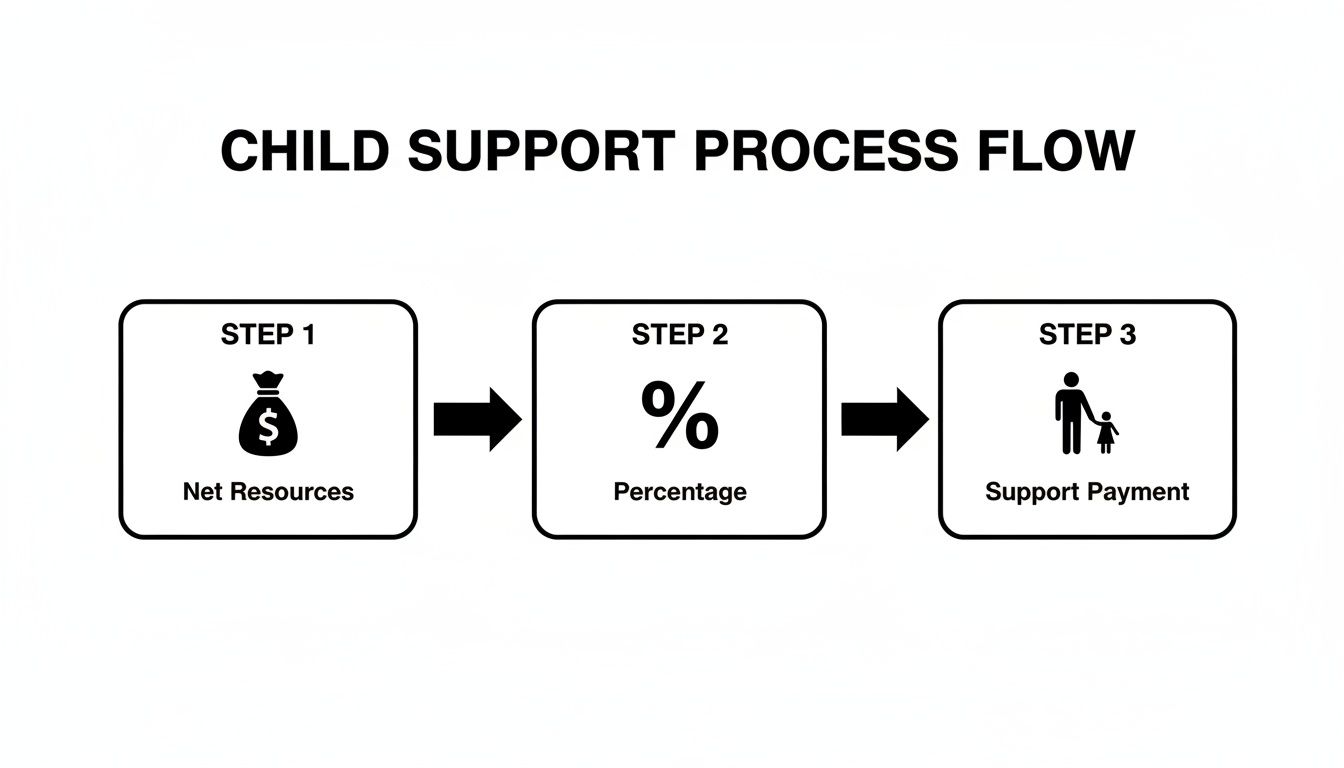
As the chart makes clear, the entire process hinges on that first box. Accurately nailing down your net resources is the foundation for everything else that follows.
Allowable Deductions From Your Gross Income
After tallying up all sources of income, Texas law allows a handful of specific deductions to get to your net resources. This is a very short list. It’s crucial to understand that your everyday expenses, like a car payment, rent, or groceries, are not deductible for child support purposes.
The Texas Family Code is incredibly strict about what can be subtracted. This isn't like doing your taxes where you can claim a home office. The court uses a standardized list to keep the calculation fair and predictable for the child.
Here’s what a Humble court will allow you to deduct:
- Federal income tax (calculated for a single person claiming one exemption)
- Social Security and Medicare taxes (FICA)
- State income tax (which isn't an issue, as Texas doesn't have one)
- Union dues, but only if they are mandatory for your employment
- The cost of health and dental insurance for the child(ren) involved in the case
Let's put this into a real-world context. Imagine a professional from Atascocita who earns a gross monthly income of $8,000. After subtracting for federal taxes, Social Security, and the $300 monthly premium she pays for the children's health insurance, her monthly net resources might come out to around $6,200. That's the figure the court will use to apply the child support guidelines.
The Texas Income Cap for High Earners
So, what happens if your income is well above average? The Texas Family Code puts a presumptive cap on the net resources used for the standard calculation. As of 2026, that cap is $9,200 per month.
This means if a parent's monthly net resources are $9,200 or less, the standard percentages apply directly to that amount. If your net resources are higher than the cap, the guideline support is presumptively calculated on the first $9,200 of your income. For two children, for example, the presumptive support amount would be $2,300 (which is 25% of $9,200).
However, a judge can order additional support above this presumptive amount. This only happens if there is clear evidence showing that the proven needs of the children justify a higher payment. This is where cases can get complicated, and having an attorney to clearly demonstrate your child's specific needs becomes invaluable.
Figuring out the nuances of what counts as income and what qualifies as a deduction is where we, as local Humble attorneys, can make a real difference. We work to ensure the numbers used are both accurate and fair. If you're facing this process and have questions about your unique financial situation, we invite you to schedule a free consultation with our team at The Law Office of Bryan Fagan.
Applying Percentages and Common Adjustments

Once you've determined the monthly net resources, you’re ready to apply the Texas guideline percentages. But this is where many people get it wrong. They see a percentage, do the simple math, and think they're done. In our experience, that initial number is just the starting line; the real calculation happens when we factor in the unique details of your family's life.
Those standard percentages are rarely the final word. From here, a Harris County judge will look at the specific, real-world factors that affect your ability to pay and your child’s needs.
Let's walk through a practical example. Say a parent from Atascocita has monthly net resources of $6,000 and is responsible for two children. The standard guideline for two kids is 25%, which gives us an initial support figure of $1,500 a month.
But what happens next is what truly matters. Credits for things like health insurance and responsibilities for other children can dramatically change that final number.
Adjustments for Health and Dental Insurance
One of the most frequent and critical adjustments we see is for the cost of the children's health and dental insurance. Texas law rightly wants to make sure every child has medical coverage, so it creates a powerful incentive for parents to provide it.
If you're the parent paying child support (the obligor) and you also cover the premiums for the children's insurance, you get a direct credit. The amount you pay each month for the children's portion of that premium is subtracted straight from your monthly support obligation.
Let's look back at our Atascocita parent:
- Guideline Support: $1,500 per month
- Monthly Health/Dental Premium for Children: $350
The court would simply deduct that insurance cost from the support amount. The adjusted child support payment becomes $1,150 per month ($1,500 – $350). This is a crucial detail that’s almost always missed when parents try to calculate support on their own.
Credits for Other Children You Support
Life is rarely simple. Many parents in our Humble and Kingwood communities are financially responsible for children from different relationships. The Texas Family Code recognizes this reality and offers a credit if you have a legal duty to support other kids.
This doesn't mean you just subtract what you pay for another child. It's more nuanced. The court actually uses a different, adjusted percentage table. You get a credit that reduces the percentage applied to your net income for the case at hand.
A huge misconception is that the guideline percentages are rigid. They are built to be flexible. Having other children you are legally obligated to support is one of the most common reasons a court will deviate from the standard and apply a lower percentage.
For instance, if you have two children in the current case but also have one other child from a prior relationship, the court won’t use the standard 25% guideline. They will refer to an adjusted table and apply a lower rate—in this case, 22.75%.
Here’s how that affects our example parent with $6,000 in net resources:
- Standard Calculation (25%): $1,500
- Adjusted Calculation with Credit (22.75%): $1,365
This credit alone creates a $135 difference every single month. When you multiply that over the years until a child turns 18, it can add up to tens of thousands of dollars. We've handled many cases where getting these credits right was the key to a fair outcome. For those looking to ensure their obligations are correct, our firm offers guidance on when and how to reduce child support payments through the proper legal channels.
Knowing how these percentages and adjustments truly work is essential when you're learning how to calculate child support in Humble, TX. The guideline percentage is just a baseline, not the final word. The unique facts of your life—from who pays for insurance to your duties to other children—are what ultimately shape the court-ordered amount.
If you're trying to figure all this out, you shouldn't have to do it alone. The Law Office of Bryan Fagan is committed to helping Humble-area families find solutions that are both fair and sustainable. We invite you to schedule a free, confidential consultation with our Humble office to talk about your specific situation.
When Courts Can Bend the Child Support Rules
While the Texas child support guidelines offer a predictable starting point, they are by no means the final word. A Harris County judge is more than just a calculator. Their ultimate responsibility is to rule in the best interest of the child, a principle that gives them the power to move away from the standard formula when the facts of a case warrant it.
For families in Humble, Kingwood, and Atascocita, this is an important concept to grasp. It means your unique circumstances—whether you're sharing parenting time equally, caring for a child with special needs, or dealing with a co-parent who isn't being honest about their income—can be brought before the court. The guideline amount is only a presumption, and it can absolutely be challenged.
The Rise of 50/50 Possession Schedules
One of the biggest changes we've seen in family law across Northeast Houston is the growing popularity of 50/50 possession schedules. As more parents share equal time with their kids, it naturally brings up fair questions about who should pay child support, and how much.
When parents have a true 50/50 split, it often doesn't make sense for one to pay the full guideline amount. In these cases, a judge can order what’s commonly called an "offset" calculation.
It's a pretty straightforward process:
- First, the court figures out what Parent A would owe Parent B under the guidelines.
- Then, it does the same for Parent B, calculating what they would owe Parent A.
- Finally, the smaller amount is subtracted from the larger one. The parent with the higher income pays the difference.
Let's say Parent A’s guideline support comes out to $1,200 a month and Parent B’s would be $800. Parent A would simply pay Parent B the $400 difference. This method acknowledges that both parents are shouldering the day-to-day costs of raising their child.
A 50/50 schedule doesn't automatically cancel out child support in Texas. A judge will always look at both parents' incomes and the child's best interest before deciding if an offset calculation—or another non-guideline amount—is the right call.
What if a Child Has Special Needs?
Standard child support is meant to cover the basics: food, housing, clothing, and other typical expenses. But what about when a child’s needs go far beyond the basics? For parents of children with significant medical, psychological, or educational challenges, the guideline amount can fall painfully short.
Thankfully, a judge has the authority to order support above the standard guidelines to cover these proven needs. This is a crucial lifeline for families managing conditions that involve:
- Expensive medical treatments or prescriptions
- Specialized physical, occupational, or speech therapy
- Private tutoring or specific educational programs
- Adaptive equipment or other necessary accommodations
To get support above the guidelines, you have to come prepared. You'll need to present the court with clear, detailed proof of these extra costs. This means gathering medical records, therapy invoices, and official statements from school personnel.
Dealing With Underemployment and "Hidden" Income
It’s an incredibly frustrating spot to be in: you suspect the other parent is deliberately earning less than they could just to lower their child support payment. This tactic is known as intentional underemployment or unemployment.
Texas law has a powerful countermeasure for this. A judge can "impute income," meaning they calculate child support based on what the parent should be earning, not what they claim to earn. To do this, the court will examine that parent’s recent work history, their skills and education, and the actual job opportunities available in the local Humble area to determine their real earning potential.
The history of child support in the U.S. has evolved dramatically since the Office of Child Support Enforcement was established in 1975, leading to a system that collected over $200 billion by 2023. This evolution includes stronger enforcement tools, and by 1988, the Family Support Act mandated that 85% of states adopt strict guidelines, which helped cut down on disputes by about 37%. For Kingwood families today, this legacy includes the court's ability to impute income, a practice which rose by 11% in 2023 in cases involving unemployed parents, often relying on local job market data like Humble's 4.1% unemployment rate. You can discover more insights about these child support trends and their history on peoples-law.org.
Proving intentional underemployment takes solid evidence, but it's a critical tool for ensuring a fair outcome. If you're in a situation where the standard calculations just don't add up, you have options. An experienced family law attorney can help you build and present a compelling case to the judge.
The team at The Law Office of Bryan Fagan knows that no two families are the same. We are dedicated to helping our neighbors in the Humble community secure child support orders that are fair and truly serve their children's best interests. To talk about the specifics of your case, we encourage you to schedule a free, no-obligation consultation with our Humble office.
Turning Your Child Support Calculation Into a Court Order in Humble

Running the numbers is one thing, but getting a court order that makes those numbers legally binding is what truly matters. For families here in Humble and Atascocita, an official child support order provides the predictability and stability your kids need. It's the step that transforms a simple calculation into a dependable financial reality.
This finalization happens in the Harris County family courts. Whether you're navigating a divorce or establishing parental rights as an unmarried couple in a Suit Affecting the Parent-Child Relationship (SAPCR), the goal is a formal, enforceable order.
Getting a Formal Child Support Order
You have a couple of main routes to get that official order. Many people start by looking into the Texas Attorney General's Office (OAG). The OAG offers services to establish and enforce support, and for some, it's a viable path. The key thing to understand, though, is that the OAG's client is the State of Texas; their job is to see that children are supported, but they don't represent you personally.
The alternative is working with a private family law attorney. We've found that for parents in Northeast Houston with complex finances, self-employment income, or disagreements over custody, this is the far better option. Having a lawyer from our Humble office means you have someone in your corner, advocating for your specific situation, and making sure every financial detail is handled correctly for the Harris County courts.
Texas stands out with its Percentage of Income model for child support, as defined in Section 154.125 of the Family Code, unlike the 41 states that use an Income Shares model. Here in Harris County, where Humble sits, our courts handled over 28,000 child support cases in 2023 alone. A huge sticking point is often proving income accurately. We've seen firsthand how crucial this is—imputed income, where a judge assigns an income level to an underemployed parent, was an issue in 12% of Texas cases back in 2022. You can learn more about how child support calculations differ across the country on Justia.com.
Making Sure Payments Actually Happen: Enforcement
For a lot of parents, the real anxiety isn't about the calculation—it's about whether the other parent will actually pay. A court order is more than just paper; it has real power, and Texas law provides strong tools to back it up. The goal isn't just to punish someone but to ensure a child receives the support they are legally entitled to.
By far, the most effective tool is a Wage Withholding Order. We make this a standard part of nearly every case. The order goes straight to the paying parent’s employer, and the support is deducted from their paycheck automatically, like taxes. This creates consistency and removes the monthly stress of chasing down a payment.
But what happens when a parent just refuses to pay? For families in Humble and Kingwood facing non-payment, we have to get serious. We can ask the court for much stronger enforcement actions:
- Property Liens: This attaches to the non-paying parent's assets, like a house or land, preventing them from selling until the back-due support is paid.
- License Suspension: A judge can order the suspension of a driver's license, professional licenses (for a nurse, realtor, etc.), and even hunting and fishing licenses.
- Bank Account Levies: The court can authorize seizing funds directly from the non-paying parent’s bank accounts to satisfy the debt.
These measures give your child support order the legal teeth it needs to be effective. We are passionate about helping our Humble neighbors find peace of mind, knowing their child's support is secure. If you're struggling with this, our guide on how to enforce child support in Humble is a great place to start.
From the first filing to enforcing the final order, the team at The Law Office of Bryan Fagan is here for our neighbors in Humble. If you need help turning a calculation into an order—or making sure that order is followed—reach out to our Humble office for a free consultation.
Answering Your Humble Child Support Questions
When you're dealing with a child support case, it's often the small, practical questions that keep you up at night, not the high-level legal theory. As attorneys working right here in the Humble, Atascocita, and Kingwood areas, we get these questions every single day from parents just like you.
Let’s cut through the noise and get you some straight answers.
Can My Ex and I Just Agree on a Child Support Amount?
Yes, you absolutely can. In fact, from what we’ve seen in Harris County courtrooms, judges prefer when parents can work together and come to an agreement on their own. It shows you're both focused on what's best for your child.
However—and this is a big one—that handshake deal isn't legally binding. For your agreement to hold up in court, it has to be written down, submitted to a judge, and signed into a formal court order. Without that judge's signature, if the other parent suddenly stops paying, your private agreement isn't worth the paper it's written on. You’ll have no legal way to enforce it.
Key Takeaway: An agreement is a fantastic starting point, but it's not official until it's part of a court order signed by a judge.
What if My Income Changes After the Order Is Final?
Life happens. People get laid off, find better jobs, or face unexpected medical issues. If you have what the law calls a "material and substantial change" in your financial situation after the child support order is in place, you can ask the court for a modification.
This works both ways. A major promotion could lead to an increase in support, while a job loss or disability could be grounds for a decrease. The crucial thing to remember is you can't just decide to pay less on your own. You must file a formal Petition to Modify with the court to legally change your payment amount.
Does My New Spouse's Income Count in the Calculation?
This is probably one of the most common questions we hear from families in Northeast Houston. The answer in Texas is a clear and simple no.
Your new spouse's income is their own separate property. It is not included in the formula used to calculate child support for a child from a previous relationship. The calculation is based only on the net resources of the child's biological or adoptive parents.
How Long Does Child Support Last in Texas?
In Texas, the obligation to pay child support typically ends when the child turns 18 or graduates from high school—whichever happens later.
So, if your child turns 18 in February of their senior year, you're still on the hook for payments until they walk across that graduation stage in May or June. There are a few exceptions. Support can end earlier if the child gets married, is legally emancipated, or passes away.
On the other hand, support can be ordered for an indefinite period if a child has a disability that makes them unable to be self-sufficient. This requires specific proof presented to the court before the child turns 18. Knowing exactly when your obligation ends is a critical part of understanding how child support works in Humble.
Trying to manage all the details of a child support case on your own can be incredibly stressful. You don't have to go through it alone. The attorneys at The Law Office of Bryan Fagan are part of your community, and we're here to offer the clear, compassionate advice you need. We can walk you through your specific situation and help you protect your child’s future.
We confidently guide our clients through the legal process with empathy and expertise. To get the support you deserve, schedule a free consultation with our Humble office today or visit us at https://humbletxlawyers.com.