Skip to content

When parents in Humble, Texas, first talk about "50/50 custody," they're usually picturing a calendar with time split perfectly down the middle. As a local attorney serving our community, I’ve found that what this really means in a Texas family court goes much deeper than just counting days. It's about a fundamental commitment to shared responsibility and co-parenting—being equally involved in every big decision that will shape your child's future.
What 50/50 Custody Really Means for Humble Parents

For many parents I work with in Humble and Atascocita, a 50/50 split sounds like the fairest path forward after a separation. It feels balanced and seems to guarantee both parents stay deeply connected to their child's life. What you need to know, however, is that Texas law doesn't have a default 50/50 possession schedule. It’s an arrangement you have to actively work toward and prove is genuinely in your child’s best interest.
Think of it as being co-captains of your child's team. You both get an equal say in the game plan. This covers everything from where your child attends school in Humble to what kind of medical care they receive. The goal is to build a stable, predictable world where your child thrives with both parents fully present, which requires a level of cooperation that goes beyond just what feels "fair" to each parent.
Beyond the Calendar: A Shared Commitment
The biggest misunderstanding I see is that 50/50 custody is just about the physical time a child spends in each home. While an equal possession schedule is a huge part of it, a true 50/50 arrangement under Texas law is built on something far more significant.
A genuine 50/50 custody plan is built on the foundation of Joint Managing Conservatorship. This is the legal framework where both parents share the rights and responsibilities of making crucial decisions for their child, regardless of the specific possession schedule.
For families I represent in Kingwood and across Northeast Houston, this shared decision-making power is often the most critical piece. It ensures that no matter where the child lays their head at night, both parents remain central, authoritative figures in their life.
To truly understand what a 50/50 custody order entails in practice, it's helpful to break down its core components. The following table summarizes what Humble parents can expect from both a legal and practical standpoint.
Breaking Down a 50/50 Custody Arrangement in Texas
| Component | What It Means for Humble Parents | Common Misconception |
|---|---|---|
| Possession Schedule | An equal or near-equal division of time with the child. This is the calendar portion, often using a week-on/week-off or 2-2-5-5 schedule. | That it must be exactly 182.5 days per year. Courts focus on creating a consistent, stable routine for the child. |
| Conservatorship | Almost always means Joint Managing Conservatorship, where both parents share the right to make major decisions (education, medical, psychological). | That the parent who has the child at any given moment makes all the decisions. Major decisions must be made jointly. |
| Geographic Restriction | Often includes a restriction limiting where the parents can live, typically to Harris County or a specific Humble-area school district, to facilitate the 50/50 schedule. | That parents can move freely. A geographic restriction is standard practice to make equal possession practical. |
| Child Support | Child support may still be ordered, even with equal time. It is often calculated based on the difference in the parents' incomes to ensure the child’s needs are met in both homes. | That if time is equal, no one pays child support. The court's goal is to equalize the child's standard of living in both homes. |
This breakdown shows that a 50/50 arrangement is a comprehensive plan designed to keep both parents fully engaged, not just a simple division of time.
Understanding Texas Custody Norms
It’s also crucial for Humble families to see where Texas stands on the national stage. Our state ranks among those with lower standard custody time awarded to non-primary parents, who on average receive around 33% of parenting time. This is a stark contrast to states that have a legal presumption of 50/50 time from the outset. You can explore more data about custody time disparities by state to get the full picture.
This reality for Harris County families underscores why getting a 50/50 order often requires a well-prepared legal strategy. A judge won't grant it just because you ask; you must provide compelling evidence that it truly serves your child's best interests above all else.
At The Law Office of Bryan Fagan, we understand the emotional weight and legal hurdles involved in protecting your child's future. Our team is dedicated to helping Humble parents craft custody agreements that promote stability and give children the best chance to thrive. If a 50/50 arrangement is what you believe is right for your family, we have the experience to provide clear guidance and strong advocacy.
You don't have to navigate this complicated process on your own. We encourage you to schedule a free consultation with our Humble office to talk through your family’s unique circumstances. Let us help you map out a positive path forward for you and your children.
The Best Interest Standard in Harris County Courts
When a Harris County judge looks at your custody case, their entire decision-making process is filtered through one single, powerful lens: the best interest of the child. This isn't just a legal buzzword. It’s the absolute bedrock of Texas family law, and it’s designed to shift the conversation away from what parents might feel they are owed and squarely onto what will help a child grow up healthy and happy.
So, when you're seeking a 50/50 schedule in Humble, the court isn't just looking at who is the "better" parent. Instead, they are meticulously examining both households to see if an equal possession schedule truly offers the most stable, nurturing, and supportive environment for your child.
Your Roadmap in Court: The Holley Factors
To keep this from being a vague guessing game, Texas law gives judges a specific set of criteria to follow. These are known as the Holley Factors.
Think of these factors less as a test you have to pass and more as a roadmap for building your case. Each factor is an opportunity for you to present clear, persuasive evidence showing that a shared parenting plan is the best path forward for your child. Your goal is to show the judge, point by point, how a 50/50 arrangement aligns with your child’s needs.
Key Factors a Humble Judge Will Consider
While the list of Holley Factors is long, some carry more weight than others in a Harris County courtroom, especially when a 50/50 schedule is on the table. Be ready to speak to each of these.
- Your Child’s Needs: The court dives deep into your child’s specific emotional, physical, and developmental needs. A toddler might need the routine of frequent, shorter visits, whereas a teenager’s life in Atascocita might demand a schedule that respects their school and social commitments.
- Parental Abilities: This isn't about who has the bigger house or makes more money. It’s about each parent’s proven ability to provide a safe, loving, and consistent home life. Can you meet the day-to-day needs of the child?
- Stability of the Home: A judge is looking for predictability and peace. A 50/50 schedule thrives when both homes are stable environments, free from chaos and conflict.
- Acts or Omissions: The court must consider any past actions—or failures to act—that might suggest a risk to the child's well-being. This is where things like a history of neglect or family violence come into play.
- The Child’s Wishes: If a child is 12 or older, the judge can speak with them privately to hear their preference. It’s not the only thing that matters, but the opinion of a mature child is taken very seriously.
It's crucial to understand that no single factor decides the case. The judge will weigh all the evidence together to create a complete picture of what your child’s life would look like under a 50/50 plan.
Proving your case is all about gathering the right evidence. To get a head start, it’s worth learning more about how to prove the best interest of the child in a Texas court, as this guide breaks down the types of documentation you’ll need.
For families here in our Humble community, showing that a 50/50 schedule is in your child's best interest means demonstrating how it will genuinely enrich their life. It’s about proving that having two cooperative, deeply involved parents provides more love, support, and stability than any other setup. At The Law Office of Bryan Fagan, we specialize in helping Humble parents present this case clearly and effectively. We invite you to a schedule a free consultation with our Humble office to see how we can help you build the strongest argument for your family.
Designing a Practical 50/50 Possession Schedule
Once you and your co-parent have landed on the idea of a 50/50 split, the real work begins. How do you turn that agreement into a practical, real-world calendar? For families here in Humble and Kingwood, this is where the theory of co-parenting meets the reality of daily life.
The ultimate goal isn't just to chop up the calendar into perfectly equal halves. It’s about creating a rhythm and routine that feels consistent and predictable for your child. A good schedule minimizes disruption and gives your child a strong sense of stability, no matter which parent’s home they are in. This means thinking hard about your child's age, their school in Humble, extracurriculars, and even the driving distance between your two homes in the Northeast Houston area.
Common 50/50 Schedules for Humble Families
There’s no one-size-fits-all answer here; the "best" schedule is the one that fits your unique family. That said, a few popular models have proven to be effective for many parents in Harris County. Each has its own rhythm and feel.
The Week-On/Week-Off Schedule: This is as straightforward as it gets. Your child spends one full week with you, then one full week with their other parent. Most families schedule the exchange on a Friday or Sunday to create a clean break between weeks.
The 2-2-5-5 Schedule: This plan provides more frequent contact. For example, your child might be with Parent A on Monday and Tuesday, Parent B on Wednesday and Thursday, and then with Parent A from Friday through Sunday. The next week, the long weekend flips to Parent B.
The 2-2-3 Schedule: Similar to the 2-2-5-5, this schedule keeps handoffs frequent. The child is with Parent A for two days, Parent B for the next two, and then back with Parent A for three. The next week, the pattern reverses. This is great for ensuring a parent never goes more than a few days without seeing their child.
A judge’s decision on what schedule is truly in a child’s best interest is guided by a set of well-established factors. Understanding them can help you see your own situation from a court's perspective.
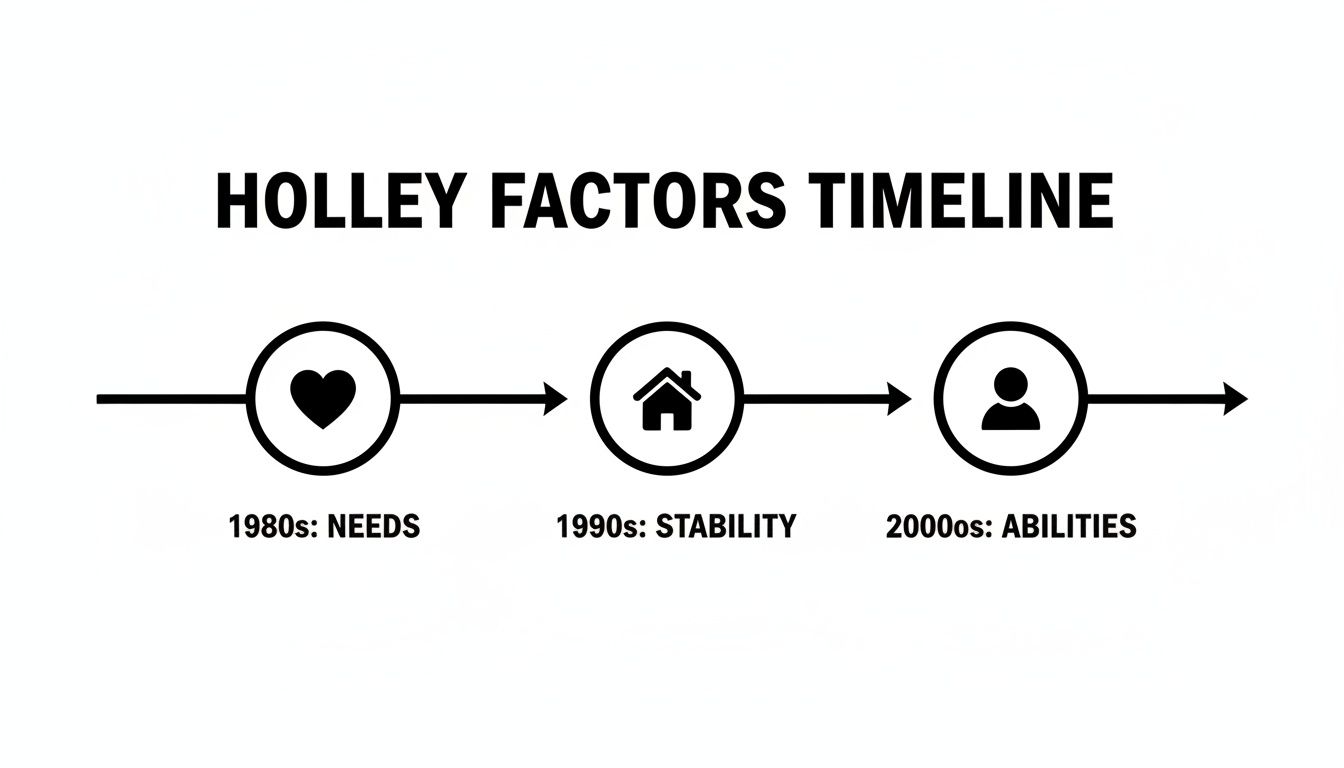
This graphic gives a great overview of how courts weigh things like the child's emotional needs, the stability of each home, and each parent's ability to care for the child—all crucial elements when crafting a possession schedule.
Comparing Popular 50/50 Possession Schedules
To help Humble parents evaluate these options, the table below breaks down the most common 50/50 schedules. Think about your child's personality, your work schedules, and your co-parenting relationship to see which one might be the best starting point for your family.
| Schedule Type | How It Works | Best For | Potential Challenges |
|---|---|---|---|
| Week-On/Week-Off | The child spends 7 days with one parent, then 7 days with the other. | Older children, teenagers, and parents who live farther apart. It simplifies logistics and reduces exchanges. | A week can feel like a long time for younger children or for a parent to be disconnected from daily life. |
| 2-2-5-5 | A repeating 2-week pattern. The child has a consistent schedule during the week, with parents alternating who gets the long weekend (Friday-Sunday). | Children who benefit from frequent contact with both parents and families who thrive on a predictable weekly routine. | The parent without the long weekend can miss out on weekend activities. It can feel a bit complex to track at first. |
| 2-2-3 | The child spends 2 days with Parent A, 2 with Parent B, then 3 with Parent A. The pattern flips the next week. | Toddlers and very young children who need to see both parents often to feel secure. Also good for parents who want mid-week involvement. | The frequent handoffs can be disruptive and create friction, especially if the parents have a high-conflict relationship. |
Remember, these are just templates. The most successful parenting plans are often customized. For instance, many parents in the Atascocita area use a week-on/week-off schedule but add a mid-week dinner visit for the other parent to stay connected.
If all these options feel a bit much, it can be grounding to understand what the state considers the default. To get a feel for that baseline, I highly recommend reading our guide on the Texas Standard Possession Order. It serves as a really useful point of comparison.
Here at The Law Office of Bryan Fagan, we've seen firsthand how a well-designed 50/50 custody schedule in Humble, Texas, can set a family up for long-term success. It’s one of the most important decisions you’ll make. We’re here to provide practical, experienced advice to help you craft a plan that puts your child’s well-being and stability first. We invite you to schedule a free consultation with our Humble office to get started.
How Shared Parenting Sets Your Child Up for Success
When you're facing a custody dispute, it's easy to get lost in the details of calendars, exchanges, and legal arguments. But the most persuasive case you can make for a 50/50 custody Humble Texas plan isn't about what you feel you’re entitled to—it’s about securing your child's future. When you advocate for shared parenting, you’re not just fighting for your time; you're making a case for your child's long-term happiness and stability.
This approach changes the entire conversation, especially for families here in Humble and across Northeast Houston. It shifts the court’s focus from what seems fair to the parents to what has been proven to be best for the child. Harris County judges aren't just open to this perspective—they expect it.
The Power of Two Involved Parents
Decades of social science research have all pointed to the same conclusion: kids do best when they have a strong, consistent relationship with both parents after a separation. An equal, or near-equal, parenting schedule sends a powerful message to a child: You are loved, you are secure, and you have not been abandoned. It helps prevent the deep-seated feeling of having "lost" a parent, a wound that can take years to heal.
That constant presence from both mom and dad creates a foundation of security that’s vital for emotional and psychological growth. Children in shared parenting arrangements tend to have lower levels of anxiety, simply because they aren't carrying the burden of worrying that one of their parents will slowly drift away.
The Clear Link Between 50/50 Time and a Child's Well-Being
The advantages of shared parenting aren't just a feel-good theory; they're grounded in hard data. Recent studies analyzing custody outcomes have found something remarkable: children in shared parenting homes perform just as well, and sometimes even better, than children from stable, two-parent households.
In fact, compelling research shows a direct correlation: as parenting time gets closer to a 50/50 split, a child's outcomes in school, mental health, and emotional stability dramatically improve.
For Humble families, this is a game-changer. When a child knows they have significant, guaranteed time with both parents, they feel secure. It also keeps both parents deeply invested in the child's daily life, from school projects to doctor's appointments, preventing the common "fading parent" syndrome. If you want to dive deeper into the data, you can read the full research about shared parenting outcomes.
Building Your Case Around What Matters Most
When you step into a Harris County courtroom, the most compelling evidence you can offer is a plan that undeniably puts your child's future first. By advocating for a 50/50 schedule, you're signaling to the judge that your priority isn't winning; it's co-parenting effectively for the person who matters most. You’re showing you understand the lifelong benefits of having two active, loving parents in a child’s corner.
- Better School Performance: With two parents involved, homework gets checked more often, and school activities get more support. It’s a simple formula for better grades.
- Stronger Emotional Health: The security of knowing both parents are fixtures in their life significantly reduces a child's risk of anxiety and depression.
- Fewer Behavioral Problems: When rules and expectations are consistent across two homes, children feel more stable, which often leads to better behavior.
For parents in communities like Atascocita and Kingwood, framing your arguments this way is the key to a successful outcome. It demonstrates your commitment to being a true co-parent and places your child's best interests where they belong: at the absolute center of the case.
At The Law Office of Bryan Fagan, we specialize in helping Humble-area parents build these compelling, child-focused cases. We know the local courts and understand how to present the evidence that truly makes a difference. Schedule a free consultation with our Humble office today, and let's talk about how we can fight for the best possible future for your child.
A Step-by-Step Guide to the Humble Custody Process

Navigating a custody case can feel overwhelming, with unfamiliar legal terms and court procedures. As a law firm dedicated to serving the Humble community, our goal is to provide a clear, step-by-step guide so you understand the path ahead.
Knowing what’s coming next can reduce stress and uncertainty. When you understand the purpose of each stage, you can prepare effectively and move forward with confidence. Let’s walk through the four main phases of getting a 50/50 custody order in Humble, Texas.
Step 1: Filing the Initial Lawsuit
Every custody case begins when one parent files an official document, called a petition, with the Harris County District Clerk. This is what legally starts the process. If you’re married, the document is called an Original Petition for Divorce. If you're not married, it’s a Suit Affecting the Parent-Child Relationship (SAPCR).
This petition tells the court who the parents and children are and outlines what you're asking for, like a possession schedule and child support. After it’s filed, the other parent must be formally notified of the lawsuit through a legal delivery process known as "service."
Step 2: Establishing Temporary Orders
Your family's life can't be put on hold while the legal case unfolds, which can take several months. To create immediate stability for your children, the court will put temporary orders in place. Think of these as the rules of the road that both parents must follow until the case is finalized.
A judge will establish these rules at a Temporary Orders Hearing. This is a mini-trial where you and your attorney present evidence to show why your proposed plan is best for your child right now. Common temporary orders include:
- A temporary parenting time schedule.
- Who pays temporary child support and how much.
- Who gets to decide where the child lives (often within Humble, Kingwood, or a specific school zone).
- Rules about how parents communicate with each other and the child.
This is your first chance to make an impression on the judge, so being prepared with clear evidence is critical.
Step 3: Finding Common Ground in Mediation
Before you go to a final trial, a Harris County judge will almost certainly order you to attend mediation. This is a private, confidential meeting where a neutral third-party—the mediator—helps you and the other parent try to negotiate a settlement.
I tell my clients that mediation is their single best opportunity to control their own outcome. A judge is limited by Texas law, but in mediation, you and the other parent can get creative and design a custom parenting plan that truly fits your family’s unique needs.
The vast majority of Humble custody cases, even complex ones seeking 50/50 possession, settle here. A successful mediation results in a Mediated Settlement Agreement (MSA), which is a binding contract that becomes part of your final order.
Of course, the legal process is only one part of the equation. Successfully co-parenting also requires dealing with divorce and rebuilding your life on an emotional level.
Step 4: Preparing for a Final Trial
If you can’t reach an agreement in mediation, the case proceeds toward a final trial. This phase kicks off with "discovery," the formal process where both sides exchange information and gather evidence. This can involve sending written questions, requesting financial documents, or conducting depositions (sworn testimony taken outside of court).
All the documentation you’ve been keeping—calendars, communication logs, photos—becomes invaluable here. Your attorney will use this evidence to build the strongest possible case to show the judge that a 50/50 custody arrangement is in your child's best interest. The trial is your chance to tell your story, present your evidence, and have a judge make the final decision.
This path can seem long, but understanding the steps makes it manageable. If you’re a parent in Humble, Atascocita, or Kingwood, you don’t have to navigate it alone. The Law Office of Bryan Fagan is here to guide you through every stage. Schedule a free consultation with our Humble office to talk about your situation and see how we can help protect your family.
Why a Humble Family Law Attorney Is Your Best Ally
Trying to handle a 50/50 custody case on your own is more than just overwhelming—it's an uphill battle while you're already dealing with the emotional weight of a family transition. This is where having an experienced Humble family law attorney by your side can make all the difference. We do more than just file papers; our job is to tell your story in a way the court understands, based on the specific legal standards here in Harris County.
Think of your lawyer as both a guide and an advocate. We translate your dedication as a parent into the legal language of the "best interest of the child." We know exactly how to highlight your strengths and present the kind of evidence that judges need to see, ensuring your case is positioned for the best possible outcome.
The Advantage of Local Expertise
Hiring a local attorney gives you an immediate home-field advantage. We don't just know Texas law; we know the local landscape of Humble, Atascocita, and Kingwood. We understand the specific procedures of our Harris County courts, the tendencies of local judges, and how to effectively negotiate with other lawyers in the area. This insider knowledge is incredibly valuable, whether in mediation or in the courtroom.
A skilled attorney helps ensure your case is decided on its unique facts.
A dedicated family law attorney is your strategist, your advocate, and your guide. We cut through the noise and focus on what matters most: building a powerful, evidence-based case that protects your rights and puts your child first.
Your Partner in Negotiation and Court
Whether your case is settled through peaceful negotiation or must go to trial, having a legal professional in your corner is priceless. We manage the difficult conversations, track every deadline, and act as a buffer to shield you from unnecessary conflict so you can focus on being there for your child. Our goal is to secure a fair and workable 50/50 custody Humble Texas plan that actually fits your family’s life. For a deeper look, you can find more information on our Humble child custody lawyer page.
We aren't just attorneys; we are members of this community, committed to helping our neighbors secure the best possible future for their families. You absolutely do not have to go through this alone. We encourage you to schedule a free consultation with our Humble office to talk about your situation and learn how we can help.
Common Questions About 50/50 Custody in Texas
As lawyers working with families right here in the Humble area, we've heard just about every question there is when it comes to 50/50 custody. It's a goal for many parents, but the path to get there can be confusing. Let's clear up a few of the biggest and most frequent concerns we address.
Does 50/50 Custody Eliminate Child Support in Texas?
This is probably the number one myth we have to bust. While having equal time with your child absolutely impacts how child support is calculated, it does not automatically eliminate it. The court’s main priority is making sure the child's needs are met and their lifestyle is as stable as possible in both homes.
So, if there's a significant gap between your income and the other parent's, a Harris County judge will almost certainly order the higher earner to pay what's called "offset" child support. This is a way to balance the financial resources, ensuring the child has a similar standard of living no matter which parent's roof they're under that week.
Can We Get 50/50 Custody if We Have High Conflict?
It's tougher, but yes, it’s still possible. While smooth, open communication is the ideal for any 50/50 custody Humble Texas plan, a history of conflict doesn't automatically disqualify you. What you must do is show the judge that even with the friction, you can create a predictable and stable life for your child.
A judge has tools to manage high-conflict situations. They might order co-parenting classes, family therapy, or mandate the use of a monitored communication app where every conversation is documented. These measures are designed to keep things focused on the child and hold both parents accountable.
How Do We Handle Major Decisions for Our Child?
This gets to the heart of a key legal distinction: physical possession (who the child is with) versus legal conservatorship (who gets to make big decisions). In almost all 50/50 cases, parents are named Joint Managing Conservators.
Being Joint Managing Conservators means you and the other parent must work together on the big-picture issues affecting your child's life, including:
- Education: Agreeing on schools, tutors, or special programs.
- Medical Care: Making joint decisions on non-emergency medical, dental, and mental health care.
- Religious Upbringing: Determining any religious instruction for the child.
Even in a 50/50 split, the court order will usually designate one parent to establish the child's primary residence. This is often tied to a specific geographic area, like ensuring the child stays within the Humble or Atascocita school district boundaries, to maintain stability.
At The Law Office of Bryan Fagan, we know these questions are just the tip of the iceberg. Our team is here to give Humble families the straightforward answers and strong representation they need to move forward. To talk about the specifics of your situation, we invite you to schedule a free consultation with our Humble office.