Skip to content

You're sitting in your car outside school in Humble, your phone buzzes, and there it is. A text from your ex that has nothing to do with pickup time, homework, or the pediatrician. It's bait. Maybe it's an accusation. Maybe it's a guilt trip. Maybe it's a long rant about your relationship that ended months ago.
Your first instinct is human. You want to defend yourself, correct the lie, and fire back.
Don't.
If you're in a Texas custody case, especially in Harris County, your communication with your ex is no longer just personal. It's part of your case. The words you send can help show a judge that you're steady, child-focused, and cooperative. Or they can make you look reactive and difficult, even when you feel completely justified.
For parents in Humble, Atascocita, Kingwood, and Northeast Houston, this is one of the hardest adjustments in a custody fight. You're not just trying to survive a stressful breakup. You're trying to protect your children and your credibility at the same time. That means every text, email, and app message needs a new purpose. It needs to move your case forward, not your emotions.
Your New Reality Communication as Courtroom Evidence
Texas courts care about one thing above almost everything else in custody cases. They care about the child's best interest. Under Texas Family Code Section 153.001 and the continued frequent contact standard, courts must support continued, frequent contact with both parents when the environment is safe, and judges in Harris County look closely at whether each parent can communicate effectively and professionally.
That means your messages matter.
The text that can change your case
A parent in Atascocita might get a message like this: “You're late again. You clearly don't care about the kids. Don't bother showing up unless you can act like a real parent.”
A bad response is easy to imagine: “You're the one causing problems. Stop poisoning the kids against me.”
A useful response looks completely different: “I'm in traffic and will arrive at 5:12 p.m. Please have the children ready. Thank you.”
Same stress. Same unfair message. Very different record.
Practical rule: Write every message as if a Harris County judge may read it later.
What judges actually see
Judges don't just read your words. They read your tone, your restraint, and your priorities. They notice who stays on topic. They notice who keeps dragging the conversation back to adult conflict. They notice who communicates about school, medical care, exchanges, and the child's routine instead of old arguments.
If you want to know how to communicate with ex during custody case texas, start with this mindset shift: you are building evidence every time you hit send.
That doesn't mean you have to sound robotic. It means you need to sound stable.
Your goal from this point forward
Your goal isn't to win the argument in the parking lot, over text, or on the phone. Your goal is to build a record that shows:
- You support the child's relationship with the other parent
- You communicate clearly about logistics and needs
- You don't escalate
- You follow orders and expect the same
- You act like a parent, not a combatant
That approach plays better in court, and it usually makes daily life less chaotic for your child.
Establish a Written and Child-Focused Communication Protocol
Your ex calls during dinner, starts arguing about pickup, and then claims you refused to cooperate. Two days later, the story changes again. That is how parents lose control of the record.
Set up a communication protocol now, before more damage is done. In a Harris County custody case, a good protocol does more than reduce conflict. It helps you create a clean, credible history that shows you are organized, child-focused, and easy to work with.
Put your communication in writing
Use written communication for nearly everything tied to the children. Text, email, or a co-parenting app all work. High-conflict cases usually do better with an app because it keeps messages in one place and reduces the usual disputes about who said what.
Written communication helps you in practical ways:
- It preserves the exact words
- It slows the urge to react emotionally
- It keeps discussions tied to facts and logistics
If direct collaboration keeps breaking down, read this guide on parallel parenting vs co-parenting in Texas. Some parents need more structure, not more access to each other.
Choose one main channel
Stop switching between text, email, social media, and surprise phone calls. Pick one primary channel and use it consistently. That makes your record easier to review, easier for your attorney to organize, and harder for the other parent to distort.
For many families, that means a co-parenting app. If text is the practical choice, keep texts limited to child-related issues. If a phone call happens because of an urgent situation, send a short written recap right after.
Example:
“Confirming our call. I will pick up Emma Friday at 5:30 p.m. from your house.”
Do that every time a verbal conversation matters.
Keep the subject on the children
A child-focused message deals with parenting. It does not reopen the breakup, score points, or bait the other parent into a fight. Judges notice the difference quickly.
Use this protocol for topics such as:
- Exchange details, including pickup times, drop-off locations, and delays
- School matters, including assignments, teacher meetings, attendance, and events
- Medical issues, including appointments, symptoms, medications, and urgent updates
- Activity schedules, including practices, games, recitals, and changes
- Basic welfare updates, including illness, injury, sleep issues, or needed items
Leave these topics out unless your lawyer tells you otherwise:
- Old relationship arguments
- Insults about character or parenting
- Side disputes about money that are not tied to the child's immediate needs
- Your dating life or theirs
- Threats about court
Use a businesslike tone
You are not co-writing the history of your relationship. You are managing your child's schedule, health, education, and stability with another adult. Treat it that way.
Your messages should be clear, short, polite, and difficult to twist. If you need help tightening your wording, this article on improving your email communication workflow has useful habits for writing cleaner messages.
Some local parents use a co-parenting system alongside advice from their lawyer. The Law Office of Bryan Fagan Humble office handles custody disputes for families in Humble and nearby communities, and one common recommendation in conflict-heavy cases is to shift communication into written channels that can be preserved and reviewed.
Calm, consistent communication does not make you look weak. It makes you look credible.
How to Craft Legally Sound Messages to Your Ex
Most parents don't lose ground in custody cases because they had one bad day. They lose ground because they create a pattern of ugly, bloated, emotional communication. That pattern becomes evidence.
A 2024 Texas Family Law study on written-only fact-based communication protocols found that parents using a structured Electronic Communication Protocol were 35% more likely to achieve favorable custody modifications, and a key benchmark was keeping messages under 100 words and strictly factual.
That's the standard I want you to use.
Use the BIFF approach
BIFF stands for Brief, Informative, Friendly, Firm. It's a practical way to write messages that won't embarrass you in court later.
Brief
Don't write essays. Long messages create more places to sound emotional, sarcastic, or defensive.
Bad: five paragraphs of history, blame, and side issues.
Better: three sentences about the actual issue.
Informative
Give facts, not feelings. Dates, times, locations, symptoms, school information, and yes-or-no requests.
Bad: “You always make everything difficult.”
Better: “Parent-teacher night is Thursday at 6:00 p.m. Please confirm whether you'll attend.”
Friendly
You don't need to sound warm. You do need to sound civil.
Use “please” and “thank you.” Skip sarcasm. Skip passive aggression. Skip the little digs that feel satisfying for ten seconds and look terrible later.
Firm
Friendly doesn't mean weak. If a boundary matters, state it plainly.
Example: “I'll follow the current temporary orders for this weekend's exchange.”
Sample Co-Parenting Messages The Right Way vs. The Risky Way
| Scenario | Risky Message (What to Avoid) | Better Message (Court-Friendly) |
|---|---|---|
| Schedule change request | “I guess your plans matter more than mine again. Can you even handle one weekend without changing everything?” | “I'm requesting a swap for this Saturday due to a work conflict. I can exchange Saturday for next Sunday. Please let me know by 6:00 p.m. today.” |
| Confirming pickup | “Don't start your nonsense. I'll get there when I get there.” | “I'm on the way and expect to arrive at 5:20 p.m. Please have the children ready for pickup.” |
| Doctor appointment notice | “Since you never help with medical stuff, I handled it myself.” | “Ethan has a pediatric appointment on Tuesday at 3:00 p.m. for his cough. I'll send the visit summary after the appointment.” |
| Responding to insults | “You're insane. Stop texting me unless you want the truth in court.” | “I'm willing to discuss school and exchange issues. I won't respond to personal remarks.” |
| Missed call follow-up | “You ignored me like always.” | “I called at 4:15 p.m. regarding tomorrow's pickup. Please confirm whether 5:30 p.m. still works.” |
Don't answer every accusation
A lot of parents think silence equals weakness. It doesn't. Sometimes the smartest response is no response, or a partial response that addresses only the child-related piece.
If your ex sends this: “You're selfish, the kids hate your house, and by the way are you bringing their backpacks?”
Your response should be: “Yes. I will bring both backpacks at pickup.”
That's it.
Build a message filter before you send
Before you hit send, ask yourself:
- Does this message help my child?
- Does it answer a real parenting issue?
- Would I be comfortable seeing this printed in court?
- Can I cut this in half?
If the answer to the third question is no, rewrite it.
Use tools that slow you down
Many parents in Northeast Houston benefit from drafting difficult messages in notes first, then revising before sending. If you struggle with writing clear responses under pressure, basic lessons from improving your email communication workflow can help you tighten tone, remove clutter, and make your requests easier to understand.
Send messages that answer the issue, not your anger.
Documenting Communication for Your Attorney and the Court
Good communication helps. Good documentation wins arguments about what happened.
Too many parents tell me, “I have all the texts somewhere.” That's not enough. Somewhere is not a courtroom strategy. You need a clean, organized record your attorney can use without spending hours digging through screenshots.
According to 2025 Texas Bar data on documented co-parenting communications and enforcement motions, parents who provided thorough documentation won 62% of enforcement motions, compared with 28% for undocumented claims.
What to preserve
Keep records of communication that involve:
- Possession and exchange problems such as lateness, no-shows, or refusals
- Medical and school decisions that show cooperation or obstruction
- Denied access or interference with communication involving the child
- Threats, harassment, or repeated hostility
- Your reasonable efforts to solve problems calmly
If it shows a pattern, save it.
How to save it correctly
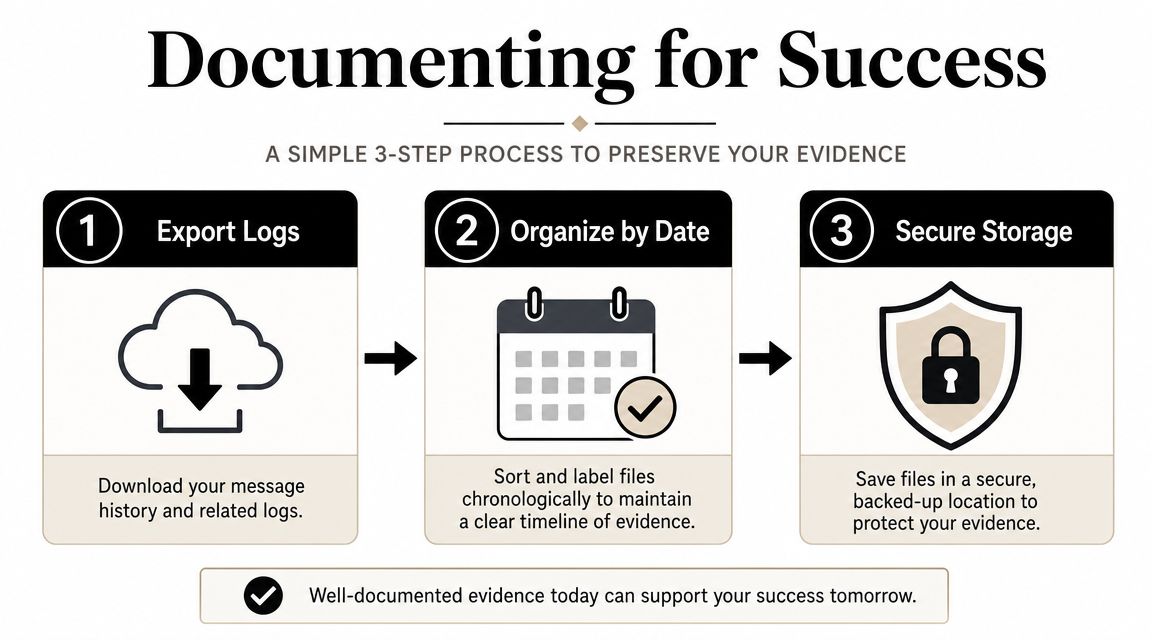
Don't crop screenshots so tightly that context disappears. Include names, dates, and timestamps when possible. If you use an app like OurFamilyWizard or TalkingParents, export full logs instead of cherry-picking single messages.
Use a simple folder structure:
- Create monthly folders such as “2026-01 January”
- Save screenshots and exports by date
- Rename files clearly like “2026-01-14 missed exchange text”
- Back everything up to a secure cloud account or external drive
- Keep a running summary log in a document or spreadsheet
That summary log should be boring. Boring is good. Example:
- January 14, 5:00 p.m. exchange scheduled
- Other parent arrived 40 minutes late
- Text confirmation attached
- Child missed start of practice
Show patterns, not isolated drama
Judges care more about repeated conduct than one ugly afternoon. A single rude text may not move the needle much. A pattern of interference, refusal, lateness, or abuse often does.
That's why a timeline matters. Your attorney can use a clear record to show consistent behavior over weeks or months instead of relying on memory.
If you're dealing with repeated order violations, this guide on how to document custody violations in Texas gives a useful framework for organizing what matters most.
Bring your lawyer organized facts, not a pile of screenshots.
What not to do
Don't alter messages. Don't delete your side of the conversation. Don't highlight only the other parent's worst moments while leaving out the full thread if context matters. If something is going to court, assume the other side will try to challenge authenticity and completeness.
Clean records make your attorney's job easier. They also make you look prepared, honest, and credible.
Handling High-Conflict Situations and Special Orders
Some custody cases aren't just tense. They're dangerous, volatile, or controlled by strict temporary orders. If that's your situation, regular co-parenting advice isn't enough. You need a tighter plan.

If there's a protective order, a no-contact provision, supervised exchange requirements, or a specific communication rule in your temporary orders, follow it exactly. Not approximately. Exactly.
Court orders beat convenience every time
Parents get into trouble when they think they can “work around” a court order because it seems easier in the moment. Don't do that. If your order says communication goes through an app, use the app. If it says third-party exchange, don't show up at the other parent's door trying to talk things out.
In high-conflict cases around Humble and Northeast Houston, one of the smartest moves is reducing direct contact as much as possible. That may mean using a neutral app, a parenting coordinator, supervised exchange staff, or attorney-to-attorney communication for disputed issues. If your case fits that category, this resource on high-conflict custody cases and Texas strategy is a strong starting point.
When safety is the issue
If there has been domestic violence, stalking, threats, or intimidation, your communication strategy must prioritize safety before courtesy. That may mean:
- Using only written communication so there's a record
- Avoiding spontaneous phone calls unless there's a true emergency
- Handling exchanges through a third party or approved location
- Reporting violations promptly to your attorney and, when necessary, law enforcement
- Keeping your child out of the middle no matter how tempted you feel
You do not have to absorb abuse to look cooperative.
Be careful with recordings
Texas is a one-party consent state, so recording a call you're part of can be legal. But legal doesn't always mean wise. According to a 2025 discussion of recording risks in Texas custody disputes, 41% of recorded calls backfire in custody court because judges perceive them as manipulative, while neutral written app logs tend to be viewed more favorably.
That matters.
If you're constantly recording every conversation, a judge may see that as escalating conflict instead of managing it. Written logs are usually cleaner, calmer, and easier to authenticate.
Here's a practical explainer on the broader issue:
My advice in hard cases
Use recordings sparingly and only after getting legal advice tied to your facts. In most cases, I'd rather see a parent with a disciplined written record than a phone full of secret audio files and a history of escalating calls.
If your ex is volatile, the answer usually isn't more conversation. It's better structure.
Communication Mistakes That Can Jeopardize Your Custody Case
Many parents believe the primary danger is saying something awful directly to the ex. That is dangerous, yes. But the bigger problem is usually the collection of smaller bad habits that make you look impulsive, bitter, or unable to put your child first.
The biggest mistake I see is this: people think a private rant is harmless if it happens outside the courtroom. It isn't.
A 2021 American Academy of Matrimonial Lawyers study discussed in this Texas custody communication article found that 81% of Texas divorce attorneys had seen social media evidence affect custody cases, and posts bad-mouthing an ex were used against a parent in nearly 30% of those cases.
The habits that hurt parents most
Talking about your ex online
Facebook posts, Instagram captions, stories, comments, and even indirect memes can become evidence. If it sounds bitter, mocking, or unstable, don't post it.
Using your child as a messenger
Don't tell your child, “Tell your dad he's late,” or “Ask your mom why she didn't pack your clothes.” That puts pressure on the child and makes you look like you're dragging them into adult conflict.
Sending repeated messages
One clear message is enough. Ten messages in a row starts to look harassing, even if you were initially right.
Discussing the lawsuit with your ex
Don't threaten. Don't lecture about what the judge will do. Don't argue your legal position over text. Save legal strategy for your attorney.
The problem with “being honest” in the wrong way
Some parents say, “I'm just telling the truth.” Maybe you are. But if you're telling it in a hostile, uncontrolled way, the judge may focus less on the truth and more on your judgment.
That's why emotional discipline matters. If you struggle to stay regulated when your ex provokes you, a practical outside resource like this guide to emotional regulation and boundaries can help you pause before you send something you'll regret.
If a message feels good to send in anger, it usually reads badly later.
One rule that simplifies almost everything
Don't write, post, or say anything about your ex that you wouldn't want discussed in a Harris County courtroom with your child's future on the line.
That rule will save you from a lot of mistakes.
Taking Control of the Narrative for Your Family's Future
Custody cases are stressful because so much feels out of your hands. Your ex may be difficult. The process may be slow. The facts may be disputed. But your communication is one area you can control immediately.
Write instead of argue. Stay child-focused. Keep your messages short. Preserve your records. Follow court orders exactly. When conflict rises, get more structured, not more emotional.
That's how you change the story a judge sees.
For parents in Humble, Atascocita, Kingwood, and Northeast Houston, the right communication strategy does more than avoid fights. It helps prove that you're the parent who brings stability, maturity, and focus to your child's life. That matters in Texas custody court, and it matters even more at home.
If you're dealing with a custody dispute and you're tired of guessing what to say, get legal guidance before another bad text becomes part of your case.
If you need help building a communication plan that protects your rights and your child's best interests, schedule a free consultation with the Law Office of Bryan Fagan. Our Humble office works with families across Humble, Atascocita, Kingwood, and Northeast Houston, and we can help you evaluate your messages, your documentation, and the next steps in your custody case.