The text from your co-parent comes in at 10:47 p.m. Pickup is suddenly changing. Again. Your child is standing in the kitchen asking where they're sleeping tomorrow, and you're trying to answer without sounding angry, scared, or exhausted.
That's a common scene for parents in Humble, Atascocita, Kingwood, and across Northeast Houston. A difficult co-parent can turn ordinary school nights, holidays, and doctor visits into constant conflict. The stress doesn't stay between adults. Children feel the instability quickly, especially when schedules keep shifting, communication turns hostile, or one parent uses access to the child for control.
If you're searching for how to deal with a difficult co parent texas, you probably don't need vague advice about “just getting along.” You need practical tools that work in Harris County family court, and you need to know when to stop managing the problem privately and start using legal remedies. Texas law gives parents options, but timing and documentation matter.
Navigating Co-Parenting Challenges in the Humble Community
A lot of local parents come in thinking they have only two choices. Keep absorbing the chaos, or go straight into a courtroom fight. In reality, there's a middle path, and sometimes several of them.
One Humble parent may be dealing with nonstop hostile messages before every exchange. Another in Kingwood may have a co-parent who agrees to everything verbally and then denies it later. A parent in Atascocita may be facing something heavier, such as manipulation of the child, repeated interference with possession, or behavior that raises genuine safety concerns. These situations don't all require the same response.
What works usually starts with one question. Is this person merely difficult, or are they actively undermining the court order, the child's stability, or the child's safety? That distinction matters because the right strategy depends on the level of conflict.
What local families usually need first
Most parents benefit from a calm, structured approach before they make a major court move. That often includes:
- Reducing direct conflict: Limiting conversations to child-related topics only.
- Creating predictability: Using one communication channel and one shared calendar.
- Building a record: Saving messages, missed exchanges, and school or medical issues in an organized way.
- Separating emotion from action: Responding strategically instead of reacting in the moment.
Practical rule: Your goal isn't to win arguments with a difficult co-parent. Your goal is to protect your child, preserve your credibility, and make the facts easy for a judge to understand if court becomes necessary.
Families in Harris County often find that the legal side and the emotional side of co-parenting are tightly connected. If the communication process is messy, the evidence usually is too. If the evidence is weak, even a very real problem can become harder to prove.
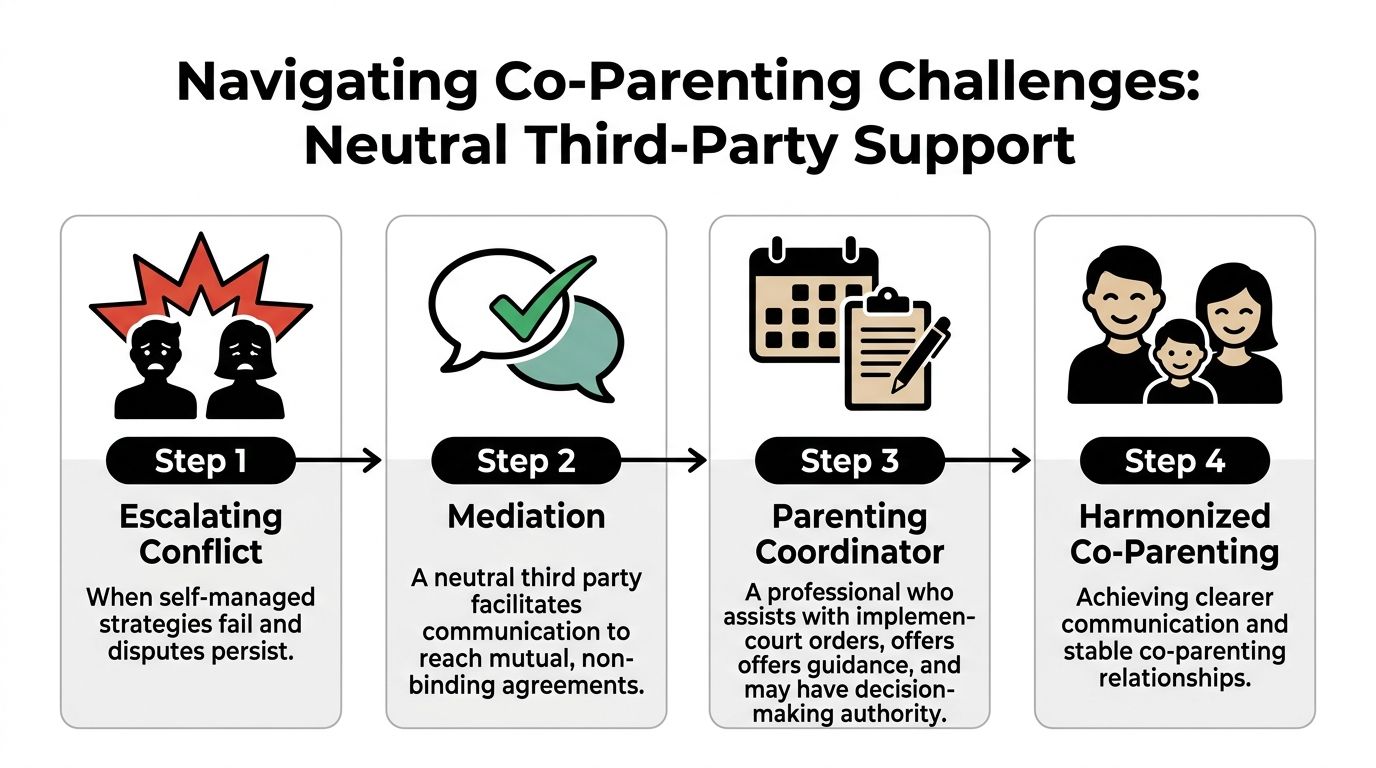
That's why the path forward usually starts with communication discipline, then moves to neutral support, then to modification or enforcement if the behavior continues.
Your First Line of Defense Communication and Documentation Strategies
When a co-parent thrives on conflict, more conversation usually makes things worse. Better structure helps more than better persuasion.

Use parallel parenting when cooperation isn't realistic
Some parents can co-parent closely. Others can't, at least not safely or productively. In high-conflict cases, parallel parenting is often the better fit. That means each parent handles day-to-day decisions during their own time, with minimal direct contact except where the order requires communication.
This approach lowers the number of opportunities for arguments. It also helps children by reducing the amount of adult tension they're exposed to. In practice, that can mean school exchanges instead of front-door handoffs, a shared digital calendar instead of ongoing text debates, and tightly limited communication about logistics only.
If your co-parent sends guilt-driven, sarcastic, or baiting messages, it also helps to learn basic techniques for responding to passive aggressive behavior without feeding the conflict. The goal is not to sound clever. The goal is to become boring to fight with.
Write every message using BIFF
A useful filter for every written message is BIFF, which stands for Brief, Informative, Friendly, Firm.
Here's what that looks like in real life:
- Brief: Keep it short. Long explanations create new openings for attack.
- Informative: Stick to facts, dates, times, and child-related needs.
- Friendly: Neutral tone helps you look reasonable, even when the other parent isn't.
- Firm: End with a clear position. Don't invite unnecessary back-and-forth.
A BIFF response might say: “Per the current schedule, I'll pick up at 6:00 p.m. at the school.” It doesn't defend, accuse, or revisit old fights.
Keep your message clean enough that you'd be comfortable seeing it printed as an exhibit in Harris County court.
Documentation is not optional
Texas family law practice strongly favors documented communication through court-approved tools. A step-by-step Texas methodology for hostile co-parenting includes documenting all communications through platforms such as Our Family Wizard to create an evidentiary trail. The same source notes that poor documentation leads to 65% of unfavorable court rulings, while parenting apps cut conflict incidents by 40% in monitored studies according to Texas hostile co-parenting guidance.
That matters because judges don't decide cases based on who feels more frustrated. They decide based on what can be shown clearly and consistently.
What to document and how to organize it
A workable system is simple and repeatable:
- Save every written exchange in one place, preferably through a parenting app.
- Track missed or late exchanges with date, time, location, and what happened.
- Keep school and medical records that show disruptions, absences, or missed appointments.
- Use a timeline instead of scattered screenshots.
If you need a practical framework, this guide on how to document custody violations in Texas is a useful starting point.
What doesn't work is equally important. Don't edit screenshots. Don't argue in the same thread where you're trying to preserve evidence. Don't rely on memory six months later.
Bringing in a Neutral Third Party Mediation and Parenting Coordinators
Some disputes aren't solved by better messages. They need a buffer.
Mediation and coordination are not the same thing
Parents often hear these terms used together and assume they mean the same process. They don't.
| Option | Main purpose | Best use |
|---|---|---|
| Mediation | Helps parents reach an agreement | Disputes over schedule changes, decision-making, and revised terms |
| Parenting coordinator or facilitator | Helps reduce conflict and improve compliance with an existing structure | Ongoing day-to-day disputes after orders are in place |
Mediation is usually the first neutral step. A mediator doesn't act as the judge and doesn't represent either parent. The mediator helps move the conversation from blame to workable terms.
Texas courts are increasingly relying on this process. Mediation resolves 70 to 80% of custody disputes without trial and can reduce litigation costs by 50 to 60%, according to Texas Office of Court Administration data cited in Texas co-parenting guidance on mediation.
That matters for families in Humble and Northeast Houston because court time is expensive in every sense. It costs money, time off work, and emotional energy.
When a parenting coordinator helps more than another hearing
A parenting coordinator or similar neutral professional can help when the order exists, but daily implementation keeps breaking down. These cases often involve recurring arguments about extracurriculars, pickup details, communication tone, school notices, or small decisions that turn into large fights.
A neutral professional can help in several ways:
- Absorbing conflict: The parents communicate through a process instead of direct confrontation.
- Keeping the focus on the child: Conversations stay tied to the parenting plan.
- Improving follow-through: Repeated misunderstandings become easier to identify and address.
- Reducing emergency motions: Not every disagreement has to become a court filing.
Mediation is for reaching terms. A parenting coordinator is for helping people live with those terms without constant collapse.
For some families, local legal counsel helps behind the scenes. A Humble family lawyer can prepare the parent for mediation, review proposed language, and push for details that reduce future loopholes.
If you're weighing whether that process makes sense, this overview of what mediation in family court involves can help you compare your options.
What usually works in the room
Parents do better in mediation when they stop trying to prove the other person is impossible and start asking for language that is precise. Specific pickup times work better than “reasonable notice.” Specific holiday rotation works better than “we'll work it out.” Specific communication rules work better than “be respectful.”
That's the trade-off. You give up some flexibility in exchange for fewer future arguments.
Changing the Rules Modifying Your Texas Custody Order
Sometimes the problem isn't just that the co-parent is difficult. The problem is that the current order no longer protects the child well enough.

A custody modification is not supposed to be punishment for bad behavior. It's a request to change the legal structure because circumstances have changed in a way that affects the child's best interests. In Texas, that usually means showing a material and substantial change in circumstances.
When a modification becomes the right move
In practice, parents often reach this point after a pattern emerges, not after one ugly weekend. A court may need to revisit the order when one parent repeatedly refuses to follow the schedule, creates instability around school and medical care, exposes the child to dangerous conduct, or consistently uses the child as a weapon in the adult conflict.
Common examples include:
- Ongoing interference with possession
- Serious concerns about substance abuse
- An unstable home environment
- Manipulation that damages the child's relationship with the other parent
- Credible abuse concerns that require stronger limits
The key is proof. Judges want specifics, patterns, and a clear explanation of why the current order is no longer workable.
The 2025 Texas change matters
As of September 2025, Texas courts cannot force reunification therapy if credible abuse allegations exist, and Texas law now explicitly recognizes both parental alienation and family violence as forms of child abuse, requiring immediate intervention, according to this 2025 Texas family law update on difficult co-parenting.
That is a meaningful legal development for parents in Humble, Atascocita, Kingwood, and the broader Harris County area. It changes the conversation in cases where one parent tries to frame every child's resistance as something to be “fixed” through forced contact, even when there are credible abuse concerns behind it.
If a child's safety is genuinely at issue, the court's job is protection first. Forced therapeutic contact is not a substitute for careful judicial review.
This short video helps explain how courts look at post-order custody issues in Texas:
Better orders reduce future conflict
A strong modification request doesn't just ask the judge to “do something.” It proposes a better structure.
That may mean requesting more defined exchange locations, narrower communication rules, decision-making changes, supervised periods when appropriate, or revisions that reduce direct parent contact. For some families, the best outcome is not more forced collaboration. It's less unnecessary interaction and more predictable boundaries.
If your current order leaves too much room for manipulation, modification may be the most practical way to restore stability.
Enforcing Your Court Order When Your Co-Parent Wont Comply
A different problem comes up when the order is already clear, but your co-parent ignores it. That's not a modification issue. That's an enforcement issue.

What enforcement is meant to do
A Motion for Enforcement asks the court to hold the other parent accountable for violating a specific order. In Harris County, that means the language of the order matters a great deal. Courts enforce clear commands better than vague expectations.
Typical enforcement issues include denied possession, failure to return the child on time, refusal to follow exchange terms, or noncompliance with required duties in the order. The court will want details for each violation, including the date, time, place, and the exact provision that was broken.
What good evidence looks like
The strongest enforcement cases usually have a disciplined paper trail. Not a pile of emotional messages. Not a long story with no exhibits. A trail.
Useful evidence often includes:
- App messages or emails showing the denial or refusal
- Exchange logs with dates, times, and witnesses if relevant
- School or medical records showing impact on the child
- Copies of the signed order with the violated language highlighted for legal review
The main mistake parents make is waiting too long and then trying to reconstruct a year of violations from memory. Enforcement works best when each incident is logged close to when it happened.
Courts can only enforce what they can identify clearly. Specific facts beat generalized frustration every time.
Accountability tools inside and outside the courtroom
Not every enforcement problem needs to explode into repeated hearings. In some cases, a parenting coordinator can help stabilize an already volatile situation. Parenting coordinator involvement resolves 82% of ongoing disputes within 6 months, and North Texas courts now integrate 2025 Family Code updates that grant judges authority for parental alienation sanctions in 70% of proven cases, according to Texas co-parent accountability data discussed here.
That doesn't mean every difficult case should go straight to a coordinator. It means courts are showing a stronger willingness to hold parents accountable when the facts are proven.
What a successful enforcement action can accomplish
A successful enforcement case can do more than produce a warning. Depending on the facts and the order involved, the court may require compliance, award make-up time, or impose other contempt-related consequences allowed under Texas law.
For many parents, the primary value is this. Enforcement tells the other side that the order is not a suggestion. If your co-parent has built a pattern of testing boundaries, one well-prepared enforcement action can change the tone of the case.
Urgent Action Safety Concerns and Protective Orders
Some situations are not about frustration or inconvenience. They are about danger.
If your co-parent has become physically threatening, is abusing substances around the child, is escalating harassment, or is creating severe emotional harm, the response needs to change immediately. In those cases, your first priority is safety, not negotiation.
When to move fast
Warning signs that call for urgent legal review include:
- Threats or acts of family violence
- Driving with the child while impaired or visibly intoxicated
- Severe mental health instability affecting the child's safety
- Harassment, stalking, or intimidation
- Pressure on the child that creates fear, panic, or serious emotional distress
Texas law has become more protective in this area. The current legal environment gives stronger footing for parents raising credible abuse concerns, and courts can act quickly when the facts support emergency relief.
TROs and protective orders serve different functions
A Temporary Restraining Order, often called a TRO, can be part of a family law case and can temporarily restrain certain conduct while the case is pending. A Protective Order is typically aimed at preventing family violence and can impose stronger safety-based restrictions.
Depending on the situation, a court may order measures such as no-contact provisions, limits on communication, supervised exchanges, or other restrictions designed to protect the child and the other parent.
If you need a basic starting point, this page on what a temporary restraining order is in Texas family court explains the role that emergency relief can play.
Digital abuse counts too
Dangerous conduct isn't always in person. Some co-parents use social media, messaging platforms, shared accounts, or public accusations to harass and intimidate. If that's happening, practical digital safety steps matter alongside legal action. This resource on combatting online harassment from an ex offers useful ideas for preserving evidence and reducing online exposure.
When abuse or credible safety threats are present, trying to “keep the peace” can expose you and your child to more risk. Fast legal action is often the safer path.
In Harris County, emergency filings are highly fact-driven. The more clearly you can show specific incidents, the more effectively the court can respond. If safety is in question, speak with a lawyer right away rather than waiting to see if the behavior settles down on its own.
Let Our Humble Team Help Protect Your Peace of Mind
A difficult co-parent can make you feel trapped in a cycle that never ends. One week it's a late pickup. The next it's a barrage of messages, a denied exchange, or a child who's suddenly carrying adult stress they should never have to carry. The good news is that Texas law gives you more than one tool.
Sometimes the right first move is stricter communication and better records. Sometimes it's mediation or a neutral professional who can reduce the chaos. Sometimes the facts support a modification because the current order no longer protects your child's stability. And sometimes enforcement or emergency relief is the only reasonable next step.
The important part is choosing the response that fits the behavior. Overreacting can waste time and money. Underreacting can let a damaging pattern grow. A grounded legal strategy helps you avoid both.
For parents in Humble, Atascocita, Kingwood, and Northeast Houston, local court knowledge matters. Harris County judges want clear facts, workable proposals, and child-focused reasoning. That's why many parents benefit from legal help early, even if they're not sure yet whether they need to file. The Law Office of Bryan Fagan can assist with custody disputes, enforcement, modification planning, mediation preparation, and protective-order strategy in Texas family law matters.
You do not have to keep guessing your way through this. You can create structure. You can draw boundaries. You can ask the court to step in when necessary. Most of all, you can build a calmer and safer framework for your child.
If you're dealing with a difficult co-parent in Humble, Atascocita, Kingwood, or anywhere in Northeast Houston, schedule a free consultation with Law Office of Bryan Fagan. We'll listen to what's happening, explain your options under Texas law, and help you build a practical strategy for communication, enforcement, modification, or urgent court protection.