Skip to content

A parent in Humble gets a call on a Tuesday afternoon. The job offer is good. The pay is better. The new city might mean more family help, a shorter commute, or a safer fresh start.
Then the hard part hits.
If you share custody, a move doesn’t only affect your address. It affects school pickup, weekends, holidays, and the child’s relationship with the other parent. In Humble, Atascocita, Kingwood, and across Northeast Houston, I’ve seen how fast hope can turn into panic when a parent realizes, “I can’t just pack up and go.”
Planning a Move? What Humble Families Need to Know First
A relocation case usually starts with a normal life event. A parent receives a transfer. A grandparent in another state offers housing and childcare. A remarriage changes household plans. Or a parent feels stretched thin and wants to move closer to support.
That part is human. The legal part is where families get blindsided.

Texas courts don’t look at relocation as only an adult decision. They look at how the move changes the child’s daily life and the child’s relationship with both parents. Texas Family Code §153.001(a) says courts must assure “frequent and continuing contact” between children and parents, a principle explained in this Texas family law breakdown. That idea sits at the center of nearly every relocation dispute.
Why parents get tripped up early
Many parents assume a move is allowed if they have primary custody. Often, that isn’t true. Your order may give you the right to determine the child’s residence, but only within limits set by the court.
A parent in Kingwood might think moving to Dallas is just a personal choice. A parent in Atascocita might assume a move to Louisiana is manageable if they promise summer visitation. A court may see those situations very differently, especially if the existing schedule would be hard to preserve.
Practical rule: Before you sign a lease, accept a transfer, or enroll your child in a new school, read your custody order from top to bottom.
If you’re still in the planning stage, practical moving logistics matter too. Families often find it helpful to use an essential moving out of state checklist guide so the non-legal parts of the move don’t spiral while you’re handling the legal side.
Start with your current parenting order
Your order is the roadmap. It tells you who has the right to decide the child’s primary residence, whether there’s a geographic restriction, and how visitation is supposed to work. If your schedule is based on a standard possession framework, this standard possession order resource for Humble parents can help you understand how a move could disrupt the routine already in place.
Three questions matter right away:
- Who decides residence: One parent may have that right, but not without limits.
- Where the child can live: The order may restrict residence to a county or group of counties.
- How the other parent’s time works: If travel makes the schedule unrealistic, conflict usually follows.
A child custody relocation lawyer humble texas families trust should help with both the law and the local reality. In this part of Harris County, parents aren’t just managing court language. They’re managing school districts, traffic patterns, family support, and the emotional weight of changing a child’s world.
Understanding Relocation in Texas and Your Custody Order
Relocation sounds simple. In custody law, it usually isn’t.
In Texas, the key question is not just “Are you moving?rdquo; The critical question is whether the move crosses the boundary allowed by your court order. Many orders include a geographic restriction, often limiting the child’s residence to the current county and contiguous counties. If a parent wants to move beyond that area, the parent usually must seek a modification and prove both a material and substantial change in circumstances and that the move is in the child’s best interest, as described in this Texas relocation overview.
Think of the restriction as the child’s home territory
A geographic restriction works like a court-drawn home territory for the child. Inside that territory, the child’s school, doctors, activities, and contact with each parent are expected to remain reasonably workable. Outside that territory, the court assumes the move could change too much.
That’s why a move from Humble to another nearby area may be treated differently than a move from Humble to Austin, Dallas, or another state.
Here’s a simple way to look at it:
| Move type | Likely legal impact |
|---|---|
| Move within the allowed area | May be permitted under the existing order, depending on the exact language |
| Move outside the allowed area | Usually requires a court modification before the child relocates |
| Move that disrupts possession even if nearby | Can still trigger conflict and court review |
Common points of confusion
Parents often ask whether relocation only means leaving Texas. It doesn’t. A move can become a relocation problem if it breaks the terms of the order or makes the parenting schedule difficult to follow.
A few examples help:
- Humble to Downtown Houston: This may or may not be allowed. It depends on the wording in the order and whether the county restriction is still satisfied.
- Atascocita to Dallas: This usually raises modification issues because the move changes distance, travel time, and routine.
- Kingwood to another state: This almost always requires court involvement unless the other parent fully agrees and the court signs off if needed.
A good first read of the order answers two questions fast. Where can the child live, and what has to happen before that changes?
Why the wording matters so much
Two orders can look similar but produce very different outcomes. One parent may hold the right to determine residence subject to a county restriction. Another may have a broader clause. Some orders are detailed. Some are vague enough to create arguments.
That’s why relocation cases are rarely solved by general internet advice. Humble families need to read the actual decree or prior custody order carefully, then match it to the move being considered.
If you’re searching for a child custody relocation lawyer humble texas parents can turn to, legal guidance starts paying off. Not with dramatic courtroom talk. With line-by-line review of what your order says.
The Best Interest of the Child Standard in Harris County Courts
Once a move requires court approval, the judge’s focus narrows to one question. Is this move in the child’s best interest?
That phrase can feel frustrating because it sounds broad. In practice, judges look at concrete details. They want to know how the child will live, learn, stay connected, and adjust if the move happens.

What a judge is really weighing
Parents sometimes think the hearing is about which adult has the stronger reason. It’s more accurate to say the hearing is about the child’s lived experience.
A Harris County judge may look at issues like these:
- Emotional needs: How stable is the child right now, and how would the move affect that stability?
- Physical needs: Would the move improve or disrupt access to school, healthcare, housing, and daily care?
- Parent-child relationships: Can the child maintain meaningful contact with the nonmoving parent?
- Home stability: Is the new environment settled and realistic, or still uncertain?
- Parenting abilities: Who has been handling school, appointments, activities, and day-to-day structure?
- Future plans: Is there a clear, child-focused plan after the move?
These are not boxes to check with slogans. Judges want specifics. Which school? Which after-school care? Who handles transportation? How will midweek contact be replaced if distance increases?
Parents who want a clearer sense of how courts evaluate these issues can review this guide on how to prove best interest of a child in Texas custody cases.
Local reality matters
A judge serving families from Humble, Atascocita, Kingwood, and Northeast Houston sees patterns. The child’s ties to a local school, a familiar therapist, nearby grandparents, church, sports, or a long-standing special education plan can matter. So can the practical burden of travel.
A parent asking to relocate should be ready to show more than personal improvement. The court usually wants to see how the move benefits the child, not just the moving parent.
Here’s a helpful comparison:
| Argument focus | How a judge may react |
|---|---|
| “I want a fresh start” | Often seen as adult-centered unless backed by child-focused details |
| “The child will have stable housing, school continuity, and support” | More persuasive when supported by documents and a realistic plan |
| “We’ll figure out visitation later” | Usually weak because it leaves the other parent’s contact uncertain |
Courts respond better to plans than promises.
Two local issues families often overlook
In this part of Harris County, two issues often add complexity and deserve careful handling.
First, immigration-related concerns can affect relocation planning. A parent may face travel limits, documentation concerns, or instability connected to visa status. Courts still focus on the child’s stability, so the family needs a careful record showing the child’s routine and support system won’t collapse if the move happens.
Second, family violence changes the analysis significantly. Texas courts can allow a parent to move immediately without notice if the parent and child are fleeing documented family violence under Texas Family Code §153.134(b)(1), as discussed in this Humble parental relocation resource. That exception exists to protect victims, and it can be critical when delay would create risk.
What judges often distrust
Judges tend to look closely at moves that seem driven by a new relationship, frustration with co-parenting, or a desire to gain an advantage. That doesn’t mean the request will fail. It means the parent should expect hard questions.
The stronger case usually connects the move to a stable plan for the child’s schooling, care, support network, and ongoing relationship with the other parent.
A Step-by-Step Guide to the Relocation Legal Process
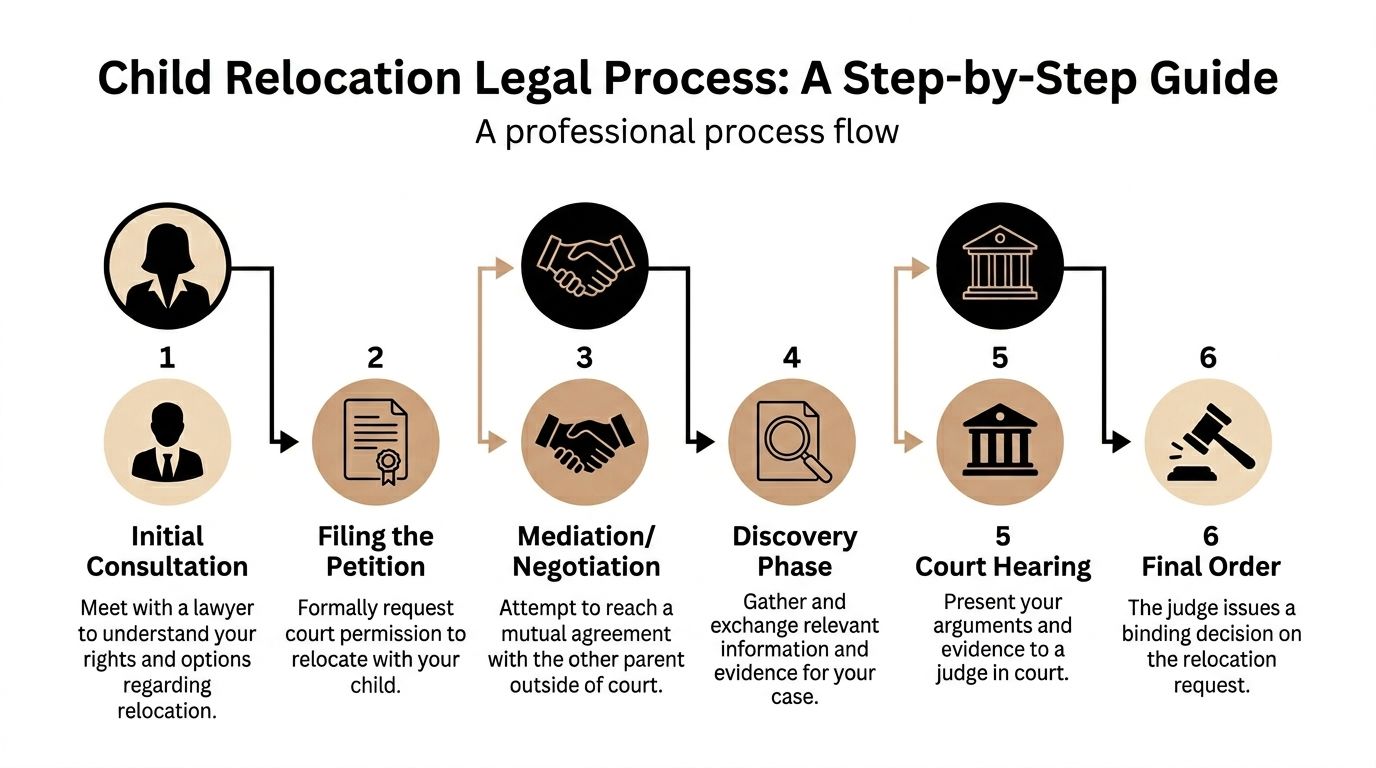
Relocation cases feel less overwhelming when you break them into tasks. Most parents do better when they stop thinking, “How do I win this?rdquo; and start thinking, “What happens next?rdquo;
Start with the order and the calendar
Your first job is to review the current order. Don’t rely on memory. Pull the signed version and identify the clauses on primary residence, geographic restriction, notice, and possession.
If the order includes a residency restriction, you must typically give written notice of the move at least 60 days in advance, and failure to do so is a common reason Harris County courts deny relocation motions, according to this Texas parental relocation notice guide.
That deadline matters because relocation cases often move slower than families expect.
The basic timeline most parents follow
Review the decree or order carefully
Find out whether the move is inside or outside the allowed area. Confirm who has the right to determine residence and whether court approval is needed.Give written notice when required
Notice should be clear, timely, and documented. Keep copies. If conflict is likely, the wording matters.File a modification case if the move requires one
A parent asking to relocate beyond the restricted area usually needs to file for modification in the proper court. If you’re preparing for that process, this custody modification attorney resource for Humble families explains the bigger modification framework.Request temporary orders if the situation is urgent
Some moves can’t wait. A job start date, school timing, or safety concern may require temporary relief while the case is pending.
Before going further, it helps to hear a plain-language explanation of how relocation disputes are approached in practice.
What happens after filing
Once the case is active, the court process usually becomes more structured.
- Mediation often comes early: Many custody disputes are pushed toward negotiation before a full hearing. That can help parents create school-year and holiday schedules that fit the new distance.
- Evidence gets exchanged: Parents gather records, calendars, school information, communications, and other documents.
- A hearing or trial may follow: If no agreement is reached, the judge decides.
Local practice note: The earlier you organize dates, school records, and communication history, the more options you usually have in mediation.
What to prepare before court dates start stacking up
A relocation case moves better when you build a working file early. That file might include:
- The current order: Signed copy, not screenshots or memory.
- Move details: Proposed address, housing plan, and timing.
- School information: Enrollment options, calendars, and special programs if relevant.
- Parenting proposal: A realistic long-distance schedule that shows how the other parent will stay involved.
- Communication record: Respectful written messages are often more useful than emotional arguments.
Parents in Humble and Kingwood often run into trouble when they act first and file later. That sequence can make the move look careless, even if the parent had good reasons. Judges usually prefer a parent who planned ahead, gave proper notice, and came to court with a child-focused proposal.
If you oppose the move
The process is still active for you. Don’t assume “no” is enough. You’ll usually need to respond, gather proof, and show how the child’s daily life and parent-child bond would be harmed by the relocation.
That might mean school records, activity schedules, proof of regular involvement, and a clear explanation of why the current arrangement supports the child better.
Building Your Case Evidence for a Relocation Hearing
Relocation cases are won and lost on evidence. Not feelings alone. Not assumptions. Not the idea that a judge will “just understand.”
A strong case gives the court something concrete to trust.

If you are the parent requesting the move
Your evidence should answer one central concern. How does this move improve the child’s life while protecting the child’s relationship with the other parent?
Useful proof often includes:
- Employment documents: A written job offer, transfer paperwork, or a letter explaining why the move is necessary.
- Housing information: Lease terms, home details, and evidence the new living situation is stable.
- School research: Enrollment information, program details, and records showing the child’s needs will be met.
- Support network proof: Information about nearby family members or childcare help in the new location.
- A detailed parenting plan: Travel arrangements, holiday proposals, virtual contact schedules, and transportation responsibilities.
The biggest mistake moving parents make is offering broad statements. “It’s a better opportunity” is not enough by itself. Courts usually respond better to a packet that shows planning, structure, and respect for the other parent’s role.
If you are the parent opposing the move
Your case should stay focused on the child, not punishment. Judges usually see the difference.
Helpful evidence may include:
- School and activity records: Proof the child is doing well in Humble, Atascocita, or Kingwood.
- Involvement history: Calendars, photos, messages, pickup logs, coaching records, and appointment attendance.
- Community ties: Teachers, counselors, coaches, church leaders, or relatives who help show the child’s rooted life here.
- Schedule impact evidence: Travel realities, missed school concerns, and how distance would reduce meaningful contact.
- A workable alternative: If the move is about finances or support, the court may want to know whether those needs can be addressed without relocation.
When parents stay child-centered, their evidence tends to sound more credible.
Expert witnesses and when they matter
Some cases are simple enough to resolve with documents and testimony from the parents. Others involve mental health issues, family conflict, special needs, alienation claims, or questions about adjustment and stability. In those cases, expert testimony can become important.
In contested relocation cases, experts such as child psychologists or parental fitness evaluators may charge $225 to $400+ per hour, with total fees often ranging from $15,000 to $50,000, and their testimony can improve the chance of a favorable outcome by as much as 75%, according to this Texas child custody expert witness directory.
That doesn’t mean every case needs an expert. It means some cases benefit from one when the facts are disputed and the judge needs a trained professional to interpret what the evidence shows.
A balanced way to think about proof
| Issue | Moving parent evidence | Opposing parent evidence |
|---|---|---|
| Schooling | Better fit, continuity plan, support services | Strong current performance, disruption concerns |
| Family support | Nearby relatives, childcare help, stable home | Existing support in Northeast Houston already works |
| Parent-child contact | Detailed long-distance schedule | Proof current frequent contact can’t be replaced well |
| Stability | Clear housing and employment | Child is already settled and thriving here |
A child custody relocation lawyer humble texas parents hire should help shape evidence into a story the court can follow. Not a stack of papers with no theme. The court needs to see how each document answers the same question: what arrangement serves this child best?
How a Humble Relocation Lawyer Protects Your Family
A parent in Humble gets a job offer in another city on Monday. By Friday, the other parent is threatening court, grandparents are calling, and the school year is about to start. That is how relocation cases often feel here. Not abstract. Immediate, personal, and tied to a child’s daily life.
A local relocation lawyer helps bring order to that pressure. The job is not only to argue in court. It is to read the custody order carefully, explain what the law allows, map out the safest next step, and keep a stressful family dispute from turning into a legal crisis.
A lawyer helps prevent mistakes that are hard to undo
In relocation cases, timing matters. So does wording. Parents sometimes rely on a text message, an informal promise, or a rushed conversation in a parking lot after pickup. Harris County courts usually care about the signed order, not what everyone assumed it meant.
If a move happens too soon or in violation of the order, the consequences can be serious. The court may treat it as contempt, order the child returned, or require one parent to pay the other side’s attorney’s fees. As noted earlier, Texas courts also have emergency tools available when a child is moved improperly.
A good lawyer slows things down long enough to protect you. That may mean sending formal notice, filing for a modification before any move happens, requesting temporary orders, or telling a parent not to make a commitment that could hurt the case later.
Local practice matters in Humble, Kingwood, and Northeast Houston
Relocation law is statewide. Courtroom reality is local.
Families in Humble, Atascocita, and Kingwood often deal with long commutes, shared caregiving by grandparents, and school routines that stretch across several neighborhoods. Those details can matter more than parents expect. A judge looking at a proposed move may want clear answers about transportation, exchanges, school stability, and whether the child’s support system will remain intact.
Local knowledge also matters when a case includes concerns that generic articles skip over. Some parents in Northeast Houston worry that a move could affect immigration appointments, sponsor relationships, or access to trusted language support. Others need to raise family violence concerns without putting themselves or their child at greater risk. In some cases, domestic violence changes how notice, possession, or safety planning should be handled. Those are not side issues. In the right case, they shape strategy from the beginning.
What protection actually looks like
A relocation lawyer protects a family by handling specific tasks well:
- Reading the exact order: Geographic restrictions, notice rules, and modification language often decide what can happen next.
- Choosing the right filing and timing: A case may call for a modification, enforcement action, temporary restraining order, or emergency request.
- Keeping the focus on the child: Judges hear anger every day. They respond better to a clear plan tied to the child’s needs and routine.
- Preparing for mediation and court: Many cases settle in part, even when emotions run high. The issues that do not settle need to be framed cleanly for a judge.
- Protecting safety and stability: If family violence, coercive control, or immigration-related fear is part of the story, the legal plan should reflect that reality from the start.
Law works like guardrails here. It does not remove the stress, but it helps keep one bad decision from pushing the family into a ditch.
A lawyer can help whether you want to move or stop the move
Some parents need to relocate for work, housing, safety, or family support. Others are trying to preserve frequent contact with a child whose life is centered in Humble or Northeast Houston. Both situations deserve careful legal advice.
The lawyer’s role is to test the facts, spot weak points early, and help the parent present a position the court can follow. That may include correcting unrealistic proposals, pointing out gaps in a visitation plan, or explaining why a child’s established ties to this community still carry weight.
One option local families consider is the Law Office of Bryan Fagan in Humble, which handles family law matters including custody and modification disputes. Other parents look for counsel through bar referral services or personal recommendations. The better question is not who advertises the most. It is whether the lawyer understands relocation cases in this part of Harris County and can respond calmly when the facts get complicated.
Why families here benefit from steady legal help
Children in this community are often tied closely to more than one home. They may see a parent during the week, spend afternoons with grandparents in Atascocita, attend school in Kingwood, and play sports in Northeast Houston. A relocation case can rearrange that whole pattern at once.
That is why legal help matters in a practical sense. It protects your right to be heard, helps you avoid preventable mistakes, and gives the court a clearer picture of what life will look like for your child. In a case this personal, clear advice can make the difference between reacting out of fear and making a plan you can stand behind.
Your Next Steps Schedule a Free Consultation
If you’re thinking about moving with your child, or you’ve just learned the other parent plans to move, don’t wait for the problem to get bigger. Relocation issues are easier to handle when the facts are still organized, the deadlines haven’t passed, and no one has acted in a way that puts the child or the case at risk.
For parents in Humble, Atascocita, Kingwood, and Northeast Houston, the hardest part is usually not caring enough. It’s caring so much that every option feels loaded. You may be trying to build a safer life, keep a job, stay close to your child, or protect a routine that already works.
A short checklist for what to do today
- Find your signed court order: You need the exact language, not a summary.
- Write down the move details: Dates, destination, reason for the move, and how parenting time would work.
- Save communications: Keep texts, emails, and notices organized.
- Hold off on major commitments if you can: New school enrollment, leases, and one-way travel plans can complicate the case if done too soon.
- Get legal advice early: It’s easier to prevent a problem than repair one in court.
You don’t have to solve this alone
Relocation cases bring out fear, guilt, anger, and urgency. That’s normal. What matters is making decisions from a grounded legal position instead of reacting in the moment.
If you’re searching for a child custody relocation lawyer humble texas families can rely on for clear, local guidance, a one-on-one conversation can give you immediate direction. You can talk through your order, your risks, your timeline, and the practical choices in front of you.
Whether you want to request a move, oppose one, or understand your rights before speaking to the other parent, the next right step is to get advice specific to your family.
If you need guidance from a local team that serves Humble, Atascocita, Kingwood, and Northeast Houston, schedule a free consultation with the Law Office of Bryan Fagan. We’ll help you understand your custody order, your relocation options, and the steps that can protect your child and your future.