Skip to content
The exchange time passes. You check your phone again. No text. No call. You send a message that starts calmly and then gets shorter with each minute. “Are y’all on the way?” becomes “Please respond.” Then the fear sets in.
For many parents in Humble, Atascocita, Kingwood, and Northeast Houston, this is the moment when a routine possession exchange turns into a crisis. You may be sitting in a school parking lot, outside an apartment complex, or at the usual pickup spot, realizing the other parent isn’t just late. They may be refusing to return your child.
That panic is real. So is the legal risk if you react the wrong way.
When people search for what to do if other parent won’t return child texas, they usually need answers right now, not a long lecture. The right response is calm, documented, and strategic. You need to protect your child, protect your case, and create a record that helps law enforcement and the Harris County courts understand what happened.
If you’re also worried because you can’t confirm where your child is, broader family tracing tools can sometimes help you gather background information or reconnect with relatives who may know more. People in that position sometimes review PeopleFinder's guide to reconnecting while they work through the immediate legal steps. That kind of resource isn’t a substitute for a court order or police report, but it can be part of the larger effort to locate people and verify information.
The Unbearable Wait What To Do When Your Child Isn't Returned
The hardest part of these cases is the first stretch of uncertainty. Parents often tell me the silence is worse than the argument. A late pickup can still be a traffic problem. A refusal to answer after the return time feels very different.
In this moment, focus on facts. What does your court order say? What time was the child supposed to be returned? Where was the exchange supposed to happen? Who was present? Those details matter more than whatever explanation the other parent gives later.
Practical rule: Treat the first missed return like a legal event, not just a co-parenting disagreement.
That mindset helps you avoid two common mistakes. First, it keeps you from escalating with threats, insults, or impulsive decisions that can show up later in court. Second, it helps you start building the clear timeline that Harris County judges expect to see when they review an enforcement request.
For families in Humble and nearby communities, the local reality matters. You may be dealing with the Humble Police Department, the Harris County Sheriff’s Office, school personnel, or a constable. Each of those people will respond more effectively if you present the situation in an organized way. A certified copy of your order, a short timeline, and saved communications are more useful than a vague statement that the other parent is “keeping my child from me.”
You do have options. They start with what you do in the next hour.
Your First Hour Immediate Actions and Safety Checks
The first hour is about control. Not emotional control alone, but control over information, proof, and next steps. If you move too fast, you can create problems for yourself. If you wait too long without documenting anything, you can weaken your case.
Confirm the order before you say anything else
Pull out the most recent custody or SAPCR order and read the possession terms exactly as written. Look at the return time, exchange location, holiday language, and any modifications that changed the normal schedule. In these cases, parents sometimes act on memory and discover later that they relied on the wrong weekend, an old order, or a verbal side agreement that isn’t enforceable.
If you need general help understanding Texas possession and access systems, the guide to the access and visitation hotline for Humble families can help you orient yourself before you decide on the next move.
Make one calm contact attempt, then document
Send a short written message. Keep it neutral. Ask where the child is and request immediate return under the order. Avoid accusations, profanity, or long emotional paragraphs.
A useful message sounds like this:
- State the obligation: “The order requires return at [time] at [location].”
- Ask for immediate compliance: “Please confirm you are returning [child’s name] now.”
- Ask about safety if needed: “Please confirm [child’s name] is safe.”
Then stop arguing. If the other parent starts baiting you into a fight, let the record stay clean.
Keep communications in writing when you can. Texts and emails preserve timing and wording better than a phone call no one can later verify.
Decide whether to call local law enforcement
If you believe your child is in immediate danger, call emergency services right away. If there is no immediate safety threat but the other parent is refusing to return the child, contact the local agency with jurisdiction. For many families in this area, that may be Humble Police Department or the Harris County Sheriff’s Office, depending on where the exchange occurred and where the child is believed to be.
When you call, be ready with:
- Your court order
- The child’s full name and date of birth
- The other parent’s full name
- The exchange time and location
- A concise summary of what happened
Ask for an incident report or report number, even if the officer explains that they can’t physically enforce the order on the spot. That record can still matter later.
What works and what doesn’t
A few responses help. A few almost always hurt.
| Response | Usually Helps | Usually Hurts |
|---|---|---|
| Reviewing the exact order | Yes | |
| Written request for return | Yes | |
| Showing up angry at the other parent’s house | Yes | |
| Social media posts accusing the other parent | Yes | |
| Calling for a welfare check when facts support it | Yes | |
| Taking the child back by force | Yes |
If your child attends school or daycare in Humble, Atascocita, Kingwood, or Northeast Houston, contact the campus or facility after you’ve reviewed your order. Ask them to note the issue in their file and confirm who is authorized for pickup under the current order. Keep the conversation factual and brief.
Building Your Case How to Document Everything
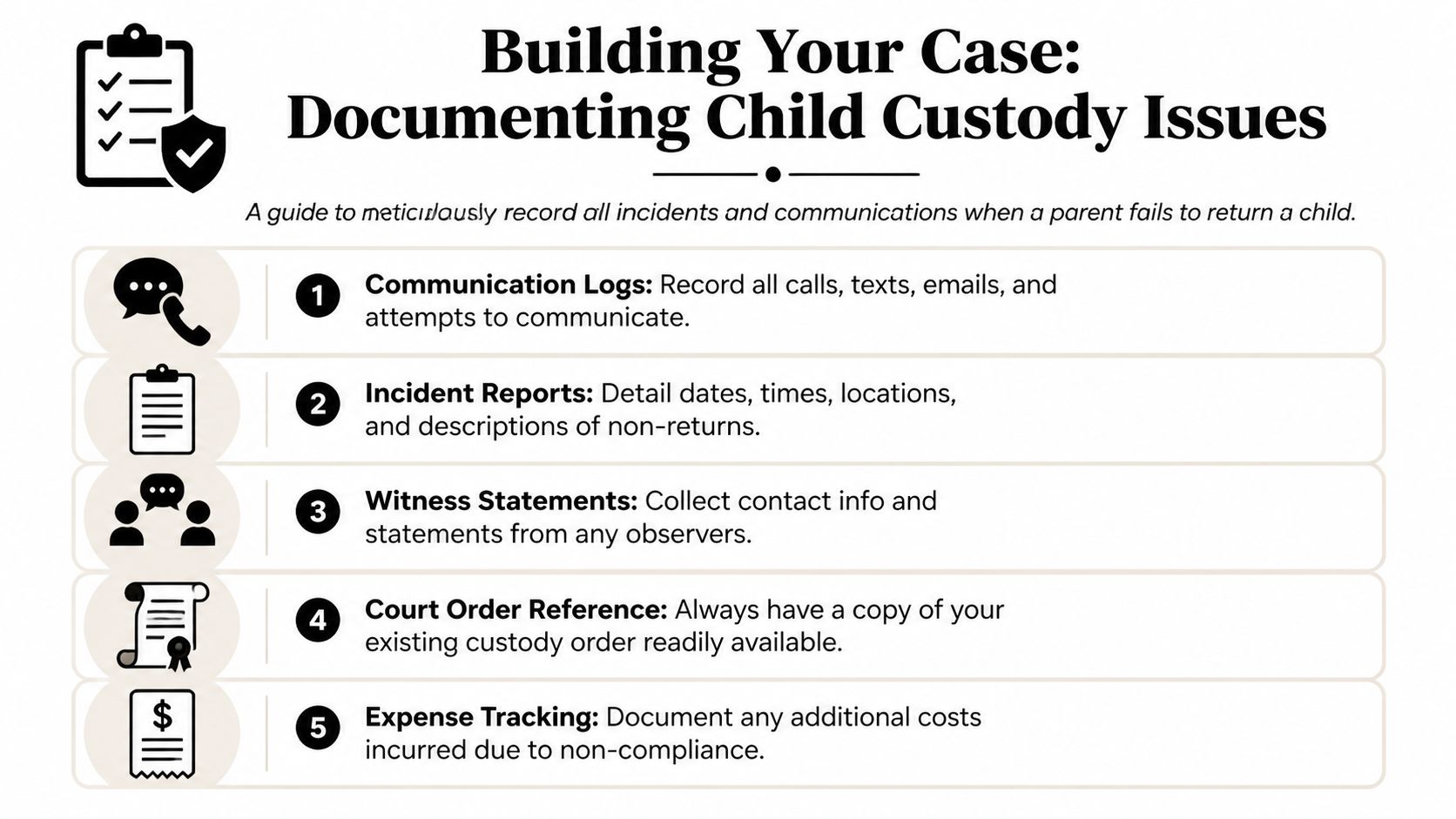
Good documentation wins more custody enforcement disputes than dramatic courtroom speeches. Courts want specifics. They want to know exactly what order existed, exactly what the other parent did, and exactly how you know it happened.
That isn’t just good practice. It’s built into the way enforcement motions work. As noted in guidance on enforcing custody orders, motions must list “each violation with the date, time, and place,” and Harris County courts rely heavily on contemporaneous records such as text logs, calendar notes, and witness statements. A lack of specific documentation is a common reason early enforcement efforts struggle, as explained in this discussion of enforcing a Texas custody order.
Build a simple evidence file the same day
Start one folder on your phone and one folder in cloud storage. Put everything there. Don’t scatter screenshots across albums and don’t trust yourself to “find it later.”
Include these categories:
- Court papers: Your signed order, any later modification, and any exchange provisions.
- Messages: Screenshots of texts, emails, missed calls, and voicemails. Make sure timestamps are visible.
- Timeline notes: Write out what happened in order. Include times, locations, who was present, and what was said.
- Witness information: Names and phone numbers of anyone who saw the failed exchange or heard the refusal.
- Child-related records: School attendance notes, daycare communications, or medical appointment issues caused by the non-return.
- Expenses: Extra childcare, transportation, lodging, or work disruption tied to the violation.
The cleaner your file, the faster an attorney can evaluate your options.
Use contemporaneous notes, not reconstructed memories
A note written while events are unfolding carries more weight than a vague summary you write two weeks later. Open your notes app and record events as they happen. If you spoke to an officer, note the time, the agency, the officer’s name, and the report number. If the other parent changed their story three times, write each version down separately.
Write like someone else will read it in court. Leave out insults, assumptions, and personal commentary.
What useful evidence looks like
Some proof is stronger because it answers basic questions immediately. This is what you want to collect:
- Screenshots with visible timestamps rather than cropped snippets that hide context
- Call logs showing attempted contact
- Photos of the exchange location if you appeared and the child was not returned
- Calendar entries that match the order and show the scheduled possession period
- Third-party observations from grandparents, neighbors, or friends who were present
- School or daycare communication if pickup, attendance, or release information became part of the dispute
If your larger custody case may also involve a best-interest argument later, the resource on how to prove the best interest of a child is worth reviewing. It helps parents understand how courts connect everyday facts to larger parenting decisions.
Keep your record boring and credible
The best evidence file is often the least emotional one. Judges see exaggerated claims all the time. What stands out is a parent who has a neat timeline, a readable set of exhibits, and a clear explanation of the violation.
Here’s a practical template you can follow:
| Item | Example |
|---|---|
| Date | Friday, scheduled return date |
| Required return time | As stated in the order |
| Location | Exact exchange site |
| What happened | Child not returned |
| Your action | Sent text, waited, called |
| Response | No reply or refusal |
| Witnesses | Names and contact info |
| Supporting proof | Screenshot, photo, report number |
That kind of organization saves time and gives your lawyer something usable immediately.
Involving Law Enforcement The Right Way

Many parents in Humble are told some version of this: “It’s a civil matter.” Sometimes that’s the end of the conversation, and they leave thinking they have no real remedy until a court date weeks away. That’s not always the full picture.
Under Texas Penal Code Section 25.03, refusing to return a child in violation of a custody order can be Interference with Child Custody, a state jail felony with penalties of up to 2 years in state jail and a $10,000 fine, as discussed in this explanation of what happens when a non-custodial parent refuses to return a child. Texas law also distinguishes related conduct under Section 25.04, which can apply when a child under 17 is taken through persuasion, coercion, or enticement.
What to say when you make the report
Don’t frame the situation as “we’re having a co-parenting argument.” That invites a brush-off. Explain that there is a court order, identify the possession provision that required return, and state that the child has not been returned in violation of that order.
Bring or send:
- A certified copy of the court order if you have it
- Photo identification
- The child’s identifying information
- The other parent’s identifying information
- A short written timeline
If you’re speaking with Humble PD or the Harris County Sheriff’s Office, stay respectful and direct. Ask whether they can take a report for interference with child custody or at minimum document the incident.
Understand the trade-off
Police officers are not family court judges. Even when an officer agrees the order was violated, that doesn’t guarantee an on-the-spot recovery of the child. Their involvement still matters for two reasons. First, it creates an official record. Second, it may affect how urgently the other parent takes the situation once law enforcement contact begins.
A police report isn’t the end of the process. It’s often the document that makes the next legal step stronger.
Use calendars and schedules to make your report clearer
Confusion helps the parent who violated the order. Clarity helps you. If your order has complicated weekend rotations, holiday provisions, or summer periods, keep a clean co-parenting calendar available when you speak with officers. Some parents find it helpful to review resources on understanding co-parenting schedules so they can present the possession schedule in a format that’s easy for a third party to follow.
What law enforcement can and can’t do well
A simple distinction helps:
| Situation | Law enforcement may help with | Law enforcement usually won’t do |
|---|---|---|
| Immediate safety concern | Welfare check, emergency response | |
| Clear order violation | Incident report, possible criminal report | Rewrite the parenting schedule |
| Ongoing custody conflict | Documentation | Act as long-term co-parenting referee |
If the officer says it’s a court matter, don’t argue on the roadside. Ask for the report number, note the officer’s name, and move to the next step. The record you create there can become part of a stronger filing in Harris County.
Taking Legal Action in Harris County Courts

When the other parent won’t return your child, the court system gives you more than one tool. The challenge is choosing the right one for the problem in front of you. In Harris County, that choice often comes down to urgency.
The fastest and most targeted option is often a Petition for Writ of Habeas Corpus. Under Texas Family Code Chapter 157, this filing asks the court to require the other parent to appear with the child. In Harris County, a properly filed writ can move the hearing timeline to within 72 hours, while a standard enforcement motion may take 30 to 60 days to be heard, according to the Texas State Law Library guidance on enforcing a SAPCR.
When a writ makes sense
A writ is about getting the child returned. It is not mainly about punishing the other parent for past behavior. If your order clearly gives you the superior right to possession at that moment, a writ can put the issue in front of a judge quickly.
The process usually begins with careful review of the existing order. The court will want to see that the return obligation is specific and enforceable. General complaints that the other parent is “being difficult” aren’t enough.
A strong filing package often includes:
- The controlling order
- A clear timeline of the violation
- Proof of your attempts to resolve the issue
- Any police report or incident number
- A request for a writ of attachment if there is a real concern the other parent may evade service or hide the child
How a Motion for Enforcement differs
A Motion for Enforcement looks backward as much as forward. It asks the court to address the violation, impose consequences, and order compliance going forward. It can also request make-up possession and attorney’s fees, and in the right case it may support contempt remedies.
The role of documentation proves decisive. Courts need each violation identified with enough detail to enforce the order. If the return problem happened once, your strategy may differ from a pattern of denied exchanges, missed holidays, and blocked communication.
Which remedy fits which problem
The easiest way to think about it is this:
| Legal tool | Main purpose | Typical use |
|---|---|---|
| Writ of Habeas Corpus | Get the child returned quickly | Immediate possession dispute |
| Motion for Enforcement | Address violations and seek consequences | Repeated or documented noncompliance |
Sometimes both should be filed. One addresses the emergency. The other addresses the pattern.
The Harris County process in real life
Filing happens in the court that issued the original SAPCR or custody order. That matters because the judge who signed the original order, or the court handling that file, retains authority over enforcement. Parents sometimes lose time by trying to start in the wrong place.
In a local case, the practical sequence often looks like this:
- Review the order carefully. Confirm the exact possession language and whether you have the superior right to possession at that moment.
- Assemble evidence. Organize your messages, notes, witness information, and any law enforcement records.
- Prepare the emergency filing. If return is urgent, the writ takes priority.
- Arrange service. The respondent must be served, often through a constable or sheriff.
- Appear prepared. Bring the order, your timeline, and your supporting exhibits in a format the court can easily follow.
If you believe the situation requires immediate court involvement, the guide to emergency custody orders in Humble can help you understand how urgent family law relief works in this area.
Local strategy matters
A Harris County filing is not just paperwork. It’s timing, presentation, and knowing what the court is likely to do with the facts you have. In some cases, a sharply drafted writ gets movement quickly. In others, filing a weak emergency request too early can waste momentum.
This is one place where legal counsel makes a real difference. The Law Office of Bryan Fagan handles custody enforcement matters under Texas Family Code Chapter 157, including requests aimed at securing return of the child and addressing violations of possession orders. For a parent in Humble or Northeast Houston, the practical value is having someone assess whether the facts support emergency relief, contempt-based enforcement, a modification request, or a combination of those approaches.
The right filing is the one that matches your current goal. “Get my child back now” and “hold the other parent accountable” are related, but they are not the same request.
That distinction is where many self-filed cases get stuck.
Critical Mistakes to Avoid During a Custody Standoff
Parents can damage a strong case in a single afternoon. Most of the mistakes come from fear, anger, or exhaustion. All three are understandable. None of them help.
Don’t use self-help
Don’t force your way into the other parent’s home. Don’t take the child from school in violation of the existing order. Don’t bring friends or relatives to “help” you confront the other parent. A desperate attempt to fix the problem yourself can create a second legal problem, and that can shift attention away from the original violation.
Don’t turn your phone into Exhibit A against you
Judges read text messages carefully. So do opposing lawyers. If your messages are threatening, insulting, or erratic, they can be used to portray you as unstable or unsafe.
Keep your written communication short and court-ready. If you need help cooling down before responding, some parents benefit from simple communication exercises that practice empathy through structured listening tasks. That won’t solve a custody standoff by itself, but it can help you avoid sending the message you later regret.
Don’t post about it online
Social media is a trap in family cases. A post calling the other parent a kidnapper, liar, addict, or abuser may feel justified in the moment. It also gives the other side a clean screenshot to use against you. Public posts can inflame the conflict, involve the child’s extended circle, and make settlement harder.
Silence online is often smarter than a perfect legal argument posted at midnight.
Don’t stop paying child support
Child support and possession are separate obligations. If the other parent violates the order, your remedy is enforcement through the court. Stopping support in retaliation can hand the other side a new complaint and distract from their misconduct.
Don’t wait for the problem to “blow over”
Sometimes a child is returned after a few hours. Even then, don’t assume the issue is over. Preserve the evidence and talk with a lawyer about whether you should still act. A one-time return after a violation may still reveal a serious risk of repetition.
You Are Not Alone Let Our Humble Attorneys Help
If you’re living through this right now, you’re probably exhausted. You may be trying to keep your job, answer family questions, and act calm for other children in the home while worrying about the one who hasn’t been returned. That’s a heavy place to be.
The path forward is usually not louder. It’s smarter. Verify the order. Document everything. Use law enforcement carefully. Move quickly in Harris County court when the facts support it. That approach protects your child and puts you in the strongest legal position possible.
Families in Humble, Atascocita, Kingwood, and Northeast Houston deserve guidance that fits the local courts and the reality on the ground. A lawyer who understands how these cases move in Harris County can help you decide whether you need emergency action, enforcement, modification, or all three.
You do not have to figure this out alone.
If the other parent won’t return your child, contact the Law Office of Bryan Fagan for a free, confidential consultation with our Humble office. We help parents in Humble, Atascocita, Kingwood, and Northeast Houston take calm, immediate legal action and build a strategy that protects their children and their rights.