Skip to content
If you're reading this, there's a good chance your family is carrying two burdens at once. You're grieving someone you love, and at the same time you're hearing new words from banks, title companies, or relatives like "executor," "letters testamentary," and "probate."
For many families in Humble, Atascocita, Kingwood, and Northeast Houston, that moment feels disorienting. One day you're helping sort through a parent’s paperwork or cleaning out a closet. The next day you're trying to figure out whether a will has to be filed, whether bills still need to be paid, and whether you have to drive into downtown Houston to handle everything yourself.
That confusion is normal.
Individuals rarely deal with probate until life forces them to. When it happens, the process can feel bigger than it really is. The legal system uses formal language, the courthouse is not in Humble, and every decision suddenly feels high stakes because it involves a loved one’s home, bank accounts, personal belongings, and final wishes.
A harris county probate attorney near humble can help turn that fog into a workable plan. The goal isn't to make a hard season feel easy. It’s to make the legal part clear, organized, and manageable so your family can move forward with fewer surprises.
Losing a Loved One is Hard Enough Probate Does Not Have to Be
A common story goes like this. A daughter in Kingwood gets a call that her father has passed. Within days, she's trying to help her mother in Atascocita find the will, answer questions from family members, and deal with a bank that won't release funds because no one has legal authority yet.
Then someone says, "You need to probate the estate."
That phrase alone can raise your stress level. It sounds like a courtroom battle, months of delays, and stacks of paperwork. Sometimes probate is complicated, but often it’s the legal process for wrapping up a person’s affairs in an orderly way.
Probate represents closing the final chapter of a household’s financial life. Someone must gather records, identify estate assets, adhere to legal statutes, and properly transfer property. Probate creates the legal authority to accomplish this.
Probate doesn't mean your family did something wrong. It usually means institutions need formal proof about who has authority to act.
Families in Humble often feel caught between two worlds during this process. Your daily life is here. Your routines are here. Your support system is here. But the probate system for Harris County operates at the county level, which means the legal work usually moves through downtown Houston rather than a neighborhood office near home.
That distance matters more than people expect. It affects filing, scheduling, records, and practical logistics. It also explains why local guidance matters so much. A lawyer who regularly helps families from Humble, Atascocita, and Kingwood can explain the process in plain English and handle the courthouse side without asking you to learn everything from scratch.
If you're an executor, spouse, child, or heir, you don't need to have all the answers today. You just need to understand the next step. Probate becomes less intimidating once someone breaks it down and tells you what has to happen, what can wait, and what problems can be avoided early.
What is Probate and Why Does it Matter in Harris County
A Humble family can agree on everything after a loss and still hit a wall at the bank, the title company, or the county records office. The reason is simple. Love and agreement are not the same as legal authority.
Probate is the court process that gives someone the authority to act for a person who has died. If there is a will, the court reviews it and confirms who should carry out its instructions. If there is no will, the court determines who the legal heirs are under Texas law and who can handle the estate.
A helpful comparison is balancing the books after a business owner passes away. Bills still exist. Property still has to be identified. Records still need to match up. Someone has to be officially put in charge before those jobs can be done the right way.

What probate usually does
Probate often involves a few main jobs:
- Confirming authority: The court decides who has legal authority to act for the estate.
- Handling the will if one exists: The will is filed with the court so the estate can be administered under Texas law.
- Addressing debts and claims: Valid debts, taxes, and other obligations may need attention before property is distributed.
- Transferring property: Estate assets are passed to the people entitled to receive them.
Those steps sound orderly on paper. Real life is usually less tidy.
For example, a surviving spouse in Atascocita may know that a bank account should go to the family, but the bank may still refuse access until it sees court papers. An adult child in Kingwood may be ready to sell a parent’s home, but a title company may require probate documents before closing. Probate matters because it turns family understanding into paperwork that outside institutions will accept.
Why this matters more in Harris County
For families in Humble, Kingwood, and Atascocita, probate is not only a legal issue. It is also a county process with local habits, filing rules, and court expectations that affect how smoothly a case moves.
Harris County is large, busy, and more formal than many families expect. That matters because even a straightforward estate can slow down if paperwork is incomplete, heirs are not clearly identified, or the wrong probate path is chosen at the start. A small mistake early can create weeks of delay later.
This is one reason generic Houston articles often miss the mark for Northeast Houston families. They explain probate in broad terms, but they do not always answer the practical question a Humble resident is really asking. Which court process fits this estate, and what will Harris County require before the family can move ahead?
If you want a plain-English overview of the local filing process, this guide on how to probate a will in Humble, Texas can help connect the legal terms to what families in this area face.
Probate is only one part of settling an estate
Probate gives authority, but it does not finish every task by itself. Families still have to locate accounts, gather deeds, sort through personal property, handle insurance issues, and keep records of what comes in and what goes out.
That wider checklist is why some people benefit from a practical overview of how to settle an estate in addition to legal advice. It helps families see the full picture while the court process is getting underway.
Practical rule: Probate is about legal authority. Until the right person has that authority, even simple tasks can stall.
Why families ask about time and cost right away
That question comes up early for good reason. Families are trying to plan around mortgage payments, property upkeep, account access, and the emotional strain of uncertainty.
In Harris County, a probate case with a clear will, cooperative heirs, and organized records usually moves faster and costs less than a case with no will, missing documents, or disputes about who should inherit. The exact timeline and expense depend on the estate, the court, and whether problems appear along the way. What matters most at the beginning is choosing the correct procedure and avoiding preventable delays.
If you are searching for a harris county probate attorney near humble, you are probably not looking for legal theory. You are looking for clear answers about what the court needs, what can wait, and what your family should do first. Probate matters because it creates a lawful path for transferring property, paying valid obligations, and closing out a loved one’s affairs with less confusion.
Navigating the Harris County Probate Courts from Humble
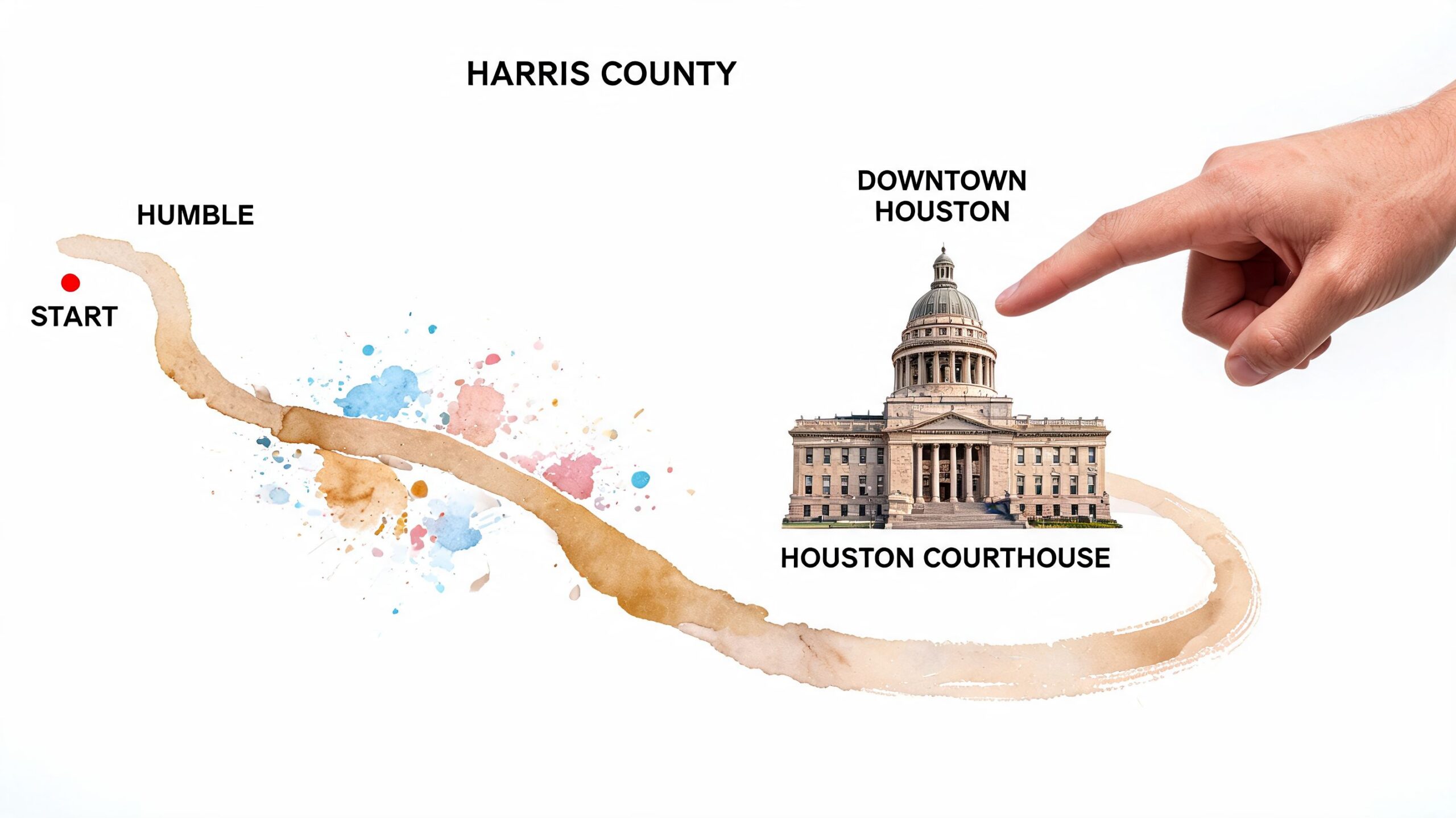
A Humble family often starts with a simple assumption. If their loved one lived nearby, the court process must be nearby too. Then they learn the probate case usually runs through the Harris County probate courts in downtown Houston, and the stress level rises fast.
That surprise matters in real life. A hearing that sounds simple on paper can mean time off work, traffic on 59, parking, security lines, and trying to find the right clerk window while you are still grieving. For families in Humble, Kingwood, and Atascocita, local help is not just about legal advice. It is also about having someone who already knows how these downtown probate courts operate day to day.
Where Humble probate cases are handled
Harris County probate matters are handled in five specialized probate courts. The county lists Probate Courts No. 1 through No. 5, with most court operations centered around 201 Caroline Street in downtown Houston, while Probate Court No. 5 is listed at 1115 Congress Street. The Harris County Clerk’s Probate Department is also based at 201 Caroline, Suite 800, and the county notes that construction around Caroline Street may affect access through May 4, 2026, according to the Harris County probate court system.
For a Northeast Houston family, that single address can be misleading. The system is centralized, but each court has its own rhythm. Cases do not feel the same from one courtroom to another, even when the legal issue is similar.
What local court knowledge looks like in practice
Probate works a lot like getting a set of keys after a loss. The law may say you are the right person to take charge, but the court still has to hand you the legal key before a bank, title company, or buyer will deal with you. In Harris County, getting that key depends not only on the paperwork being correct, but also on how the assigned court wants that paperwork presented.
A lawyer who regularly handles probate cases from Humble, Kingwood, and Atascocita usually helps with more than drafting forms. They often:
- prepare the initial application so it fits the court’s expectations the first time
- coordinate e-filing and correct rejected filings quickly before a hearing date is lost
- track whether the clerk has issued citation and whether posting or service is lagging
- prepare clients for what the judge is likely to focus on at the prove-up hearing
- reduce unnecessary downtown trips by handling filings, follow-up, and routine court contact
If you want a practical local overview before talking through your own facts, this guide on how to probate a will in Humble, Texas can help you see the steps in plain English.
Insider details that families near Humble usually do not hear
This is the part generic Houston articles often miss.
Some Harris County probate courts are quicker to move routine uncontested matters once the e-filed packet is clean and complete. Others are more likely to push a setting back if a required document is missing, signed incorrectly, or uploaded under the wrong event code. To a family, that can feel random. To a lawyer who appears there often, it is a pattern.
Judges and court staff also tend to have practical preferences. One court may want proposed orders uploaded in a very specific format. Another may be stricter about hearing notebooks, waivers, or the wording in an oath. Some courts are more willing to resolve small procedural issues through staff communication before a setting, while others expect the file to be hearing-ready with little room for cleanup. Those differences do not usually change the law, but they can change how many weeks a family loses to avoidable corrections.
The clerk’s office has its own learning curve too. If a death certificate is unclear, an heirship application is inconsistent, or a filing lands in the wrong queue, the problem may sit longer than a family expects unless someone follows up the right way. A local probate attorney who handles Harris County cases regularly knows when a delay is ordinary, when it signals a filing problem, and when it makes sense to contact the clerk instead of waiting quietly.
Why that matters for Humble, Kingwood, and Atascocita families
Distance is only part of the problem. Unfamiliar procedure is the bigger one.
Families in Northeast Houston are often balancing school schedules, commutes, caregiving, and funeral arrangements while trying to deal with a downtown court system that has its own pace and preferences. A lawyer who knows both communities can translate the process into something manageable. That means explaining which court your case is in, what that court is likely to expect, whether you probably need to appear in person, and what can be handled without another drive into Houston.
That kind of guidance brings order to a hard season. It helps families avoid preventable delays and spend less energy guessing what the courthouse wants.
Understanding Probate Timelines and Costs in Northeast Houston
A family in Humble often calls with the same worry: "We have a house, a few accounts, and a will. Are we dealing with weeks, months, or years?"
That question matters because probate affects practical things right away. Bills still arrive. Utilities at a vacant home still need attention. A bank may freeze access until someone has legal authority to act.
What changes the timeline
The first big question is whether the estate is peaceful or disputed.
If everyone agrees on the will, the executor, and the basic facts, probate usually moves faster. If someone challenges the will, questions who the heirs are, or objects to how property is being handled, the case can slow down in a hurry. Probate works a lot like road construction on the Eastex Freeway. A clear lane keeps traffic moving. One accident can back up everything behind it.
The second question is which probate path fits the estate. In Harris County, that choice affects both the amount of court involvement and the amount of paperwork a family should expect. For Humble, Kingwood, and Atascocita families, that local detail matters because you are not just dealing with Texas probate law in the abstract. You are dealing with Harris County courts, Harris County filing practices, and downtown hearing schedules that can add time if the wrong procedure is chosen at the start.
Types of Probate Administration in Texas
| Type of Administration | Best For | Typical Timeline | Court Involvement |
|---|---|---|---|
| Independent Administration | Estates where authority can be handled with less ongoing court supervision | Often aligns with the shorter end of the process for uncontested cases | Lower ongoing court involvement after appointment |
| Dependent Administration | Estates that need closer court oversight | Can take longer because more actions require court involvement | Higher court supervision |
| Small Estate Affidavit | Smaller qualifying estates that may avoid full probate proceedings | Often faster when available | Limited court process compared with full administration |
| Heirship and Intestate Administration | Estates where no valid will controls the distribution | Often more complex than probate with a will | Greater need for court involvement to establish heirs |
As noted earlier, uncontested Harris County probate matters often move far more quickly than disputed ones. A straightforward will-based case may be measured in months, while a contested estate can continue much longer because hearings, objections, and extra filings add time.
What counts as a smaller estate
Some families may be able to use a small estate affidavit instead of full probate. In Texas, that option is generally tied to modest estates and specific legal requirements. The key point is that "small" does not just mean low dollar value.
The kind of property matters. The way title is held matters. Whether there is a will matters too. A house in the decedent's name alone can change the analysis. So can multiple heirs who do not agree on the facts. Families are often surprised here because an estate can look simple at the kitchen table but become more complicated once deeds, account statements, and beneficiary designations are reviewed.
The fastest path is the one that fits the estate's real legal facts.
What costs often look like around Northeast Houston
Probate cost usually tracks complexity more than wealth.
A clear will, organized records, and cooperative family members often mean less legal work. No will, missing paperwork, unclear title to property, or conflict among relatives usually means more time and more expense. That is why two estates with similar bank balances can have very different fee ranges.
One useful local benchmark comes from Harris County fee materials. Probate lawyers in this area often bill by the hour in some matters, and many uncontested estates are handled on a flat-fee basis. Families in Humble, Kingwood, and Atascocita should also plan for court filing fees, certified copies, and smaller administrative charges that add up over the life of a case. Even a public records search can carry a separate fee through the probate department.
Flat fees can make budgeting easier when the scope is fairly clear. Hourly billing is more common when no one yet knows whether the case will stay calm or turn into a dispute. A good consultation should help you answer two separate questions: what kind of estate this is, and which billing method fits that kind of work.
If you want a fuller picture of common timing patterns before meeting with counsel, this guide on how long probate takes in Texas gives a helpful starting point.
A practical way to estimate both time and cost
It helps to sort the estate into one of three buckets.
- Will-based and cooperative: Usually the most direct path. The court admits the will, appoints the executor, and the estate administration can begin with fewer complications.
- No will: Often requires added work to identify heirs and establish authority before anyone can act.
- Disputed: Hearings, objections, and family conflict can change the case from administrative work into litigation.
For Northeast Houston families, early classification saves time. It is a lot like choosing the right line at H-E-B before unloading the cart. Once you know whether the estate is straightforward, qualifies for a smaller procedure, or needs heirship or litigation work, both the timeline and the cost become much easier to estimate.
When a Humble Probate Attorney Becomes Essential
Some probate matters are orderly. Others start orderly and then become tense the moment one relative questions a document, a bank account, or the way property is being handled.
That’s when legal help stops being a convenience and becomes a safeguard.
When there is a will and you want to avoid mistakes
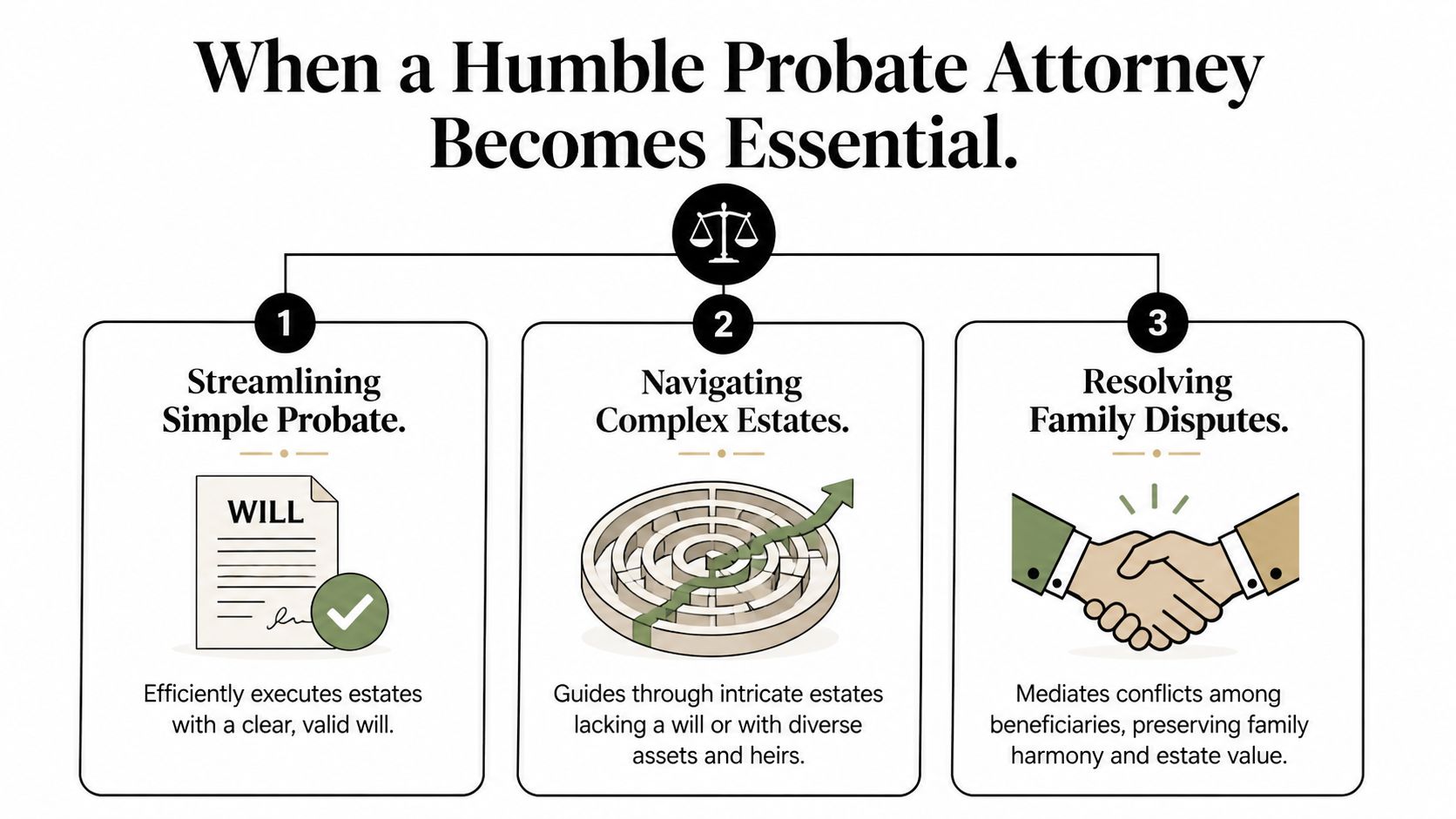
People often assume a valid will means the process will run on autopilot. It won't. Even a straightforward estate usually still needs filings, deadlines, notices, and follow-through.
A lawyer helps the executor avoid practical errors such as filing the wrong pleading, misunderstanding what property belongs to the estate, or acting before legal authority is in place. Those mistakes can create delays and frustration even when no one is fighting.
This is also where process management matters. A probate attorney can help organize the sequence of tasks so the executor isn’t guessing about what comes first and what can wait.
When there is no will
Many families feel lost in these situations. If a loved one died without a will, Texas law controls who inherits. The family may already "know" who the heirs are, but the legal system still requires formal steps to establish that status.
That can be emotionally difficult in blended families, second marriages, and situations where relatives are estranged or hard to locate. It can also create tension when one person has been handling the practical side of the estate and others worry they aren't being fully informed.
A local attorney helps by turning vague assumptions into documented legal action. The work may include identifying heirs, organizing records, and making sure no one oversteps before authority is granted.
When conflict enters the room
Conflict changes everything. What looked like a family matter can become litigation.
Common flashpoints include:
- Questions about the will: A relative may challenge whether the document should control.
- Concerns about the executor: Beneficiaries may believe estate property is being mishandled.
- Disputes over gifts or account access: Families often disagree about what was meant to pass outside the estate.
If you're serving as executor, this risk is personal. In Harris County, fiduciary litigation can result in personal liability for executors, and courts can impose sanctions averaging $50,000 to $200,000 for misconduct in estates over $1M, according to this overview of Harris County probate litigation benchmarks.
That doesn’t mean every disagreement leads to sanctions. It does mean the role carries serious duties. An executor must act carefully, keep records, and avoid treating estate assets like personal property.
Reality check: Being "the responsible family member" doesn't automatically protect you. Executors can face legal exposure if they act without proper guidance.
For families dealing with tension around authority and responsibilities, this explanation of executor duties in Harris County can help clarify the role before problems grow.
Three situations where counsel changes the outcome
Here’s a practical way to think about when a lawyer becomes essential rather than optional.
You need speed with accuracy
A simple estate can still stall if paperwork is incorrect. Counsel helps keep a straightforward matter from becoming a drawn-out one.You need legal structure because there is no will
Intestate estates don't leave room for guesswork. The family may be cooperative, but the law still controls the order and method of inheritance.You need protection because someone may challenge your actions
Once conflict appears, every informal decision becomes riskier. Documentation, communication, and procedural accuracy matter far more.
In some cases, families also want counsel to handle the estate administration from start to finish rather than piecing together help from different places. That may include organizing inventories, communicating with institutions, and preparing for court appearances. Firms that do this work, including the Law Office of Bryan Fagan, can assist with probate and estate administration matters for Harris County families.
The main point is simple. Probate isn't only about filing forms. It's about protecting the estate, the executor, and the family from preventable mistakes during a vulnerable time.
How to Choose the Right Probate Lawyer for Your Family
A Humble family often starts calling lawyers on a day that already feels too heavy. One sibling lives in Atascocita, another is in Kingwood, everyone is asking what happens to the house, and no one is sure which Harris County court will handle the case. In that moment, the right probate lawyer is not merely someone with a law license. It is someone who can turn a confusing county process into clear next steps.

Look for real Harris County probate experience
Families in Humble, Kingwood, and Atascocita may live northeast of Houston, but the probate work usually runs through the Harris County probate courts downtown. That distance matters in practice. A lawyer who regularly appears in these courts usually knows how each court prefers filings organized, how hearings tend to be run, and which cases need extra care before they ever reach the clerk's desk.
Court-to-court differences are not just trivia. They affect how smoothly a case moves.
For example, some local lawyers view Probate Court No. 1 as more comfortable with electronic systems and process management. That can help in a straightforward administration where clean filings and prompt follow-up matter. Other courts may be a better fit for cases that need closer attention to contested issues, heirship questions, or family conflict because the judge and staff see those matters often and expect a more developed record. The point is simple. A lawyer who knows the habits of Harris County's probate courts can prepare your case for the courtroom it is entering, not for a generic idea of "probate."
That kind of local knowledge is easy to miss when a firm advertises across all of Houston. For a family here in Northeast Houston, it can make a real difference.
Ask questions that show how the lawyer works
A consultation is not a quiz for you. It is a chance to see whether the lawyer can guide your family calmly and clearly.
Good questions include:
- How much of your practice is probate in Harris County?
- Have you handled estates with facts like mine, such as no will, a homestead, stepchildren, or family disagreement?
- Which Harris County probate courts do you appear in most often?
- What usually slows cases down in these courts?
- Will I work with you directly, or mainly with staff?
- How do you charge for an uncontested probate compared with a dispute or heirship case?
- What should I bring first so we do not waste time or money?
Those questions do two jobs at once. They help you get information, and they show you whether the lawyer gives practical answers or vague ones.
After the first meeting, you should feel more oriented. You should not feel talked around.
Notice whether the explanation makes sense
Probate is a legal process, but a good lawyer should explain it like a neighbor explaining the route to the courthouse. Step one. Step two. Here is where people get stuck. Here is what we can do about it.
If every answer is wrapped in jargon, you may have trouble later when decisions get more serious. The executor needs to understand duties. Family members need to know what the lawyer can do and what the court must decide. Clear communication lowers mistakes, lowers friction, and helps everyone stay on the same page.
This short video gives a useful overview to keep in mind as you compare your options.
Compare fit, responsiveness, and judgment
Price matters. So do responsiveness and judgment.
Probate work is a little like handing someone the family keys for a season. The lawyer may be helping with court filings, creditor issues, a home in Humble, bank accounts, and tense conversations between relatives. A lower fee does not help much if calls sit unanswered or if the lawyer treats every estate like the same file with different names on it.
Pay attention to small signs during the first conversation. Did the lawyer listen before giving advice? Did they explain what they know, what they do not know yet, and what documents would answer the open questions? Did they speak respectfully about your family situation, even if conflict may be coming?
For families in Humble, Atascocita, Kingwood, and nearby communities, the strongest choice is often a lawyer who combines Harris County court familiarity with plain English, steady follow-through, and a realistic plan for your particular estate. That is what helps a hard season feel manageable.
Your Next Steps Toward Peace of Mind in Humble
Probate feels intimidating when it arrives all at once. A death in the family is already hard. Add county court procedure, paperwork, deadlines, and questions about property, and it's easy to feel stuck before the process even begins.
But this is manageable.
Most families don't need to memorize probate law. They need to know whether there is a will, what kind of estate they’re dealing with, which Harris County court process applies, and who has authority to act. Once those questions are answered, the path usually becomes much clearer.
If you live in Humble, Atascocita, Kingwood, or nearby in Northeast Houston, it's worth remembering that your probate case may be handled downtown even though your life is here at home. That local reality is why many families prefer working with a harris county probate attorney near humble who understands both the community and the county system.
A good first step is simple:
- Find the will if one exists
- Gather basic records and account information
- Avoid distributing property too early
- Get legal guidance before making assumptions about heirship or authority
You don’t have to solve every issue today. You just need a clear place to start.
The right legal guidance can reduce confusion, protect the executor, and help your family handle the estate with less friction and more confidence. During a difficult season, that peace of mind matters.
If your family is facing probate questions after the loss of a loved one, Law Office of Bryan Fagan offers free consultations for families in Humble, Atascocita, Kingwood, and Northeast Houston. We can talk through your situation, explain the Harris County probate process in plain language, and help you understand the next step with no obligation.