Skip to content

When a loved one passes away, the last thing anyone in your family expects is to find a will that feels completely wrong. For families here in Humble and the surrounding Atascocita area, discovering a suspicious document during a time of grief is both confusing and deeply painful. If you're questioning the validity of a will, a contesting a will lawyer in Humble, Texas from The Law Office of Bryan Fagan can help you understand your rights and protect your family's true legacy.
What to Do When a Loved One's Will Seems Wrong
Discovering a will that seems to betray a loved one's real wishes is a shocking moment. You might be staring at a document that inexplicably cuts out children, leaves a huge inheritance to a new acquaintance, or was changed under murky circumstances right before their passing.
This initial shock often leaves families in Humble, Kingwood, and across Northeast Houston feeling powerless. The good news? Texas law provides a clear path forward for you and your family.

This process starts with understanding what it means to "contest" a will and, just as importantly, who has the legal right—or "standing"—to do so. Time is critical, so knowing the first steps is key to protecting your family's interests.
Translating Legal Terms into Real-World Scenarios
Legal jargon can be intimidating, but our goal is to make it simple. To "contest a will" means you are formally challenging its validity in probate court. You aren't just saying you disagree with it; you're arguing that the document itself is legally flawed for a specific reason recognized by Texas law.
Think about a situation we’ve seen happen in our Humble community: an elderly parent, who for decades had a will leaving their estate equally to their three children, suddenly signs a brand-new will just weeks before dying. This new document leaves everything to a caregiver who only recently came into their life. The children are left with a profound sense of injustice.
This is a classic scenario where a will contest is not only possible but often necessary. The law is designed to protect people from being taken advantage of, especially when they're vulnerable. Your gut feeling that something is wrong could be the first step toward uncovering the truth.
In this situation, the children would almost certainly have standing to challenge that new will. Standing is the very first hurdle. In Texas, you must be an "interested person" with a direct financial stake in the estate's outcome.
This generally includes:
- Heirs who would have inherited if there were no will (like a spouse or children).
- Beneficiaries named in a previous, valid will who were written out of the new one.
- In some cases, creditors with a valid claim against the estate.
If you fit into one of these categories, you have the right to ask the Harris County probate court to take a closer look. The table below outlines some of the most common legal grounds for challenging a will in Texas.
Valid Reasons to Challenge a Will in Texas
| Legal Ground | Simple Explanation | Common Example in Our Community |
|---|---|---|
| Undue Influence | Someone pressured or manipulated your loved one into creating or changing the will against their true wishes. | A caregiver in Atascocita isolates an elderly person from family and convinces them to change the will in their favor. |
| Lack of Testamentary Capacity | The person was not of sound mind when they signed the will (e.g., due to dementia, illness, or medication). | Someone with advanced Alzheimer's signs a complex new will they couldn't possibly understand. |
| Fraud or Forgery | Your loved one was tricked into signing the document, or their signature was forged altogether. | Someone presents a document as "routine paperwork" when it's actually a will, or someone forges the signature. |
| Improper Execution | The will was not signed or witnessed according to the strict requirements of Texas law. | The will was signed without the two required credible witnesses present, or the witnesses signed it later. |
Understanding these grounds is the first step in determining if you have a case. Each one requires a specific type of evidence to prove in court, and our team is here to help you find it.
Your First Steps Toward Protecting Your Family’s Legacy
Realizing you might need to contest a will is overwhelming, but you don't have to face it alone. Your first move should be to get advice from a local attorney who knows Texas probate law and the Harris County court system that serves our Humble community.
Here's a practical, step-by-step approach:
- Gather all documents: Collect the suspicious will, any previous wills, and contact information for potential witnesses.
- Write down a timeline: Note when your loved one’s health changed, when new people entered their life, and when the will was altered.
- Do not delay: Strict deadlines apply, and acting quickly is crucial to preserving your rights.
- Schedule a consultation: Speak with an experienced local attorney to understand your specific legal options.
Acting quickly is absolutely critical. Strict deadlines, called statutes of limitations, control how long you have to file a challenge. An experienced attorney can help you preserve crucial evidence, meet all your legal deadlines, and build the strongest possible case to honor your loved one's actual intentions.
Who Has the Legal Right to Challenge a Will in Humble?
Before you can even begin to challenge a will in a Texas court, you have to clear the first and most important legal hurdle: proving you have “standing.” It’s a term lawyers use, but what it boils down to for you is this: you must be an “interested person.”
Think of it as the court’s way of asking, “What’s your stake in this?rdquo; To have standing, you must have a direct and personal financial interest in the estate. If the will is thrown out, you must stand to inherit something or have your financial position improved.
This rule isn't just a technicality; it's a gatekeeper. The Harris County probate courts, which handle cases for Humble, Kingwood, and the surrounding communities, use it to filter out challenges from those who don't have a legitimate claim. A nosy neighbor who thinks the deceased made a bad choice or a disgruntled former employee can’t just walk into court and contest a will. You’ve got to have skin in the game.
What Does It Mean to Be an "Interested Person" in Texas?
So, who gets to be an "interested person"? The Texas Estates Code is clear on this. The right to contest a will is generally limited to a few specific groups:
- Heirs-at-Law: These are the people who would inherit under Texas law if the person had died without any will at all. This usually means a spouse, children, or sometimes parents and siblings.
- Beneficiaries of a Prior Will: Let's say you were included in an older will, but a newer, suspicious one cuts you out or drastically reduces your inheritance. You have standing because invalidating the new will could reinstate the old one, giving you a financial benefit.
- Certain Creditors: In some cases, a creditor with a legitimate, unpaid claim against the estate might have standing. This typically only happens if the will as written threatens their ability to be paid back.
This framework keeps the focus on those who are truly and financially impacted. In our experience helping local families, the vast majority of will contests are brought by heirs who were disinherited or beneficiaries from a previous will. If you’re unsure about where you stand, that's what our free consultation is for—to help you understand your rights.
A Real-World Example in Northeast Houston
Let's put this in a real-world context you might see right here in Northeast Houston. Imagine a father with two adult children. He has a will from 2015 that divides his estate equally between them. But in 2026, just months before he passes away, a brand-new will surfaces. This new document leaves his entire estate—the house in Kingwood, the retirement accounts, everything—to a new acquaintance and completely cuts out his two children.
Do the kids have standing to fight the 2026 will? Absolutely. They actually have two separate grounds for standing:
- As his children, they are his heirs-at-law. If the 2026 will is found to be invalid and no other will exists, they would inherit the entire estate under Texas's intestacy laws.
- They are the primary beneficiaries in the 2015 will. If a judge throws out the 2026 will, the court might admit the 2015 will to probate, which would restore their inheritance.
Because the children have a direct and substantial financial interest tied to the will's validity, the court will recognize their right to challenge it. Without that clear financial stake, their case would be dismissed before it even started.
Proving Your Standing Is the First Step
If you feel you’ve been unfairly left out of a will in Atascocita, Humble, or anywhere nearby, establishing your standing is the very first thing an attorney at The Law Office of Bryan Fagan will do. It’s the foundation of your entire case.
This involves gathering the necessary proof—things like birth certificates showing you’re a legal heir or tracking down a copy of a prior will that names you as a beneficiary. Until you can prove to the court that you are an "interested person," you can't move on to the real substance of the fight, whether it's about undue influence, fraud, or your loved one's lack of capacity. It’s the essential key that unlocks the courthouse doors for you.
Common Grounds for a Successful Will Contest in Texas
Many people walk into our Humble office convinced a loved one's will is fundamentally "wrong" or "unfair." While those feelings are completely valid, a Texas court needs more than just a gut feeling to overturn a legal document.
To successfully challenge a will in Harris County, you have to prove it's invalid on specific, legally recognized grounds. As a firm that has guided many Humble families through this process, we know that understanding these grounds is the very first step in figuring out if you have a strong case.
Proving Lack of Testamentary Capacity
One of the most frequent challenges is based on a lack of testamentary capacity. In plain English, this means the person who created the will (the testator) wasn't of "sound mind" at the exact moment they signed it.
This isn't a judgment on their overall intelligence or life choices. The court is focused on a very narrow window of time and asks four key questions about your loved one's mental state then:
- Did they understand they were signing a will to give away their property after death?
- Did they have a general idea of what they owned—their house, bank accounts, etc.?
- Could they recognize their closest family members, like a spouse or children?
- Did they grasp how this specific document would distribute their assets?
Think of an elderly parent in Atascocita with advanced dementia. If they sign a completely new will during a period of severe confusion, that document is vulnerable. Proving this requires more than just a diagnosis; it requires medical records, testimony from doctors or nurses, and powerful stories from family and friends who witnessed their cognitive decline firsthand.
Uncovering Undue Influence
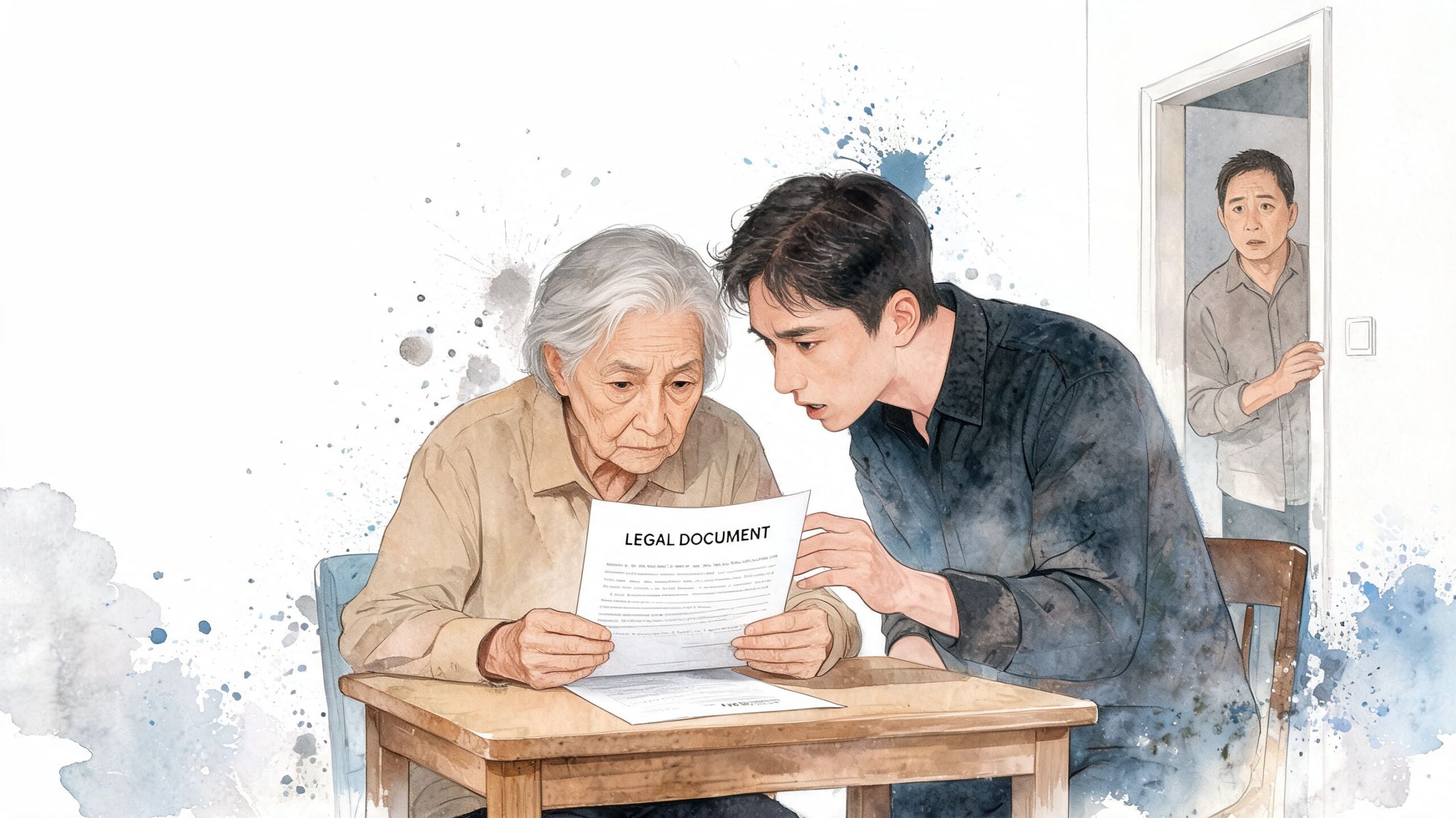
Undue influence is another major reason wills get thrown out. This is a darker, more manipulative situation where someone in a position of trust pressures the testator to change their will for personal gain. This isn't just persuasion; it's outright coercion that effectively hijacks your loved one's free will.
We’ve seen this happen. Imagine an isolated senior in Humble who becomes completely dependent on a new caregiver. That caregiver starts limiting family visits, takes control of the finances, and then "helps" draft a new will that leaves everything to them. That's a textbook case of undue influence in our community.
The court looks for a perfect storm of red flags: the testator's clear vulnerability (due to age, illness, or isolation), the influencer's opportunity to exert that control, and a resulting will that seems unnatural or suspicious.
Evidence here is often circumstantial. It might be emails revealing manipulation, financial records showing sudden large withdrawals, or testimony from family members who were pushed away. The goal is to show the will reflects the influencer's wishes, not the true desires of the person who passed away.
Identifying Fraud or Forgery
Sometimes, the issue is much more straightforward: criminal deception.
- Fraud: This happens when the testator is actively tricked into signing. Someone might slide the will into a stack of "routine paperwork" or lie and say it's a power of attorney. The signature is real, but it was obtained through a direct lie.
- Forgery: This is even simpler—the signature on the will is a fake. Someone else signed the testator's name.
Proving forgery often comes down to hiring a forensic handwriting expert who can compare the signature on the will to known, legitimate samples of your loved one's writing. Proving fraud can be trickier, often relying on witness testimony to piece together how the deception occurred.
Meeting the Strict Rules of Proper Execution
Finally, a will can be invalidated on a technicality. Texas has very strict procedural rules, and if they weren't followed to the letter, the will can be thrown out for improper execution.
For a standard will to be valid in Texas, it must be:
- In writing.
- Signed by the testator (or by someone else at their direction and in their presence).
- Signed by two credible witnesses, both at least 14 years old, who saw the testator sign (or acknowledge their signature) and then signed the will in the testator's presence.
If the witnesses signed it later, weren't actually in the room, or didn't meet the age requirement, the will is invalid. This is precisely why it’s so critical to have a knowledgeable attorney oversee the creation of a will—to prevent these simple but costly mistakes for local Humble and Kingwood families.
Ultimately, winning a will contest depends on the strength of your evidence. Having an experienced contesting a will lawyer in Humble, Texas, who knows how to gather and present this evidence can significantly impact the outcome. Learn more about how an attorney's skill can affect success rates and settlement opportunities.
When you discover a problem with a loved one’s will, time is not on your side. In Texas, the law is unforgiving when it comes to deadlines for challenging a will. If you miss the window, your claim could be barred forever, regardless of how strong your case is. For our clients here in Humble and the surrounding Harris County communities, this is often the most stressful and confusing part of the process.
The legal stopwatch for these cases is called the statute of limitations. Once it runs out, your right to take legal action simply vanishes.
The Two-Year Deadline That Catches So Many Families by Surprise
In most situations, Texas law gives you two years to contest a will. The critical question, though, is when that two-year clock starts ticking. We’ve seen countless families get this wrong, and the consequences are heartbreaking.
The countdown begins the very day a judge in a Harris County probate court signs an order admitting the will to probate. It does not start when your loved one passed away, when the will was first read, or when the executor was named. The clock starts ticking only when the will is made official by the court.
This rule catches many people off guard. It's a tough lesson to learn that you might only discover a will's flaws months or even years after a judge has already approved it. That’s why proactive legal advice is so important.
Why Acting Before Probate Gives You a Powerful Advantage
While you technically have two years after probate is granted, there's a massive strategic benefit to filing your contest before the will is ever approved by a court.
When you challenge a will pre-probate, the legal burden falls on the other side—the person submitting the will. They have to prove to the court that the will is valid. If you wait until after the will has been probated, that burden flips. Now, it's on you to prove that a will the court has already stamped as valid is actually illegitimate.
We've worked with families all over Atascocita and Northeast Houston, and we can tell you from experience: challenging a will before it’s probated puts you in a much stronger position. It's a proactive move that shows you are serious about honoring your loved one’s true wishes right from the start.
This isn’t just an anecdotal observation; the numbers back it up. Taking action before probate is a smarter, more effective path for protecting your inheritance.
What if the Deadline Has Already Passed? Are There Exceptions?
Texas law does have a very narrow exception to the two-year rule, but you should never count on it. A court might extend the deadline if you can prove you were prevented from filing your challenge because of fraud or forgery.
For example, imagine an executor intentionally hides the probate case from a known heir in Humble. Three years later, that heir finally discovers the will and its questionable terms. In a situation like that, a judge might agree to “toll,” or pause, the statute of limitations.
But relying on this exception is a huge gamble. It demands a very high level of proof to show there was deliberate deception. The safest and most effective strategy is always to act the moment you suspect something is wrong. If you have questions about the estate administration timeline, it helps to see the big picture. Check out our guide on how long does probate take in texas/ for a clearer understanding.
Don't let the clock run out on your rights. If you have any concern at all about a will, the most important thing you can do is speak with an experienced will contest lawyer in Humble, Texas, right away. We can help you identify your specific deadlines, protect your standing, and build a strategy before it’s too late.
The Will Contest Process in Harris County
Deciding to challenge a will is a monumental first step. But what comes next? For many families in Humble, the legal road ahead feels like a tangled, intimidating maze. We're here to shine a light on it.
Let's walk through the actual process in the Harris County probate courts. Understanding the journey from start to finish can take away a lot of the anxiety and help you and your family move forward with a clear head.
Step 1: Kicking Off the Legal Challenge
Your first move is to work with an attorney to file a formal petition with the probate court. This isn't just a simple letter—it's a specific legal document that officially starts your will contest. In it, you'll state who you are, why you have the legal right (or "standing") to bring the challenge, and the specific grounds you're alleging, like undue influence or forgery. Once that petition is filed, the person who submitted the will (the executor) and the other beneficiaries will be formally served with the lawsuit. This is the point where a family disagreement transforms into a formal court proceeding.
Step 2: The Discovery Phase: Uncovering the Facts
After the initial filings, your case moves into what lawyers call the discovery phase. This is where the real work begins. It’s often the longest part of the process, focused entirely on gathering the evidence needed to prove your case. A good will contest lawyer will use several tools to dig for the truth:
- Written Discovery: This is where we send formal, written questions (interrogatories) to the other side. We also request specific documents, like bank statements, medical records, or emails that could be crucial to the case.
- Depositions: This is where we get to question key people under oath, but outside of a courtroom. Think of it as a formal, recorded interview. We might depose the executor, other heirs, witnesses to the will signing, or even neighbors and caregivers. Everything said is transcribed by a court reporter and can be used as powerful evidence later.
For example, if we suspect a caregiver in Kingwood took advantage of an elderly parent, we'd use discovery to get phone records, bank statements showing odd checks or transfers, and then depose neighbors who saw how isolated the parent had become. Discovery is all about building a mountain of proof, piece by piece.
Step 3: The Push for a Settlement Through Mediation
Believe it or not, very few will contests actually go to a full-blown trial. Before that happens, Harris County courts almost always require both sides to try mediation. This is a structured negotiation session, held in a private setting and guided by a neutral third-party mediator. The entire goal is to find a compromise and reach a settlement.
Mediation is a powerful tool. It allows for creative solutions that a judge might not be able to order. We’ve seen many cases resolve here, giving families in Atascocita and Humble a way to find closure without a public court battle.
Your lawyer will lay out the strengths of your case and negotiate hard on your behalf. If you reach an agreement, it's put into a legally binding contract, and the dispute is over. If the two sides are just too far apart, then you start preparing for the final step.
Step 4: What to Expect if Your Case Goes to Trial
If mediation doesn't lead to a resolution, your case will be scheduled for trial in a Harris County probate courtroom. This is where all the evidence you’ve gathered is presented to a judge (and sometimes a jury) for a final decision. At trial, your attorney will call witnesses, present documents, and make legal arguments. The other side will do the same. After hearing all the evidence, the judge will issue a final ruling on whether the will is valid. A trial provides a definite answer, but it's also the most expensive and emotionally draining part of the process.
For a closer look at the local court system that serves our community, you can learn more about the Harris County Probate Court that serves Humble residents.
How a Humble Probate Lawyer Can Help Your Case
Trying to challenge a will on your own is an uphill battle, to say the least. You're not just grieving; you're suddenly thrown into a complex legal maze, often facing off against family members. Having the right legal partner doesn't just give you an expert in your corner—it provides a crucial buffer during an incredibly stressful time.
At The Law Office of Bryan Fagan, we’ve stood beside many families in Humble, Atascocita, and across Northeast Houston in these exact situations. We know this is about far more than just money; it's about honoring your loved one's true wishes and protecting your family's legacy.
Your Local Guide Through the Harris County Courts
There's a real home-field advantage to hiring an attorney who practices day-in and day-out in the local courts. Our firm is deeply rooted in this community, and we have years of experience navigating the specific Harris County probate courts that will hear your case. We know the judges, the staff, and the local procedures that can make all the difference.
This local experience means we can:
- Give you an honest, no-nonsense assessment of your case's strengths and weaknesses.
- Handle the endless paperwork and deadlines, so nothing falls through the cracks.
- Translate dense "legalese" into plain English, ensuring you're always informed and in control.
Our job is to carry the legal burden. This allows you and your family to step back and focus on what’s most important: healing.
Building a Winning Strategy for a Tough Fight
A contesting a will lawyer in Humble, Texas, is much more than just a paper-pusher. We act as your strategic partner, committed to uncovering the truth and building the strongest possible case on your behalf.
This is where the real work begins. We dig deep, gathering the evidence needed to prove your claim. That might mean deposing a manipulative caregiver to prove undue influence, subpoenaing medical records to show a lack of capacity, or bringing in a handwriting expert to expose a forgery. We follow the facts wherever they lead to fight for your family.
The path through the Harris County courts follows a well-defined, though often complex, process.
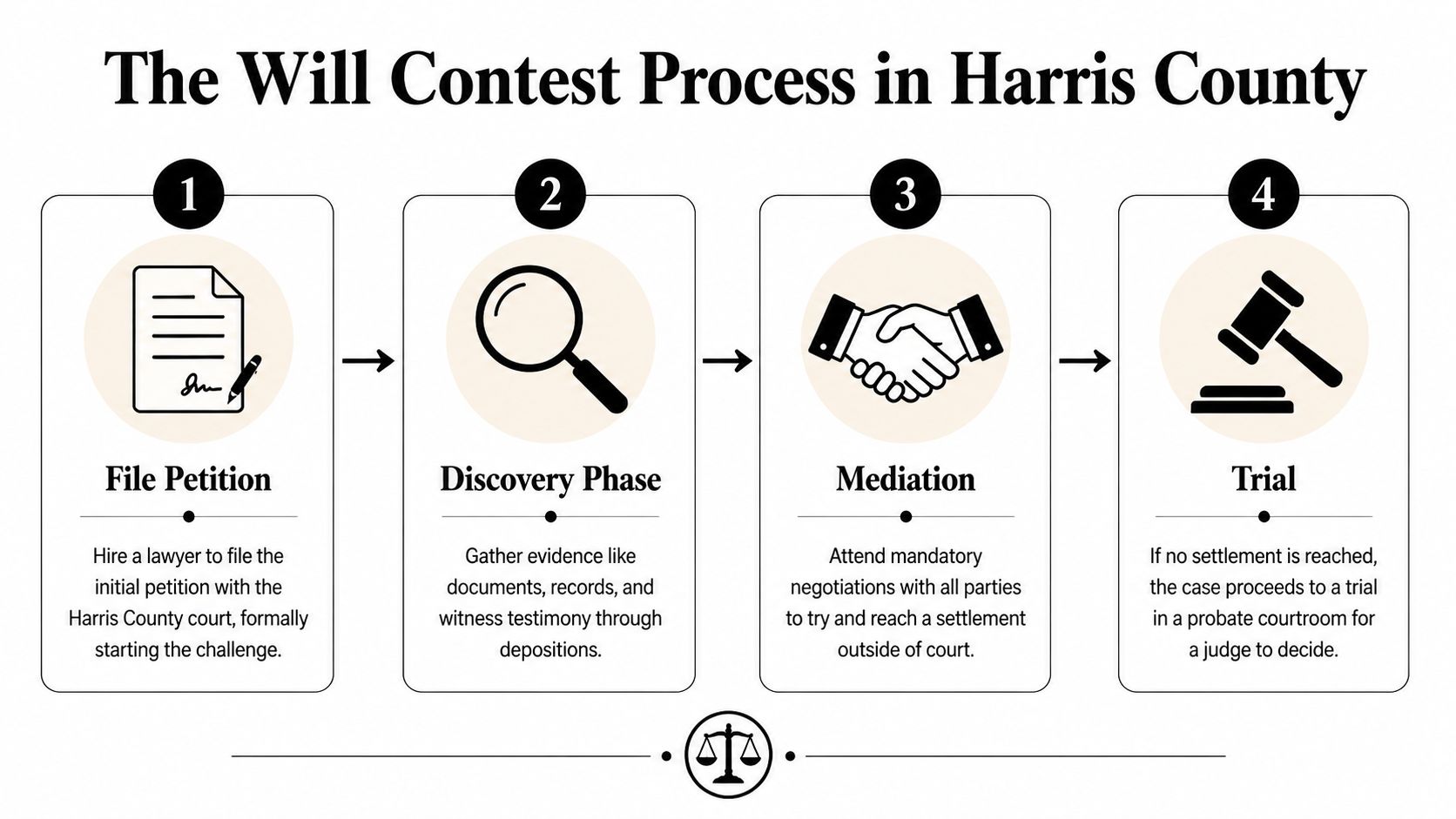
From that initial filing to discovery, mediation, and a potential trial, every single step requires skill and careful planning. We’re prepared to fight for a fair outcome, whether that means negotiating a favorable settlement or presenting your case persuasively to a judge.
We believe that protecting your loved one's true intentions is a noble cause. Our role is to provide the legal strength and compassionate support needed to see it through, offering you a clear path forward when the way seems uncertain.
You don't have to face this challenge alone. We are committed to providing the determined, knowledgeable representation our neighbors in Kingwood, Humble, and the surrounding Northeast Houston areas deserve.
At The Law Office of Bryan Fagan, we know how emotionally and financially draining a will contest can be. We are here to offer the clear guidance and strong advocacy you need to navigate this difficult time. To understand your options and protect your family's future, we encourage you to schedule a free, confidential consultation with our Humble office today. You can take that first step with confidence by visiting us at https://humbletxlawyers.com.