Skip to content

Losing a loved one is one of life’s most profound challenges, and the legal responsibilities that follow can feel overwhelming. For families in Humble, Atascocita, and Kingwood, navigating the Harris County Probate Court system might seem like a daunting task, but it doesn’t have to be. As a local law firm deeply committed to our community, our goal is to provide clear, compassionate guidance to help you through this process with confidence.
Your Guide to Probate in Humble and Northeast Houston
When someone in our community passes away, their final affairs must be legally settled. This court-supervised process is called probate. While the term may sound intimidating, probate is simply a structured way to honor your loved one’s wishes, settle their final debts, and ensure their property is transferred to the right people. It brings legal closure and prevents potential family disputes down the road.
At The Law Office of Bryan Fagan, we work with families across Northeast Houston every day. We understand that the biggest source of stress is often the unknown. This guide is designed to demystify probate, explaining it in plain English so you and your family can feel in control during a difficult time.
Understanding Key Probate Terms for Humble Families
One of the first hurdles in any legal matter is the terminology. You'll encounter these words in court documents and conversations with attorneys, and understanding them is the first step toward feeling empowered. Let's break down the most common terms you’ll see.
| Probate Term | What It Means for Your Family |
|---|---|
| Executor/Administrator | This is the person the court puts in charge of managing the estate. An Executor is named in the will, while an Administrator is appointed by the court if there is no will. This person is responsible for paying bills and distributing assets. |
| Beneficiary/Heir | A beneficiary is a person or entity specifically named in a will to receive property. An heir is someone Texas law designates to inherit property when there isn't a will. Your relationship to the person who passed determines your status. |
| Estate | This is simply a legal term for all the property the person owned at the time of their death, including their home, bank accounts, vehicles, and personal belongings. Identifying what assets go through probate is a crucial first step. |
| Letters Testamentary | These are the official court documents that grant the executor legal authority to act on behalf of the estate. Banks and other institutions will require these letters before allowing access to accounts. |
| Intestate | This term describes the situation when a person passes away without a valid will. In such cases, Texas law dictates how the estate is divided, which may not align with the person's wishes. |
Grasping this vocabulary will help you follow the process and ask informed questions.
Probate isn't meant to be a punishment. It's a court-supervised process designed to protect everyone involved—from the person who passed away to their family and creditors. It ensures their legacy is handled with care and legal integrity.
As a firm based right here in Humble, we are dedicated to helping our neighbors through these challenges. The rest of this guide provides practical, step-by-step advice on the probate process. If you feel you need one-on-one guidance, we invite you to schedule a free consultation with our Humble office. We're here to give your family the clear, supportive legal help you deserve.
What's the Right Probate Path for Your Family in Texas?
Before any paperwork is filed at the Harris County courthouse, the first step is to determine the correct legal path for the estate. In Texas, probate is not a one-size-fits-all procedure. The right approach depends on the estate’s specific circumstances, primarily whether your loved one left a valid will. This initial decision affects the cost, timeline, and level of court supervision required.
Getting this right from the start can save your family significant time, money, and frustration.
This chart illustrates how the presence of a will shapes the entire probate process for Humble families.
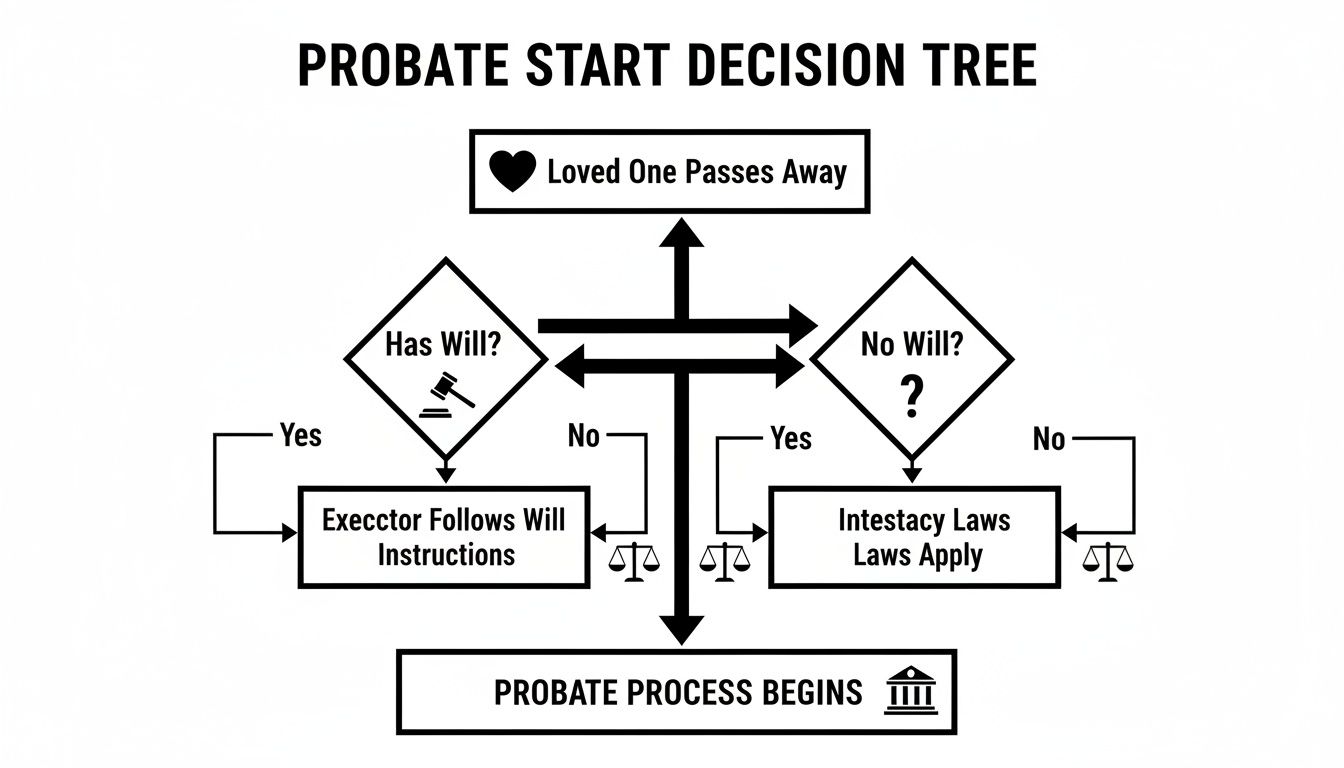
As you can see, a will provides a clear roadmap for the estate, making the process much more straightforward.
When Your Loved One Left a Will
For families in Humble and the surrounding Kingwood area, having a well-drafted will is the best-case scenario, as it streamlines the entire process. Even with a will, the Harris County Probate Court offers a few different paths.
- Independent Administration: This is the preferred method in Texas. If the will requests it, or if all beneficiaries agree, the court appoints an executor to manage the estate with minimal supervision. This is a faster, more affordable route that allows the executor to pay debts and distribute assets without needing a judge's permission for every action.
- Dependent Administration: This involves intensive court supervision. The administrator must get a judge’s approval for nearly every task, from selling property to paying bills. While more expensive and time-consuming, it is sometimes necessary if the will requires it, beneficiaries are in conflict, or a minor’s interests must be protected.
- Muniment of Title: This unique Texas shortcut is ideal in specific situations. If there is a will, no debts other than a mortgage, and the primary asset is real estate, this process can be used to simply transfer the property's title to the heirs. It avoids a full administration, making it a quick and cost-effective option for many families in Atascocita and Northeast Houston.
When There Is No Will (Intestate Succession)
Losing a loved one is difficult enough, but discovering they passed away without a will adds a layer of legal complexity. When a person dies "intestate" in Texas, the state has a rigid formula to determine who inherits their property. This process, known as a Determination of Heirship, is often more involved and costly than probating an estate with a will.
The court’s main job in an heirship proceeding is to officially identify who the deceased person's heirs are. To do this, the judge appoints a special attorney, called an "attorney ad litem," whose sole purpose is to conduct an independent investigation, track down all potential heirs, and make sure everyone is accounted for.
Consider a young family in Humble where one parent passes away unexpectedly without a will. Texas law has specific, and sometimes surprising, rules for how their community and separate property is divided between the surviving spouse and children. These default rules might be completely different from what the couple would have wanted. It’s a complex area, which we cover in our guide on how to handle probate without a will in Texas.
Determining the right path for your family’s situation is the foundation of a successful probate. Filing the wrong type of administration can lead to dismissals and unnecessary expenses. This is why consulting with a local attorney who knows the Harris County Probate Court in Humble is so valuable. We can help you confidently choose the right path from the very beginning.
How to File Your Case With the Harris County Clerk
Once you know which type of probate is right for your loved one’s estate, the next step is to officially file the case. For families in Humble, Atascocita, and the surrounding Northeast Houston area, this involves working with the Harris County Clerk. The idea of navigating a downtown courthouse can feel intimidating, but knowing what to expect makes it much more manageable.
The Harris County Clerk is the official record-keeper for all probate cases. This office accepts the initial application, assigns a case number, and directs it to the appropriate court. Their meticulous records date back to 1836, when Texas was still a Republic, highlighting their long-standing role in our community’s history.

A Step-by-Step Guide for Humble Residents
All probate filings for Harris County are handled at one central location: the Harris County Civil Courthouse at 201 Caroline Street, Houston, TX 77002.
- Prepare Your Documents: The first step is to complete the correct application for the type of probate you are seeking. This document must be accurate and complete.
- Plan Your Visit: The Clerk's office is open from 8:00 AM to 4:30 PM, Monday through Friday. If you're driving from Kingwood or Humble, try to avoid peak rush hour traffic to make the trip less stressful.
- File with the Probate Division: You will file your documents with the probate division of the County Clerk’s office. The staff are knowledgeable but are legally prohibited from offering any legal advice.
- Pay the Filing Fee: You will need to pay the required fee to officially open the case.
Even a small mistake on a form can cause your application to be rejected, requiring another trip downtown. This is why we strongly recommend having an experienced attorney handle the filing. We ensure it’s done correctly the first time, saving you time and frustration. For a closer look at these initial steps, you can read our detailed guide on how to probate a will in Humble, Texas.
Understanding the Filing Fees
One of the first questions Humble families ask is about the initial costs. Harris County has a predictable fee structure for most probate proceedings.
The initial filing fee is typically a standard $360. This applies to most common proceedings, such as:
- Probating a will
- Filing for a Determination of Heirship
- Using a Small Estate Affidavit
- Filing a will from another state (a foreign will)
Other smaller costs may arise, such as a $2 fee for a judge's signature, $8 for issuing official documents like Letters Testamentary, or an $85 fee for a constable to post public notice. The Harris County Clerk's official fee schedule provides a full list of potential costs.
Think of the initial filing fee as the key that unlocks the courthouse door. It gets your case officially on the docket and assigned to a judge, moving you from a state of uncertainty into a structured legal process.
It’s also wise to anticipate other expenses, such as the fee for an attorney ad litem—an independent attorney appointed by the court to find unknown heirs, which often costs around $300. An experienced probate lawyer can help you foresee these costs, providing a complete financial picture so your family can move forward with confidence.
What to Really Expect at Your Harris County Probate Hearing
The word "court" often brings to mind dramatic television scenes, but for most Humble families, a hearing at the Harris County probate court is a much more straightforward, administrative process. It’s less of a battle and more of a formal meeting to get your loved one's estate moving in the right direction.
For many, the first hearing is also the only one. This is typically when the will is probated. It's often a brief, simple affair where the judge confirms the will's validity and officially appoints the executor. With an attorney who has prepared everything in advance, you can be in and out quickly, leaving with the "Letters Testamentary" needed to begin settling the estate.

Why the Harris County System Works So Well for Local Families
One source of comfort for families in Humble, Atascocita, and Kingwood is the remarkable efficiency of the Harris County probate courts. These courts are well-organized and designed to handle a massive caseload without getting bogged down, which is a huge relief when you are grieving and seeking closure.
The numbers support this. For example, in a recent 12-month period, Harris County Probate Court No. 1 achieved a clearance rate of 128.8%, resolving 3,092 cases while taking in only 2,401 new ones. This means they cleared their docket and reduced the backlog by nearly 30%. You can explore these remarkable court productivity stats yourself, but the message is clear: these courts are committed to moving cases forward efficiently.
A high clearance rate is more than just a number. It means your case is far less likely to get stuck in a long line, waiting for a judge’s time. It shows a court system that respects your family and is committed to a timely resolution, which is exactly what you need.
The volume of work these courts handle is staggering. In a single year, one court might hold over 3,100 hearings and sign more than 12,000 orders. This is why working with a local attorney who knows the Harris County probate court system is so critical. We understand how the system works and how to keep your case on track.
Not All Hearings Are the Same
While the initial hearing to probate a will is the most common, other court appearances may be necessary depending on the estate's circumstances.
Your path through the harris county probate court humble system might involve:
- Heirship Hearings: If there is no will, the court must hold a hearing to legally determine the heirs based on Texas law. We present evidence and testimony to map out the family tree for the judge.
- Hearings to Sell Property: In a "dependent" administration, you need a judge’s permission to sell major assets like a house. This hearing ensures the sale is fair and in the estate's best interest.
- Guardianship Proceedings: Handled in the same courts, these proceedings appoint a guardian to manage the affairs of a minor or an incapacitated adult and require close judicial supervision.
- Contested Hearings or Trials: These are the exception, not the rule. If someone challenges the will or an executor’s actions, more formal hearings—or even a trial—may be required to resolve the dispute.
The thought of any court date can be stressful. But when you walk into the courtroom with a knowledgeable attorney from The Law Office of Bryan Fagan, you will feel prepared and supported. We handle the legal procedures so you can focus on the best outcome for your family.
Where Things Can Go Wrong in Probate (And How to Keep Them on Track)
Even with the best intentions, the probate process can have pitfalls. After years of working with families here in Humble, we've seen how simple mistakes can cause major delays, increase costs, and create friction between loved ones.
The most common issues usually stem from a misunderstanding of an executor's duties or the strict rules of the Harris County probate court. Knowing these common traps is the best way for families in Humble and Atascocita to ensure a smooth process.
Pitfall #1: Accidentally Mixing Estate and Personal Funds
This is perhaps the most serious mistake an executor can make, and it’s surprisingly easy to do. It’s called commingling funds—mixing your personal money with the estate’s money—and it can lead to significant legal trouble.
For example, you might use your personal debit card to pay a final utility bill for your mother’s house in Humble, planning to reimburse yourself later. Or you might "borrow" from the estate account to cover a personal expense, fully intending to pay it back.
From a legal standpoint, this is a major red flag. It makes it impossible for the court or beneficiaries to track the estate’s finances clearly. This can quickly lead to accusations of mismanagement or even theft, eroding trust and potentially leading to a lawsuit.
Practical Step-by-Step Advice to Avoid This:
- Open a Separate Bank Account: As soon as you receive your Letters Testamentary, open a dedicated checking account in the name of the estate.
- Pay All Estate Bills from That Account: Use this account for all estate-related expenses, including funeral costs, property taxes, and attorney fees.
- Deposit All Estate Income into That Account: This includes any refunds, final paychecks, or other funds owed to the deceased.
Keeping the finances separate creates a clear trail that protects you and satisfies the court.
Pitfall #2: Letting Critical Deadlines Slip By
The Texas probate system operates on strict timelines. For instance, there is generally a four-year statute of limitations to probate a will after a person’s death. Missing this window can make it extremely difficult to legally transfer property.
Another crucial deadline is the 90-day requirement to file an inventory of the estate’s assets after being appointed executor. This is not just a casual list but a detailed, formal accounting filed with the court. Missing this deadline can lead to removal as executor and financial penalties. These dates are firm rules of the harris county probate court humble system.
Pitfall #3: Not Keeping Meticulous Records
As an executor, excellent record-keeping is your best friend. The Harris County Clerk's Office maintains probate records dating back to 1836, a testament to how seriously documentation is taken. With thousands of new cases filed annually, a clear paper trail is vital. You can learn more about the county's extensive public records archives to see the standard they uphold.
You must document everything:
- Every dollar that comes into and goes out of the estate.
- Every decision made about managing or selling property.
- Every important conversation with beneficiaries, heirs, and creditors.
Keep a detailed log, save all receipts, and copy all correspondence. This diligence protects you. When an heir from Kingwood asks about an expense, you can provide the receipt and explanation instantly.
Avoiding trouble is about being organized, transparent, and proactive. A local probate attorney familiar with the Harris County system can provide a clear roadmap, ensuring you meet every deadline and fulfill your duties.
Your Next Steps With a Local Humble Attorney
Navigating the Harris County probate court Humble system can feel like trying to solve a puzzle without all the pieces. It’s completely natural to feel overwhelmed by the legal requirements.
This guide provides a solid foundation, but nothing can replace advice tailored to your family's unique situation.

You don’t have to handle this alone. The Law Office of Bryan Fagan has been a trusted partner for families in Humble, Atascocita, and Kingwood for years. We are here to lift the legal burden from your shoulders with effective and compassionate guidance.
It's also helpful to know that probate is often linked to other important topics. Understanding the broader context of senior citizen legal assistance and elder law can help you plan and protect your family’s future.
Taking the first step to ask for help is an act of strength. It allows you to move from uncertainty to a position of clarity and control during a difficult time.
We invite you to schedule a free, no-obligation consultation at our Humble office. This is a conversation—an opportunity for you to ask questions, understand your options, and see if our team is the right fit to help your family.
Let our experienced probate attorneys manage the legal details so you can focus on what matters most: healing and supporting your family. Call The Law Office of Bryan Fagan today to get the peace of mind you deserve. We're here to help.
Your Humble Probate Questions, Answered
When you're dealing with the loss of a loved one, the last thing you need is a complicated legal process full of confusing terms. Here in our Humble office, we find that once families get clear answers to their most pressing questions, they feel a huge sense of relief. Let's walk through some of the most common concerns we hear every day.
How Long Does Probate Usually Take in Harris County?
This is often the very first question people ask. For a straightforward case with a valid will and no family disputes, an independent administration can often be completed in about six to nine months. The Harris County probate courts are known for being relatively efficient, which is a great benefit to local families.
However, if there is no will, if an heir cannot be located, or if someone contests the will, the timeline can extend to a year or more. The most important factor in keeping the process on track is filing everything correctly and on time, which is where the experience of a local Humble probate attorney is invaluable.
Do I Really Need an Attorney for Probate in Humble?
In Texas, the answer is almost always yes. Courts require you to have an attorney for most probate and estate administration cases. This is because the executor or administrator has a fiduciary duty to act in the best interests of others, including beneficiaries and creditors. The court wants to ensure you have proper legal guidance to fulfill this role correctly.
An attorney does more than just satisfy a legal rule. They're your guide through the specific procedures and paperwork of the Harris County courts. They help you sidestep common but costly mistakes that can stall the entire process, giving your family the support you need during an already difficult time.
What Happens if My Loved One Had No Will?
When someone passes away without a will in Texas, it is known as dying "intestate." The estate will still need to go through the harris county probate court humble system, but through a different process called a "Determination of Heirship."
In this proceeding, the court's primary role is to legally identify the deceased's heirs according to a strict formula set by Texas law. The property is then divided based on that formula, which may not align with what your loved one would have wanted. This process is typically more complex and expensive than probating a will, which is why we always stress that a clear estate plan is one of the kindest gifts you can leave for your family.
You don't have to figure all this out on your own. The Law Office of Bryan Fagan is proud to be a part of the Humble community, and we're here to help you through it. Schedule a free consultation today to get the straightforward answers and compassionate guidance your family deserves. Find out more at https://humbletxlawyers.com.