Skip to content

Losing someone you love is overwhelming. On top of the grief, you're suddenly faced with a mountain of legal tasks that can feel confusing and stressful, especially when you’re dealing with the Harris County court system. If you're in Humble, Kingwood, or Atascocita, you’re not alone in this. At the Law Office of Bryan Fagan, we've walked countless local families through this process, and we're here to explain it in a clear, supportive way.
Before anything else can happen, you need to gather the two most fundamental pieces of the probate puzzle.
First, Hunt Down the Original Will
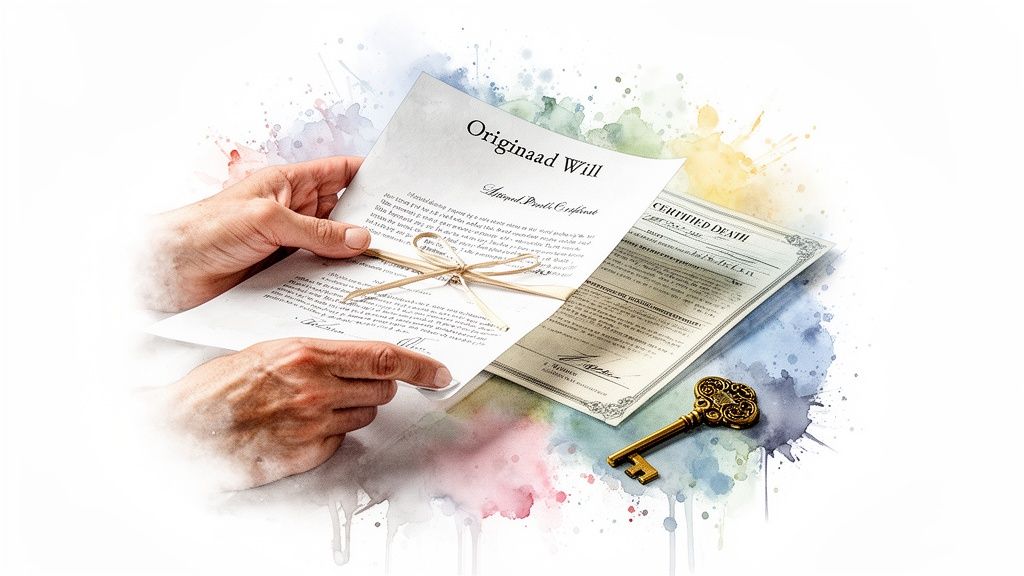
The most critical document is your loved one's original signed will. We can't stress this enough—photocopies create major headaches and can sometimes be rejected by the court, forcing a much more complicated and expensive legal process. Start by looking in the obvious places: a home safe, a fireproof box, a desk drawer, or a safe deposit box at their bank.
The gold standard here is what's called a "self-proved" will. This is a will that includes a separate affidavit, signed by the person who made the will and their two witnesses in front of a notary.
A Practical Tip for Humble Families: If the will is self-proved, it’s a huge time and money saver. It essentially proves itself to the court, meaning you won't need to track down the original witnesses to have them testify in person. This simple feature makes the initial court filing much smoother for our neighbors in Humble, Atascocita, and Kingwood.
Under Texas law, a will is only valid if it's in writing, signed by the testator (the person who made it), and attested to by two credible witnesses in the testator's presence. Finding an original that meets these criteria is your primary mission. If you're struggling to determine if the document you have is valid, you can learn more about how to probate a will in Harris County.
Next, Get Certified Copies of the Death Certificate
The second document you'll need is the death certificate. And you'll need more than one—plan on getting several certified copies, not just photocopies.
Think of these as official keys. You'll need them for the court, but also for banks, life insurance companies, credit card companies, the Social Security Administration, and any other institution that needs legal proof of death to close an account or release funds.
For deaths occurring in the Humble area, you can typically order these directly from the Harris County Clerk's office or through the Texas DSHS Vital Statistics Unit. We usually advise our clients to order 5 to 10 copies right away; it’s easier than going back for more later.
Probate Starter Checklist for Humble Residents
Getting these initial documents together can feel like a scavenger hunt, but it’s the essential groundwork for everything that follows. This practical, step-by-step checklist breaks down exactly what you need to get started.
| Item | Description | Why It's Critical for Humble Residents |
|---|---|---|
| Original Will | The final, signed document. Not a copy. | The Harris County court requires the original to validate your loved one's final wishes. Copies can lead to significant legal hurdles. |
| Certified Death Certificate | An official copy issued by a government agency. | This is the official legal proof of death required by the court, banks, and other institutions to transfer assets. |
| List of Heirs/Beneficiaries | Names, ages, and last known addresses of everyone named in the will or who would inherit by law. | The court needs to know who must be officially notified that the probate process has begun. This is a crucial step in the local court procedure. |
| Initial Asset Inventory | A basic list of known property (bank accounts, real estate in Humble, vehicles, etc.). | This gives your attorney a preliminary snapshot of the estate's size and complexity to determine the best path forward. |
Having these items ready for your first meeting with an attorney will make the conversation incredibly productive and set you on the right path from day one. Once you have the will and death certificates in hand, you're officially ready to begin the formal court process.
Filing the Will for Probate in Harris County
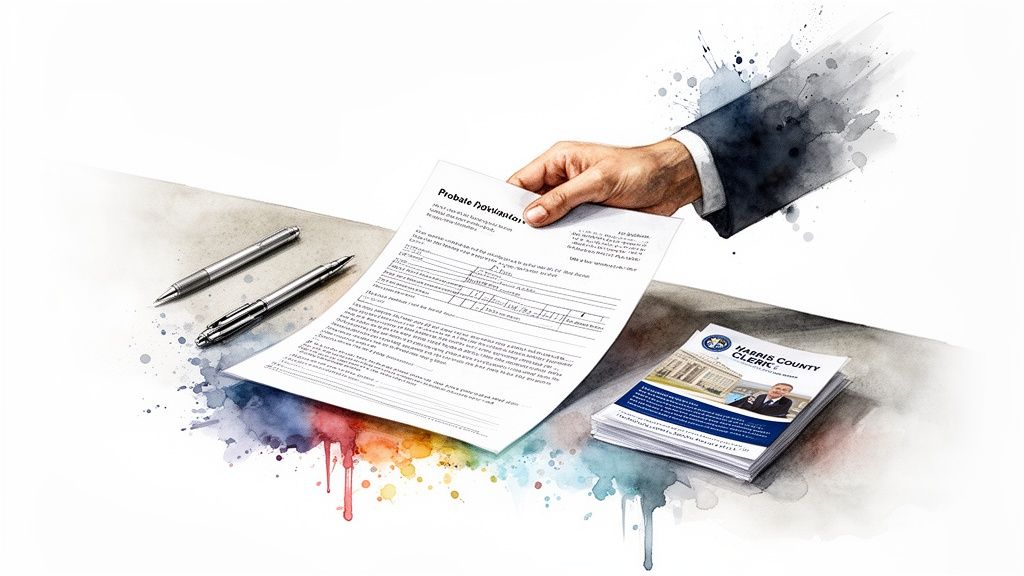
With the original will and the official death certificate in hand, you're ready to start the formal legal process. This begins by filing a key document, the "Application to Probate Will and for Issuance of Letters Testamentary," with the Harris County Clerk. This application is what officially opens the probate case and gets it on the court's radar.
For those of us in Humble, Kingwood, or Atascocita, this means your case will be handled by the Harris County probate courts. From this point forward, what was a private family matter becomes a public record, making accuracy and following local court procedures absolutely essential.
One of the most unforgiving rules is the deadline. Texas law gives you a strict four-year statute of limitations to file a will for probate, which starts on the day your loved one passed away. Missing this window can create massive, and often expensive, legal headaches. We've seen too many families in Northeast Houston get caught by surprise here; delaying the filing can jeopardize the entire estate settlement.
What Goes into the Application
The application is essentially a sworn statement telling the judge everything they need to know about the deceased person (the "decedent"), their will, and you, the person asking to serve as executor. It’s your case’s first impression.
When putting together these crucial documents, most legal professionals use tools like document assembly software to ensure every required detail is filled out correctly. Precision is everything—even a small mistake or omission can get your application kicked back, causing significant delays.
At a minimum, the application must contain:
- Your name and current address as the applicant.
- The decedent's full name, date of death, and proof they lived in Harris County (e.g., in Humble).
- A complete list of all heirs and beneficiaries, including their names, ages, and where they live.
- A sworn statement confirming that you believe the will you're submitting is the decedent's final, valid will.
A Community-Focused Insight: We can't tell you how many families from Humble and the surrounding Northeast Houston area come to us after trying to file the application themselves, only to have it rejected. It’s often for something that seems minor, like misstating an heir's relationship or using the wrong legal term. These small errors can easily set the process back by weeks or even months.
Understanding the Filing Fees and Waiting Period
Filing your application isn't free. You'll need to pay a filing fee directly to the Harris County Clerk, which is typically between $300 and $350. This amount can change, so it's always smart to check the clerk's current fee schedule or have your attorney confirm the exact cost.
Once your application is accepted, the process enters a mandatory waiting period. By law, a public notice must be physically posted at the courthouse for at least 10 to 14 days.
This "posting" period serves as a public announcement that a probate case has been opened. It gives anyone with an interest in the estate, like a creditor or a family member who was left out of the will, a formal chance to come forward and contest it. You can't even schedule your first court hearing until this waiting period is over.
Having an experienced local guide who knows the Harris County courts can make all the difference. If you're feeling overwhelmed, our team is here to help. You can learn more about how a dedicated Harris County probate attorney can simplify this for you.
When you’re ready to take this important step, don't feel like you have to do it alone. The Law Office of Bryan Fagan is here to provide the support you need. Schedule a free consultation with our Humble office, and let us help you file with confidence.
The Probate Hearing and Taking Your Place as Executor

The very words "court hearing" can make anyone feel a bit on edge. But for families in Humble going through probate, this part of the journey is almost always far less dramatic than what you see on TV. Once the mandatory posting period is over, your next step is a short hearing at the Harris County courthouse. This is where the will officially becomes legal and you are formally appointed as the executor.
We’ve walked countless clients from Humble and Atascocita through this, and they are always surprised by how straightforward it is. A standard probate hearing in Harris County to admit a will is often over in just 10 to 15 minutes. But that speed is only possible if every piece of paperwork is perfect. Any small mistake can bring the whole process to a halt. You can find more discussions about what to expect on this Texas probate attorney's blog.
During this short hearing, the judge is essentially working through a legal checklist. Their job isn't to second-guess the will; it's to confirm a few critical facts for the official record.
What the Judge Needs to Hear
Think of this less as a trial and more as a formality. You, or your attorney, will provide testimony that establishes four key things.
The judge simply needs to verify:
- Proof of Death: That the testator (the person who wrote the will) has passed away, which the certified death certificate proves.
- Court Jurisdiction: That Harris County is the right place for this case because your loved one lived in Humble, Kingwood, or another community within the county.
- Will Validity: That the will being presented is the real, final, and legally sound version that follows all Texas requirements.
- Executor Qualification: That you, the person named in the will, are legally fit and not disqualified from serving as the executor.
This is exactly where having a "self-proved" will is a game-changer. If the will has that special notarized affidavit attached, you won't need to track down the original witnesses and bring them to court. The affidavit does the "proving" for you, saving an incredible amount of time and potential headaches.
For our clients in Northeast Houston, seeing this in action is often a huge relief. A properly drafted, self-proved will transforms what could be a stressful court date into a simple, procedural step.
Getting Your "Letters Testamentary"
Once the judge has heard the testimony and reviewed the documents, they'll sign an Order Admitting Will to Probate. This is the green light. The judge will then ask you to take the Oath of Executor.
Taking the oath is a formal promise, made under penalty of perjury, that you will honor the wishes in the will and follow Texas law to the best of your ability. Immediately after, the court clerk will issue a document called Letters Testamentary.
This document is your new superpower. The Letters Testamentary is a one-page certificate that serves as your official proof of authority. It’s what you'll show to banks, insurance companies, real estate agents, and anyone else to prove you have the legal right to manage the estate's affairs.
With your freshly issued Letters Testamentary in hand, you are the Executor. You now have the legal power to start gathering assets, pay the estate's bills, and move forward with settling your loved one's affairs with clarity and confidence.
Your Responsibilities as Executor: A Practical Guide for Humble Residents
Once the Harris County court hands you your Letters Testamentary, it might feel like you've crossed the finish line. In reality, you've just stepped up to the starting line. This is where your duties as an executor truly begin, and for folks in Humble, Atascocita, and the surrounding areas, having a clear, step-by-step game plan is everything.
From this moment on, every action you take is governed by your fiduciary duty. It’s a legal term, but the meaning is simple: you must act with complete honesty and diligence, always putting the best interests of the estate and its beneficiaries ahead of your own.
The 90-Day Inventory Clock Is Ticking
Your first and most time-sensitive task is to prepare and file the Inventory, Appraisement, and List of Claims—usually just called the "Inventory." The Texas Estates Code is very clear on this: you have exactly 90 days from the date you took your oath to get this document filed with the court.
This isn't a casual list of belongings. It's a comprehensive, sworn accounting of every single asset the person owned when they passed away, right down to the fair market value of each item on that specific date. It’s the bedrock of the entire probate process, creating a transparent record for the court and all beneficiaries.
Putting this together is often the biggest lift for any executor. You'll be tracking down everything from bank statements and vehicle titles to property deeds, investment accounts, and valuable personal items. If you're trying to figure out what counts as a probate asset, our guide on what assets go through probate can be a huge help.
Letting Heirs and Creditors Know What's Happening
While you're hunting down assets for the inventory, you have a couple of other critical communication tasks. Keeping everyone in the loop is not just good practice; it's required by law.
First, you have 60 days from the day the will was probated to officially notify every beneficiary named in the will. This is a formal notice letting them know the court has accepted the will and you’re the appointed executor. You’ll later have to prove to the court you sent these notices by filing an affidavit.
Next up is dealing with potential creditors. The law requires you to publish a "Notice to Creditors" in a local newspaper—one that circulates in Harris County. This is a public announcement telling anyone the deceased owed money to that they need to come forward and present their claim. For our clients in Humble and Kingwood, we often handle this step to ensure every legal box is ticked.
An Executor's Insight: This published notice is your best defense against surprise claims down the road. Once it's published, secured creditors (like a mortgage lender) have about four months to act. For unsecured creditors (like credit card companies), the clock runs out even sooner. Skipping this step could leave the estate vulnerable to claims for a much longer time.
Settling Up: Debts, Taxes, and Final Expenses
With the inventory filed and notices sent, you can now shift your focus to settling the estate's financial obligations. As the executor, you'll use the estate's funds to pay all its legitimate bills.
This practical, step-by-step process typically includes:
- The deceased's final income taxes
- Valid debts that have been properly claimed (medical bills, credit cards, etc.)
- Funeral and burial costs
- Expenses of administration, like attorney and court fees
It is absolutely crucial to pay these in the correct legal order. Paying a lower-priority credit card bill before a high-priority medical bill, for example, could make you personally responsible for the error. This is one of the biggest reasons executors in Humble and across Texas choose to work with an attorney—to avoid missteps that can cost them personally.
Being an executor is a job with a lot of moving parts and serious responsibilities. If you're feeling the pressure of these duties, you don't have to manage it all on your own. At the Law Office of Bryan Fagan, we guide executors through this process every day. We invite you to schedule a free consultation at our Humble office to see how we can give you the support and confidence you need to settle the estate correctly.
Alternatives to Traditional Probate for Humble Families
When families in our Humble office first sit down with us, many assume that a full, formal probate is their only option. The good news is, for many estates here in Texas, that’s just not the case. The law actually provides a few simpler, faster, and more affordable paths that could be a much better fit for your family.
Taking a moment to understand these alternatives can be a real game-changer. For many families we work with in Atascocita and Kingwood, one of these probate shortcuts is all they ever need. For anyone looking to sidestep a lengthy court battle, learning more about the different strategies for how to avoid probate in Texas can be incredibly helpful.
The Small Estate Affidavit: A Simpler Path Without a Will
One of the most powerful tools we have for smaller estates is the Small Estate Affidavit (SEA). This is a great option specifically designed for situations where your loved one passed away without a will and their estate isn't overwhelmingly large.
To qualify for an SEA in Harris County, the estate needs to check a few boxes:
- The total value of the assets (not counting the homestead and other exempt property) must be $75,000 or less.
- The person who passed away did not leave a will.
- The estate’s assets are worth more than its known debts.
- At least 30 days have gone by since the date of death.
If your situation lines up with these rules, the SEA allows you to transfer property to the rightful heirs without ever appointing an executor or having a formal court hearing. It's a sworn legal document filed with the court that, once a judge approves it, acts as the authority you need to collect assets from banks or other institutions.
The flowchart below gives you a bird's-eye view of the steps involved in formal probate, which helps highlight just how much simpler these alternatives can be.
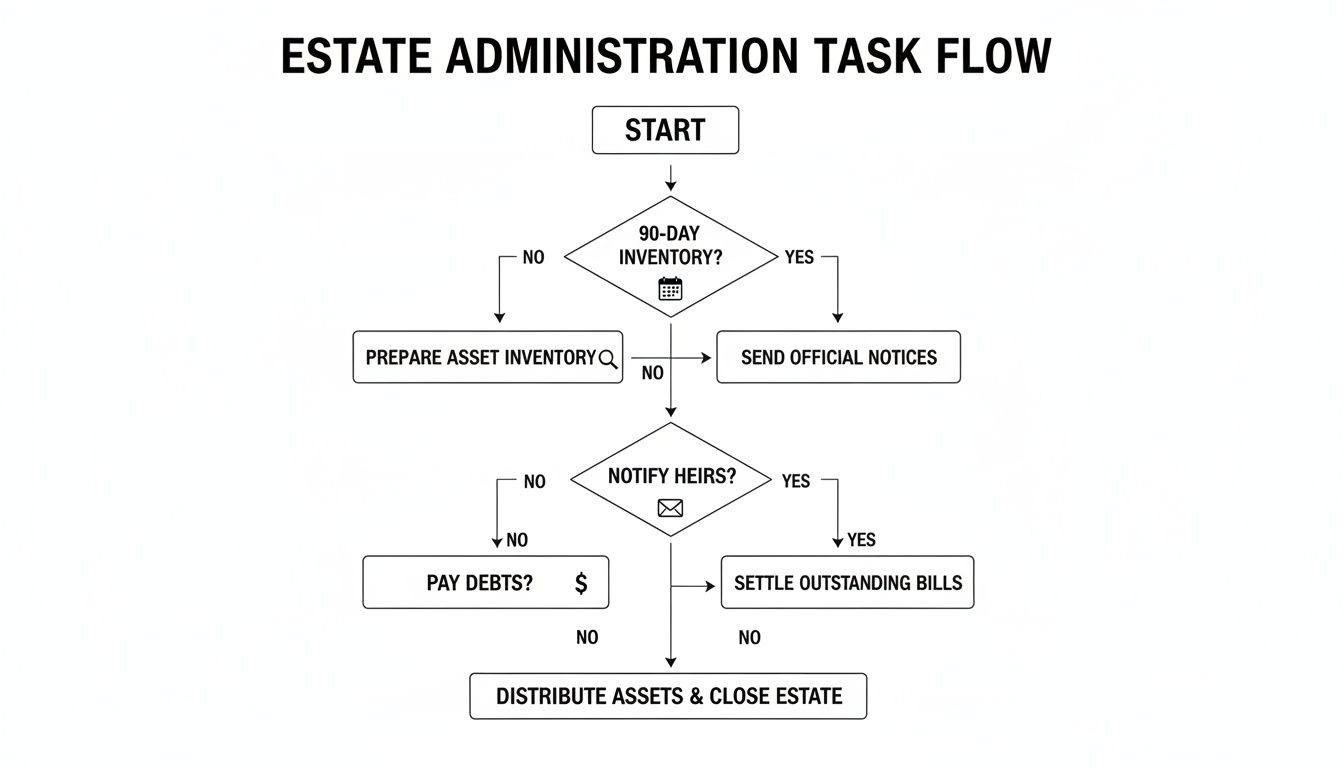
As you can see, formal probate has several required steps like filing a detailed inventory and notifying all potential heirs. An SEA, on the other hand, lets you bypass many of these time-consuming tasks.
Using a Will as a Muniment of Title
So, what happens if there is a will but the estate is pretty straightforward? For families in Humble and across Northeast Houston, the Muniment of Title process can be a fantastic solution. This is a unique Texas procedure that lets a valid will be recognized by the court as the legal document that officially passes ownership of property.
Think of a Muniment of Title like this: the will itself essentially becomes the new deed. Once the Harris County court gives its approval, the will and the judge's order are filed in the public records, formally transferring title to the beneficiaries named in the will.
This streamlined approach is a perfect fit when the estate has no outstanding debts, aside from maybe a mortgage on a home. Because there are no debts to pay off or manage, there’s no need to appoint an executor. This simple fact eliminates huge steps like publishing notices to creditors, filing an inventory, and managing the estate’s bank accounts. It’s a much faster and more affordable way to handle a will when the financial picture is clean.
Probate Options in Texas: A Comparison for Humble Families
Trying to decide between full probate and one of these alternatives can feel overwhelming. This easy-to-understand table breaks down the main differences to help you see which path might make the most sense for your family.
| Feature | Full Probate (Independent Administration) | Muniment of Title | Small Estate Affidavit |
|---|---|---|---|
| Will Required? | Yes | Yes | No |
| Executor Appointed? | Yes | No | No |
| Typical Timeline | 6 months to 1+ year | 2-3 months | 2-3 months |
| Ideal For | Estates with assets and debts | Debt-free estates with a will | Small estates (under $75k) without a will |
| Main Benefit | Can handle complex situations and debts | Faster and cheaper way to transfer property | Bypasses the formal probate process entirely |
Figuring out if you're eligible for one of these simpler routes requires a close look at the estate's assets, its debts, and the will itself. At The Law Office of Bryan Fagan, we can review your specific circumstances in a free consultation and give you clear, honest advice on the most effective and least stressful path forward for your family.
Common Questions We Hear About Probate in Humble, Texas
Even with a roadmap in hand, it’s completely normal to have questions. This process comes at a time when you’re already coping with loss. Our firm works with families all over Humble, Atascocita, and the greater Northeast Houston area, and we tend to hear the same concerns time and again. Here are some clear, easy-to-understand answers.
How Long Does Probate Take in Harris County?
This is usually the first thing people ask, and the honest answer is: it depends. Every estate is unique.
For a straightforward, uncontested probate in Harris County, you're generally looking at a six to nine-month process. This assumes there’s a solid, self-proved will and no family disputes.
But if conflicts arise, the clock can really start to tick. A contested will, arguments between heirs, or just the challenge of tracking down all the assets can easily stretch probate out to a year or even longer. The best way to keep things moving is to be organized and get good legal advice from day one.
What’s the Average Cost to Probate a Will in the Humble Area?
Cost is, without a doubt, another major worry for local families. For a typical, independent administration here in the Humble area, the total expense is a combination of court fees and attorney fees.
- Court Costs: You can expect to pay between $300 and $350 just to file the case in Harris County. There will also be some smaller charges for things like posting official notices and getting certified copies of court orders.
- Attorney Fees: This is where the numbers can vary. For simple cases, many local attorneys offer a flat fee, which is great for budgeting. Based on what we see in the region, average attorney costs can fall anywhere between $3,600 and $6,000. If an attorney charges hourly, rates often hover around $481.
At The Law Office of Bryan Fagan, we believe you deserve to know what to expect. In our free consultation, we'll review your situation and give you a straightforward estimate of the costs involved. No surprises, just honest advice for our Humble neighbors.
What if I Can't Find the Original Will?
It happens more often than you'd think. Finding a copy but not the original will can feel like a major setback, but it doesn't have to be a dead end. Texas law provides a path forward, though it does make things more complicated.
To have a copy of a will accepted by the court, you have to prove a few key things:
- That the original will was properly signed and witnessed.
- Why the original document can't be found.
- That the copy accurately reflects the contents of the original will.
The challenge here is that the court starts with a presumption: if the will was last seen with the person who wrote it and now it’s gone, they must have intended to revoke it. You’ll need strong, persuasive evidence to overcome that assumption. This is one area where having an experienced local attorney is absolutely critical. If you're just getting started, brushing up on the basics with a resource like What Is Probate And How Does It Work can be helpful.
Do I Really Need a Lawyer to Probate a Will in Humble?
Legally, you have the right to represent yourself ("pro se") in many court proceedings. In reality, probate courts in Texas, including those in Harris County, almost always require you to have a licensed attorney.
Why? Because the role of an executor comes with immense responsibility and personal liability. The probate process is a maze of strict deadlines, specific legal notices, and complex financial duties. One wrong move—missing a deadline or mishandling a creditor claim—can cause serious delays, cost the estate money, and even open you up to being sued.
Hiring a probate attorney isn't an extra expense; it's a necessary protection for the estate, for your loved one's final wishes, and for you as the executor.
Navigating the probate process in Humble can feel overwhelming, but you don't have to do it alone. The team at The Law Office of Bryan Fagan is here to guide our neighbors in Humble, Atascocita, and Kingwood with compassion and experience. We are committed to helping local families through these challenges with clear, practical advice. Schedule a free, no-obligation consultation with our Humble office today to get the clarity and support your family deserves. Visit us at https://humbletxlawyers.com to get started.