Skip to content

The phone has stopped ringing. Family members have gone home. You’re sitting at the kitchen table in Humble, Atascocita, or Kingwood with a will in front of you, and your name is written beside a word that suddenly feels much heavier than it did before: executor.
Individuals in that moment aren’t worried about legal vocabulary first. They’re worried about doing something wrong. They don’t want to miss a deadline, upset a sibling, or mishandle a parent’s home, bank account, or personal belongings. They want to honor the person they lost and keep the family steady.
That’s where a local estate administration lawyer humble tx families can turn to becomes helpful. Probate and estate administration in Harris County are legal processes, but they’re also very personal. If you’ve been asked to handle a loved one’s final affairs, you don’t need more jargon. You need a clear path, plain language, and practical guidance grounded in how things work around Northeast Houston.
Navigating a Loss in Humble Your First Steps in Estate Administration
Maria, a fictional example based on the situations many families face, lives near Kingwood and loses her father unexpectedly. A week later, she finds his will in a desk drawer. It names her as executor. She knows what that means in a general sense, but not in a legal one. Does she pay his bills from her account? Can she give her brother his share now? Does she need to go to court in downtown Houston?
Those are normal questions. They’re the same questions many families in Humble and Atascocita ask after a loss.

What your job really is right now
At the start, your role isn’t to solve the whole estate in one weekend. Your job is to pause, gather the key papers, and avoid acting too quickly.
That usually means locating:
- The original will if one exists
- Death certificates
- Basic asset records such as deeds, account statements, and insurance information
- A list of immediate bills that may need attention
- Contact information for close family members and beneficiaries
A lot of confusion starts because people mix up family responsibilities with legal authority. You may be the child, spouse, or sibling everyone looks to. But until the probate court gives formal authority, there are limits on what you should do with estate property.
Practical rule: Don’t distribute property just because the family agrees informally at the kitchen table. Early handoffs can create bigger problems later.
Why local guidance matters in Harris County
Harris County probate isn’t a small-town side process. It’s a busy court system with its own forms, filing expectations, and local habits. If you’re trying to manage a home in Humble, rental property near Northeast Houston, or accounts spread across several institutions, the details matter.
A good starting point is learning the executor duties in Harris County. That gives you a realistic picture of what the court expects, what beneficiaries may expect, and where mistakes often happen.
You don’t need to know everything today. You do need to know that probate is manageable when you handle it in the right order.
What Is Estate Administration in Texas
Estate administration is the legal process of gathering a person’s property, handling debts and required notices, and transferring what remains to the right people. In plain language, it’s the final project a person leaves behind, and someone has to finish it carefully.
A simple way to think about it is this. The estate is a ship carrying valuable cargo. The executor or administrator is the captain. The court sets the route. The heirs and beneficiaries are waiting at the destination.
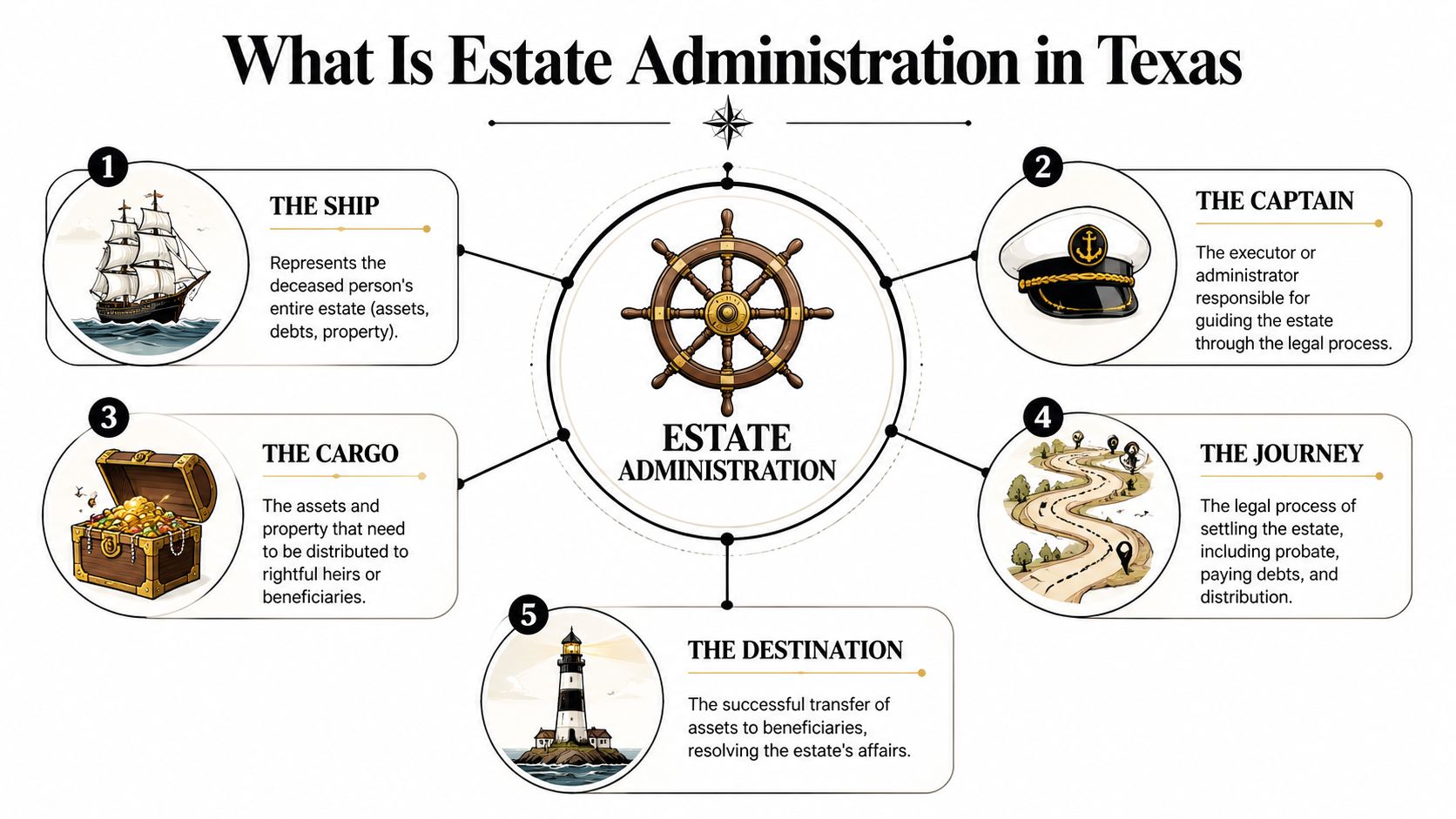
The ship, the captain, and the cargo
The ship is everything the deceased person owned and owed. That can include a home, vehicles, bank accounts, personal items, business interests, and debts.
The captain is the person appointed to steer the estate through probate. If there’s a will, that person is often called the executor. If there isn’t a will, the court may appoint an administrator.
The cargo is what must be protected and delivered correctly. Some cargo goes through probate. Some doesn’t.
What usually goes through probate
Not every asset follows the same path. That surprises many families.
Assets that often require probate are those titled only in the deceased person’s name and without a built-in transfer method. That can include:
- A house titled only in the deceased’s name
- A bank account with no payable-on-death designation
- Personal property that needs formal authority for transfer
- Certain business or investment interests
Some assets may pass outside probate, such as life insurance with a named beneficiary or accounts with valid transfer designations. If you want a fuller explanation, this guide on what assets go through probate is a useful next read.
What the executor actually does
Being executor isn’t honorary. It’s hands-on work. In most estates, the person in charge will need to:
- Identify assets and determine what belongs to the estate
- Protect property so nothing disappears, lapses, or gets mishandled
- Notify creditors and review claims
- Handle taxes and paperwork when required
- Communicate with beneficiaries so people understand the process
- Distribute property only after the proper steps are complete
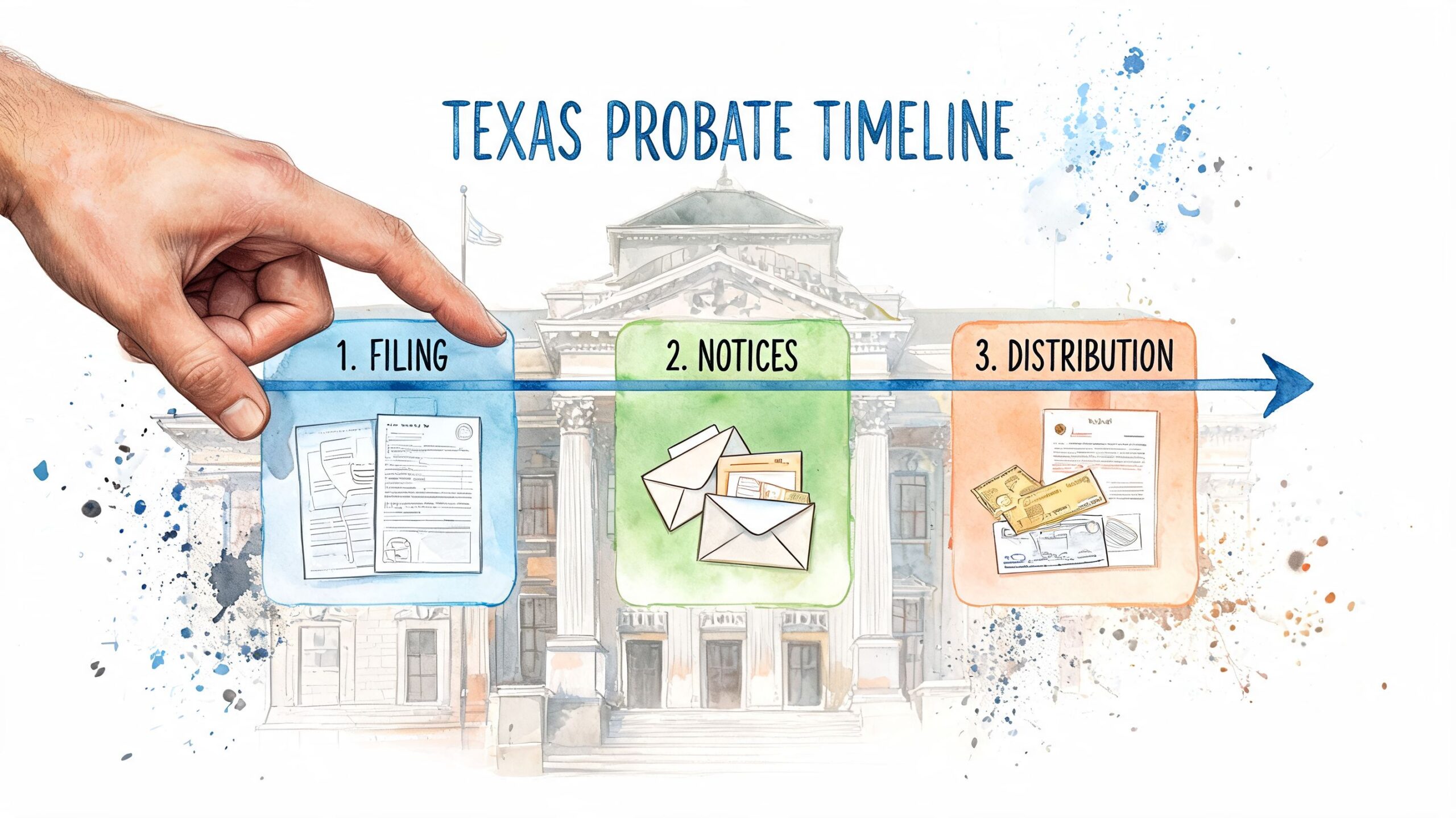
Texas probate follows a sequence for a reason. The benchmark standard requires asset identification within 30 to 60 days of probate filing, debt notification within 120 days, and final distribution within 12 to 18 months, according to this Texas estate administration timeline guide.
If you skip ahead and distribute before debts, notices, or classifications are handled, you can create personal liability as executor.
Why legal classification matters so much
Families often think of property in emotional categories. Dad’s truck. Mom’s house. Grandma’s jewelry. The court looks at legal categories. Real property, financial accounts, estate income, creditor claims, and beneficiary designations each raise different issues.
That’s why estate administration can feel slower than families expect. The delay isn’t always bureaucracy for its own sake. Sometimes the executor must sort out what the estate owns, what passes automatically, and what obligations must be paid first.
A careful executor acts less like someone “giving things away” and more like someone checking every package before delivery. That protects both the estate and the family.
The Texas Probate Timeline and Local Harris County Paperwork
In Harris County, probate has a rhythm. Once you understand the rhythm, the process becomes far less intimidating.
That matters because Harris County is one of the largest probate markets in the country, with over 10,000 probate cases filed annually, as noted in this Humble probate market overview. High volume means the court sees these cases every day, but it also means paperwork and timing need to be handled correctly.
Step one begins with the will and the application
If there’s a will, the original usually needs to be filed with the appropriate probate court. Then an application is filed asking the court to admit the will to probate and appoint the executor.
At this stage, families often expect immediate authority. Usually, it doesn’t work that way. There is a court process first, and the judge must approve the appointment.
A few early documents often matter most:
- Application for probate or administration
- The original will, if one exists
- A death certificate
- Supporting information about heirs and the estate
The hearing and court authority
After filing, the court sets the matter for hearing. That hearing is where the judge reviews the application and decides whether to appoint the person seeking authority.
Once approved, the executor may receive Letters Testamentary. Those letters are what banks, title companies, and others often want to see before they’ll recognize the executor’s authority.
This is why people get stuck when they try to act too early. Being named in a will matters, but the court order and letters are what usually enable the next steps.
The middle phase is paperwork heavy
The middle part of probate is less dramatic than families expect. It’s mostly documentation, notice, organization, and patient follow-through.
Executors commonly need to:
- Gather and value estate assets
- Notify beneficiaries as required
- Notify creditors as required
- Prepare inventory-related filings or alternatives when appropriate
- Maintain records of every payment and transaction
If you’re trying to estimate timing, this overview of how long probate takes in Texas helps put expectations in context.
Here’s a helpful visual explanation of the process many families ask about after the first court filing:
Final distribution only comes after the estate is ready
This is the part families care about most, and it’s the part executors need to approach most carefully. Distribution usually comes after the executor has identified estate assets, handled notices, addressed valid debts and expenses, and confirmed what can be transferred.
A probate case often feels slow because the executor is building a clean paper trail. That paper trail is what protects everyone if a question comes up later.
A straightforward estate may move steadily. A complicated one can slow down because of title issues, missing documents, disputes among family members, or assets that don’t fit neatly into one category.
The main point is simple. Probate in Harris County isn’t random. It follows an order. When you know that order, you stop feeling like the estate is drifting.
Independent Administration A Faster Path for Humble Families
For many families in Humble, Kingwood, and Atascocita, the smartest probate question isn’t “How do we get through probate?” It’s “Can we use the simpler version?”
That simpler version is independent administration.
Texas allows many estates to be handled with far less court supervision after the initial appointment. For families who qualify, that can save time, lower stress, and reduce the number of times the executor must go back to court for permission.
Why independent administration matters
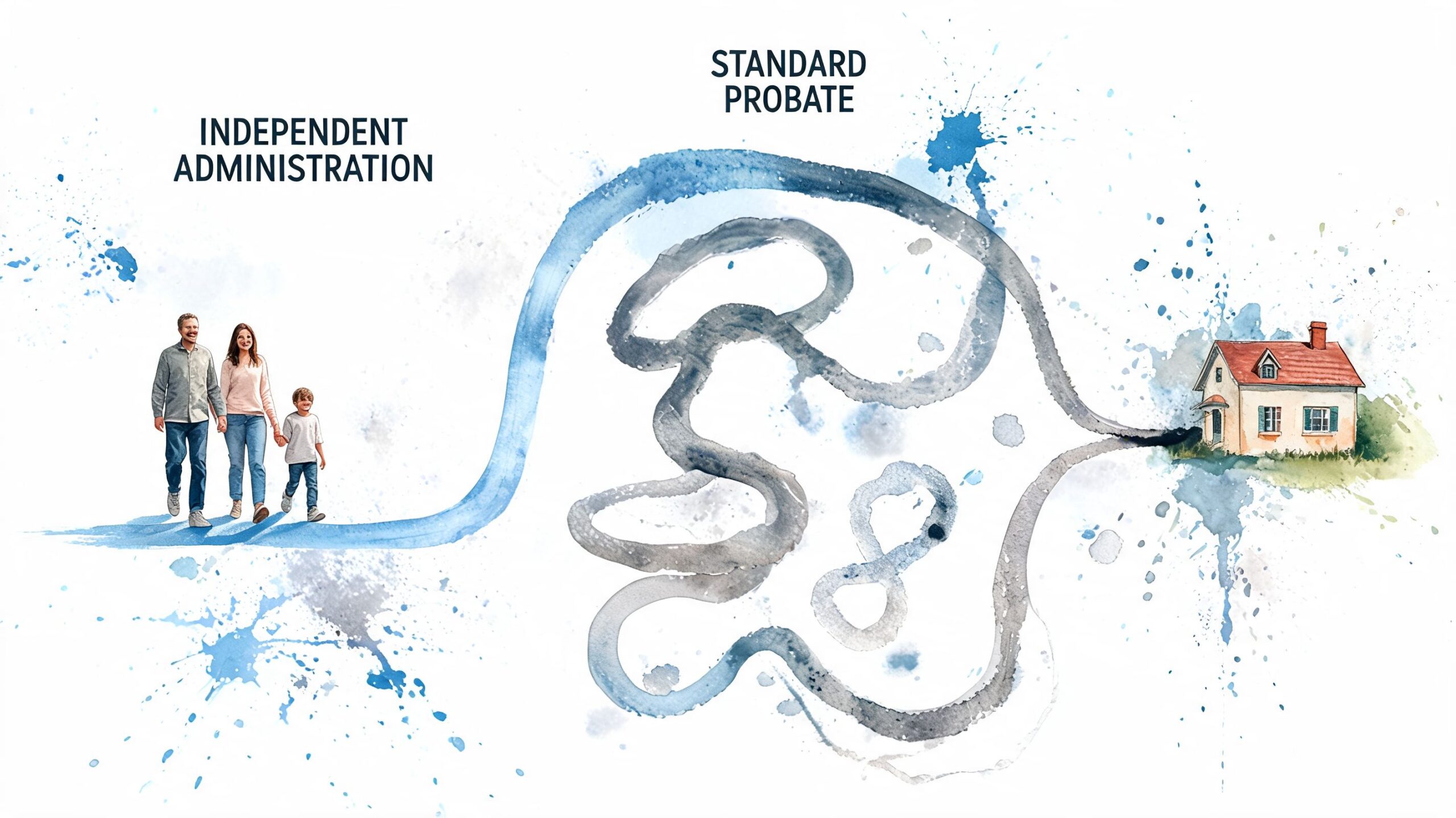
Independent administration is often the express lane of Texas probate. It doesn’t erase the executor’s duties. It changes how much ongoing supervision the court requires.
For qualifying estates in Harris County, independent administration can reduce settlement time from 12 to 18 months to as little as 6 to 9 months and cut administrative costs by 30 to 50 percent, according to this independent administration overview for Humble families.
That difference is practical, not theoretical. Fewer approval requests can mean fewer delays when the executor needs to manage routine estate tasks.
When an estate may qualify
Many families qualify when:
- The will authorizes independent administration
- All necessary parties agree to it
- The estate doesn’t require close court supervision because of conflict or complexity
If family members are cooperative, this option can make the process much more manageable. If there’s deep mistrust, active fighting, or unusual complications, a more supervised path may still be necessary.
What changes for the executor
An executor in independent administration still has serious duties. They must gather assets, deal with debts, keep records, and follow Texas law. The difference is that they usually don’t need court approval for every routine action.
That matters when:
- A house needs to be listed for sale
- Estate bills must be paid in the proper order
- Financial accounts need to be collected or transferred
- Distributions are ready once obligations have been handled
To illustrate, dependent administration is driving with a court officer in the passenger seat for most turns. Independent administration is driving with a valid license and a map, but still being responsible for obeying every rule of the road.
Questions families in Northeast Houston often ask
Some of the most common concerns sound like this:
| Question | Practical answer |
|---|---|
| Can we choose independent administration if the family agrees? | Often, yes, if the legal requirements are met and the court approves the arrangement. |
| Does “independent” mean no court at all? | No. The court is still involved at the beginning, and the executor still owes legal duties. |
| Is it right for every estate? | No. It works best when the estate is organized enough and the family conflict level is low enough. |
Independent administration is faster, but it isn’t casual. The executor still needs discipline, records, and legal judgment.
For some families, one option among local legal resources is the Law Office of Bryan Fagan, which handles probate and trust administration matters in Humble. The value of counsel in this setting is often less about courtroom drama and more about choosing the right probate track at the start.
Common Probate Pitfalls and How an Attorney Prevents Them
Most probate problems don’t begin with bad intentions. They begin with ordinary people trying to be helpful too soon.
A daughter pays estate bills from her personal account and loses track of reimbursement. A son gives away a vehicle before title issues are resolved. Siblings agree verbally on who gets what, then months later one person remembers the conversation differently. Those small moments can turn a manageable estate into a conflict-heavy one.
The cost of weak documents and unclear planning
When estate planning documents are incomplete or poorly executed, probate gets riskier fast. According to this Humble probate litigation resource, inadequate documentation can increase administrative costs by 200 to 400 percent and extend resolution timelines by 2 to 4 years due to will contests. The same resource explains that proper legal execution can reduce the probability of litigation to under 2 percent.
That’s a dramatic difference. It shows why probate isn’t just paperwork. It’s risk control.
Four mistakes that create trouble
Premature distributions
A family in Atascocita may feel ready to divide personal property as soon as the funeral ends. But if the executor hands out assets before debts, notices, and legal classifications are handled, the executor can create a mess that’s hard to unwind.
Property should move only when the estate is ready for it to move.
Poor recordkeeping
An executor in Kingwood might use one checking account for everything and forget which expenses were personal and which belonged to the estate. Months later, beneficiaries want an explanation.
Attorneys often prevent this by helping executors keep estate activity separate, documented, and easier to explain.
Creditor notice mistakes
Some people assume that if they ignore bills long enough, the estate can just move on. Probate doesn’t work that way. Notice requirements matter, and claim handling has a sequence.
A lawyer helps the executor identify what needs attention, what can be disputed, and what should be paid only after review.
Family communication breakdowns
Many probate fights begin with silence, not greed. One beneficiary doesn’t hear anything for weeks. Another thinks the executor is hiding information. A third starts pushing for immediate payment.
A lawyer often lowers tension by creating a process. Questions get answered in one place. Timing gets explained clearly. The executor stops carrying every emotional conversation alone.
A calm paper trail can do more to prevent litigation than a dozen emotional family meetings.
How legal counsel protects the executor
The executor is the person most exposed when things go wrong. Beneficiaries may be frustrated, but the executor is the one signing forms, moving funds, and making decisions.
An attorney helps by:
- Checking whether the will and supporting documents are legally solid
- Guiding the order of notices, filings, and payments
- Advising when not to distribute yet
- Helping with disputes over real estate, business interests, or unclear ownership
- Creating a record that can stand up if someone later challenges the administration
That protection matters whether the estate is modest or substantial. In both, the objective is the same. Keep the process lawful, clear, and steady.
Your Next Steps Navigating Probate with Confidence in Humble
If you’re handling a loved one’s estate in Humble, you don’t need to become a probate professional overnight. You need a reliable plan and the patience to follow it in the right order.
Start with the basics. Locate the will. Gather the main financial and property records. Avoid informal distributions. Write down the questions that are keeping you up at night. Those first steps alone can prevent many of the mistakes families make when grief and urgency collide.
A simple way to move forward
Use this short checklist:
- Confirm whether there is an original will
- Identify the main assets and debts
- Keep estate property separate
- Don’t promise distributions before legal review
- Get advice early if anything feels unclear
For families in Humble, Atascocita, Kingwood, and across Northeast Houston, probate often feels hardest at the beginning because the path is unfamiliar. Once you understand whether the estate needs probate, whether independent administration is available, and what the court expects, the situation usually becomes much more manageable.
You don’t have to carry the legal side of this alone. A local probate consultation can help you understand your role, your deadlines, and the safest next move for your family.
Frequently Asked Questions for Humble Residents
Some probate questions don’t fit neatly into a general guide. They come up at the kitchen table, in the driveway after a funeral, or when someone gains access to a loved one’s phone and realizes an entire part of the estate may exist online.
Quick answers to common concerns
| Question | Answer |
|---|---|
| Do I have to be the executor if the will names me? | Not always. Being named and serving are not the same thing. If you have concerns, speak with counsel before taking action. |
| What if there’s no will? | The court may appoint an administrator, and Texas inheritance rules will control who receives property. |
| Can I sell the house during probate? | Sometimes, but authority depends on the type of administration, the estate documents, and the procedural posture of the case. |
| What if one sibling refuses to cooperate? | Disagreement can affect probate strategy, especially whether a streamlined path is realistic. |
| Do I need to worry about online accounts and crypto? | Yes. Digital assets now create real probate problems if nobody planned for access. |
What happens if the family can’t agree on independent administration
This is common. One family member wants speed. Another wants court oversight. A third doesn’t trust anyone handling the estate informally.
When heirs disagree, the probate path can become more supervised and more document-driven. The key is not to force a quick family compromise that later collapses. It’s usually better to identify the disagreement early and choose the process that matches the conflict level.
How do digital assets affect a Humble probate case
This issue is getting more important every year. Under the 2025 Texas digital asset inheritance laws, fiduciaries now need court orders to access digital wallets and emails, and 15 percent of Harris County estates include digital assets. The same resource warns that failing to plan for them can lead to 10 to 20 percent asset loss due to inaccessibility, according to this Texas digital asset inheritance discussion.
That can include:
- Email accounts that hold account recovery information
- Crypto wallets
- Online payment platforms
- Cloud storage with financial records
- Subscription or rewards accounts with value
If you know a loved one owned digital assets, don’t assume a password alone solves the problem. Access rights and legal authority are separate issues.
Digital property is still property. If the estate can’t lawfully access it, the family can lose value without ever seeing what was there.
What if I find property after probate has already started
That happens often. A forgotten account statement turns up. A mineral interest appears in old papers. A storage unit key is found months later.
The answer usually isn’t panic. It’s documentation. Executors should update counsel, gather proof of ownership, and determine how the newly discovered asset fits into the existing administration. The worst move is trying to handle it off the books.
What should I bring to a probate consultation
Bring whatever you have, even if the file is incomplete. Useful items often include:
- The original will or a copy
- Death certificate
- Any court papers already filed
- A rough asset list
- A rough debt list
- Contact information for close relatives and beneficiaries
- Questions about real estate, business interests, or digital assets
You don’t need a perfect binder. You need enough information to let someone spot the next legal step.
Is probate always a fight
No. Many estates are routine. But routine doesn’t mean simple enough to handle casually.
A smooth probate usually comes from three things working together:
- Clear documents
- A realistic process
- Consistent communication
That’s especially true for families in Humble and Northeast Houston who are trying to balance work, caregiving, grief, and court obligations at the same time.
If you’re looking for practical help with probate or need to know whether independent administration may fit your family’s situation, Law Office of Bryan Fagan offers free consultations for Humble, Atascocita, Kingwood, and Northeast Houston residents. A conversation can help you sort out your next step, understand your role as executor or administrator, and move forward with more confidence.