Skip to content

When a loved one dies, most families in Humble aren't thinking about court filings, creditor notices, or who has authority to talk to the bank. They're trying to find the will, answer calls from relatives, and make it through the week. Then someone says the word probate, and the whole situation starts to feel heavier.
That reaction is normal.
If you're looking for a probate administration attorney humble texas families can turn to, you're probably carrying two burdens at once. You're grieving, and you're trying not to make a legal mistake. Around Humble, Atascocita, Kingwood, and Northeast Houston, I meet people in exactly that position all the time. They want plain answers. They want to know whether probate is required, whether it can be avoided, what Harris County expects, and what it will cost.
This guide is written the way I'd explain it to a neighbor. Clear language. Practical steps. No unnecessary legal fog.
Navigating Loss and Legal Steps in Humble Texas
A common scene looks like this. A family in Kingwood loses a parent. One child has the house key, another has a folder with old insurance papers, and nobody is sure where the original will is. The bank account is still in the parent's name. A car is sitting in the driveway. Bills keep arriving. Everyone wants to do the right thing, but nobody wants to do the wrong thing first.

That's where probate usually enters the conversation. In simple terms, probate is the legal process for handling a person's property, debts, and final instructions after death. Sometimes it's straightforward. Sometimes it gets complicated quickly, especially when there are questions about heirs, unpaid debts, real estate, or missing documents.
For families in Humble and nearby communities, the first surprise is often this: not every estate needs full probate. Some estates may qualify for simpler paths. Some assets pass outside probate altogether. Knowing that early can save stress, time, and unnecessary expense.
Practical rule: Don't start transferring, selling, or dividing property just because family members agree informally. Legal authority matters, and acting too early can create problems later.
The second surprise is that probate isn't just one court hearing. Texas estate administration can involve multiple filings, deadlines, notices, asset reviews, and careful decisions about who gets what and when. That doesn't mean you should panic. It means you should slow down, get organized, and understand the path before taking major action.
What is Probate and Can It Be Avoided in Texas
A lot of Humble families reach this point with one practical question: do we need probate at all, or is there a simpler path?
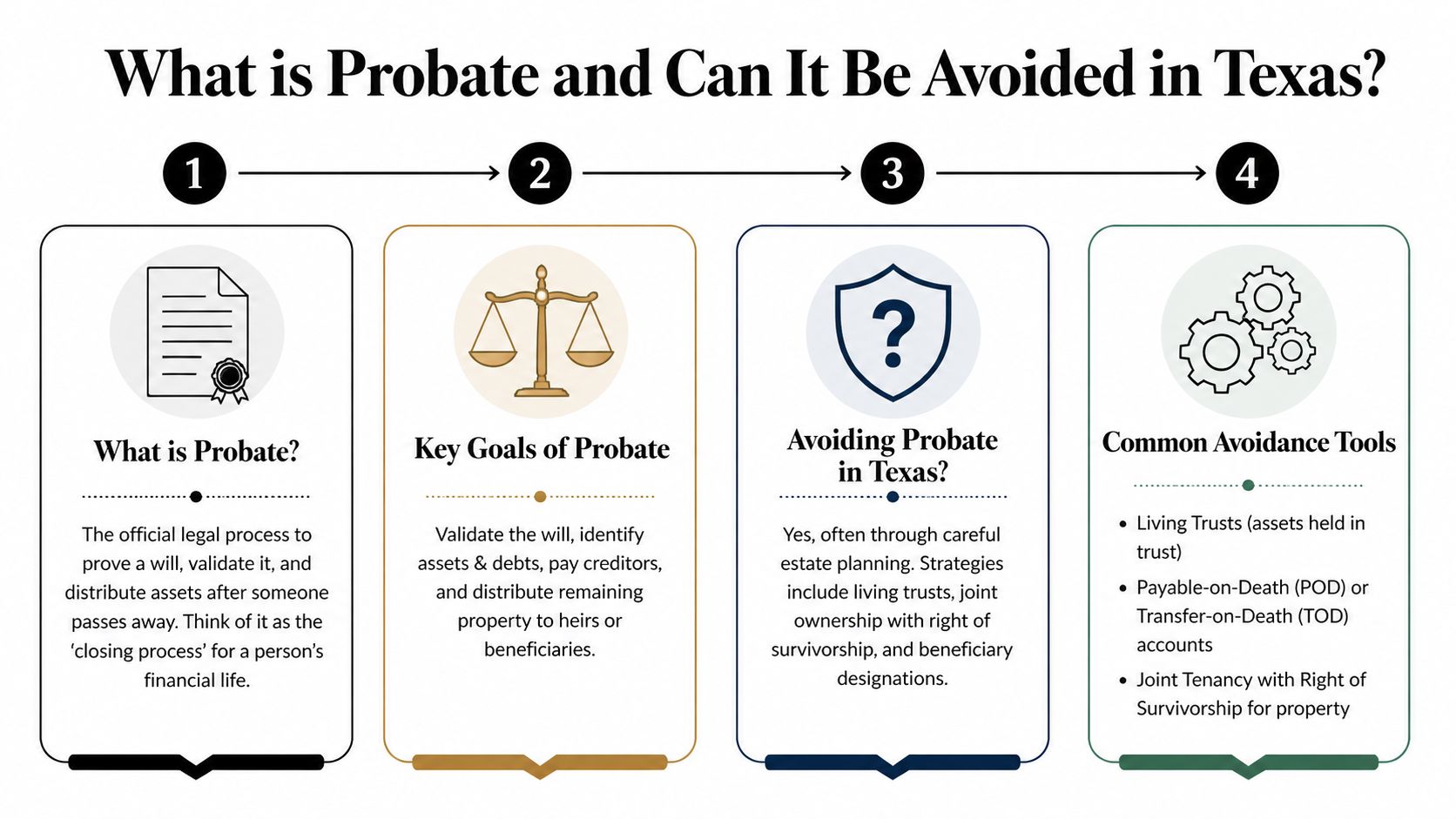
Probate is the court-supervised process for settling a person's legal and financial affairs after death. In simple terms, it gives someone the authority to gather property, deal with debts, and pass what remains to the right people. It also helps clear up ownership, which matters if a house, bank account, or other asset cannot change hands without legal proof.
What probate is meant to do
Probate answers a short list of questions, but each one carries real consequences for a family:
- Is there a valid will
- Who has legal authority to act for the estate
- What property is part of the estate
- What debts and claims must be handled
- Who receives the remaining property
That sounds formal because it is. Still, the basic idea is familiar. Probate works like a set of instructions the court uses to keep property from being transferred based on guesswork, family pressure, or incomplete paperwork.
Some estates need that full process. Some do not.
Can probate be avoided in Texas?
Yes, sometimes. Texas law gives certain families ways to transfer property with less court involvement, and in some situations with no full probate at all. The key is knowing which assets require probate and which pass by title, contract, or prior planning. A helpful starting point is this guide explaining what assets go through probate.
This is often where confusion starts. Families hear that an estate is "small" or that there is a will, and they assume the answer is obvious. It rarely is. Whether probate can be avoided depends on the type of property, the value of the estate, whether there are unpaid debts, whether heirs agree, and whether planning documents were signed before death.
Small Estate Affidavits in Texas
For some Harris County families, a Small Estate Affidavit is the clearest alternative to full probate.
This option is generally available only if the estate, not counting the homestead and exempt property, is worth less than $75,000. There is also a 30-day waiting period after death before the affidavit can be filed. Those two details matter because many families focus on the total value of everything owned and miss the fact that the law excludes certain property from the threshold calculation.
A Small Estate Affidavit usually works best when:
- There is no will
- The heirs are known and can agree on the facts
- The estate qualifies under the $75,000 limit, excluding homestead and exempt assets
- The estate is simple enough that formal administration is unnecessary
Here is the practical catch. "Small" does not mean automatic approval. The affidavit still has to correctly identify heirs, assets, liabilities, and the legal status of the homestead. If one piece is wrong, the delay you hoped to avoid can show up later in the form of title problems or a rejected filing.
For many families, this tool is less like a shortcut and more like an express lane. It is faster only if you are in the right lane to begin with.
Transfer on Death Deeds and other probate-avoidance tools
If the person who died owned real estate, a Transfer on Death Deed may keep that property out of probate. The deed must be signed and recorded during the owner's lifetime. If that did not happen before death, it cannot be created afterward to fix the problem.
That timing trips people up.
A Transfer on Death Deed is proactive planning. It lets real property pass directly to a named beneficiary without waiting for a full estate administration, assuming the deed was prepared correctly and no other title issue interferes. For Harris County homeowners, this can be one of the most practical ways to reduce cost, paperwork, and delay for the next generation.
Other assets may also avoid probate if they already have beneficiary designations or rights of survivorship attached to them. Life insurance, retirement accounts, and some joint accounts often fall into that category. The answer depends on the paperwork already in place, not just on what the family intended.
A simple way to compare the main paths
| Path | Best For | Typical Timeline | Cost Level |
|---|---|---|---|
| Full probate | Estates with a will, disputes, multiple assets, or title issues | Depends on court deadlines, filings, and estate complexity | Higher |
| Small Estate Affidavit | Estates under $75,000 excluding homestead and exempt property, with no will and clear heirship | Often shorter if the estate clearly qualifies and the paperwork is accurate | Lower |
| Non-probate transfers | Assets covered by beneficiary designations, survivorship terms, or a properly recorded Transfer on Death Deed | Often the fastest path because the asset may pass outside probate | Lower |
For families in Humble, Atascocita, and nearby parts of Harris County, relief often begins with this realization: probate is not the only path. A good probate administration attorney in Humble, Texas should help you figure out whether court involvement is needed, whether a Small Estate Affidavit may work, and whether existing tools like a Transfer on Death Deed already changed the picture before anyone files anything.
The Probate Administration Process in Harris County
A Humble family often reaches this point after a hard week. Someone has passed away, bills are still arriving, and a bank or title company has started asking for documents no one has seen before. Probate can feel like standing in front of a locked gate with a ring of unfamiliar keys. The process becomes easier once you know which key fits which step, and whether you even need to open that gate at all.
For Harris County families, the first question is practical. Does this estate require full probate, or can it use a shorter path? Before filing anything, it helps to check for probate-avoidance tools that may already control part of the estate. A transfer-on-death deed may pass real property outside probate if it was properly signed, recorded before death, and the beneficiary completes the follow-up paperwork after death. A Small Estate Affidavit may be available if the person died without a will, the estate qualifies under Texas rules, and the assets fit that procedure. If you want a court-specific overview, this Harris County probate court guide for Humble residents explains the local court setting in plain language.
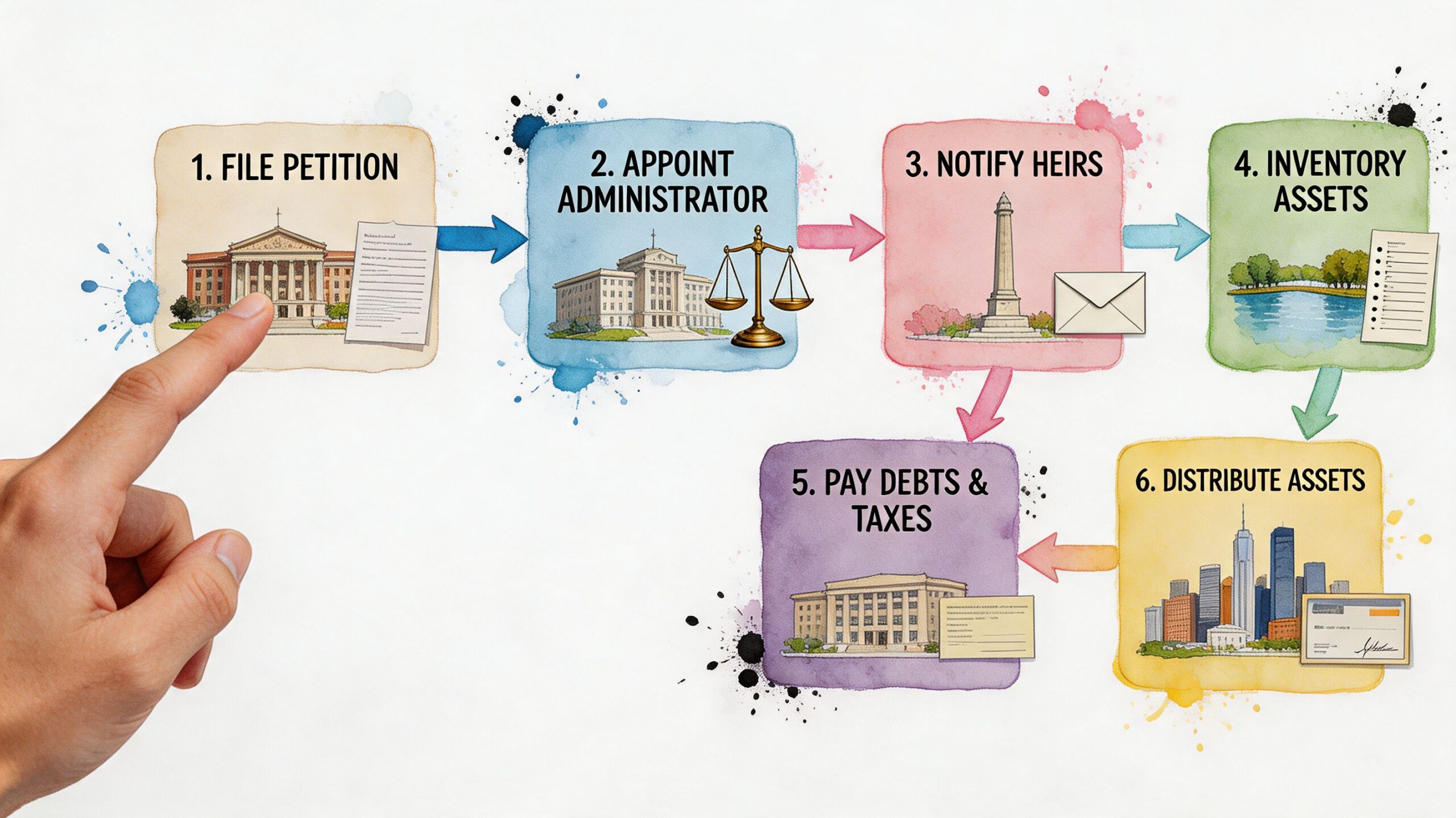
If full probate is required, Harris County usually follows a sequence that is easier to handle when you view it as a checklist instead of one large legal problem.
Filing the application
Probate usually starts with an application filed in the correct Harris County probate court. The filing tells the court what you are requesting, such as admitting a will to probate or appointing an administrator when there is no will.
Accuracy matters here. A misspelled name, the wrong date of death, or an incomplete family history can slow the case and create confusion later when banks, title companies, or heirs compare records.
Court review and appointment
After filing, the court reviews the application and decides who should receive authority to act for the estate. If there is a will, the named executor often asks to be appointed. If there is no will, the court may need more information about family relationships before appointing an administrator.
Families are often surprised by this step. Agreement at the kitchen table does not give legal authority. The court order does.
Letters Testamentary or other authority
Once the court appoints the executor or administrator, that person receives formal proof of authority. In many estates, that means Letters Testamentary or Letters of Administration.
These documents work like an official ID card for estate business. Financial institutions, buyers, and title companies often want to see them before discussing account access, property transfers, or sales.
Notice, inventory, and control of property
After appointment, the estate shifts from court filings to day-to-day administration. The executor or administrator must identify assets, protect them, and sort out what belongs in the estate versus what passes outside probate.
That can include a home, vehicles, bank accounts, personal property, mineral interests, or a small business interest. Some assets require extra attention because title is unclear or value is hard to confirm. For families who want a plain-English overview of the larger sequence, this compassionate guide to Texas probate can help frame the process before you focus on Harris County specifics.
This is also the stage where probate avoidance still matters. Even after a probate case is opened, some assets may stay outside the estate because they have a beneficiary designation, survivorship feature, or recorded transfer-on-death deed. Good administration includes separating those assets early so the executor does not spend time and money trying to pull non-probate property into the wrong process.
A short video can help make that sequence easier to picture.
Debts, taxes, and claims
Before heirs receive property, the estate must address valid debts and other legal obligations. Creditors may need notice. Claims need review. Some estates also require help from a CPA or tax professional.
This part causes many avoidable mistakes. An executor may feel pressure to distribute money early to keep peace in the family. That decision can create personal risk if a debt, tax issue, or reimbursement claim appears later.
Estate funds should be paid in the proper order. Debts and legal obligations come before final distribution.
Distribution and closing the estate
Once debts, notices, and asset issues are handled, the executor or administrator can distribute what remains under the will or under Texas intestacy rules if there is no will. The final step is closing the estate with the court when required.
Here is the process in a simple working list:
- Confirm whether probate is needed by checking for non-probate assets, transfer-on-death deeds, and possible Small Estate Affidavit eligibility.
- File the probate application in the appropriate Harris County court.
- Attend the hearing and request appointment.
- Receive legal authority to act for the estate.
- Give required notices and gather financial and property records.
- Prepare the inventory and protect estate assets while sorting out title and value questions.
- Review debts and claims before any distribution.
- Distribute remaining property and complete closing steps.
For families in Humble, Kingwood, and Atascocita, probate becomes much more manageable when each step is handled in the right order, and when you first rule out simpler options that Harris County law may already allow.
Common Probate Complications and Legal Solutions
The clean version of probate is orderly. Real life is messier.
A daughter believes the will reflects her mother's wishes. A son thinks the document was signed under pressure. A second marriage changed the family picture. A house title doesn't match what everyone assumed. One heir lives out of state and won't return calls. Those are the moments when probate stops feeling like paperwork and starts feeling personal.
Family conflict and will disputes
Some of the most difficult probate cases begin with a simple sentence: "That's not what Mom wanted." Disputes can arise over whether a will is valid, whether someone influenced the deceased, or whether an executor is acting fairly.
Harris County probate matters can involve disputes among beneficiaries, creditors, and potential heirs, and probate counsel helps prevent emotional conflict from turning into expensive litigation, as summarized in Justia's Humble probate attorney listings and practice overview.
When conflict starts, the right legal response isn't always to "fight harder." Sometimes the first job is to clarify facts, gather records, and slow everyone down before irreversible accusations take over.
Missing heirs, hidden assets, and no will cases
Another common complication is uncertainty. You may not know whether all heirs have been identified. You may suspect there are more accounts, older deeds, or unpaid debts. If there's no will, the legal questions often get harder.
For readers facing that situation, this article on probate without a will in Texas is a useful starting point because intestate estates usually require closer attention to family history and legal heirship.
Families who want a broad, non-law-firm perspective may also appreciate this compassionate guide to Texas probate from Cremation.Green. It gives a readable overview that can make the court process feel less intimidating before you dive into case-specific decisions.
Executor risk is real
Many executors don't realize how much personal responsibility they carry. If an executor distributes property too early, ignores a required step, or mishandles creditor issues, the consequences may fall on that executor personally.
That doesn't mean every estate is dangerous. It means probate isn't something to approach casually.
- Improper distributions can create repayment problems later.
- Unclear tax handling can leave loose ends that should've been addressed before closing.
- Procedural mistakes can delay the estate or trigger disputes that were avoidable.
- Poor communication often makes neutral issues feel hostile.
Good probate work is part legal analysis, part project management, and part conflict control.
In a complicated estate, a lawyer often acts as translator, traffic director, and problem solver at the same time. That's especially important when grief, old family tension, and legal deadlines all arrive together.
Understanding the Costs of Probate in the Humble Area
A family in Humble can leave a lawyer's office with two very different reactions. One is relief because the estate qualifies for a simpler, lower-cost option. The other is stress because no one asked that question early, and the family assumed full probate was the only path.
Cost often starts with the procedure you choose.

Attorney fee structures
Texas probate lawyers usually bill in one of two ways: a flat fee for a straightforward matter or hourly billing when the work may expand. If the estate is simple, organized, and uncontested, a flat fee may make sense because the family knows the legal cost up front. If the estate includes conflict, missing documents, unclear assets, or creditor issues, hourly billing is more common because the amount of work is harder to predict.
The practical question is not just, "What do you charge?" A better question is, "Is probate even required, and if so, which type?"
That question can save real money. In Harris County, some families may avoid a full administration by using a small estate affidavit or, for real property in the right circumstances, planning tools such as a transfer-on-death deed before death. A small estate affidavit is often the least expensive court-based option because it is designed for qualifying estates with limited non-exempt assets and no will. The exact fit depends on the facts, but the threshold question should always come first.
Probate costs work a lot like home repair costs. Replacing one broken board is cheaper than rebuilding the whole porch. The same is true here. A narrowly focused probate strategy usually costs less than opening a broader case than the estate needs.
Harris County court filing fees
Court costs are separate from attorney fees. The Harris County Clerk lists a standardized $360.00 filing fee for several probate filings, including probate of a will, administration, heirship, and small estate proceedings, on the Harris County Clerk Probate Courts page.
That filing fee is the starting line, not the whole bill. Families may also face charges for certified copies, service, publication, appraisals, bond premiums in some cases, or help from a tax professional or real estate professional.
What raises or lowers the total cost
The biggest cost driver is usually complexity. A clear will, a house, a bank account, and cooperative heirs usually cost less to handle than a blended-family dispute or a file cabinet full of missing records.
Here is how that plays out in real life:
| Cost factor | Why it matters |
|---|---|
| Procedure used | A small estate affidavit or other simplified option can cost less than a full dependent or independent administration |
| Will or no will | A valid will often shortens the process, while heirship questions can add hearings and evidence |
| Type of property | Real estate, business interests, mineral rights, and hard-to-value assets usually require more work |
| Condition of records | Death certificates, deeds, account statements, and contact information in one place reduce attorney time |
| Conflict level | Disputes among heirs increase filings, hearings, and communication demands |
| Outside professionals | Appraisers, CPAs, surveyors, and title issues can add separate costs |
One detail many families miss is timing. Delays can increase cost. If property taxes, insurance, mortgage issues, or vacant-house problems sit too long, the estate can become more expensive to protect and harder to close cleanly.
The cost-saving question many families should ask first
Before assuming full probate is ahead, ask whether the estate qualifies for a simpler path under Texas law.
For example, a small estate affidavit may be available if the decedent died without a will and the estate falls within the legal limit for non-exempt assets, after subtracting liens and excluding homestead and other exempt property. That option is not right for every family, and title issues can still matter, especially with real estate. Still, in the right case, it can reduce both court involvement and legal fees.
Transfer-on-death deeds belong in the same conversation, even though they are signed before death rather than used after. They can let real property pass outside probate if the deed was prepared and recorded correctly during life. For Harris County families who want to spare children from a longer court process later, that kind of planning can matter as much as any courtroom step.
A careful probate lawyer should help you compare the cost of full probate against the cost of avoiding it where the law allows. That is often where families in Humble save the most.
How to Choose the Right Probate Attorney in Humble
Not every lawyer who can handle a probate case is the right fit for your family. After a death, you need more than technical competence. You need someone who can explain the process clearly, spot local procedural issues early, and keep the matter moving without adding confusion.
Local knowledge matters
A lawyer who regularly works with Harris County probate matters will usually understand how local filings, court expectations, and practical bottlenecks tend to unfold. That's valuable in a way online information can't fully replace. Local familiarity helps with pacing, paperwork, and anticipating what the court is likely to need.
For someone searching specifically for a probate administration attorney humble texas, that local connection matters because your case doesn't happen in the abstract. It happens in the routines of Harris County courts and the day-to-day concerns of Northeast Houston families.
Look for a focused, communicative practice
Probate can look simple from the outside. It isn't always. You want a lawyer who deals with estate administration regularly and who can explain the difference between a straightforward filing and a problem case before the problem gets expensive.
Here are good questions to ask in a consultation:
- How often do you handle probate administration matters in Harris County and nearby areas like Humble or Kingwood?
- Will you explain whether probate can be avoided before recommending a full court process?
- How do you bill, and what circumstances usually increase cost?
- Who will communicate with me if documents, deadlines, or family questions come up?
Pay attention to how the lawyer talks
If a lawyer answers every question with jargon, that's a warning sign. Families under stress need plain English. You should leave the meeting with more clarity than you had when you walked in.
One local option families may consider is the Law Office of Bryan Fagan, which handles probate and estate matters from its Humble office along with other legal services for area residents. Whether you speak with that firm or another probate-focused lawyer, the important thing is to choose someone who gives direct answers, respects the emotional side of the case, and doesn't treat your family like a file number.
A Practical Checklist for Executors and Heirs
The first days after a death are disorienting. A short checklist helps because it gives you something concrete to do without rushing into legal mistakes.
In the first days
- Locate the original will and estate documents if they exist. Check home files, safes, desk drawers, and any attorney or bank records the family knows about.
- Order multiple death certificates because banks, insurance companies, and other institutions often ask for certified copies.
- Secure the home, vehicle, and personal property so nothing disappears, gets damaged, or gets "borrowed" during a chaotic week.
- Start a simple paper trail. Keep notes on who has keys, what mail arrives, and which accounts or bills you discover.
Don't mix estate business with your own money. If you pay a bill personally in the rush of the moment, reimbursement can become a headache later.
In the next stage
- Make a rough asset list that includes real estate, vehicles, bank accounts, insurance, retirement accounts, business interests, and valuable personal property.
- Make a debt list from mail, online statements, loan paperwork, and known recurring bills.
- Avoid promising anyone a specific asset before legal authority and estate obligations are clear.
- Pause any plan to sell inherited property until you understand title, authority, and probate status.
If a house is part of the estate, families often need practical guidance on what happens before a sale. This Property Nation's 2026 inherited property guide can help you think through the practical aspects of inherited real estate, especially when several relatives are involved.
Before major decisions
A few "don'ts" matter just as much as the to-do list:
- Don't clean out the house too fast if papers, deeds, account records, or valuables may still be inside.
- Don't retitle property informally based on family agreement alone.
- Don't assume no will means no probate. Estates without wills often require more legal analysis, not less.
- Don't wait until conflict grows before talking with a probate lawyer.
Executors and heirs in Humble, Atascocita, and Northeast Houston usually feel steadier once they have a written list, a folder for documents, and a legal opinion before taking big steps.
Your Next Steps with The Law Office of Bryan Fagan
A common Humble scenario starts like this. A parent passes away, the family gathers important papers, and someone asks, "Do we need probate right now, or is there a simpler path?" That question matters because the right first step can save months of delay, extra court filings, and avoidable stress.
In many Harris County estates, the first job is not filing something. It is figuring out what kind of estate you have. Some assets may pass outside probate through beneficiary designations or joint ownership. In other cases, a small estate affidavit or a transfer-on-death deed may offer a more direct solution than full probate, depending on the property involved, the value of the estate, and whether the legal requirements are met.
Probate works a lot like following the right road at the first fork. If you take the wrong turn early, fixing it later can cost time and money. A short consultation before anyone transfers title, pays estate debts from personal funds, or tells relatives who gets what can prevent problems that are much harder to correct after paperwork has been filed.
That is where practical legal advice helps.
At The Law Office of Bryan Fagan, families in Humble, Kingwood, Atascocita, and Northeast Houston can get help sorting through the first questions in a calm, organized way. Does this estate qualify for a small estate affidavit under Texas rules. Is there a recorded transfer-on-death deed affecting the home. Is full probate administration required in Harris County. Who has authority to act now, and what should wait until the court gives that authority.
These are answerable questions. You do not have to work through them while guessing.
If you are dealing with a recent loss, the next useful step is to sit down with a probate attorney who can review the will, the asset picture, and any probate-avoidance options before major decisions are made. The goal is simple. Protect the estate, avoid unnecessary court involvement where the law allows, and give your family a clear path from confusion to action.
If you need help with probate, estate administration, or probate avoidance planning, schedule a free consultation with Law Office of Bryan Fagan. We help families in Humble, Atascocita, Kingwood, and Northeast Houston understand their options, protect estate property, and proceed with a clear plan.