Skip to content

That envelope usually arrives on an ordinary day. You're juggling work, school pickup, bills, and the emotional strain that often comes with separation or divorce. Then you see a court notice about child support, and suddenly everything feels urgent.
If you're searching for child support court hearing humble tx, you're probably not looking for abstract legal theory. You want to know where to go, what to bring, what the judge will care about, and how to avoid making a costly mistake. For families in Humble, Atascocita, Kingwood, and across Northeast Houston, those questions are practical, immediate, and stressful.
A child support hearing isn't just about paperwork. It affects your monthly budget, your child's daily needs, and your ability to move forward with some stability. The good news is that the process becomes much less intimidating once you understand how Harris County family courts handle these cases and what local residents need to do to prepare.
Your Guide to Navigating a Humble Child Support Hearing
A parent in Humble opens the mailbox, sees a court envelope, and assumes the hearing must be somewhere nearby. That's a common first reaction. Then the confusion starts. Is this through the Attorney General? Is it part of a divorce? Is it a custody case? Do you have to go to court right away?

For many local parents, the hardest part is the first few days after that notice arrives. People freeze. They set the envelope aside because they're worried about what it means. That delay can create bigger problems than the case itself.
The better approach is simple. Open it, identify the court date, find out who filed the case, and start gathering your information. Child support hearings in this area usually connect to a broader family law matter, such as a divorce, custody dispute, or a suit involving parent-child rights. Once you know what kind of case you're dealing with, the path gets clearer.
Practical rule: The earlier you get organized, the more options you usually have.
Families in Humble, Atascocita, and Kingwood often face an extra layer of stress because the court process doesn't happen in their own neighborhood courthouse. That means you need a legal plan and a transportation plan. Both matter.
What works is preparation that matches real life. Put your notice, pay records, insurance information, and childcare receipts in one folder. Mark deadlines on your phone calendar. If you're unsure whether your case involves the Office of the Attorney General or a district court judge, don't guess.
A well-prepared parent usually presents better, speaks more clearly, and avoids preventable errors. That's true whether you're asking for support, responding to a request, or seeking a fair adjustment based on your situation.
Understanding Your Notice and Critical First Steps
A lot of Humble parents have the same moment. You open the envelope after work, see court language, notice a date, and your mind jumps straight to the worst-case scenario. The better response is slower and more practical. Figure out what document you received, who sent it, and what action is required first.
In many child support cases, the paperwork starts with a petition, often a Suit Affecting the Parent-Child Relationship, or SAPCR. The notice should also tell you whether the matter is tied to the Office of the Attorney General or set in a Harris County family court. That difference matters for Humble residents because the process, staffing, and hearing flow can look different depending on where the case is being handled.
One source of confusion is that the hearing usually will not be in Humble itself. Parents from Humble, Atascocita, and Kingwood often have to deal with downtown courthouse logistics, security screening, parking delays, and travel time on top of the legal issue. A missed turn, a full garage, or a long security line can turn a manageable morning into a missed setting. Treat the notice like both a legal deadline and a travel deadline.
What your notice is actually telling you
Start by pulling out four details:
- Who filed the case
- Which court, associate judge, or agency is assigned
- What kind of setting is scheduled
- What date and time you must appear or respond
Then check whether you were formally served and whether the papers mention a deadline to file an answer. In contested matters, Texas law generally requires advance notice before a final hearing, as explained in this Texas child support court proceedings overview. Do not assume the only date that matters is the hearing date printed in bold.
I tell clients to mark every deadline in two places. Put it in your phone calendar and write it on the first page of your case folder.
First steps that prevent expensive mistakes
These are the steps that usually help the most in the first 24 to 48 hours:
- Read every page, including attachments. The small print often explains whether the setting is a review, temporary hearing, or final hearing.
- Keep the envelope and service papers. If service was improper, that can matter later.
- Create one file for the case. Paper, digital, or both is fine, as long as everything goes in one place.
- Write down your questions immediately. Stress makes people forget facts they meant to ask about.
- Do not rely on verbal side agreements. If it is not in a signed court order, it may not protect you.
- Start organizing income and child-related expenses now. A simple spreadsheet works, and this comprehensive expense guide gives a useful method for tracking receipts and recurring costs.
One more point. If the papers use terms you do not know, resist the urge to guess. Confusing a review conference with a court hearing, or an Attorney General matter with a district court case, can lead to the wrong preparation.
If your case goes through the Child Support Review Process
Some parents will be scheduled for the Child Support Review Process, often called CSRP, before a courtroom hearing. These meetings are meant to see whether the parties can reach an agreement on support terms without putting the judge’s docket through a full contested hearing. If that happens in your case, come prepared the same way you would for court.
A realistic, documented position helps. Missing records, vague numbers, and anger about the relationship usually do not.
Before you show up anywhere, make sure you understand how support is generally calculated under Texas guidelines. This explanation of how child support is calculated in Humble gives a useful foundation for reading your notice and spotting what financial issues are likely to matter in your case.
What helps your case early
Judges, review officers, and court staff see the same patterns every day. Parents who do well are usually the ones who are organized, on time, and focused on the child rather than the history between the adults.
Helpful habits include:
- bringing complete paperwork
- answering questions directly
- correcting errors early
- planning your trip to Harris County before the hearing day
- arranging childcare and time off work in advance
What creates trouble is also predictable:
- skipping the setting because the other parent said it would be continued
- showing up late because you did not account for downtown traffic or parking
- arguing about old relationship problems instead of support issues
- leaving out cash income, contract work, or overtime
- assuming the court will fill in missing facts for you
Missing a hearing often means orders get made without your side being fully heard. Early preparation gives you a better chance to present clear facts, protect your position, and avoid a problem that could have been prevented with one careful review of the notice.
Gathering Your Financial Evidence for Court
Most child support hearings turn on one central question. What are the paying parent's net monthly resources, and what evidence proves that number?
Under Texas Family Code §154.125, child support is generally set as a percentage of the non-custodial parent's net monthly income. The guideline is 20% for one child, 25% for two children, and up to 40% for five or more under the Texas guideline summary in this child support percentage explanation. That same source gives a straightforward example: $5,000 in net monthly resources would lead to $1,000 for one child.
Why these documents matter
In child support court, many parents from Humble, Atascocita, and Kingwood lose ground. They know what they earn in a rough sense, but court doesn't work off rough sense. Court works off documents.
Judges look for records that show income, deductions, insurance costs, and child-related expenses. If your paperwork is incomplete, the court may rely on the other side's records, available wage information, or draw conclusions you may not like.
For a deeper walkthrough of the calculation itself, this page on how child support is calculated in Humble is a useful companion when you're organizing numbers.
Child Support Hearing Document Checklist
| Document Category | Specific Items to Gather | Why It's Important |
|---|---|---|
| Income records | Recent pay stubs, bonus statements, commission records | Shows current earnings and whether your income changes month to month |
| Tax documents | Federal tax returns for the past 2 to 3 years | Helps the court compare current income with longer-term earnings history |
| Bank records | Bank statements showing deposits and account activity | Can help confirm income patterns and self-employment revenue |
| Health insurance | Proof of premiums for the child and policy details | Child-related insurance costs can affect support calculations |
| Childcare expenses | Daycare invoices, after-school care receipts, provider statements | Shows actual child-related costs tied to work or school schedules |
| Medical costs | Unreimbursed medical bills, prescriptions, therapy invoices | Important when a child has ongoing health needs |
| Self-employment records | Profit and loss statements, invoices, business expense records | Helps separate true income from unsupported claims about business losses |
| Other support obligations | Orders involving other children if applicable | The court may need the full picture of legal support obligations |
| Employment changes | Termination notices, new hire records, reduced-hours proof | Useful if your income recently changed and you need to explain why |
How to organize it so the judge can follow it
Don't hand the court a stack of loose papers. That creates confusion and wastes time. Instead:
- Group by topic. Income in one section, insurance in another, childcare in another.
- Put documents in date order. Oldest to newest or newest to oldest is fine. Just stay consistent.
- Label your exhibits. Even simple tabs or cover sheets help.
- Bring copies. One for you, one for the other side, one for the court if needed.
- Check for gaps. If a pay period is missing, figure out why before hearing day.
Parents who need help staying organized often benefit from simple expense tracking habits long before the hearing. If you're trying to rebuild records or sort recurring child-related costs, this comprehensive expense guide gives practical methods for tracking receipts and categories in a way that can make court prep easier.
Good evidence doesn't have to be fancy. It has to be clear, complete, and believable.
Honesty matters more than spin
Some parents try to minimize income. Others exaggerate expenses. Both strategies usually backfire.
If you work overtime sometimes, include it. If your income dropped, document why. If you are self-employed, don't assume the court will accept a verbal estimate. Show the deposits, invoices, returns, and business records that support your position.
The same goes for the parent receiving support. If you're asking the court to consider specific costs, bring the records. Judges are much more receptive to a neat packet of therapy invoices or childcare statements than to broad claims that things have gotten expensive.
Your Humble-to-Courthouse Game Plan
Parents often assume a local child support matter will be heard in Humble. That's one of the most common mistakes I see. Child support hearings for Humble residents are handled in Houston-area Family District Courts, not in Humble Municipal Court, and getting there takes planning.
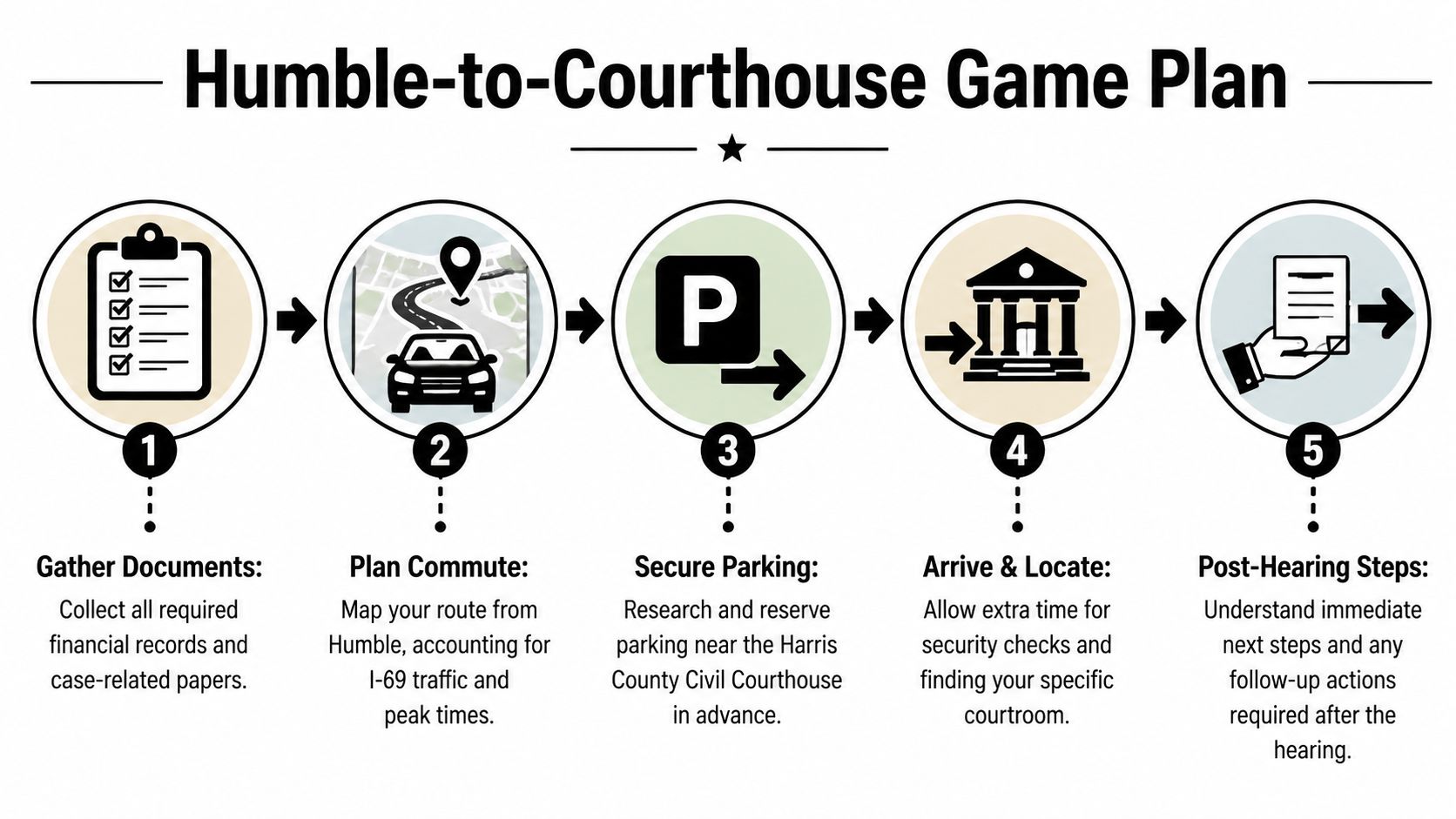
For local families, the legal issue may be straightforward, but the logistics aren't. The drive from Humble into Houston can take 20 to 40 minutes, and parking can cost $10 or more, based on this practical guide to what to expect in Texas child support IV-D court. The same guide notes that some hearings can be virtual, but only about 30% of cases qualify without an attorney's request.
Start with the right destination
If you live in Humble, Atascocita, or Kingwood, don't drive to the municipal court building expecting your family law matter to be there. Family cases are generally heard in Harris County family courts in Houston.
That sounds obvious once you know it, but on a stressful morning, people still end up at the wrong building. Check your notice for the court number and address. Then verify the court information again before hearing day. If you need a local orientation to the court system, this page on Harris County family court for Humble residents helps connect the dots.
A realistic hearing-day schedule
A strong game plan looks like this:
- The night before: Put your notice, exhibits, ID, and a notepad in one bag.
- Before leaving Humble: Check the court address and your parking target.
- During the drive: Assume traffic may slow more than expected.
- At arrival: Give yourself time for security screening and elevator delays.
- Before docket call: Find your courtroom and sit where you can hear your case called.
Leave earlier than you think you need to. Court stress starts in the parking garage for a lot of people.
Parking, security, and waiting time
Downtown court trips are rarely smooth if you're improvising. Research parking in advance. If possible, identify more than one garage or lot near the courthouse. Carry a payment method that will work without surprises.
Inside the building, expect security screening. That means you shouldn't bring anything that could create a delay at the checkpoint. Once you're upstairs, there may be a hallway full of other families, lawyers, and court staff waiting for different matters to be called.
Bring:
- Your case file
- Photo identification
- A pen and paper
- A fully charged phone
- Any medication or personal essentials you may need during a long wait
Don't bring extra stress if you can avoid it. Arrange childcare if possible. Dress neatly. Eat something before you leave. Those details matter more than people think when nerves are already high.
Ask about virtual options early
Virtual hearings can help, especially for parents trying to coordinate work schedules or transportation from Northeast Houston. But don't assume you'll automatically get that option. Ask early, confirm in writing if available, and follow every instruction carefully if your hearing is set online.
The biggest logistical mistakes aren't legal mistakes. They're late arrival, wrong courthouse, no parking plan, and incomplete documents sitting back at home on the kitchen counter.
Inside the Courtroom Demystified
Walking into a family courtroom for the first time can feel unnerving, especially if the other parent has a lawyer and you don't. The room is formal, the language is unfamiliar, and people worry they'll say the wrong thing.

Most hearings are more structured than dramatic. Once you understand the sequence, the courtroom becomes easier to handle.
Who's who in the room
You may see several people with different roles:
- The judge decides the issues before the court.
- The bailiff helps manage the courtroom and maintain order.
- The court reporter creates the official record in many hearings.
- The attorneys, if either side has one, present arguments and evidence.
- The parties, meaning the parents, may testify and provide documents.
Address the judge as Your Honor. Don't interrupt. If you don't understand a question, ask for it to be repeated.
What usually happens during the hearing
The exact flow varies, but most child support hearings follow a predictable pattern. The case is called. The parties identify themselves. Witnesses may be sworn in. Then the court hears testimony and reviews documents.
A practical way to think about your role is this:
- Answer the question asked
- Point the judge to the document that supports your answer
- Stay focused on facts that affect child support
That last point matters. A hearing about support can quickly get sidetracked into parenting grievances, text-message arguments, or complaints about the past. Judges usually don't find that useful unless it directly relates to the legal issue in front of them.
For parents who like to study legal records and testimony formats ahead of time, reviewing resources about the transcript of deposition can help you get comfortable with how formal testimony is captured and why precise answers matter.
How to present a deviation request
Texas courts don't always have to apply the standard guideline amount without adjustment. Under Texas Family Code §154.123, a judge may deviate when the guideline amount would be unjust, and parents need evidence to support that request, such as therapy invoices, travel costs for visitation, or proof of a major parenting-time imbalance, as outlined in this discussion of Texas child support deviation factors.
What works in those situations is specificity.
If you're asking for a deviation, bring the records that show:
- the child's special medical or educational needs
- the actual out-of-pocket expense
- why the standard amount doesn't fairly address the situation
If you're opposing a deviation, focus on whether the claimed expense is documented and whether it justifies changing support.
Calm, document-based testimony usually carries more weight than emotional arguments.
This short video can help you get more comfortable with the hearing mindset before you go to court.
Courtroom habits that help
Some practical courtroom habits make a real difference:
- Pause before answering. Fast answers often become unclear answers.
- Use exhibit names consistently. If you call something "my insurance packet," keep calling it that.
- Stay seated or stand when directed. Watch how the courtroom is operating.
- Take notes. If the other side says something inaccurate, write it down and address it when it's your turn.
- Never argue with the judge. If you disagree, preserve the issue respectfully.
The parents who do best are usually not the loudest. They're the ones who come in prepared, speak clearly, and give the court something reliable to work with.
After the Hearing What Comes Next
When the hearing ends, many parents feel a brief sense of relief and then a new wave of uncertainty. They want to know when the order takes effect, how payment works, and what happens if life changes again.
The first job is to get the signed order and read it carefully. Don't rely on memory or hallway conversations. The written order controls.
Review the order line by line
Once you receive the signed order, check the parts that affect daily life:
- Support amount
- When payments start
- How payments are made
- Who provides health insurance
- Any reimbursement terms for medical expenses
If something in the signed order doesn't match what happened in court, address it quickly. Waiting can make corrections harder.
If support isn't paid
Enforcement issues often start small. A missed payment becomes two. Then the parent receiving support starts relying on promises instead of the order.
In many cases, wage withholding is part of the system, and the Office of the Attorney General may also play a role in collection and enforcement. But don't assume every problem fixes itself automatically. Keep records of missed payments, notices, and communications tied to the order.
The court can only enforce what the written order actually says.
When modification makes sense
Child support orders aren't meant to stay frozen when real life changes in a serious way. For Humble-area families, modification often depends on showing a material and substantial change, such as job loss, a major income shift, or increased child-related needs, as discussed in this explanation of the Texas child support court process and modifications.
That source also warns about an issue I see often in practice. If unemployment or underemployment isn't well documented, the court can impute income. In plain English, that means the court may assign earning ability based on the evidence instead of accepting a parent's unsupported claim of no income.
Modification requests are strongest when they include:
- job loss records or reduced-hours proof
- updated pay information
- medical records and invoices if a child's needs increased
- documentation of extraordinary expenses
- a clear timeline showing what changed and when
The complexity here is real. A parent may honestly be struggling and still lose a modification request if the evidence is too thin. That's why careful preparation matters just as much after the order as it did before the hearing.
Your Next Step Toward Peace of Mind
A child support hearing feels less overwhelming when you break it into parts. Read the notice carefully. Gather complete financial records. Plan the trip from Humble to the courthouse. Stay calm in the courtroom. Read the signed order before you move on with your week.
Those steps sound simple, but they protect you from the mistakes that cause the most damage. In child support cases, preparation isn't just helpful. It's often the difference between walking in confused and walking in ready.
If you want personal guidance for your situation, speaking with counsel before the hearing can save time, stress, and avoidable setbacks. The child support attorney page for Humble families explains the kinds of child support matters that legal representation can help address, including establishment, review, and modification.
The Law Office of Bryan Fagan serves families in Humble, Atascocita, Kingwood, and Northeast Houston who need practical help with support, custody, and related family court issues. A free consultation can help you understand what your notice means, what the court is likely to focus on, and what documents you should bring.
Frequently Asked Questions About Humble Child Support Hearings
A lot of Humble parents ask the same practical questions once the hearing date is on the calendar. Here are the answers that matter most.
Do I go to court in Humble for a child support case
Usually no. Child support hearings for Humble residents are often handled through the Harris County family courts in Houston, not Humble Municipal Court.
That catches people off guard. A parent may prepare the paperwork and still lose time because they planned for the wrong building, the wrong parking setup, or a longer drive than expected from Humble, Atascocita, or Kingwood. Check the notice closely so you know the exact courthouse, floor, and court number before hearing day.
What if I can't make the hearing date
Act quickly. Call your lawyer if you have one, and contact the court clerk to find out the proper procedure.
Missing a child support hearing can lead to orders being made without your side of the story. Judges usually expect a formal request and a real reason, not a last-minute call after the docket has already started.
What should I wear to a child support hearing
Wear clean, conservative clothes.
The goal is to show respect for the court and signal that you are taking the hearing seriously. Expensive clothes do not matter. A neat appearance, organized papers, and a calm attitude matter much more.
Can I explain that my income changed recently
Yes, but bring proof. Good examples include recent pay stubs, tax returns, termination papers, medical leave records, reduced-hours notices, or business records if you are self-employed.
I regularly see parents hurt their own position by giving a truthful explanation with no documents behind it. In these hearings, records carry more weight than a verbal account alone.
What if the other parent is lying about income or expenses
Stay with the evidence. Bring documents that show what you believe is correct, and point out gaps or inconsistencies without turning the hearing into an argument about character.
That approach works better in Harris County family court. Judges and associate judges need something they can rely on, and that usually means pay records, bank statements, tax documents, receipts, or prior orders.
Can the judge order something different from the standard amount
Yes. Guideline child support is the starting point in many cases, but it is not always the final number.
If either parent wants a different amount, the court usually wants specific facts tied to the child's needs or the parents' actual financial situation. The trade-off is simple. A request for a different number may be reasonable, but it also requires better preparation and clearer proof.
Do I need a lawyer for a child support hearing
Some parents handle a hearing on their own. Others are better served by getting legal help before they walk into court.
A lawyer is especially useful if income is disputed, one parent is self-employed, a modification is requested, or the other side is asking for something outside the usual guideline amount. What looks simple in the notice can get complicated once the court starts asking for backup documents and precise answers.
What if I already have an order and need to change it
You may need to file a modification case rather than show up and ask for a different amount at the existing hearing. The court generally wants proof of a substantial change, such as a job loss, a major income shift, or a change in the child's needs.
Bring current records, not just older paperwork. In modification cases, updated information often makes the difference between a request the court can act on and one it will deny.