You're home in Humble after an arrest, trying to return to work, arrange school pickup, and understand a stack of bond paperwork. You may know your next court date but still be unsure whether you can leave the county, drink alcohol, change addresses, or reschedule a check-in.
Harris County Pretrial Services supervision conditions are requirements attached to your release, not suggestions. Understanding the written order, keeping proof, and asking the court for a specific change can help you protect your freedom while your case is pending. You don't have to sort through every detail alone.
Harris County Supervision Conditions at a Glance
| Condition | What It Usually Requires | Common Violation | Who Sets It |
|---|---|---|---|
| Reporting to Pretrial Services | Phone or in-person check-ins on a set schedule | Missed or late check-in | Judge sets; Pretrial Services monitors |
| Drug and alcohol testing | Scheduled or random tests, often with a stated frequency | Missed test or positive result | Judge or magistrate orders; staff administer |
| Alcohol restrictions | Avoiding alcohol and sometimes testing for it | Drinking or missed alcohol test | Judge sets; Pretrial Services monitors |
| Curfew | Staying home during set hours | Leaving home or arriving late | Judge sets in the bond order |
| Driving limits | Driving only as far as the order allows, such as to work | Driving outside the allowed limits | Judge sets in the bond order |
| Travel and area restrictions | Staying within Harris County or Texas unless travel is approved | Leaving the approved area without permission | Judge sets in the bond order |
| Stay-away or no-contact order | Avoiding a named person or listed places | Prohibited contact, including an encounter that needs explanation | Judge sets in the bond order |
| Electronic monitoring | Wearing an ankle device and keeping it charged | Dead battery, missed signal, or tampering | Judge orders; Pretrial Services monitors |
| Residence requirement | Living at an approved address | Moving without required notification or approval | Judge sets in the bond order |
These are typical conditions, not a universal list. The written order controls, and a judge may add, remove, or tailor requirements to the case. The examples identify conduct that can prompt a report, not a finding that every accidental encounter or device alert proves a violation.
Read the details behind each condition
For reporting and testing, identify the required method, location, deadline, and contact person. Alcohol restrictions deserve their own line on your checklist because an order prohibiting drinking creates a different obligation from an order requiring testing.
For curfews, driving limits, and travel boundaries, write down precisely when and where you're allowed to go. A work-related driving exception doesn't necessarily authorize a personal trip, and permission to travel within Texas doesn't necessarily permit travel outside it.
No-contact and stay-away provisions require careful attention to named people, addresses, and prohibited communications. With electronic monitoring, identify charging and equipment instructions; with residence requirements, determine what must happen before a move.
Practical rule: Don't fill gaps in your order with assumptions. Flag unclear language for your attorney before acting on it.
Residents of Humble, Atascocita, Kingwood, and Northeast Houston may face similar conditions, but commuting distance can make in-person reporting harder to manage. Before your first check-in, copy every condition from your own order into a list and use the table to identify details you still need clarified.
Who Sets Your Conditions and Who Monitors Them
A common mistake is assuming a supervision officer can change a bond condition by agreement. Judges or magistrates set the conditions; Pretrial Services administers them. An officer can explain procedures and communicate concerns, but an informal conversation doesn't replace a changed court order.
Texas Code of Criminal Procedure Chapter 17 provides the legal framework for bail and release conditions. Your attorney should examine the actual bond order rather than assume that a general explanation of Texas bail law answers your particular question.
The written order connects the court's decision to your daily responsibilities.

Individual orders within a large system
Harris County Pretrial Services uses graduated supervision, ranging from administrative monitoring to intensive supervision involving electronic or alcohol monitoring. Its role is risk management rather than punishment: staff monitor compliance, inform judicial officers, support court appearances, and address public-safety concerns.
For example, a Kingwood resident ordered to report by phone and avoid a named address has different responsibilities from a Humble resident assigned an ankle device and intensive monitoring. Even people charged with the same offense can receive different conditions.
A Harvard Kennedy School case study describes approximately 770% growth in Harris County's supervised population, from about 3,750 people in 2017 to roughly 32,500 by 2020. That expansion helps explain why accurate orders, clear reporting instructions, and reliable records matter across such a large system.
Prepare before you call
Have these documents available before discussing a disputed requirement:
- Written bond order: This identifies the court's controlling requirements.
- Reporting schedule: This shows how staff have instructed you to comply.
- Alleged-violation notice: This identifies the conduct being questioned, if a notice exists.
Our Humble bond-hearing legal guidance can help you understand the issues to discuss with counsel when release conditions need judicial attention.
Day-to-Day Obligations and Keeping Proof
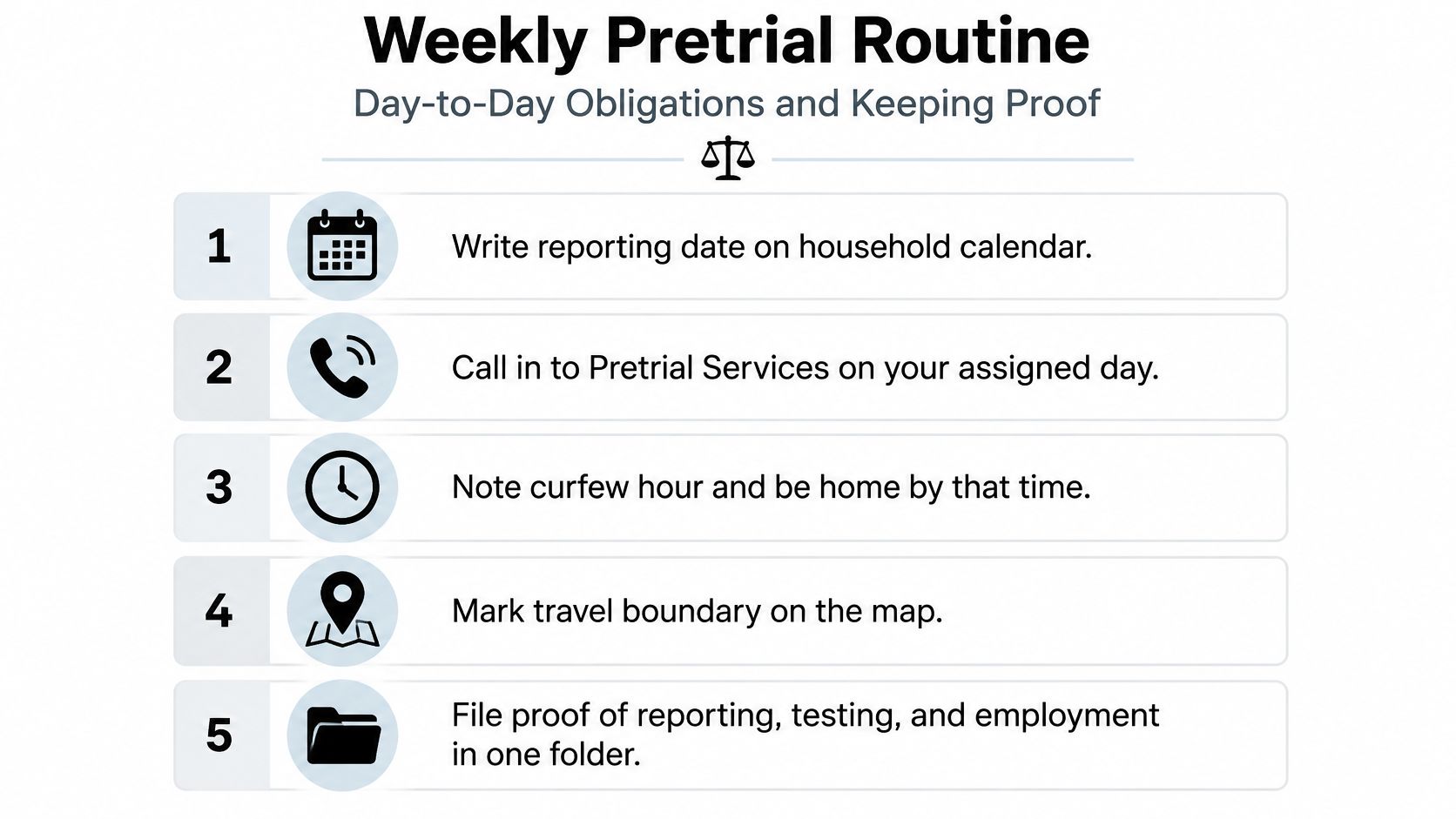
Start your week with a household calendar. Enter each reporting appointment, testing window, curfew, court setting, and approved travel commitment, then arrange transportation and childcare around those obligations.
Keep private case details out of shared calendar entries if necessary. Your household may need to know that you have an appointment without knowing sensitive information about the allegation.
Use a simple routine to make those responsibilities easier to track.
Confirm where you're expected
The county's Pretrial Services office-location directory lists the Enhanced Support Division at 49 San Jacinto, First Floor, Houston, Texas 77002, with weekday hours of 7:00 a.m. to 5:00 p.m. and telephone 832-927-3520. Confirm that this is the office assigned to your appointment before traveling downtown from Atascocita or Kingwood.
Pretrial officers monitor conditions and present information for judicial review, while docket clerks provide court-date reminders. A reminder call doesn't replace your responsibility to appear, and a supervision appointment isn't the same as a court setting.
Build a usable proof folder
- Current contact information: Keep your address and phone number updated so staff can reach you.
- Check-in confirmations: Save emails, portal confirmations, or a dated note identifying whom you spoke with.
- Testing receipts: Preserve proof that you attended, even when results aren't immediately available.
- Travel approvals: Keep the authorization and its precise limits together.
- Contact log: Record the officer's name, date, question, and response after each communication.
- Device paperwork: Save installation instructions, service notices, and equipment-related messages.
Say a Northeast Houston worker completes an assigned phone check-in, preserves a shift schedule, and files a testing receipt. That worker can give counsel a concrete account of the week instead of trying to reconstruct it from memory.
If relatives send advice from another state, separate general information from your own obligations. Georgia DUI Schools' explanation of pre-arraignment alcohol restrictions in Georgia may help someone understand that jurisdiction, but it doesn't establish what a Texas bond permits.
Bring your calendar and proof folder to your first attorney meeting.
Testing and Monitoring Conditions Worth Questioning
Drug testing and electronic monitoring are targeted tools, not automatic safeguards. A useful condition should address an identified concern, and counsel can question a requirement that creates burdens without a clear connection to the case.
Testing paperwork deserves the same attention as the device itself.
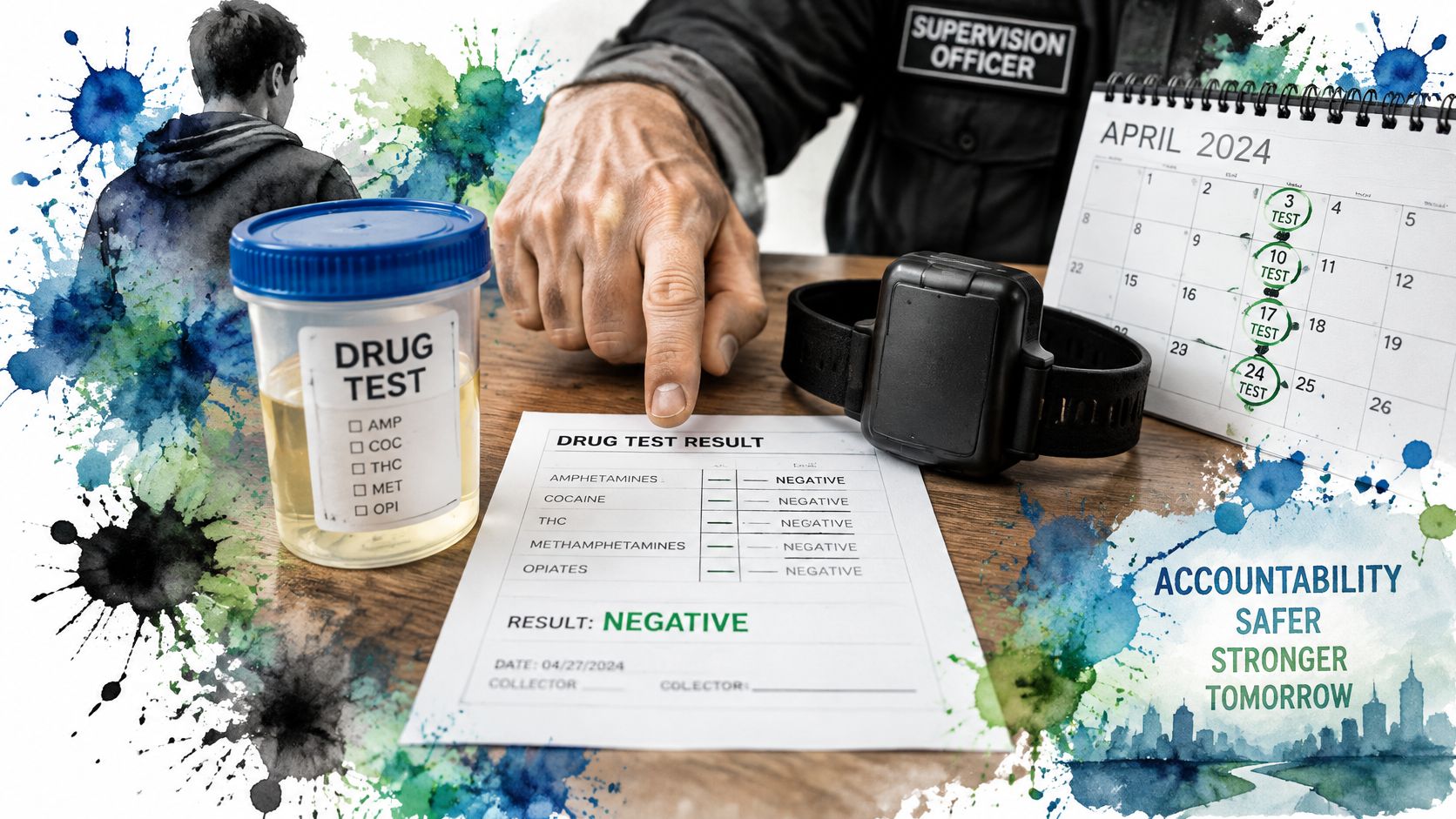
Harris County budget materials summarized through its Auxiliary Services resources report that, in 2019, 60.2% of drug tests were negative and approximately 30% were positive for THC, while characterizing testing as staff-intensive and citing no clear general association with improved pretrial outcomes. The analysis also identifies evidence that testing can produce worse outcomes for lower-level defendants and that broadly imposed electronic monitoring can increase technical violations.
That doesn't mean you can refuse a test or remove a device. It means your attorney should examine whether the condition has a documented, case-specific purpose, especially whether monitoring enforces a defined curfew, house-detention requirement, or stay-away restriction.
Identify the exact problem
- Unclear boundaries: An exclusion zone appears to overlap your home, workplace, or permitted route.
- Incompatible schedules: A testing window conflicts with a documented job shift.
- False alerts: The device reports movement you dispute.
- Communication failures: You receive missed-device messages despite following equipment instructions.
- Incomplete testing protocols: Instructions don't identify frequency, reporting procedures, or how disputed results receive confirmation.
For a disputed alert, record the time, location, device message, steps you took, and any witness. Describe what happened factually rather than writing that the equipment was wrong.
Use the following video as supplemental information, not as a substitute for your written instructions.
Bring the device report, work schedule, and every testing notice to counsel. Those documents give an attorney something specific to raise with the judge in writing, whether the requested remedy is clarification, a schedule adjustment, or reduced monitoring.
What Happens After an Alleged Violation
Say you miss a phone check-in because your work shift changes unexpectedly. You intend to explain later, but the officer documents the missed contact and reports it to the court before you provide your schedule.
The judge may review the report and decide whether release conditions need to change or whether revocation should be considered. An allegation isn't the same as a judicial finding, but ignoring it leaves the court without your explanation and supporting records.
Technical violation compared with a new arrest
| Situation | What Triggers It | Legal Consequence | Typical Path |
|---|---|---|---|
| Technical violation | A broken condition, such as a missed check-in or positive test | No new criminal charge is required | Warning, added condition, court hearing, or bond change |
| New arrest | Alleged conduct leading to a new criminal charge | A separate criminal case with its own bond determination | The new case proceeds, and existing supervision may also be reviewed |
An explanation or warning may resolve some issues. Other situations may lead to more frequent reporting or testing, a hearing, changed bond terms, or possible revocation. These are possible responses, not a required sequence.
Pretrial release also differs from probation after a case disposition. Our Humble violation-defense guidance can help you frame questions for counsel, but your attorney must identify the procedure that applies to your bond rather than treat every supervision issue as a probation case.
Respond before the record becomes incomplete
- Request the report: Ask for the alleged violation in writing through the appropriate channel.
- Preserve dates: Record when the event occurred, when you learned of the allegation, and what you did afterward.
- Contact counsel promptly: Tell your defense attorney the same day an officer reports an alleged violation whenever possible.
- Gather the explanation: Save the shift change, transportation record, appointment confirmation, or relevant message.
A documented explanation gives the court something to evaluate. Silence doesn't explain a missed appointment.
Early attention can make a technical problem more manageable, but no attorney should promise that a work conflict or transportation difficulty excuses it. Keep complying with every other requirement while counsel addresses the disputed event.
How to Request a Modification or Termination Step by Step
Only the judge or magistrate with authority over the condition can change it. Your request therefore needs to reach the court, not stop with a conversation with your officer.
The Harris County Pretrial Services FAQ describes the agency's compliance-monitoring and reporting responsibilities. For someone seeking relief, the practical distinction is important: staff can administer your supervision, but judicial review is the route to changing the underlying requirement.
A written request should connect the proposed change to documents the court can evaluate.
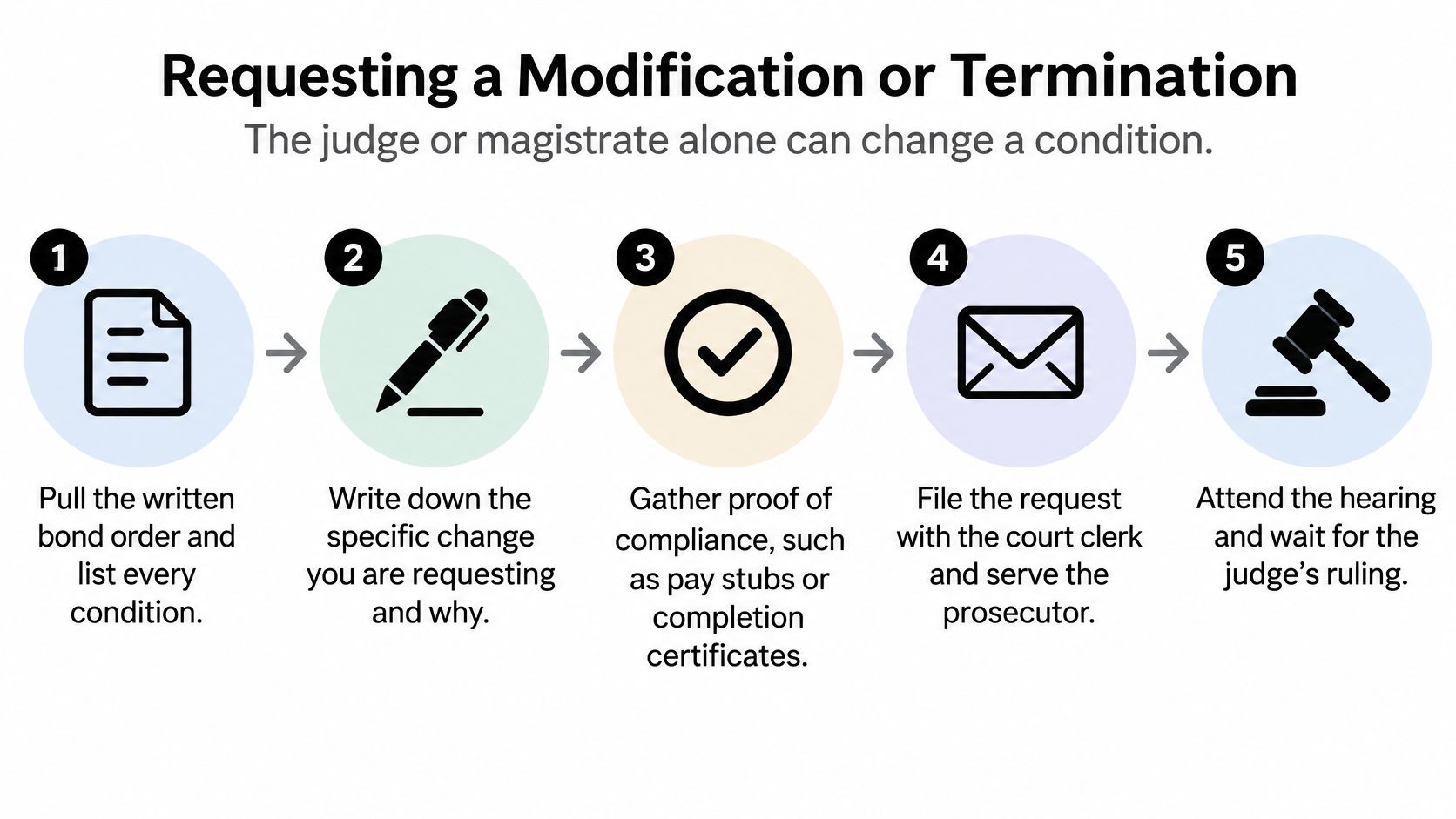
Prepare a request the court can evaluate
Pull the written bond order. List each condition and deadline using the order's wording. Mark any difference between the order and the instructions you've received.
Compare requirements with daily obligations. Review check-in frequency, testing, curfew, driving limits, exclusion zones, and device use against your actual schedule. Identify the precise conflict rather than describing supervision as generally difficult.
Gather supporting proof. Useful records may include an employment letter, shift schedule, transportation limitations, childcare or caregiving records, treatment attendance, and proof of a stable address. Include compliance records as well as hardship documents.
Choose the relief with counsel. A modification might change reporting methods, adjust permitted hours, or clarify a boundary. Termination means ending a particular requirement or supervision where legally available, not automatically dismissing the criminal case.
Submit the request in writing. Have your attorney prepare the appropriate filing, attach supporting documents, and handle applicable filing, notice, and hearing requirements. A proposed alternative helps explain how you'll continue meeting the court's concerns.
Follow the existing order while awaiting a ruling. Don't implement the proposed schedule yourself. Obtain and review the signed ruling so you understand exactly what changed.
Make hardship concrete
Repeated downtown trips can create serious difficulties for workers and caregivers living in Humble or farther across Northeast Houston. Show the court the actual reporting appointment, required travel, lost work opportunity, and childcare conflict rather than relying on a broad statement that transportation is hard.
For example, an employer's letter identifying mandatory shift hours can support a request for a compatible reporting arrangement. A transportation schedule and caregiving records can explain why a particular appointment format is difficult to maintain.
A stronger request: Identify the condition, explain the documented conflict, and propose a workable replacement.
Handle an accidental violation separately from the request for future relief. Promptly contact counsel, follow applicable reporting requirements, and preserve dates and records; asking for a modification doesn't erase earlier conduct.
Your written request and proof folder can materially strengthen the court's ability to assess relief, but they don't guarantee approval. Specific, reasoned requests give the judge a clearer basis for deciding than an unsupported claim of hardship.
Confirm Your Next Step Before Your Next Court Date
Your immediate decision is practical: confirm each condition against the written order, then determine whether there's a specific change worth requesting. Don't wait until the next court setting to discover that your reporting instructions conflict with your work schedule or that an alleged violation needs attention.
A defense attorney can separate questions about the charge from questions about release. For charge-related preparation, our guide to the Harris County misdemeanor court process explains the local criminal-court setting in plain language.
Bring documents that support a plan
Prepare these materials for your meeting:
- Bond order: Include the complete order and any later amendments.
- Condition list: Mark unclear wording and the changes you want considered.
- Device and testing records: Include notices, receipts, service messages, and disputed alerts.
- Proof folder: Bring employment, transportation, treatment, residence, and caregiving records relevant to your request.
- Timeline: Identify reports, appointments, contacts, and any alleged violation in date order.
During a free consultation, we provide a confidential review of your case details, honest feedback about legal options and potential outcomes, guidance on the Texas family, estate, or criminal law relevant to your situation, and clear direction on what to do next. The discussion should help you understand both what you can do immediately and what requires court action.
Address overlapping family responsibilities
If a restriction interferes with custody exchanges or support-related responsibilities, bring those family-court orders too. Our family law services cover divorce, child custody, and support issues, allowing you to raise those concerns without assuming that one court's order automatically changes another's.
The Law Office of Bryan Fagan serves Humble, Atascocita, Kingwood, and Northeast Houston, as well as clients throughout Harris County and the Houston metropolitan area. A consultation is a low-pressure opportunity to organize the facts and identify a practical next step, not a promise of a particular ruling.
Our Humble office offers a free consultation to review your bond paperwork, discuss Harris County Pretrial Services supervision conditions, and identify whether a documented request for relief makes sense. Call (281) 817-1827 or visit Law Office of Bryan Fagan to schedule your consultation, and bring your order and proof folder so we can move straight to a practical plan.