You get a call from your probation officer, a letter arrives, or someone tells you a motion may be filed. You're still working, caring for your family, and trying to follow the rules in Humble, Atascocita, Kingwood, or Northeast Houston. Suddenly, you're worried that one missed appointment, unpaid obligation, failed test, or new arrest could send you to jail or prison.
Don't wait to see whether the problem disappears. A probation violation allegation can move quickly, and the right defense depends on what allegedly happened, whether you're detained, and what evidence you can present. If you're searching for a probation violation lawyer in Humble, TX, start by understanding the difference between a technical violation and a new-offense allegation, then act before the hearing becomes your first opportunity to respond.
Understanding Probation Violations in Texas
You have followed probation for months, then miss one meeting because your car breaks down. You expect to explain it at the next appointment. Instead, the probation officer may document the missed condition, the prosecutor may seek court action, and you may face a warrant, detention, and a hearing before a Harris County judge.
Probation does not end the case. Texas calls it community supervision, and it lets a person remain outside jail or prison while following a written set of court-ordered conditions. Those conditions may cover reporting, payments, treatment, testing, community service, travel, and avoiding new criminal conduct.
Practical rule: Treat every alleged violation as a legal emergency, even when the underlying problem seems minor.
What probation requires from you
Probation conditions are requirements, not suggestions. Keep the written order and preserve records that show what you did to comply. Appointment confirmations, payment receipts, class certificates, treatment records, work schedules, medical documents, and written explanations about transportation or family emergencies can all matter.
A missed appointment and an allegation of a new crime require different preparation. The first may call for proof of a scheduling or transportation problem. The second can involve an arrest, separate evidence, and greater pressure to detain you. Do not assume the probation officer's report gives the court the complete story.
Texas probation affects a large number of people, and revocation can move someone from community supervision to incarceration. That practical risk is why you should respond before the hearing, not wait for the judge to ask what happened.
An allegation does not automatically end probation. The judge may examine whether a condition was violated, how reliable the evidence is, your record of compliance, and whether a structured modification can address the issue. A person may need additional reporting, treatment, testing, or another court-ordered condition instead of revocation. The available response depends on the order, the alleged conduct, and the case history.
Why local help matters
Humble cases proceed through the Harris County criminal-justice system. Whether you live near FM 1960, Atascocita, Kingwood, or Northeast Houston, the process may involve detention, probation personnel, prosecutors, and a court setting that demands a prompt response. A lawyer should obtain the exact supervision order, identify the alleged breach, check whether notice and evidence support it, and organize records that explain or challenge the allegation.
If your case involved deferred adjudication, review what deferred adjudication means in Texas. That form of supervision has its own consequences. Completing most conditions does not eliminate the risk created by a new allegation, and the original case may remain significant when the court considers the response.
Technical Violations Versus New Offense Allegations
A missed probation meeting can place your Harris County supervision at risk. An allegation of assault, DWI, theft, or drug possession creates a different problem. Start by identifying the category, because the evidence, defense plan, and possible consequences may differ sharply.
Technical violations
A technical violation involves an alleged breach of a probation condition, such as:
- Missed reporting: You did not attend a scheduled meeting or report as ordered.
- Unpaid obligations: You fell behind on restitution, fines, fees, or another court-ordered payment.
- Program problems: You missed treatment, classes, community service, or an evaluation deadline.
- Travel issues: You left an approved area or traveled without permission.
- Testing or monitoring concerns: A drug, alcohol, or device report suggests noncompliance.
These allegations are common in supervision practice and can still threaten continued probation, even without a new criminal charge. Do not dismiss them as paperwork problems. Review the exact order and identify whether the requirement was clear, whether the event occurred, and whether circumstances explain it.
Records may change the court's understanding of the allegation. Bring payment receipts, medical documentation, an employer schedule, treatment enrollment records, messages with a supervision officer, or proof of completed community service to your lawyer promptly.
New-offense allegations
A new-offense allegation claims that you committed another crime while under supervision. An arrest is not a conviction, but the arrest and related evidence can still affect the probation proceeding. Your lawyer must coordinate the supervision defense with the new criminal case and avoid creating admissions that harm either matter.
The State may argue that the alleged conduct shows you cannot follow court orders. The defense should separate an accusation from proof, examine identification and records, challenge unreliable evidence, and present a specific response to the court's concerns. A technical violation may call for documentation and a correction plan. A new-offense allegation requires closer attention to the underlying evidence and the risks created by parallel proceedings.
Whether the issue concerns a criminal allegation or another family legal matter, local court procedures matter. For example, a Property Division Lawyer in Humble addresses division of community property and complex assets for Humble divorces, which is separate from probation defense.
The practical rule is direct: do not describe a technical problem as harmless, and do not treat a new-offense allegation like routine paperwork. Tell your lawyer what happened, preserve relevant records, and discuss the facts only with your attorney.
How Texas Probation Revocation Hearings Work
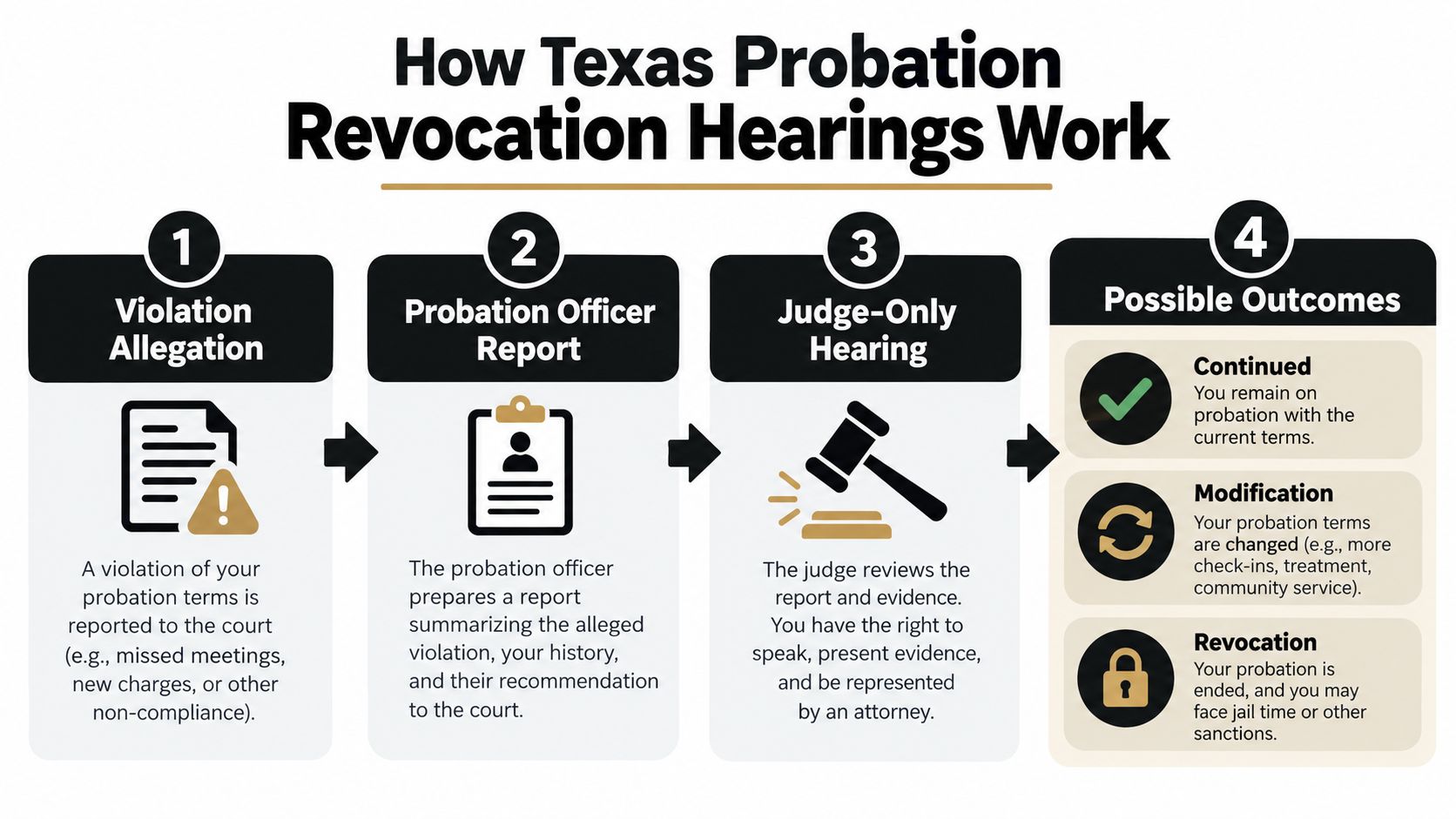
A Texas probation revocation hearing isn't a criminal jury trial. The judge decides the matter, and the State doesn't have to prove the alleged violation beyond a reasonable doubt. Instead, the State generally must prove the violation by a preponderance of the evidence, meaning the greater weight of credible evidence supports a reasonable belief that the condition was violated. The standard is described in this Texas probation revocation explanation.
That lower burden changes how the defense should prepare. A person shouldn't assume that an allegation fails merely because it might not support a criminal conviction. The lawyer should examine the probation order, reports, records, witnesses, testing information, and any explanation offered by the State.
The hearing is judge-only
The judge may consider evidence under procedures that are generally more relaxed than those used at trial. The defense can challenge the allegation, cross-examine witnesses when appropriate, identify gaps in records, and present documentation or testimony supporting a continuation or modification.
Texas courts have held that one proven violation can be enough to support revocation. The Eleventh Court of Appeals decision addressing a single violation demonstrates why a defense shouldn't spend all its energy on a strong allegation while ignoring a weaker technical allegation. If one allegation is sustained, the consequences may still follow.
Defense focus: Attack the weakest allegation first, then present the judge with a workable alternative to revocation.
Detention creates a short timeline
A judge may issue a warrant during the supervision period, and a person can be arrested and held until being brought before the judge. Texas law gives a detained defendant a time-sensitive hearing right. If the defendant hasn't been released on bail, the judge must hold a hearing within 20 days of the defendant's request under Article 42A.751(d), as reflected in the Texas statute governing community-supervision hearings.
That window is short. Counsel may need to obtain probation records, locate witnesses, gather payment or treatment documentation, review electronic monitoring information, and discuss possible resolutions. Families in Humble and Northeast Houston should move immediately if a loved one is in custody.
The Harris County Family Courts guide for Humble residents concerns how family-law cases proceed in the Harris County courts serving Humble. Probation matters are criminal proceedings, but both situations reinforce the importance of identifying the correct court and responding to deadlines promptly.
Possible Outcomes From Modification to Revocation
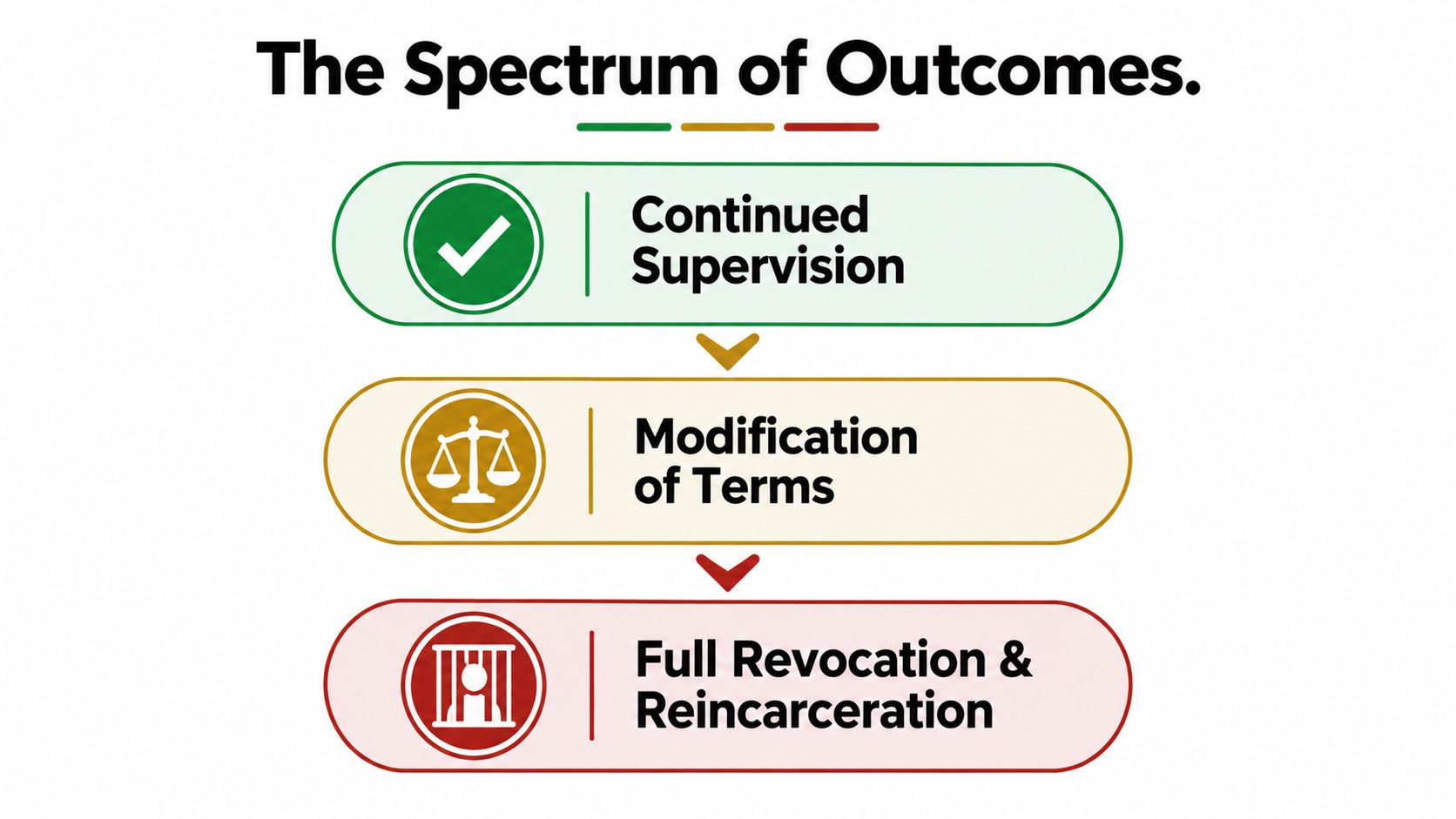
A probation violation hearing doesn't produce only two possible results. Texas law gives the court a range of responses, and the available options depend on the offense, the existing order, and the proven violation. The lawyer's job is to challenge the allegation when appropriate and give the judge a credible reason to choose a less severe outcome.
Continued supervision
The court may continue probation under the existing terms. This is the outcome people usually seek when the allegation is unsupported, documentation resolves the issue, or the violation is minor in context. A strong presentation should explain what happened without minimizing the court's order.
A person who remains on supervision should leave the hearing with a precise understanding of every condition. Confusion about reporting, payment, treatment, testing, or travel can create another problem.
Modified or extended supervision
Modification can add structure without sending the person to prison. Under Article 42A.752, Texas courts may increase community-service hours up to double the prior amount, raise fines, or order placement in a substance-abuse felony punishment program in some cases. The Texas graduated-sanctions statute shows that the court's response can be layered rather than binary.
A lawyer should present practical evidence early:
- Treatment evidence: Enrollment, attendance, or progress records can show that the person is addressing an underlying concern.
- Employment evidence: A stable work schedule may help explain a missed appointment and support a compliance plan.
- Family responsibilities: Caregiving obligations can provide context, although they don't excuse ignoring the order.
- Payment efforts: Partial payments, updated arrangements, and proof of financial hardship can help the court evaluate the problem fairly.
- Compliance history: Completion of other conditions can show that the alleged breach is isolated rather than part of a continuing pattern.
For state-jail felony supervision, Article 42A.556 provides a defined confinement-sanction range of 90 to 180 days when supervision is modified after a violation. The offense classification therefore matters, and counsel must review the judgment and supervision order rather than rely on general advice.
Full revocation
Revocation ends community supervision and can result in confinement under the underlying sentence. The Texas Department of Criminal Justice fiscal-year statistical report distinguishes revocation from other community-supervision outcomes, a useful reminder that “revocation” describes a serious category of outcomes, not one identical result in every case.
For context, the Texas Legislative Budget Board reported felony direct-community-supervision revocation rates of 15.3% in FY 2013 and 15.6% in FY 2014, with 16,828 people revoked in FY 2020. Of those revoked from felony direct supervision, 58.1% were sent to prison, 36.2% to state jail, and 5.6% to county jail, according to the Legislative Budget Board report.
If the allegation involves a technical breach, your lawyer should build a record for modification. If it involves a new offense, the defense must address both the evidence and the court's concern about future compliance. You can also review how to seal a criminal record in Texas, although record-sealing options depend on the case and outcome.
Why Early Legal Intervention Matters in Harris County
Waiting is the wrong strategy. A probation officer's report may be based on incomplete information, and a prosecutor may not know that you completed a program, paid an obligation, or had a documented reason for missing an appointment. Once you're represented, your lawyer can evaluate the allegation and communicate through the proper legal channel.
Texas revocation activity has also moved upward in recent reporting. Revocations increased by 2,608 cases, or 13.97%, from FY 2024 to FY 2025, while felony technical revocations rose by 1,217, or 13.07%, according to the Texas Department of Criminal Justice monitoring report. Those figures make technical allegations especially important to address rather than dismiss.
What early preparation accomplishes
An attorney can use the time before court to:
- Obtain the order: The exact language controls. A lawyer should identify the condition the State says was violated.
- Collect records: Gather receipts, treatment documents, work information, medical records, messages, travel approvals, and testing records.
- Identify witnesses: A supervisor, treatment provider, family member, or program administrator may help explain what happened.
- Evaluate detention: If you're in custody, counsel can address the hearing timeline and possible release issues.
- Discuss resolution: Negotiations may focus on continued supervision, additional conditions, treatment, or another modification.
A detained defendant should ask for the statutory hearing promptly. Under Article 42A.751(d), the hearing deadline is measured from the defendant's request, not from a family member's hope that the matter will resolve on its own.
Do not wait for a court date to start building your defense. Evidence becomes harder to locate, memories fade, and missed deadlines can narrow your options.
Local representation also helps with practical communication. The firm you choose should understand the Harris County setting and should explain what happens next without promising a particular result. The guidance in how to choose a criminal defense attorney can help you evaluate communication, experience, and fit.
Families may also need separate legal help with unrelated concerns. A Child Support Attorney in Humble handles establishing, modifying, and enforcing child support in Harris County. That work is distinct from criminal defense, but both matters require timely attention when a family's stability is at stake.
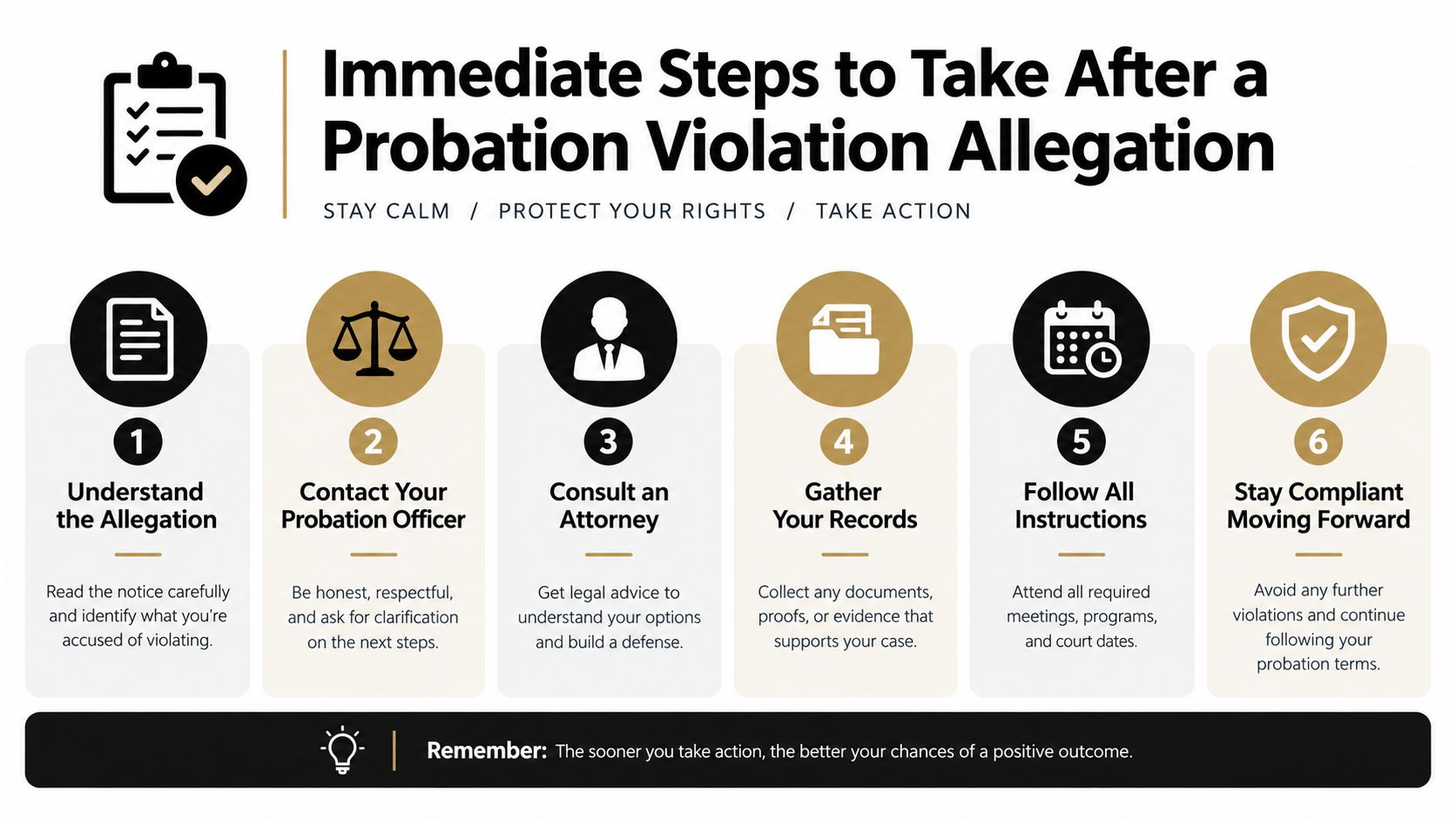
Immediate Steps to Take After a Probation Violation Allegation
Use this checklist whether you're at home in Humble, working in Atascocita, or detained near Northeast Houston.
- Contact a defense lawyer immediately. Tell the lawyer whether you received a notice, learned of a warrant, or were arrested. Don't wait for paperwork to become clearer.
- Read the allegation carefully. Write down the condition, date, location, and conduct the State claims violated probation. Save every letter, message, and court document.
- Gather proof. Collect payment confirmations, class or treatment records, appointment notices, medical documentation, employer information, travel approvals, and relevant communications.
- Stop discussing the facts publicly. Don't post about the case, argue with the probation officer, or explain the situation to friends, coworkers, or other people who may become witnesses.
- Follow current conditions. Continue reporting and complying unless your attorney gives lawful, case-specific advice. Don't leave the permitted area or contact restricted people without authorization.
- If detained, request prompt legal help. Tell your lawyer that you're in custody and ask about the hearing request under Article 42A.751(d).
Don't delete messages or alter records. Preserve the original information, including screenshots, receipts, calendars, device reports, and paperwork. A lawyer can decide what helps, what creates risk, and what should be presented to the court.
If the allegation involves a new criminal charge, don't assume resolving the new charge automatically resolves probation. The proceedings can affect each other, and your defense plan should account for both.
How the Law Office of Bryan Fagan Protects Humble Residents
The Law Office of Bryan Fagan serves residents in Humble, Atascocita, Kingwood, and Northeast Houston from its downtown Humble office. The firm handles criminal defense matters involving DWI or DUI allegations, assault, theft, drug possession, and other misdemeanor or felony cases, while also assisting local families with divorce, custody, child support, property division, estate planning, wills, trusts, and probate.
For a probation violation, the work starts with the allegation itself. The attorney reviews the supervision order, identifies whether the issue is technical or tied to a new offense, examines the State's evidence, and develops a response focused on dismissal, continuation, modification, or another lawful outcome when supported by the facts. The firm's role is to explain the process clearly, communicate with the client, and prepare for the hearing rather than offer empty assurances.
A family's legal needs don't always fit one category. A person facing probation trouble may also be dealing with custody, support, employment, or estate concerns. Those matters should be handled separately and carefully, with advice specific to the court and legal issue.
Don't face a Harris County probation allegation without understanding the risk. Schedule a free consultation with the Law Office of Bryan Fagan's Humble office, bring every document you have, and get a direct assessment of your next step.
The Law Office of Bryan Fagan offers local criminal-defense guidance for Humble residents facing probation violation allegations, including help reviewing technical violations, new-offense claims, detention issues, and possible modification strategies. Visit Law Office of Bryan Fagan to schedule a free consultation at the Humble office and speak with a legal team about protecting your freedom and your future.