A couple in Atascocita sits at the kitchen table with bank statements, a mortgage balance, a retirement account, and a question that sounds simple: “Do we each get half?” The hard part isn't dividing everything down the middle. It's figuring out what belongs in the marital estate, what may be separate property, and what each asset is really worth after debt, taxes, and transfer costs.
For Humble and Harris County families, a sound property division starts with classification and tracing, then moves to a fair division of the community estate. That process takes careful records and clear decisions, especially when a home, retirement benefits, a business, or an inheritance is involved.
Why Asset Division in Texas Starts with Classification
Texas is one of nine community-property states, but that doesn't mean every asset is automatically split equally. Most property acquired during marriage, including wages, savings, bank accounts, retirement benefits, vehicles, real estate, household goods, and certain business interests, is generally community property. Property owned before marriage, or received individually as a gift or inheritance, is generally separate property. (Texas State Law Library's guide to community property)

A bank account in one spouse's name isn't necessarily that spouse's separate property. The same goes for a car titled to only one person. Title matters, but it doesn't settle the question: when and how the property was acquired, the source of the funds, and the available records all matter.
Texas law also sets an important evidentiary starting point. Property possessed by either spouse at divorce is presumed to be community property. A spouse asking the court to treat an item as separate property generally must prove that classification by clear and convincing evidence. That makes old account statements, purchase records, inheritance paperwork, and documents showing premarital balances more than household clutter. They may be central to proving who owns what.
Start with labels, not percentages. Before debating who gets half, identify every asset and liability and determine how each should be characterized.
That approach can ease some of the tension for families in Humble, Kingwood, Atascocita, and Northeast Houston. Property division isn't a guessing game, but it does require evidence. The first useful step is to build a complete financial picture, then sort out what is community, what may be separate, and where the records leave a question to resolve.
Community Versus Separate Property Explained
Use a four-stage process to organize the estate before making proposals. Skipping a stage can turn a manageable negotiation into a costly dispute about an account, a home, or the source of funds.
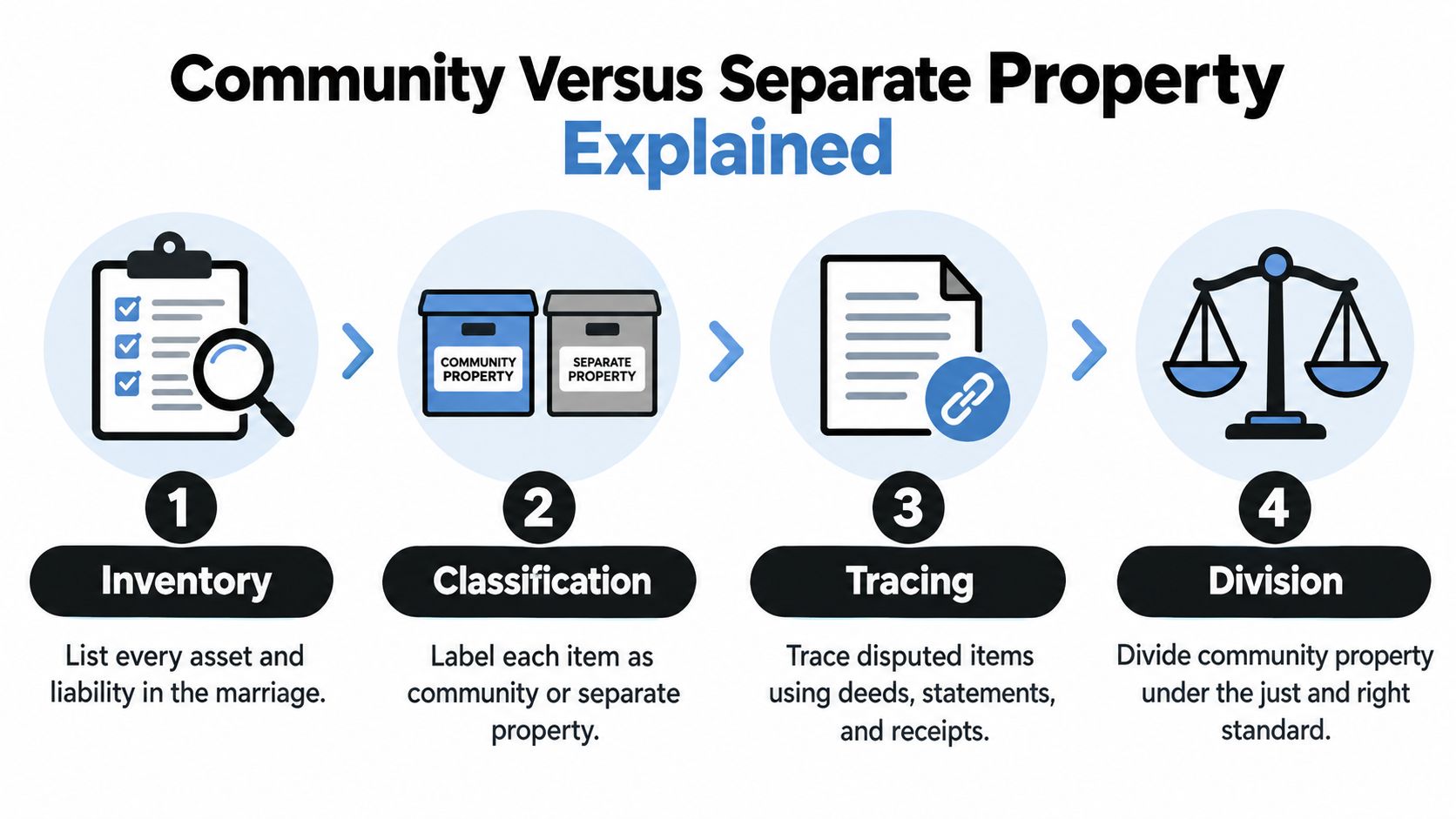
Inventory everything. List assets and liabilities, including property held outside Texas. Include homes, vehicles, bank and brokerage accounts, retirement benefits, business interests, loans, and credit-card balances. Don't leave an item off the list because it seems small or is held in only one spouse's name.
Classify each item. Note when and how each asset was acquired. A premarital home or an individual inheritance may be separate property. Wages earned during marriage and a retirement benefit accumulated during marriage are generally community property, though the characterization of a particular account or benefit can require a closer look.
Trace disputed property. Pull deeds, closing records, premarital account statements, inheritance documents, and statements showing what happened to the funds over time. An inheritance deposited into a joint account can become harder to distinguish from community funds if the money is mixed and the records don't show its path. Adding a spouse to a deed or using marital income to improve a premarital property can also raise questions that the paperwork alone may not answer.
Propose a division using net values. Show each asset's estimated value alongside related mortgages, debts, tax liabilities, and potential transaction costs. A list of gross values can make an offer look evenhanded when the usable value each spouse receives is not.
For a spouse asserting that property is separate, incomplete records can make it harder to meet the burden of proof. A car's title or an account's current name alone doesn't establish its legal character. If the source of funds or a property's history is disputed, get advice before agreeing to a classification. The separate-property tracing guidance for a Humble divorce can help you identify the records and questions to raise.
The Just and Right Standard and How Courts Apply It
Texas Family Code §7.001 requires a court to divide the community estate in a manner it considers “just and right,” with due regard for each spouse's rights and the children's interests. The statute doesn't require an exact equal split. (Texas Family Code §7.001)
That's why the familiar assumption that divorce means “half of everything” can mislead. Texas generally treats much property acquired during marriage as community property, but the court's job is to make a fair division based on the circumstances, not to mechanically assign equal shares of every item. The court may consider a range of evidence, including each spouse's separate estate, financial needs, earning capacity, responsibility for children, fault in causing the divorce, and the debts involved.
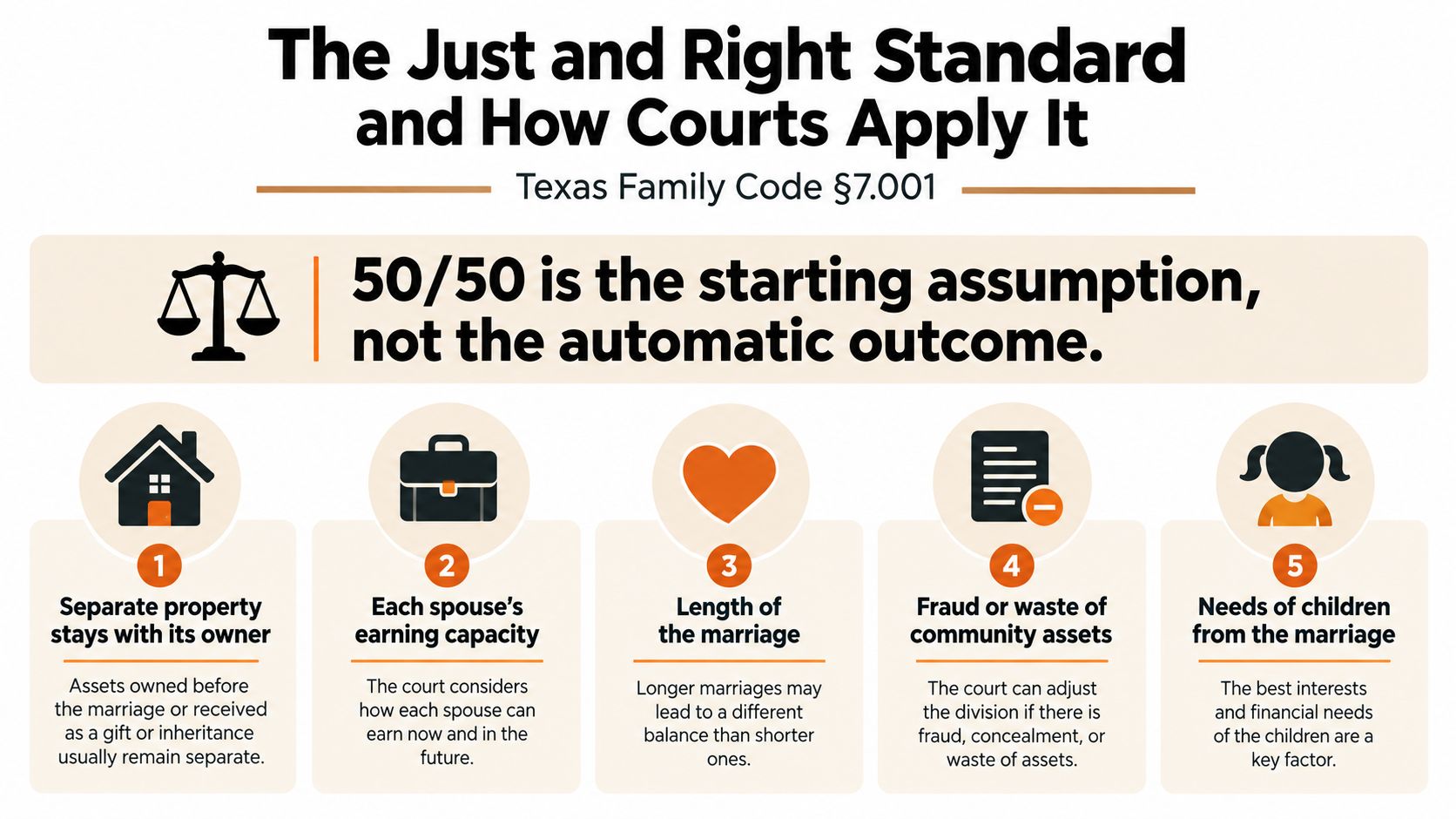
Why the facts matter more than a fixed percentage
Consider a long-term marriage in which one spouse stepped back from career opportunities to provide daily care for the children while the other built earning power. Or consider a family where one spouse has a substantial separate estate and the community estate carries considerable debt. Those facts may support a division that isn't equal in net value, but the outcome depends on the evidence. An unequal division must still be grounded in the circumstances, not an arbitrary demand.
The history of U.S. divorce law helps explain why people often expect equal division. In research on cases studied under older fault-based rules, property was divided equally only 12% of the time; after no-fault reforms, equal division of community assets and liabilities increased, and equal division had become the norm in the analyzed U.S. experience by the end of the 1970s. (Economic research on no-fault divorce and property division) That history is context, not a rule that controls the outcome of a Texas case.
When the estate includes a family home, business interests, or several types of property, ask how each proposed division accounts for the legal and financial evidence. The Property Division Lawyer in Humble page describes services involving community property and complex assets in Humble divorces.
Valuing Homes, Retirement, Businesses, and Debts
A gross number on a statement isn't the same as money you can use. To compare proposals fairly, look at each asset's net usable value: its value after considering associated debt, taxes, transaction costs, liquidity, and the steps required to transfer it.
For a Humble or Harris County family home, start with a supported estimate of value, then account for the mortgage, likely sale costs, property-related taxes, and any costs involved in keeping or selling the home. A home and a retirement account with the same stated value aren't necessarily equivalent. One may require ongoing payments and upkeep; the other may be subject to plan rules, tax treatment, and transfer procedures.
| Asset Type | Typical Valuation Method | Common Complications |
|---|---|---|
| Home or other real estate | Current market valuation, with mortgage and sale costs shown separately | Repairs, taxes, selling costs, and the ability to refinance or maintain the property |
| 401(k) or pension | Plan records and an appropriate valuation of the marital portion | Transfer requirements, taxes, gains and losses, and survivor benefits |
| Business interest | Independent valuation and review of relevant financial records | Uncertain value, cash flow, ownership terms, and whether a buyout is workable |
| Vehicle | Current market estimate, less any vehicle loan | Loan balance and the cost of keeping or transferring the vehicle |
| Digital assets | Account records and a supported valuation at an identified date | Access, transfer logistics, and incomplete records |
Retirement plans need particular care. A domestic-relations order, often a Qualified Domestic Relations Order (QDRO) for an employer plan, may be required to carry out an award. The decree and the plan's requirements need to work together; don't assume a line in the decree alone completes the transfer. Review the retirement division and QDRO guidance for Humble divorces early enough to coordinate the required paperwork.
Debts belong in the comparison, too. Credit-card balances, vehicle loans, personal loans, medical bills, and other liabilities incurred during marriage can affect the overall division. Ask for a written accounting that shows the proposed asset and debt allocations side by side. That's how you spot a settlement that looks equal by gross value but leaves one spouse with far less financial flexibility.
Negotiation Strategies and the Settlement Versus Trial Decision
There isn't one right process for every couple. Direct negotiation through attorneys, mediation, collaborative divorce, and courtroom litigation each offer a different balance of privacy, flexibility, expense, and control. The right choice depends on the estate, the level of conflict, the reliability of disclosure, and whether either spouse has safety concerns.
Research on divorce settlements supports taking mediation seriously: one study of 469 divorcing individuals reported that 30% received mediator assistance and found mediated agreements more fair, clear, and effective than litigation-based outcomes. Research published in Negotiation Journal likewise found mediation significantly more likely than litigation to produce high-quality divorce settlements. (Harvard Program on Negotiation discussion of divorce mediation) Those findings aren't a guarantee of agreement. Mediation works best when both spouses have adequate financial disclosure and enough information to evaluate proposals.
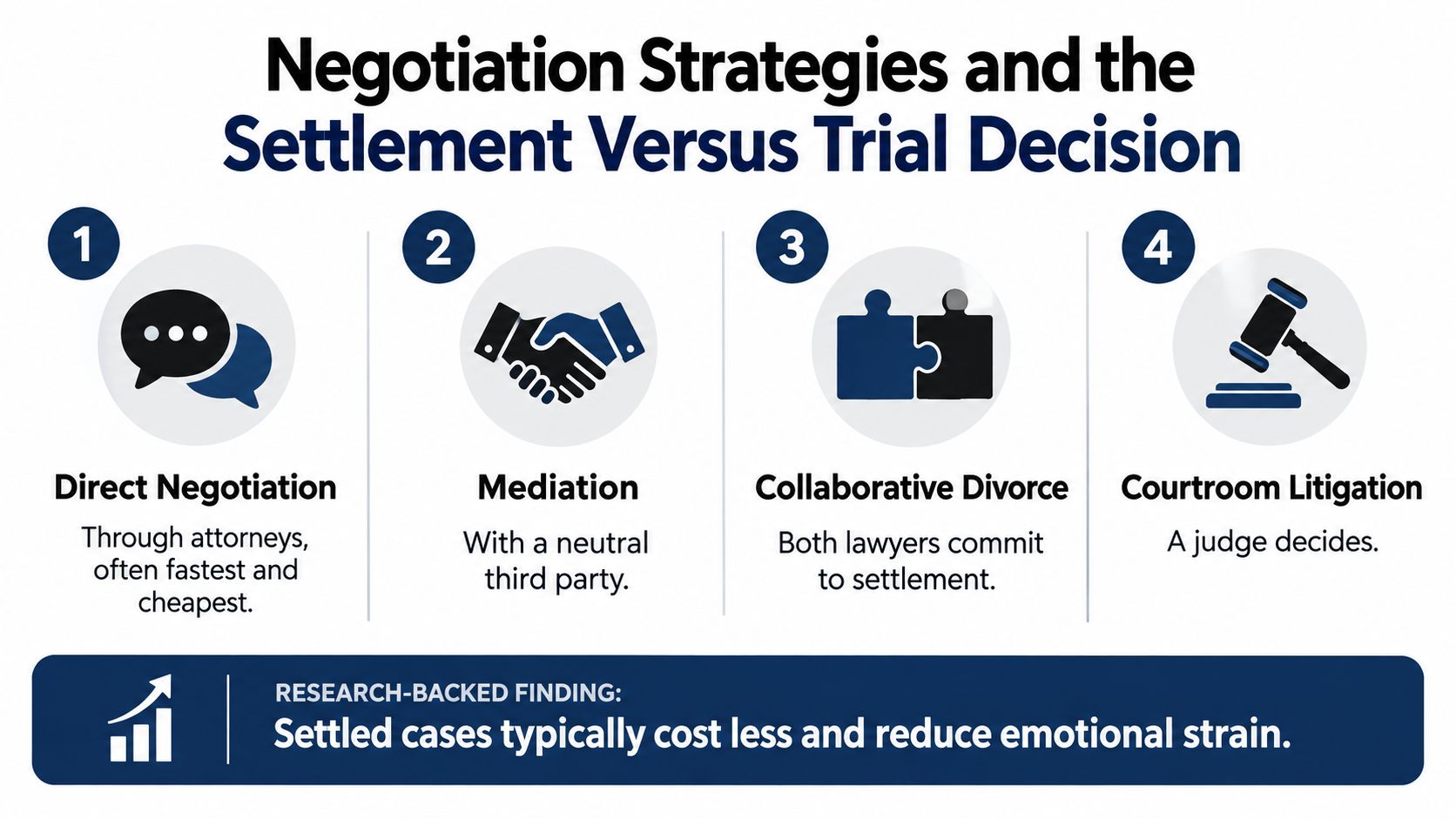
| Situation | Path to consider | What to weigh |
|---|---|---|
| Lower-conflict estate with clear records | Direct negotiation through attorneys | Whether both spouses can make informed offers and document terms |
| Disputed values or difficult trade-offs | Mediation | Full disclosure, preparation, and a neutral facilitator |
| Both spouses want a structured settlement process | Collaborative divorce | Whether both are prepared to work toward agreement with their lawyers |
| Serious conflict, safety concerns, or unresolved disclosure | Courtroom litigation | Court orders and a formal process may be needed to resolve contested issues |
Whatever path you choose, put the terms in writing. A settlement term sheet should identify the valuation date, the assets and debts, transfer mechanics, deadlines, and responsibility for future taxes. The final decree should describe the property precisely. Texas courts may need later proceedings when property is omitted from a decree, which can add expense and uncertainty.
Before a negotiation, review Ciphar's negotiation best practices for practical ways to prepare for a difficult financial discussion. For mediation preparation specific to a divorce case, see how to prepare for divorce mediation.
The video below offers another overview of negotiation choices:
Common Mistakes That Cost Texas Families Real Money
Many expensive disputes start with a shortcut that seemed harmless at the time. Avoid these common mistakes:
- Signing before disclosure is complete. Don't accept a proposed division without a full inventory of accounts, debts, business interests, and retirement benefits. Compare statements across time to spot transfers, unexplained balances, or missing liabilities.
- Treating a spouse's business estimate as established value. A number prepared for negotiation may not account for the records and cash flow needed to assess a business interest. Get an independent valuation when a business or professional practice is a meaningful part of the estate.
- Ignoring tax and transfer costs. Two assets with similar gross values may leave very different amounts available to spend. Compare the net consequences before trading retirement funds for home equity or business interests.
- Assuming a deed or account name decides ownership. Title is evidence, but it doesn't by itself resolve whether property is community or separate. Preserve records showing when and how it was acquired.
- Leaving retirement benefits vague in the decree. Identify the plan and the award clearly, then coordinate any required domestic-relations order with the decree before finalization. Texas court practice may require a retirement order to be presented when the decree is signed, so don't leave that work until afterward. (Texas court local-rules attachment on retirement orders)
Financial abuse and coerced debt need careful documentation, too. Keep bank statements, loan records, credit reports, business records, and evidence of transactions made under pressure. Abuse doesn't automatically change the classification of community property or guarantee a larger award, so separate the property-division questions from safety needs and potential protective-order or temporary-support remedies. If you're worried about immediate access to housing or funds, speak with a lawyer promptly about appropriate legal and safety steps.
Your Action Plan and When to Call a Humble Divorce Lawyer
Start with documents, not assumptions. This week, gather:
- Tax returns and account statements for the accounts and investments you can identify.
- A full debt list, including credit cards, loans, medical bills, and mortgages.
- Deeds, vehicle titles, and purchase records for major property.
- Retirement-plan information, including the administrator and available plan procedures.
- Premarital and inheritance records, such as old statements, closing documents, and gift or inheritance paperwork.
Then make a working inventory that notes the owner shown on each record, how the asset was acquired, any related debt, and what you still need to verify. Don't move, hide, or spend disputed funds to force a result. If a business, an inheritance with mixed funds, significant retirement benefits, or a possible safety issue is involved, get legal advice before signing an agreement.
Some Humble couples agree on the terms and need help documenting them; Uncontested Divorce Lawyer in Humble describes efficient uncontested divorce handling for agreeing couples. If you need broader help assessing your divorce, a Humble divorce lawyer can explain the relevant legal issues and the records to prioritize.
Dividing a life is hard, but you don't have to sort through every financial and legal question alone. A free consultation with a local Harris County attorney can help you identify the biggest risks and decide what to do next.
The Law Office of Bryan Fagan helps Humble-area families address divorce and property division with practical legal guidance. Visit Law Office of Bryan Fagan to schedule a free consultation for your family in Humble, Atascocita, Kingwood, or Northeast Houston.