Skip to content

You've got a stack of papers on the kitchen table, maybe a bank statement, an old deed, an inheritance letter, and a brokerage summary that doesn't match what you remember. That's usually where separate property tracing in a Humble TX divorce starts to matter, not in a courtroom, but in the quiet moment when one spouse realizes that money they brought into the marriage has been moved, mixed, spent, or reinvested so many times that proving it's still theirs will take more than memory.
For a lot of Humble, Atascocita, Kingwood, and Northeast Houston families, the problem isn't whether the asset started as separate property. The problem is whether the paper trail still proves it after years of shared bills, joint accounts, mortgage payments, and investment changes. That's why some people bring in help early, even something as practical as an AI answering service for lawyers, because a missed call or delayed follow-up can be the first sign that important records and deadlines are slipping away.
If you're sorting through a premarital savings account, an inheritance, or a gift from family, the starting point is simple. Texas law does not assume those funds stay separate just because you know they were yours. The law starts from the opposite presumption, and that presumption is where many good claims begin to fail if the documents aren't there.
Why Separate Property Tracing Matters in a Humble Divorce
A Humble resident may think the story is straightforward. They opened a brokerage account before marriage, added money from an inheritance years later, then used part of that account to help with a home purchase or a market downturn. To the spouse, it feels obvious that the original money should still count as separate property, but Texas courts do not work from memory alone.
The presumption starts against you
Under Texas Family Code § 3.003(a), property possessed at divorce is presumed to be community property, and the spouse claiming a separate share has to rebut that presumption with clear and convincing evidence. In plain English, that means the person claiming “this is mine” carries the burden of proving it with records, not just a sincere explanation. Texas Family Code § 3.001 defines separate property as property owned before marriage, or acquired during marriage by gift, devise, descent, or certain personal-injury recoveries, and the law recognizes that separate character can carry forward when the property changes form.
That matters in real life because families in Humble and nearby neighborhoods often handle money in ways that blur clean lines. A down payment might come from family help, an inherited account may get dipped into for remodels, or premarital cash may be rolled into a joint account to make household life easier. Those choices are common, but they create the tracing problem later.
Practical rule: if you can't show where the money started and how it moved, the court may treat it as community property even when you remember it differently.
That's the core reason tracing deserves more than a footnote. It's the bridge between what you know happened and what a judge can rely on.
For readers trying to protect inherited funds before divorce talk starts, the guidance in how to protect inheritance from divorce fits right into this issue.
Texas Separate Versus Community Property in Plain English
Texas property law is easier to understand once you strip away the legal vocabulary. Separate property is the stuff the law recognizes as belonging to one spouse alone, and community property is the property the marriage builds together. The hard part is that title alone doesn't always control, and the date the property was acquired often matters more than whose name is on the statement.
What counts as separate property
Texas Family Code § 3.001 gives you four main channels for separate property during marriage. It includes property owned before marriage, property received by gift, property received by devise or descent, and certain personal-injury recoveries. If you had the asset before the wedding, inherited it from a parent, received it as a true gift, or got a qualifying personal injury recovery, the law may treat it as separate.
That does not mean the asset stays in the exact same form forever. If premarital cash becomes stock, or an inheritance is used as a home down payment, the character can follow the money if the paper trail is strong enough. The tracing issue is proving that line from the original separate source to the current asset.
What counts as community property
Community property is the broad bucket. If property is acquired during marriage, Texas starts by assuming it belongs to the community unless the separate-property claim is proven with the right evidence. That's why a paycheck, a joint savings deposit, or a home bought during marriage usually begins life in the community category.

A simple way to think about it is this. Separate property is like a marked envelope, while community property is the shared drawer where the family keeps everyday finances. Once the envelope gets emptied into the drawer, or the drawer gets used to buy something new, the question becomes whether you can still prove which dollar came from where.
For a plain-language breakdown that many families find useful, the page on what is community property in Texas is a helpful companion to the statute.
Tracing Methods Texas Courts Actually Use
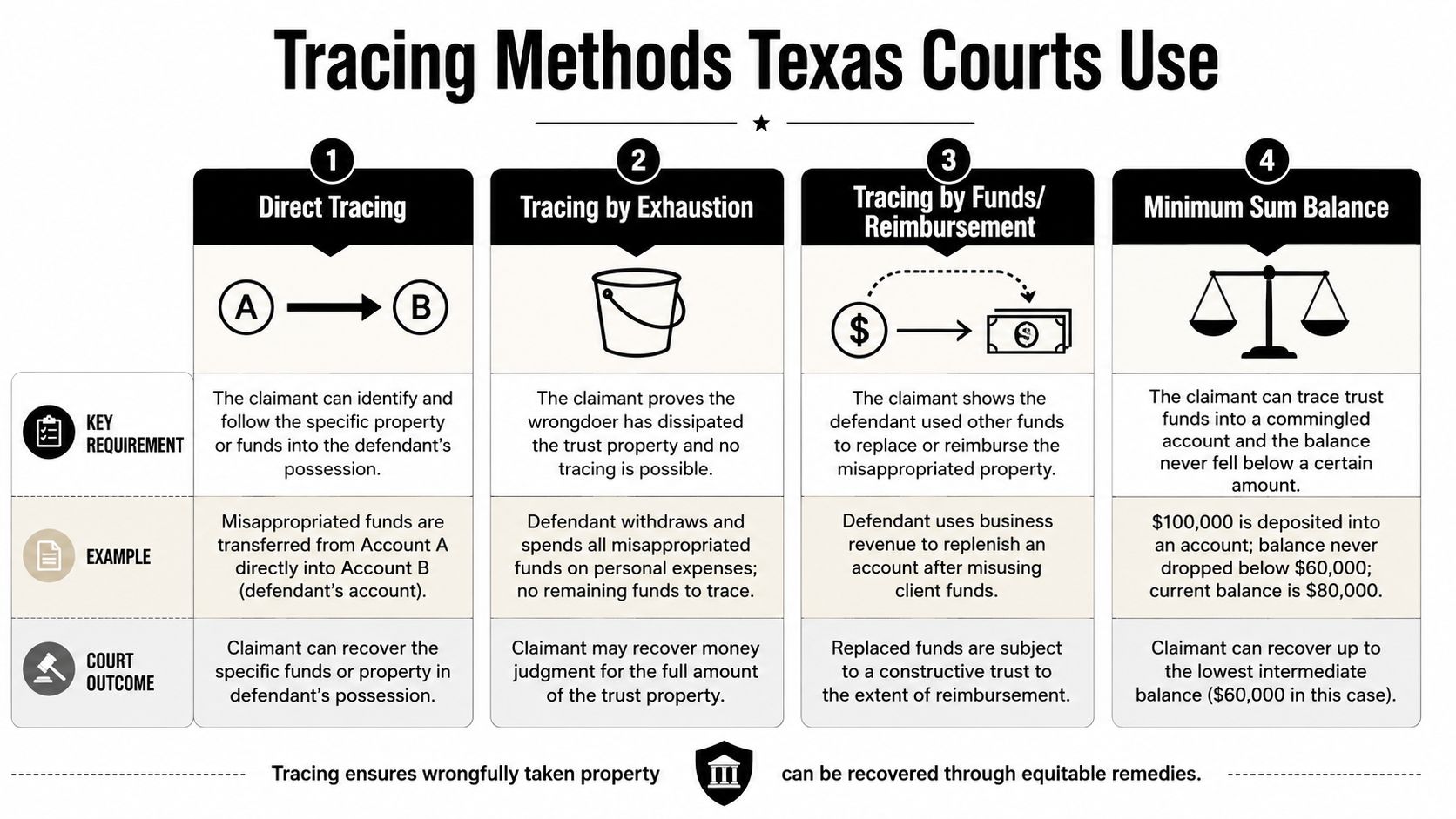
Not every tracing case uses the same method, because not every financial trail looks the same. A clean premarital account is one kind of case. A brokerage account with deposits, withdrawals, and reinvestments is another. The method has to match the mess.
Direct tracing versus the fallback methods
Direct tracing is the strongest method because it connects a specific separate source to a current asset with records you can follow step by step. If a spouse can show the original inheritance deposit, the later transfer, and the purchase record for the asset now on the table, that is the clearest path. Texas tracing experts prefer contemporaneous records over recollection, because memory gets fuzzy fast when years have passed.
When the account has been mixed, tracing by exhaustion may come into play. That method tries to show the separate funds were depleted only after the relevant transactions, which can support a separate-property argument when the account history lines up. It's a rescue tool, not a first choice.
Community-out-first and reimbursement are different tools
The minimum sum balance method, also called community-out-first, assumes community funds were spent before separate funds when the account holds both. That can preserve a separate claim if the balance never fell to zero and the records show the separate amount remained identifiable. If the balance is fully exhausted, the claim gets much harder.
Tracing by funds, often discussed in connection with reimbursement, is different again. That's the tool you use when separate money improved a community asset, such as using inherited funds to pay for repairs on the marital home. The separate property may not convert the house into separate property, but the estate may still have a reimbursement issue.
The method doesn't create the facts. It only tells the court how to read the facts you can prove.
A useful local reference for people dealing with divorce paperwork and contested records is Divorce Discovery Process in Texas, because discovery often becomes the place where tracing documents finally surface. And for readers comparing service options, Enforcement of Court Orders in Humble is the kind of practice area that matters later if a decree says one thing and a spouse keeps ignoring the property terms in Harris County.
Building the Paper Trail That Holds Up in Harris County
A Humble divorce can turn on a stack of paper that looks ordinary at first glance. A bank statement, a deed, or a probate file may seem small on its own, yet together those records show whether separate property stayed separate as it moved through different accounts and different names.
The problem is not just whether money started out separate. The harder question is whether you can still prove where it went after it changed form, because separate property can become practically unprovable long before anyone says it became community property.
What to gather before the trail goes cold
Start with the documents that show origin and movement. Bank statements, brokerage records, property deeds, closing disclosures, gift letters, probate documents, tax returns, and transfer histories are the usual building blocks. A deed can show title, a gift letter can show source, and brokerage statements can show whether separate funds were sold, reinvested, or partially withdrawn. Inherited money often leaves its best trail in probate records or transfer documents, while a home purchase usually leaves clues in closing paperwork.
For accounts that were used for both separate and community money, lawyers often need 24 to 36 months of records or more so the account history can be followed without gaps. That is not busywork. The court needs enough continuity to see whether the balance ever dropped to zero, whether later deposits changed character, and whether the records support a community-out-first analysis. If a statement is missing from the middle of the story, the paper trail can break even when the underlying money may still have been separate.
Property records and tax history can matter too. A parcel may look straightforward on a deed, yet appraisal files, payment records, and later transfers can show whether the asset was refinanced, sold, or rolled into something else. For up-to-date property records and assessment information, refer to INTELLI's 2026 protest guide.
Why timing matters
Waiting until after divorce is filed usually makes the job harder. Banks and brokerages can still produce records later, but it is often easier to gather them before the dispute becomes formal and before access starts narrowing. The earlier the records are collected, the easier it is to spot missing months, unexplained transfers, or the deposit that changed the classification issue.
Discovery is often where the missing pieces surface. If you want a plain-English look at how records get requested and forced out of the other side, see the Texas divorce discovery process. That stage often matters more than the initial intake interview because tracing depends on documents, not memory.
Rule of thumb: if the account looks simple to you, the court still needs to see it as a timeline.
That is why many people start a file at home, then hand it to counsel once the pieces are together. A tracing file that works in Harris County usually reads like a chain, not a pile, with each document answering the one before it. Even technology-focused tools like the best AI receptionist for law firms show how much first-contact organization matters in a case that depends on details.
Three Northeast Houston Fact Patterns and How Tracing Plays Out
A lot of Humble and Atascocita families recognize their own situation in one of three patterns. None of them are rare. Each one has a different likely outcome depending on the records.
A joint checking account fed by premarital money
A spouse puts premarital savings into a joint checking account and then uses that account for groceries, utilities, and household costs. By the time divorce starts, the account has been used for years and the original deposit is buried under everyday spending. That's where community-out-first can matter, but only if the records still show the balance never fully vanished and the deposit can still be tracked.
An inherited brokerage account with mixed activity
A Kingwood resident inherits a brokerage account, leaves it in place, then adds occasional community contributions and reinvests dividends over time. The account may still contain separate property, but the mixed activity means direct tracing gets harder and the court may need a transaction-by-transaction reconstruction. If the record trail is incomplete, the likely result may shift from a full separate-property claim to a narrower reimbursement theory.
A home bought with a premarital down payment
A couple in Northeast Houston buys a home during marriage, but one spouse uses premarital funds for the down payment. The home itself is usually treated through the community-property presumption because it was acquired during marriage, while the down payment source may support a separate claim if the closing documents and transfer records line up. If community money later pays the mortgage or improves the house, that can create a reimbursement issue even when the down payment was separate.

The common thread is simple. The law cares less about your intention in the abstract and more about whether the documents can still prove the money's path.
The 2026 Landry v. Landry Shift and What It Means for Your Case
The recent Landry v. Landry development matters because it changes how people should think about expert tracing in Texas. If expert testimony goes unchallenged, appellate courts may have less room to disregard it, which makes the trial record and expert selection more important than older consumer articles suggest. That's a real shift for any Humble resident with a tracing issue that may end up in Harris County court.
Why expert posture now matters more
In practical terms, the case is a reminder that tracing is not only a document exercise. It's also a litigation strategy question. If one side hires a qualified forensic accountant and the other side stays silent, the unopposed opinion may carry a lot of weight. If the other side hires a competing expert, the fight becomes more complicated, because now the court has a genuine evidentiary dispute to sort through.
That means a spouse with sparse records shouldn't assume the case is hopeless, but they also shouldn't assume a loose folder of statements will be enough. The better approach is to decide early whether the record needs expert reconstruction and whether the case posture justifies that expense.
For families in Humble, Atascocita, and Kingwood, the lesson is direct. Tracing is no longer just about proving where money started. It's also about preserving the right expert proof before the trial record closes.
Common Tracing Mistakes and Your Next Step
The mistakes that sink good claims are usually avoidable. People rely on memory, wait too long to gather records, retitle separate property into joint names, or spend separate funds on community debts without tracking the transfer. Commingling is the quiet one, because it can start with something as ordinary as a joint account that seemed easier for bill paying.
Fixes you can start on today
- Pull records early: Ask for bank, brokerage, deed, and closing records before cooperation gets harder.
- Keep the source documents: Save inheritance papers, gift letters, probate records, and any premarital statements that show the first deposit.
- Map each transfer: Write down where the money moved, not just where it ended up.
- Avoid casual joint titling: Adding a spouse to an account or deed can change the case in ways you may not intend.
- Treat mixed accounts cautiously: If funds have been commingled, assume tracing will need a fuller reconstruction.
If you're in Humble and you're not sure whether your records are enough, the safest move is to review them before decisions get made for you. A calm, organized file can turn a confusing property dispute into something a judge can follow.
If you're dealing with divorce, property division, or a tracing issue in Humble, the Law Office of Bryan Fagan can review your records, explain where the gaps are, and help you decide what proof matters most before the other side gains the upper hand. Visit Law Office of Bryan Fagan to schedule a free consultation and get local guidance on your next step.