Skip to content

If you live in Humble, Atascocita, Kingwood, or nearby Northeast Houston, you may already know the hardest part of a custody order is not the legal language, it's the drive. One parent moves a little farther from the child's school, or a new apartment changes the commute, and suddenly the whole schedule feels different. That's where Texas Standard Possession Order distance rules Humble TX parents need to understand can make a real difference, because Texas uses distance breakpoints to decide how much routine parenting time each parent gets.

A lot of parents first notice the issue when they're trying to compare a school drop-off, a work commute, and a weekend exchange. Texas law doesn't treat every distance the same. It uses 50 miles and 100 miles as the key breakpoints, and those lines can change whether the schedule feels predictable or compressed.
If you want a quick way to organize the moving parts, browse scheduling tag guides can help you think through the categories you're comparing, but the definitive answer still comes from the Texas possession rules themselves. For local families, the practical question is simple, even if the law isn't. Which schedule applies, and what does that mean for your time with your child?
How Distance Shapes Your Custody Schedule in Humble
A Humble parent usually doesn't start with a legal question, they start with a calendar problem. Maybe the other parent lives near Deerbrook Mall, maybe the child's school is in Atascocita, or maybe one parent just took a place closer to downtown Houston. The first thing families often learn is that distance controls the schedule more than people expect.
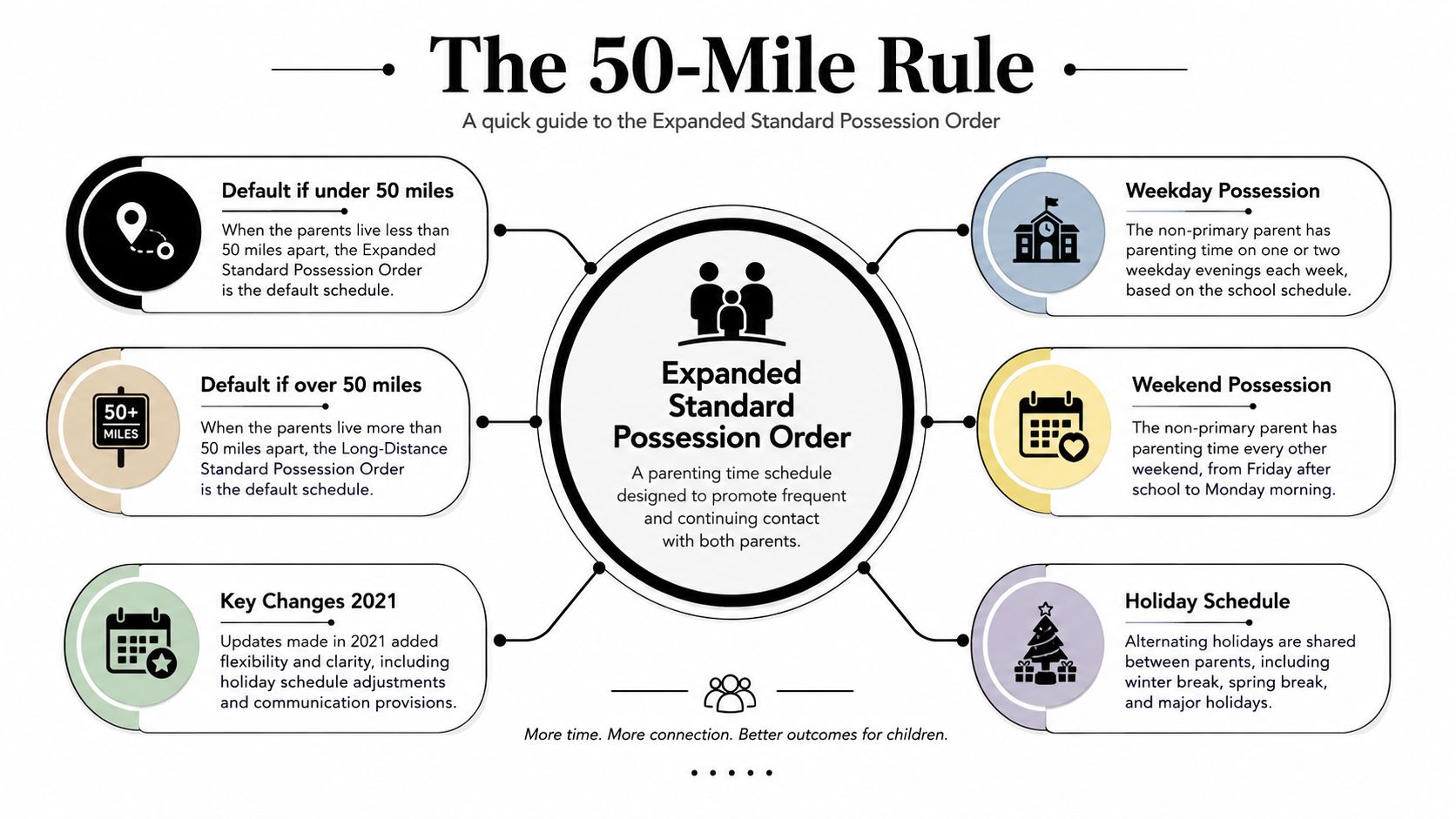
Texas draws real lines here. Under the Texas Family Code § 153.3171, the expanded standard possession order became the default starting point on September 1, 2021 when the possessory conservator lives 50 miles or less from the child's primary residence, and the Texas Attorney General's parenting-time guidance confirms that parents living 50 miles apart or less get specific schedule options instead of the older one-size-fits-all arrangement. That change matters in Humble because local commutes often sit inside that band. Texas Family Code § 153.3171 and the Attorney General's guidance together show that the law is built around real travel distance, not just labels on a custody order. Parenting Time Schedule, 50 Miles Apart or Less
Practical rule: if a move changes whether you're inside or outside the 50-mile line, it can change the whole parenting-time framework, even if nothing else about the case has changed.
For families comparing plans, it helps to think of the schedule as a routing decision, not just a legal form. A shorter commute can mean more frequent contact. A longer one can shift the plan toward fewer handoffs and longer blocks of time.
If you're sorting through a local schedule, child visitation schedule guidance for Humble can be a useful starting point for understanding how possession and access usually get organized in Harris County cases.
The 50-Mile Rule and the Expanded Standard Possession Order
The most important change for many local parents happened when Texas made the expanded standard possession order the default for close-distance cases. In plain English, that means when parents live 50 miles or less apart, the court starts from a schedule that gives the noncustodial parent more parent-friendly start and end times than the older default model. That shift was designed to improve access without forcing families into a completely different custody structure.
For a parent in Humble, Atascocita, or Kingwood, this matters because many real-world drives fall inside the 50-mile range. A parent who works in one part of Northeast Houston and sleeps in another may be close enough for the expanded schedule even if the daily commute feels long. The law cares about the legal threshold, not whether the drive feels busy.
What the expanded order changes
The key difference is timing. The expanded version adjusts the beginning and ending possession times that used to require a separate election, so the noncustodial parent gets a more generous default schedule in close-distance cases. That can make transitions less rushed and can reduce the feeling that parenting time is squeezed into a narrow window.
A local parent reading this often asks whether the expanded order means “more custody.” The better way to think about it is more usable time. The number of weekends is still tied to the possession framework, but the start and stop times are more workable for many families with school, sports, and commuting demands.
Why that matters in day-to-day life
When school, daycare, and work all sit in different parts of Harris County, a schedule with more flexible timing can be easier to follow. It can also reduce conflict because the handoff is less dependent on perfect traffic conditions. For families who share routine pickups in Humble, the difference is often felt at the door, not in the courtroom.
A useful overview appears in Texas Standard Possession Order guidance, and local families sometimes also look at Child Custody Lawyer in Humble, TX when they need custody and conservatorship representation for Humble families.
Understanding the 100-Mile Threshold and Schedule Changes
A parent can live close enough to share school drop-off traffic in Humble, yet still fall on the other side of the 100-mile line after a move. That distance matters because it changes how often the child sees each parent and how much time is spent in the car instead of at home.
Within 100 miles, the standard schedule usually keeps the familiar pattern of the 1st, 3rd, and 5th weekends of each month, Thursday evening possession during the school year, and about 30 days of summer possession. Once the distance goes over 100 miles, the schedule usually becomes less frequent during the school year, often cuts out midweek time, may reduce weekends to one weekend per month, and increases summer possession to 42 days. Child visitation and possession orders explains that framework in a plain way, and the published Texas model order reflects the same 42-day summer period for parents living more than 100 miles apart. Standard possession order PDF
Side by side comparison
| Schedule Element | Within 100 Miles | Over 100 Miles |
|---|---|---|
| Weekend pattern | 1st, 3rd, and 5th weekends | Usually one weekend per month |
| School-year midweek time | Thursday evening visitation | Midweek contact typically disappears |
| Summer possession | About 30 days | 42 days |
| Overall structure | More frequent short visits | Fewer, longer blocks of time |
The table shows the tradeoff clearly. A closer schedule spreads parenting time across the month, while a farther schedule reduces school-night exchanges and gives each parent longer uninterrupted blocks.
For Humble families, the practical effect can show up even after a move that does not feel dramatic in daily life. A parent may move from one part of Northeast Houston to another and still cross the 100-mile threshold, especially when work, school, and temporary housing all shift at the same time. The schedule then has to account for driving time, school-night fatigue, and the reality of exchanges that are harder to keep consistent.
A custody schedule is transportation, school routine, and family structure all at once.
If a move may change the threshold, a geographic restriction in a Texas custody order can also shape what happens next. Local parents often review that issue early, before a move creates avoidable conflict.
How Courts Calculate Distance for Humble-Area Families
A lot of parents ask the same first question, and it is usually not about the schedule itself. They want to know what address counts. A court may look at where a parent lives, where the child sleeps, and where the order says the child's primary residence is located, which can create confusion when families move around Northeast Harris County.
That confusion shows up often in Humble, Atascocita, and Kingwood. A short lease, temporary housing after separation, or a move that seems small in daily life can still change how the distance rule applies. The legal standard is tied to residence, but the proof often comes from ordinary details, such as where someone receives mail, where the child attends school, and which home is treated as the stable one. The Texas Attorney General's guidance on parents living 50 miles apart or less is a useful reference because it explains how the state treats that threshold. Texas Attorney General parenting time guidance
A move does not have to feel dramatic to matter in court. A parent can relocate within Harris County, or even between nearby neighborhoods, and still trigger a different possession setup once the distance line is crossed. That is why the actual driving involved, the school-night routine, and the stability of exchanges all matter when a judge looks at the family's day-to-day life.
What to gather when distance is disputed
When the distance is close to a threshold, records matter more than memory. Courts usually want something concrete, especially if one parent moved recently or if the addresses are close enough that the difference changes the order.
- Keep address records: Save lease papers, utility bills, or school enrollment documents that show where each parent and the child live.
- Track commute reality: The shortest safe driving route often matters more than a straight-line guess, especially in Northeast Houston traffic patterns.
- Use the decree address carefully: If your order names a specific residence, that language can control until the court changes it.
- Document school ties: School district boundaries and daily pickup patterns often help show where the child's main routine really sits.
- Don't guess at the threshold: If you're close to 50 miles or 100 miles, verify the numbers before you change your schedule on your own.
Parents in this part of Harris County also run into a second layer of confusion, because local moves and school-stability concerns often overlap with a geographic restriction in a Texas custody order. A move that looks modest on paper can still raise the question of whether the child's residence is limited to a certain area, so families often review Geographic Restriction Custody Humble TX before they change housing or ask the court for a new arrangement.
Enforcement Consequences and Requesting Modifications
When a parent ignores a possession order, the problem can escalate quickly. In Harris County, a court can require compliance through enforcement proceedings, and the parent asking for help needs to show what the order required and how it was violated. That's where clear records matter, especially if exchanges have become irregular because of traffic, work shifts, or a recent move.
If you're trying to understand the legal side, a tool like case law summary prompts can help you organize the issues before you meet with counsel, but the decision still turns on your order and your facts. For parents dealing with paternity questions at the same time, Paternity Lawyer in Humble provides legal help with establishing paternity and related rights in Harris County.
A practical enforcement path
- Identify the violation. Keep the order handy and write down the missed exchange, denied visit, or schedule change.
- Collect proof. Save texts, emails, exchange logs, and any travel documentation that shows what happened.
- File the right motion. Enforcement asks the court to make the other parent follow the existing order.
- Prepare for hearing. The judge will want the order, the history, and the specific violation dates.
- Ask about modification if the facts changed. A relocation, new work schedule, or different school setup may justify a different order.
A modification is different from enforcement. Enforcement says the current order was broken. Modification says the current order no longer fits the family's reality. Parents often need both ideas explained side by side because a move can trigger one issue or the other, depending on what changed.
If the schedule stopped working because someone moved, don't just improvise. Put the change in front of the court before the conflict becomes routine.
Local families also need to think about school calendars, daycare handoffs, and temporary relocation issues that can affect the best way to structure exchanges. The more the child's routine changes, the more important it is to update the order rather than rely on informal promises.

Protecting Your Parenting Time with Local Legal Support
The distance rules in Texas are straightforward once you see the breakpoints, but applying them to a real Humble family is rarely simple. The most important numbers are still 50 miles and 100 miles, and the question is how those thresholds fit your commute, your child's school, and your daily routine. Parents in Humble, Atascocita, Kingwood, and Northeast Houston often need help translating those rules into a schedule that works.
That's where local guidance matters. A custody lawyer who knows Harris County can help you think through the possession order, the exchange locations, and the effect of a move before the conflict grows. The Law Office of Bryan Fagan also works with families on related needs, including estate planning through an Estate Planning Attorney in Humble for wills, trusts, and estate plans for Humble families, so many clients already know the firm as a community-based resource.
If you're worried about a move, a denied visit, or a schedule that no longer fits your child's life, don't wait for the next missed exchange. A careful review now can save a lot of stress later, especially when the distance issue is close to the line and the facts matter.
If your custody schedule in Humble, Atascocita, Kingwood, or Northeast Houston is affected by the 50-mile or 100-mile rules, the Law Office of Bryan Fagan can help you understand your options and protect your parenting time. Visit Law Office of Bryan Fagan to schedule a free consultation and talk through the schedule, the commute, and the next steps for your family.