Skip to content

You take the job offer, then open your custody order and realize the move may not be yours to make. That's the moment a lot of Humble parents, and plenty of families in Atascocita, Kingwood, and Northeast Houston, discover that geographic restriction custody Humble TX is a court issue, not a simple life decision. If your order limits where your child can live, you need to treat that language as binding and act before you pack a single box.
Why a Job Offer Out of State Can Become a Legal Problem
A parent in Humble gets a strong offer in Dallas, or maybe across state lines, and the first instinct is to say yes and figure out the custody details later. That approach can blow up fast when the order includes a geographic restriction, because Texas Law Help explains that if a parent wants to move the child outside that area, they must return to court to modify the order. In plain terms, the court already drew the line, and you do not get to step over it just because the opportunity looks good.
People get burned. The restriction is not a soft guideline or a suggestion tucked into paperwork. It is an enforceable part of the custody order itself, which means the relocating parent generally needs judicial approval unless the other parent agrees or the order is changed. Texas Law Help's geographic restriction guidance makes that point clear, and it also gives the common Texas example of a decree that ties a child to Harris County. That kind of language is exactly why parents in Humble, Atascocita, Kingwood, and nearby neighborhoods need to read every line before they relocate. Texas Law Help on geographic restrictions
Practical rule: if the order names a county, nearby counties, or a defined area, treat that boundary like a fence around your child's primary home.
If you're checking your order and trying to make sense of the wording, a local relocation consultation can save you from a mistake that costs time and control. For parents already staring at a move deadline, PartnerScanX for family lawyers can also be a useful outside resource when you want to compare child custody-focused support and understand how these disputes are often framed. For local next steps, see our relocation custody attorney in Harris County page.
The bottom line is simple. Do not assume a career move overrides a custody order. In Harris County family courts, the safer move is to get legal advice first, then decide whether to seek a modification, negotiate with the other parent, or stay put.
How Texas Law Defines Geographic Restrictions in Custody Orders
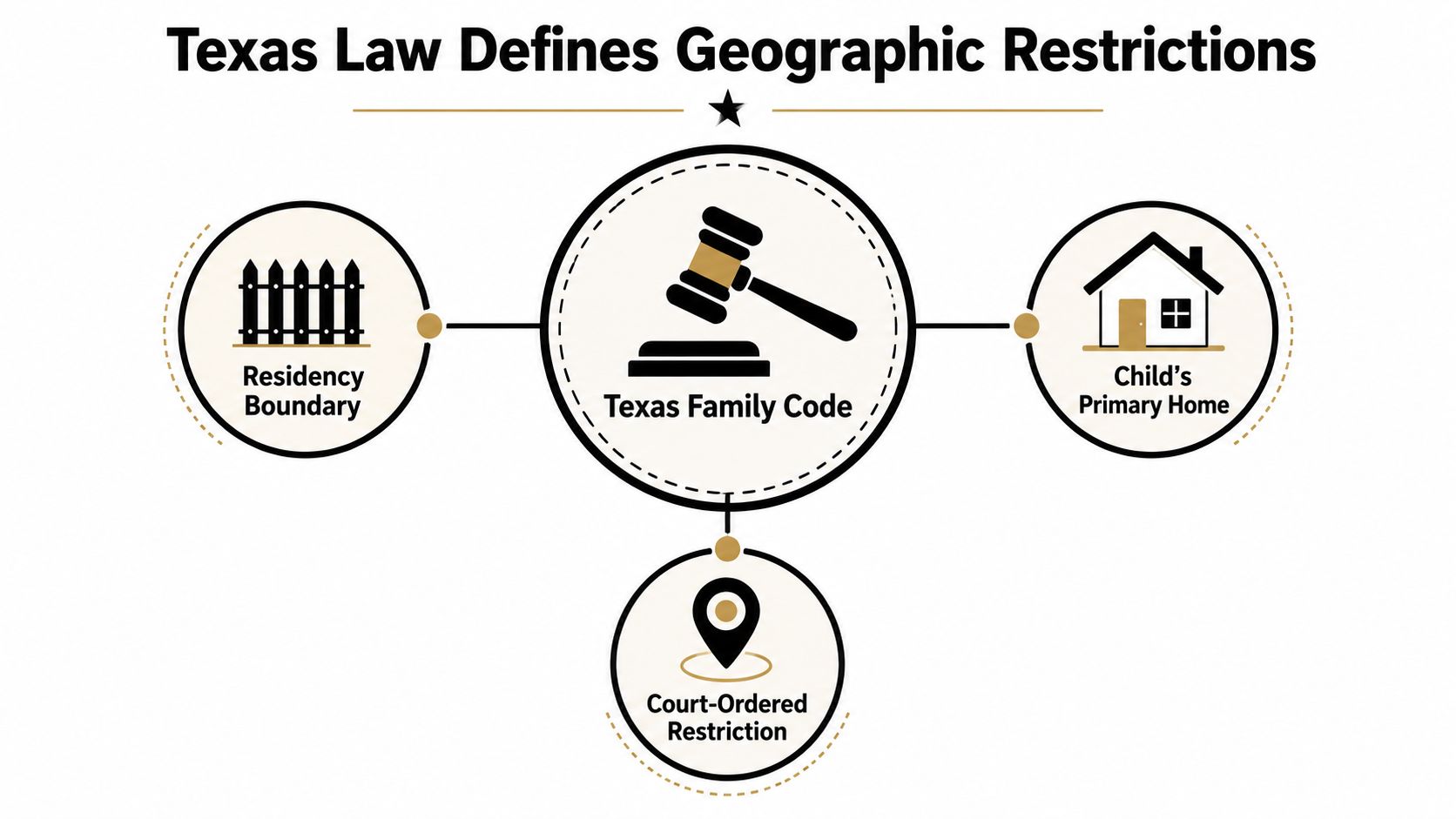
Texas law gives courts a very specific choice when parents are appointed joint managing conservators. Under Texas Family Code § 153.134(b)(1), the court must either give one conservator the exclusive right to determine the child's primary residence and set a geographic area, or allow that conservator to decide the residence without geographic limits. That statutory structure is why geographic restrictions appear so often in Texas custody orders, including cases involving Humble and the surrounding Harris County communities. Barsalou Law on Texas geographic restrictions
A geographic restriction works like a court-ordered residence zone for the child. The order can be narrow or broad, but once the judge sets it, the child's primary home has to stay inside that boundary. Texas Law Help explains that these restrictions often tie a child's residence to a county, and in many cases to a county plus neighboring counties. That means a parent in Humble may be limited to Harris County, while another order may allow residence in Harris County and contiguous counties. Texas Law Help on geographic restrictions
What the restriction actually does
The clause is part of the custody order, so it controls residential mobility, not just parenting preferences or convenience. If a parent wants to move the child outside the court-approved area, that parent usually has to ask for a formal modification instead of notifying the other parent and leaving.
That distinction matters in real life. A parent may still travel, change jobs, or remarry without asking the court for permission on every decision. Once a geographic restriction is in place, the child's home base follows the order, not the parent's personal plans. If the order names the boundary, the child stays inside it until a judge changes it.
If you are sorting through custody terms during a divorce, Divorce Lawyer in Humble, TX is a useful local reference because it addresses divorce representation for clients in Humble and Harris County. For relocation-related custody guidance, our child custody relocation lawyer in Humble, Texas page is the more direct fit.
How Harris County Courts Set and Enforce Residency Boundaries
Harris County judges handle these cases with one clear priority, keeping a child's relationship with both parents intact whenever possible. In Humble, that usually means the court treats a geographic restriction as a tool for stability, not as a punishment for either parent. The boundary is meant to keep school, exchanges, and regular parenting time workable, which is why judges often favor proximity over open-ended movement. Draper Firm on geographic restrictions in Texas custody cases
The common boundary choices
In Harris County-area cases, the restriction often keeps the child in Harris County or in the original county plus contiguous counties. That gives the primary parent some room to stay settled while protecting the other parent's ability to stay involved. Some orders also use a practical 100-mile rule as a trigger for lifting or changing the restriction if the nonprimary parent moves more than 100 miles away. That is not a universal rule, but it shows how some judges and lawyers write these limits as clear mobility boundaries instead of vague language.
For Humble, Atascocita, and Kingwood families, the court usually wants a boundary that matches the actual parenting schedule. If the order is too loose, one parent can drift too far away from day-to-day contact. If it is too tight, the parent with primary custody may be boxed in by a job change, remarriage, or a genuine housing need. The court tries to hold the line between those two pressures.
What judges look at when the boundary is challenged
Temporary changes are not automatic. Texas sources say temporary changes to a restriction must be tied to the child's safety and welfare. That standard matters because it tells you the court is looking for more than a parent's preference or convenience. A judge wants proof that the requested change protects the child, keeps stability in place, and preserves the other parent's role where possible.
A judge in Harris County is not asking, “Does this move make life easier for the parent?” The key question is whether the change serves the child and fits the order the court already entered.
That is the way these cases usually get decided in Harris County family courts serving Humble, Atascocita, and Kingwood. The judge reads the order first, then looks at the child's current routine, school ties, and how the move would affect exchanges and weekend possession. If the requested relocation would cut the other parent out of regular contact, expect resistance. If the request is tied to documented safety concerns or a real best-interest showing, the court will take it seriously and may be willing to adjust the boundary.
For families trying to plan ahead, the best neighborhoods for relocating families are only part of the issue. In this court system, the order controls first, and the practical impact on both parents comes right behind it.
Steps to Request or Modify a Geographic Restriction
If you want to change the child's residence boundary, start with the right filing. Texas sources consistently say the parent must file a Petition to Modify the Parent-Child Relationship in the same court that issued the original order. After that, the other parent has to be served, or you need a waiver of service. Skipping that step is a mistake, because the court cannot treat an informal move as a valid change to the order. Family Lawyer Katy on geographic restrictions
The process that actually matters
- File the petition in the issuing court. That keeps the case in the right Harris County courtroom, which matters for Humble families because the original judge or court system already has the existing order.
- Serve the other parent or get a waiver. The other side must have formal notice, unless service is waived.
- Prepare for mediation. Several Texas sources note that many courts require mediation before a judge rules, and that is common in practice for families trying to work out move-related disputes.
- Submit an agreed order if there is agreement. Even when both parents settle the issue, they still need to sign and file the order with the court.
That process is deliberate for a reason. Texas courts want a clear record, not side deals whispered through text messages. If you are asking the court to let a child move farther away, you need to be ready to show why the relocation serves the child's best interest. Texas sources also point to evidence of stability, safety, and welfare, so parents should gather school information, family support details, and proof that the proposed move is workable for the child. Family Lawyer Katy on geographic restrictions
If you are comparing counsel, the Child Custody Lawyer in Humble, TX page is a direct starting point because it covers custody and conservatorship representation for Humble families. The useful habit here is simple, document first, move later. A clean petition with real evidence gives you a better shot than a rushed request built on urgency alone.
Common Relocation Scenarios Humble Families Face

A move is never just a move in a custody case. In Humble, Atascocita, and Kingwood, a parent's job change, family support, or new living arrangement can collide with a geographic restriction and turn everyday planning into a court issue.
Promotion to another Texas city
A parent may get a promotion that requires leaving the restricted area for Austin, San Antonio, or another part of Texas farther from Harris County. The judge will focus on the child's best interest, the effect on possession schedules, and whether the child can keep a stable routine after the move. A higher paycheck does not answer those questions, and it does not erase the order already in place.
Moving closer to extended family in another state
Some parents want to relocate because grandparents, siblings, or a stronger support network live elsewhere. That reason may be real and understandable, but the court still weighs the other parent's access and the child's current routine. If the move would cut down regular contact with the other parent, expect close scrutiny of whether the new plan helps the child.
The nonprimary parent moves away
This is the situation that can trigger the practical 100-mile rule some orders include. If the nonprimary parent moves far enough away, the geographic restriction may stop serving the same purpose, because the original boundary no longer protects the same level of nearby contact. That does not give anyone automatic permission to move, but it can change how the court looks at the restriction.
Parents should also think about the destination with a real-world mindset, not wishful thinking. A resource like best neighborhoods for relocating families can help you weigh schools, commute patterns, and daily logistics before you ask a judge to approve a relocation. That kind of preparation does not replace legal analysis, but it does make your proposal more believable.
Harris County judges compare the reason for the move against the child's need for steady contact with both parents. If your plan creates disruption, the court will notice. If your plan is careful, supported, and centered on the child, you give yourself a real chance.
Enforcement Consequences and Protecting Your Rights
Moving a child outside the geographic boundary without approval is a serious mistake. The other parent can file an enforcement action, and the court can respond in ways that make the situation much worse, including contempt, ordering the child returned, or changing custody arrangements. Even if the move was made with good intentions, the court still cares about the order you broke, not just the story you tell about why you did it.
What to keep if you need to prove a violation or defend yourself
- School enrollment records: These can show where the child was living.
- Medical provider information: Doctors, dentists, and pharmacies often help establish the child's true residence pattern.
- Residential address records: Lease documents, utility records, and correspondence can all matter in a dispute.
- Written communication: Texts and emails often show whether the move was discussed, opposed, or secretly planned.
If you think the other parent is violating the order, act quickly and keep your records organized. If you are the one being accused, do not guess your way through it. Get legal advice before you respond, because a bad explanation can do just as much damage as the original move.
For a closer look at the penalties that can come from violating a custody order, see our violation of custody order Texas penalties page. That issue can overlap with geographic restriction disputes, especially when one parent relocates first and asks questions later.
The safest approach is straightforward, talk to a Humble family law attorney before you move, before you sign a lease, and before you enroll the child somewhere new. That is how you protect your rights and avoid turning a relocation issue into a contempt fight.
Get Trusted Guidance from a Humble Family Law Attorney
A geographic restriction is not a suggestion, it is a court-ordered limit on where your child may live. If you want to change it, you need the right petition, the right service, and the right strategy for Harris County family court. If you are trying to protect an existing order, you need to know exactly what the language allows and what it forbids.
Families in Humble, Atascocita, Kingwood, and Northeast Houston deserve clear answers from someone who works these cases every day. If you need help with a move, a modification, or a dispute over where your child can live, the Child Custody Lawyer and Harris County family court resources at the Law Office of Bryan Fagan can help you understand your options and prepare for the next step with confidence.
If you're facing a move, a custody modification, or an order that's suddenly becoming a problem, the Law Office of Bryan Fagan can help you sort out the next legal step before things get worse. Visit Law Office of Bryan Fagan to schedule a free consultation with our Humble office and get direct guidance on your geographic restriction, your modification options, and your rights in Harris County family court.