Skip to content

Staring at a map and dreaming of a new start is one thing; making that move a reality when you share custody of a child is a whole different ballgame. For many parents in Humble, a potential relocation brings a complicated mix of hope and anxiety. If you're in this position, you know you need a relocation custody attorney in Harris County who understands what’s at stake for your family and our community.
Considering a Move with Your Child from Humble, Texas
Life happens. You might get a fantastic job offer in another city, feel the pull to be closer to your aging parents, or get remarried and need to start fresh somewhere new. These are exciting milestones, but for families in Humble, Atascocita, and Kingwood, they're immediately complicated by the legal ties of a Texas custody order.
This isn't just about packing boxes and hiring a moving truck. When a child is involved, you have to follow a specific legal path laid out by the Harris County courts. As your local attorneys, we're here to explain this process in a way that makes sense for you and your family.

The first step in this process is always to pull out your existing child custody order. That document is the rulebook for your post-divorce or post-separation life, and it almost certainly has something to say about where your child can live.
Understanding Your Starting Point
Before you even start looking at new homes or schools, you have to find and understand the "geographic restriction" in your court order. We tell our clients in Humble to think of this as the legal fence a judge builds around the child's home to ensure they have stability and access to both parents.
In most Harris County custody cases, a judge establishes a specific geographic area where the child must reside. This is designed to ensure both parents can maintain a strong, consistent relationship with the child.
This restriction is everything. It defines what you can and cannot do without going back to court. For instance, moving from one part of Northeast Houston to another might be perfectly fine if you stay within the designated county or school district boundaries. But moving from Humble to Dallas, or even to a neighboring state, is a major legal event that requires a formal court process. Trying to get around this clause or simply ignoring it can land you in serious legal trouble.
Our goal with this guide is to cut through the confusing legal-speak and give you a clear, practical roadmap. The process is definitely complex, but it's not impossible. With the right local guidance from our team at The Law Office of Bryan Fagan, you can navigate this challenge with confidence. To get started, schedule a free consultation with our Humble office and let's talk about your family's unique situation.
What Is the "Best Interest of the Child" in a Harris County Court?
Every parent in Humble believes they know what's best for their child. It's a natural instinct. But when you walk into a Harris County courtroom for a custody case, "best interest" stops being just a feeling and becomes a specific legal standard—the single most important factor a judge will use, especially when a parent wants to move away.
A judge’s job is to look at the situation entirely from the child’s perspective. They have to set aside what the parents want and focus on building a complete picture of the child's life, both now and what it would look like after a move.

To do this, Texas judges rely on a set of guidelines known as the "Holley Factors." You don't need to be a legal scholar, but understanding what's on the judge's mind is crucial for preparing your case.
A Simple Look at the Holley Factors
Think of these factors not as a rigid checklist, but as a framework the judge uses to weigh all the moving parts of a child's life. It's a holistic analysis meant to get to the heart of what will genuinely benefit the child.
A judge will be asking questions like:
- Emotional and Physical Well-being: What does this child need to feel safe, loved, and stable? Which parent has been the primary caregiver, and how would a move impact the child's day-to-day life and emotional health?
- Parental Abilities: What are the parenting skills and track record of each parent? Is there a history of working together, or is there constant conflict?
- Stability of the Home: How stable is the current home environment in Humble, Kingwood, or Atascocita? And, just as importantly, what does the proposed new home and community offer in terms of support and security?
- The Child's Wishes: For older kids, usually around 12 and up, the judge will listen to what they want. It’s not the deciding vote, but a mature child's preference is definitely taken into consideration.
Crucially, the burden of proof falls squarely on the parent who wants to move. You must convince the court that the relocation offers a direct, tangible benefit to your child—not just an indirect one that comes from you getting a new job or being happier.
The bottom line in any relocation case is this: you have to show that the move itself is a positive and necessary step for your child’s development, security, and happiness. Your own personal reasons, while valid, are secondary.
Here in Harris County, which covers our communities from Humble to Kingwood and Atascocita, this "best interest of the child" standard is the bedrock of every relocation case. As your local attorneys, we understand how to frame your arguments around this standard from the very beginning. This is precisely why having an experienced relocation custody attorney in Harris County who knows the local courts is so critical.
Understanding Geographic Restrictions in Your Custody Order
Thinking about moving? For any parent in Northeast Houston with a custody order, the first place you need to look isn't a real estate app—it's the fine print of your court-ordered parenting plan. Before you even think about packing a single box, you absolutely must find and understand the geographic restriction clause.
This specific section of your order draws a legal map, defining the area where your child is allowed to live. It’s not there to be difficult; its primary job is to keep life stable for your child and make sure they can maintain a real, consistent relationship with both parents. Ignoring this part of your order can have severe consequences, including being forced by a judge to move back and even jeopardizing your rights as the primary parent.
Locating and Interpreting Your Order's Boundaries
It's time to pull out your Final Decree of Divorce or your most recent custody order. Scan through the document for a section titled "Geographic Restriction," "Domicile Restriction," or something similar that discusses where the child will live.
For parents in our area, a very common restriction limits the child’s residence to "Harris County and contiguous counties." This means you have the green light to move anywhere within Harris County itself or any county that shares a direct border with it, like Montgomery, Fort Bend, or Liberty County. A move within this zone usually doesn't require court permission.
Understanding your geographic restriction is non-negotiable. Moving within the designated zone might only require providing written notice to the other parent, but moving even one mile outside of it requires a formal legal process to modify your court order.
This is a critical distinction. In the eyes of the court, a move from Humble to nearby Atascocita is a simple life change. But a move from Humble to Austin is a major legal event that requires you to either get the other parent's written agreement or convince a judge to approve it.
Don't ever assume you know what the order means or tell yourself it’s "probably fine." The language is specific for a reason. If the wording feels ambiguous or you're just not 100% certain, the smartest thing you can do is have a relocation custody attorney in Harris County review it with you. Taking that one step first can save you from a world of financial and emotional stress down the road.
The Step-by-Step Legal Process for Relocation in Harris County
If you're a parent in Kingwood or Atascocita, the thought of going to court to ask permission to move can feel overwhelming. The legal system can seem like a confusing maze, especially when your child's future is at stake. Let's walk through the actual legal journey, step by step, so you know exactly what to expect when asking a Texas court to approve your relocation.
The entire process gets rolling when one parent formally asks the court to change the existing custody order. This isn't just a simple request; it's a specific legal filing that sets the whole case in motion.
The Initial Filing and Service
To begin, your attorney will file a Petition to Modify the Parent-Child Relationship. This formal document tells the Harris County court who you are, lays out your reasons for wanting to move, and explains why the move is in your child’s best interest. Think of it as the official starting gun for your case. For a closer look at the paperwork, you can review our guide on how to file for custody in Texas.
Once the petition is on file with the court, the other parent has to be formally notified. This critical step is called service of process. It ensures the other parent is aware of the lawsuit and has a fair chance to respond.
Before you even start this legal process, the first step is always to understand what your current custody order says.
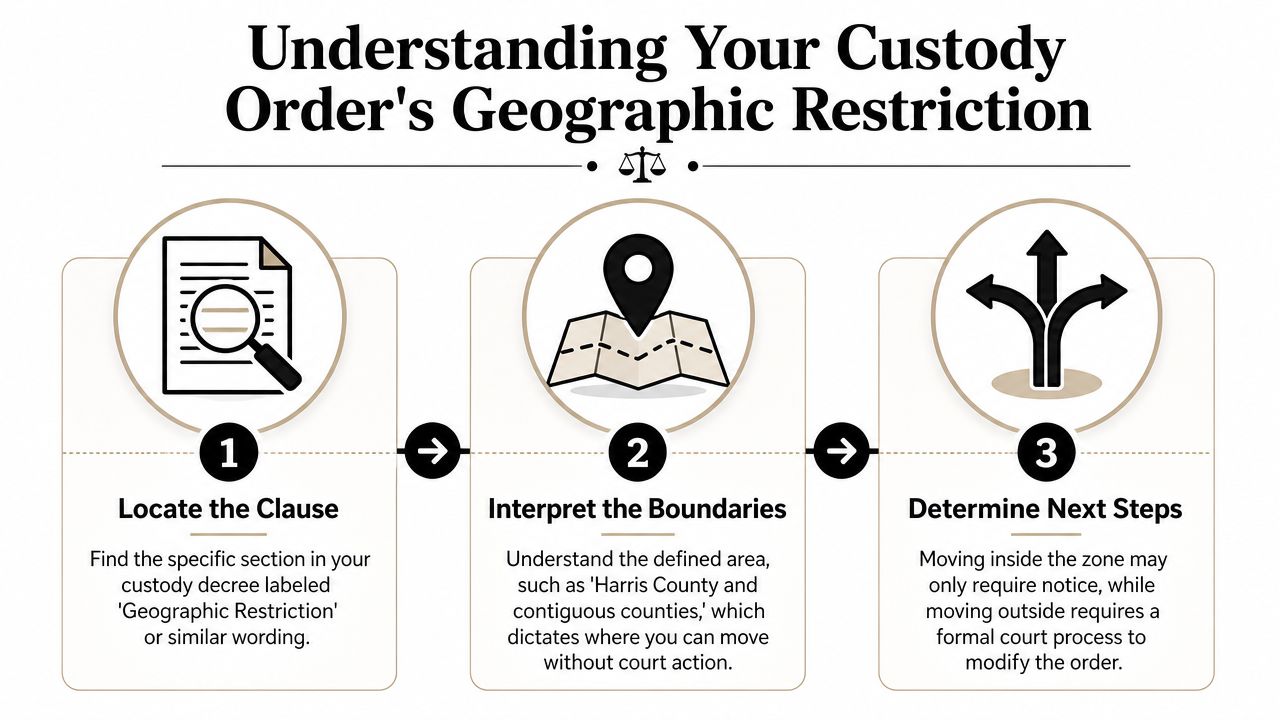
As the infographic shows, figuring out your order's specific boundaries is key. It tells you whether you need to go to court in the first place.
To help you keep track of the major milestones, here's a breakdown of the typical legal stages you'll navigate.
Key Steps in a Harris County Relocation Case
| Legal Step | What It Means for You | Key Consideration |
|---|---|---|
| Petition to Modify | You're formally asking the court to lift the geographic restriction and allow the move. | This document must clearly state how the move serves the child's best interest. |
| Service of Process | The other parent is legally notified of your request, starting their timeline to respond. | Proper service is non-negotiable; without it, the case can't move forward. |
| Temporary Orders Hearing | A judge sets temporary rules for custody, visitation, and communication while the case is pending. | This is a crucial hearing that establishes the "new normal" for the next several months. |
| Mediation | You and the other parent meet with a neutral third party to try and negotiate a settlement. | Harris County courts require mediation. Success here can save you time, money, and stress. |
| Final Hearing/Trial | If no agreement is reached, both sides present evidence and arguments to the judge. | The judge makes the final, binding decision on whether the relocation is approved. |
Each of these steps plays a vital role in the final outcome of your case.
Temporary Orders and Mandatory Mediation
After the initial paperwork is filed, the court will likely schedule a Temporary Orders Hearing. This is a mini-trial that sets the ground rules while the case is ongoing, which can often take several months. The judge might make temporary decisions about who the child lives with, visitation schedules, and how parents communicate until a final decision is made.
Before you get to a final trial, Harris County courts will almost always require you to attend mediation.
Mediation is a confidential meeting with a neutral professional—the mediator—whose job is to help you and the other parent find common ground. A surprising number of relocation cases are settled right here, allowing families in our community to avoid the expense and emotional toll of a trial.
If you can't reach an agreement in mediation, the final step is a trial. Here, both you and the other parent will present your evidence and testimony, and the judge will make the final ruling on whether the move is in your child's best interest.
Proving a Material and Substantial Change in Circumstances
If you want a judge to approve your relocation, you can't just say you feel like moving. You have to prove that the move is necessary because your family’s situation has fundamentally changed since your current custody order was put in place. This is the absolute core of any relocation case.
A judge needs a compelling reason to rewrite a court order. In legal terms, that reason is called a “material and substantial change in circumstances.”
Think of it this way: your last custody order was designed for the life your family was living at that moment. Your job is to show the court that your life looks so different now that the old rules just don't fit anymore, and moving is the best path forward for your child.
What Qualifies as a Material and Substantial Change?
This isn't some fuzzy, abstract idea. It requires real-world proof. For families we work with in Humble, Atascocita, and Kingwood, these changes are often major life events that directly affect a child’s stability and future.
A relocation custody attorney in Harris County will often build a case around circumstances like these:
- A Major Career Opportunity: Landing a new job that comes with a significant pay raise can be a huge factor. It means more financial security and better resources for your child.
- A New Marriage: If you've remarried and your new spouse lives in another city or state, this can absolutely be a valid reason to move, especially if it leads to a more stable, two-parent home.
- Needing Family Support: Sometimes, the best thing for a child is to be closer to grandparents, aunts, and uncles who can provide a much-needed support system for your family.
- Specialized Needs: You might discover a school or medical facility in another area that offers unique programs for your child’s specific health or educational needs.
Under Texas law, the parent requesting the move has to demonstrate that one of these changes has occurred. The law also allows for a modification if the child is 12 years or older and tells the judge they want to move, or if the primary parent voluntarily let someone else have primary care of the child for at least six months.
Of course, you can expect the other parent to argue against the move. They will likely focus on how the distance could disrupt their own relationship with the child, and that’s a valid concern the court will take seriously. This is precisely where having the right legal strategy becomes critical. Your attorney's role is to gather the evidence—job offer letters, proof of family ties in the new city, school acceptance letters, and testimony—to tell a powerful story that shows the judge why this move is truly in your child’s best interest.
How a Relocation Attorney Helps Your Case
Trying to manage a relocation case in Harris County on your own can feel incredibly daunting. The legal requirements are strict, the paperwork can be a nightmare, and the future of your family hangs in the balance. This is precisely when bringing a skilled relocation custody attorney in Harris County onto your team can make all the difference.
You shouldn't have to carry that weight alone. For families in Humble and throughout Northeast Houston, working with an experienced local lawyer from The Law Office of Bryan Fagan means you get a partner who is completely invested in your family's best interests.
Turning Legal Language into a Practical Plan of Action
The first thing we do is sit down and cut through the legal jargon. We'll walk you through your current custody order, explaining in plain English what your rights and responsibilities actually are. Once you have that clarity, we can start building a smart, effective strategy designed to meet your goals while always keeping your child’s well-being front and center.
Here's what an attorney brings to the table:
- Building a Compelling Case: We know what Harris County judges look for. We'll help you gather the specific evidence needed—like a concrete job offer, detailed information about the new school district, and witness testimony—to show the court why the move is a material and substantial change that benefits your child.
- Managing the Complexities: The legal system runs on deadlines and specific procedures. We take care of all the filings, paperwork, and scheduling, preventing simple mistakes that could derail your case.
- Negotiating from a Position of Strength: Whether we're in mediation or just talking with the other parent's lawyer, we advocate for you. Our goal is to secure a fair agreement that protects your parental rights and your relationship with your child.
Having an experienced local advocate means you don't have to carry this heavy burden by yourself. We handle the legal complexities so you can focus on your family.
A relocation case is easily one of the most stressful things a parent can go through. The conflict and the sheer uncertainty of it all can be overwhelming. Let us take that pressure off your shoulders. The attorneys at The Law Office of Bryan Fagan are here to offer the compassionate guidance and tenacious representation you deserve.
We are proud to serve families in Humble, Atascocita, and Kingwood. We invite you to come into our Humble office for a free, no-obligation consultation to talk about your situation. Let's discuss your family, your goals, and how we can help you move forward with confidence.
Common Questions About Relocation and Child Custody
When the idea of moving comes up, the questions start flooding in. It’s completely normal. As relocation custody attorneys in Harris County, we’ve guided families from Humble, Atascocita, and Kingwood through this complex process, and we’ve heard just about every concern you can imagine.
Here are some straightforward answers to the questions we hear most often from your neighbors.
What Happens if I Move Without the Court's Permission?
We can't stress this enough: moving with your child without the court’s blessing, in direct violation of your custody order, is a massive gamble. A Harris County judge has the authority to order you to bring the child back immediately, and they almost always will. The legal fallout can be severe.
A move like that isn't just a simple mistake; it's seen as a willful disregard for the court's authority and an attempt to interfere with the other parent's rights. The consequences can be devastating for your case:
- You could be held in contempt of court, which carries penalties ranging from heavy fines to jail time.
- Your decision-making authority could be stripped, and you might even lose your position as the primary custodial parent.
- The judge could order you to pay every penny of the other parent's attorney fees for having to drag you back to court.
This is precisely why you have to go through the proper legal channels. It’s about protecting your child, and yourself, from a world of trouble.
Does My Child Get to Decide Where They Want to Live?
This is one of the biggest misconceptions we have to clear up for parents in our community. While it’s true that in Texas, a judge must interview a child who is 12 or older to hear their preference, their opinion doesn't automatically rule the day. Think of it as one important voice in the room, but not the final decision-maker.
The judge’s decision will always hinge on the "best interest of the child." A child’s preference is just one factor weighed against many others, like the stability of each parent’s home, the schools, and which parent is better equipped to support the child's emotional needs. The opinion of a thoughtful, mature teenager will certainly carry weight, but it won't override the judge's ultimate duty to look at the entire picture.
Who Pays for Travel Costs if the Move Is Approved?
This is a huge practical and financial question for families. If the court allows the relocation, the new distance obviously makes visitation more expensive. We’re talking about flights, gas for long drives, and maybe even hotel stays.
As a general rule, courts require the parent who is moving to shoulder most, if not all, of these increased travel expenses.
The court’s logic is simple: the move shouldn't create a financial roadblock that prevents the other parent from maintaining a strong, consistent relationship with their child. To avoid any future arguments, the new, modified custody order will clearly outline who pays for what. The goal is always to protect the non-moving parent’s time and bond with their child.
The legal and emotional weight of a relocation case can feel overwhelming, but you don’t have to carry it by yourself. At The Law Office of Bryan Fagan, our team is dedicated to helping Humble families navigate these challenges and find workable solutions. We're your neighbors, and we're here to help. If you’re thinking about moving or have been served with a relocation suit, we encourage you to schedule a free consultation with our Humble office. Let us provide the reassuring, confident support you need. Visit us at https://humbletxlawyers.com to learn how we can help.