Skip to content

A rushed wedding can turn into a legal panic fast. You may be sitting in Humble, Atascocita, Kingwood, or Northeast Houston wondering whether your marriage can be undone because something was wrong from the start. Maybe one spouse hid a major fact. Maybe alcohol or drugs were involved at the ceremony. Maybe the marriage happened too soon after a license was issued, or a prior divorce was concealed.
That's where annulment in Texas becomes important. Unlike divorce, annulment isn't about ending a valid marriage that later broke down. It asks the court to decide whether the marriage should be treated as invalid because a specific legal problem existed when the marriage began.
For local families, timing matters just as much as the facts. Harris County courts won't grant an annulment just because a marriage was short or regretted. You need a recognized legal ground, the right filing procedure, and evidence that supports what happened. If you wait too long, the court may leave divorce as your only option.
Introduction to Annulment in Texas
If you're reading this soon after a wedding that feels wrong, you're not alone. People across Humble and Northeast Houston often assume a short marriage can be “canceled.” Texas law doesn't work that way.
An annulment is a narrow remedy. It's available only in specific situations defined by statute. That's why local court procedure matters. You're not just telling a judge the marriage was a mistake. You're proving that a legal defect existed at the time of the marriage itself.
That distinction confuses many people. A divorce says the marriage was valid, but it's now ending. An annulment says the marriage should not be recognized as valid from the beginning. That difference affects status, property questions, and how the court reviews your case.
Practical rule: If you think annulment may apply, gather your documents and speak with counsel quickly. Waiting can erase the remedy even when the facts are strong.
In Harris County, the process usually starts with a petition filed in district court, followed by formal service and a hearing where the judge reviews proof. For Humble residents, the biggest mistakes are usually delay, poor documentation, and assuming that “short marriage” by itself is enough. It isn't.
Understanding Annulment Under Texas Law
Under Texas law, an annulment treats the marriage as invalid from its inception. Lawyers often describe that as void ab initio. In plain language, the law treats the marriage as though it never legally existed.
That creates a very different result from divorce. Divorce ends a valid marriage. Annulment challenges whether the marriage should have legal effect at all. In practical terms, that can matter for marital status, inheritance questions, and some estate planning decisions.
What makes annulment different
The legal standard is stricter because Texas limits annulment to specific defects tied to the start of the marriage. The court is looking backward to the moment of the ceremony. If the problem arose later, annulment usually isn't the right fit.
A useful way to think about it is this:
- Divorce addresses breakdown. The marriage was valid, but the relationship failed.
- Annulment addresses invalidity. Something legally significant was wrong when the marriage began.
- Evidence must match the timing. The proof has to connect to the wedding date or the legal condition existing then.
Why annulments are uncommon
Annulments are a small part of marriage dissolution in Texas. Texas's overall divorce rate was 1.4 per 1,000 residents in 2021, rising to 2.7 per 1,000 in 2023, with annulments representing only a minor fraction of these figures, according to the Texas Divorce Index historical overview from FamilySearch.
That doesn't mean annulment is unavailable. It means courts reserve it for narrow situations, not ordinary marital conflict. For someone in Kingwood or Atascocita deciding between annulment and divorce, that's the first reality check. If your facts don't match a statutory ground, the court won't use annulment as a shortcut.
Annulment is about legal eligibility, not emotional fairness. A judge may sympathize with your situation and still deny annulment if the statutory ground isn't there.
Statutory Grounds and Eligibility Criteria
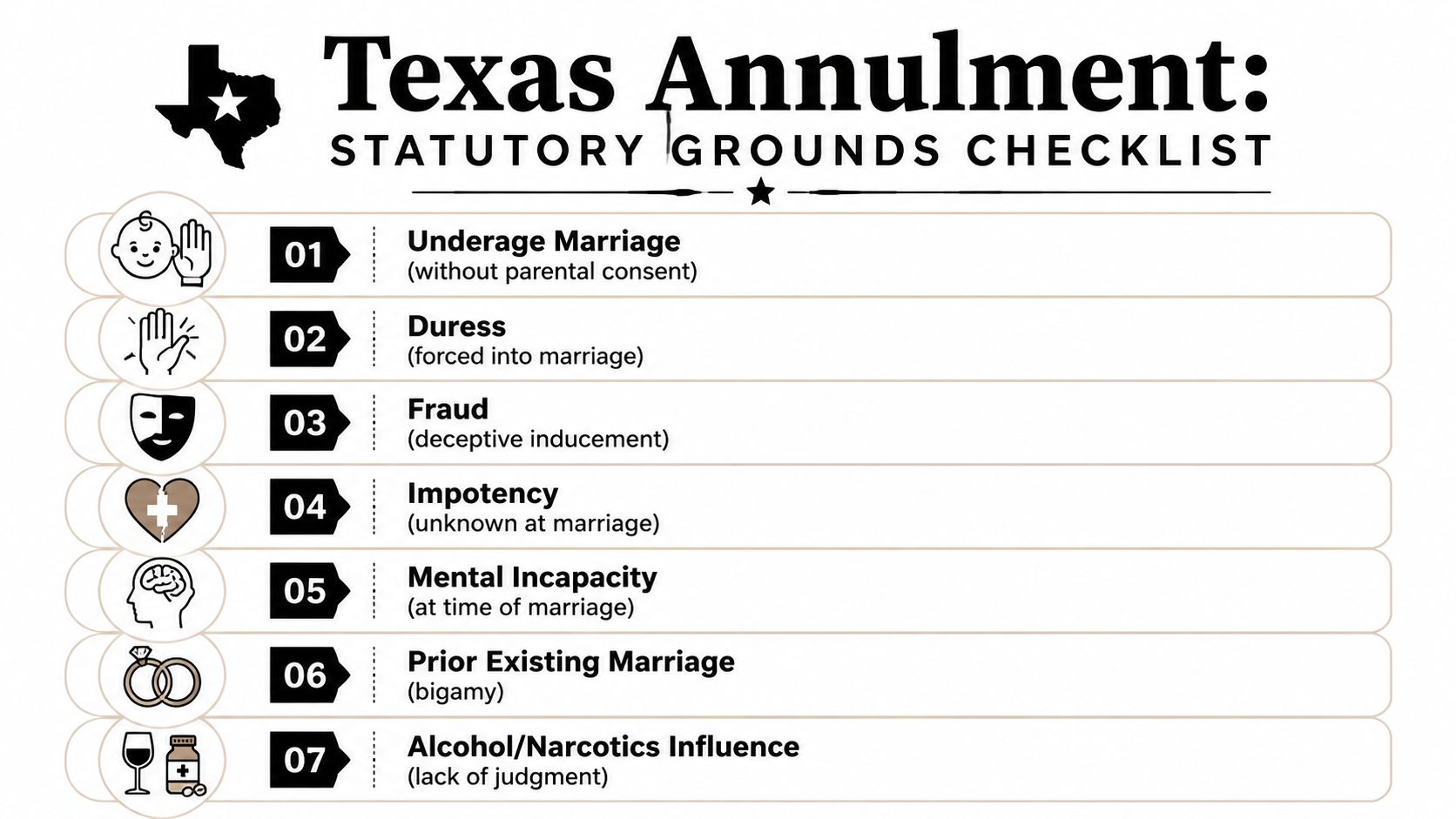
Texas recognizes exactly seven specific grounds for annulment. The list is limited, and the deadlines can be unforgiving. The broad summary appears in this Texas annulment overview, which notes that Texas law recognizes seven grounds, including underage marriage without consent, intoxication, mental incapacity, impotence, fraud, duress, and violation of the 72-hour license wait, with deadlines ranging from 30 to 365 days depending on the ground.
The seven grounds in plain English
Underage marriage without proper consent
This applies when a spouse was under 18 and the required consent was missing.Intoxication by alcohol or drugs
The issue is whether a spouse lacked judgment at the time of the ceremony because of alcohol or narcotics.Mental incapacity
This focuses on whether a spouse lacked the mental ability to consent when the marriage occurred.Permanent impotence
This ground applies when the condition existed at the time of marriage and was unknown to the other spouse.Fraud
This involves deception that induced the marriage.Duress or force
Consent must be real. If someone was forced into the marriage, annulment may be available.Marriage within the prohibited 72-hour period after getting the license
Texas has a waiting rule tied to the marriage license, and violating it can support annulment.
Who can file and when timing controls the case
The right person has to file, and the filing window matters. Some examples are strict. A parent or guardian may need to file in an underage marriage case. In other cases, the spouse seeking relief files directly.
For Harris County families, many cases are compromised from the outset.
- License waiting-period violations: You must move quickly.
- Underage marriages: Parents and guardians need to act promptly.
- Concealed recent divorce: Delay can end the claim.
- Fraud, intoxication, impotence, or incapacity: Even without a fixed statutory deadline in some situations, waiting after discovery can weaken or waive the claim.
If your case turns into a dispute about custody or compliance with later orders, Enforcement of Court Orders in Humble addresses enforcement of divorce decree and custody order provisions in Harris County. That's a different process, but it becomes relevant when a family law dispute continues after the marriage issue is resolved.
Filing Process and Required Evidence
In most cases, the process begins in a Texas district court with an Original Petition to Annul Marriage. For Humble-area residents, that often means dealing with Harris County court procedures, filing requirements, and formal service rules. Annulment cases can move faster than divorce in some respects, but they still require careful paperwork.
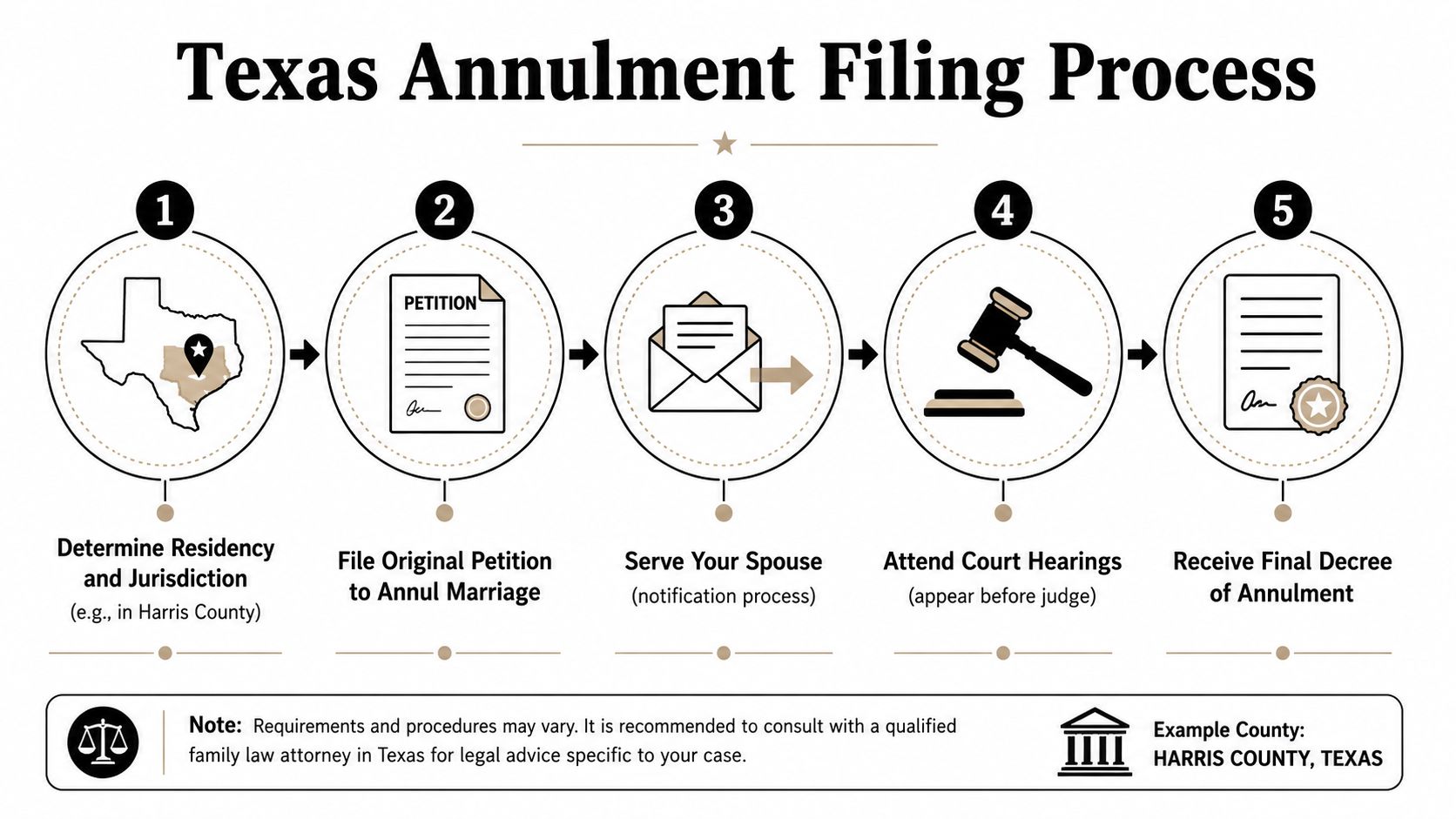
Basic filing steps in Harris County
The court will expect an organized path from filing to proof:
Confirm jurisdiction
Texas can hear an annulment if the marriage occurred in Texas or if one spouse currently treats Texas as a permanent home.File the petition
The petition should identify the statutory ground clearly and state the facts tied to that ground.Serve the other spouse
Formal service usually happens through a constable, sheriff, or private process server.Wait for a response period
The other spouse has time to file an answer.Attend the hearing
The judge will require testimony and supporting proof before signing a decree.
A simple intake system helps people avoid missing records, dates, and witness details. If you're trying to get organized before meeting counsel, this guide to legal client intake documents offers a practical framework for collecting the information lawyers typically need at the start of a case.
What evidence usually matters
Texas courts don't grant annulments on suspicion alone. You need facts that line up with the legal ground. The petitioner must give prove-up testimony showing the defect existed at the time of marriage.
Examples of useful proof may include:
- Fraud cases: Messages, emails, records, or witness statements showing the deception.
- Mental incapacity claims: Medical records or testimony that addresses the condition at the time of the ceremony.
- Intoxication claims: Witness accounts from people present at or around the ceremony.
- Concealed divorce issues: Prior divorce documents and evidence of concealment.
- License waiting-period cases: Marriage license records and ceremony dates.
Bring documents that show dates, not just feelings. In annulment cases, the timeline often decides the result.
According to McConathy Law's discussion of Texas annulment procedure, annulment filing fees in Texas district courts typically range between $250 and $350 depending on the county, and the petitioner must serve the spouse formally before proving grounds at a court hearing. That range can vary by county, so local confirmation is always smart before filing.
Where people in Humble get tripped up
The most common practical problems are ordinary but serious:
- Wrong court paperwork
- Incomplete service
- Weak evidence tied only to later events
- Unclear dates
- Assuming agreement between spouses makes annulment automatic
Even if both spouses want the marriage annulled, the judge still needs legal grounds and proof.
Comparing Annulment and Divorce in Texas
A couple in Humble gets married on a Friday, and within weeks one spouse learns facts that may fit an annulment ground. Another couple in Kingwood has been married for years and cannot keep the relationship together. Those cases may feel similar emotionally, but Texas law sends them down two very different roads.
That difference matters because annulment is narrow and deadline-driven. Divorce is broader. At the Harris County family courts serving the Humble area, people often lose time chasing an annulment label when their facts point to divorce instead.

A simple way to frame it is this: annulment asks whether the marriage was legally flawed at the start. Divorce asks how to end a valid marriage that already existed.
| Aspect | Annulment | Divorce |
|---|---|---|
| Grounds | Specific statutory defects tied to the start of the marriage | Grounds based on ending a valid marriage |
| Legal effect | Marriage is treated as invalid from the beginning | Marriage existed and is legally dissolved |
| Timing | No general 60 day waiting period like divorce, but some annulment grounds have strict filing deadlines or require fast action after discovery | Divorce usually includes a waiting period and follows a more familiar court track |
| Proof | The filing spouse must prove a recognized annulment ground with facts tied to the wedding date or shortly after | Proof depends on the divorce ground, and many divorces proceed on no-fault allegations |
| Best fit | Limited situations that meet a statute | Most marriages that need to end, even when both spouses agree |
Deadlines are where many generic guides fall short. An annulment can sound faster because it does not carry the same waiting rule people associate with divorce, but speed only helps if your facts fit the statute and you file before a deadline closes. In the Humble area, that practical question often matters more than the label itself.
Local procedure matters too. If your case will be filed through a Harris County family court, the judge is not deciding which option sounds fairer. The court looks for the correct legal vehicle, supported by pleadings and proof. Agreement between spouses may make the process less contested, but it does not turn a divorce case into an annulment case.
For a broader explanation of fault and no-fault divorce options, see grounds for divorce in Texas.
This video also gives a helpful overview of the distinction:
One practical point surprises many families. Annulment is not a shortcut for a painful marriage. It is a remedy for a marriage that meets a specific legal defect under Texas law. If the problem is incompatibility, cheating, ongoing conflict, or a relationship that broke down after a valid wedding, divorce is usually the proper route.
Effects on Children Property and Records
People often worry that an annulment will erase a child's legal rights. Texas law does not allow that result. Children born during an annulled marriage remain fully legitimate with the same custody and support rights as in a divorce, and the marriage is void ab initio for property and estate planning purposes, as explained in this Texas annulment discussion.
What happens with children
The marriage may be declared invalid, but parenthood remains fully enforceable. Courts can still enter orders for conservatorship, possession, access, and child support. For parents in Humble or Northeast Houston, that means an annulment does not remove the need for a solid parenting plan.
A simple example helps. If a couple in Atascocita has a child during a marriage later annulled for fraud, the child still has the same legal protection the court would provide in a divorce setting. The judge can still address custody and support.
Property questions can get complicated fast
Because annulment treats the marriage as invalid from the beginning, property analysis can look different from a standard divorce. Instead of assuming a normal marital estate, the court may have to sort out what belonged to each person before the marriage and what was acquired afterward.
If you need a clearer background on how Texas usually treats marital assets, this explanation of community property in Texas helps frame why annulment cases can create unusual tracing issues.
If accounts, vehicles, or home funds were mixed together, property disputes can become one of the hardest parts of an annulment case.
Records and privacy concerns
Annulment filings still create court records. If your case includes medical information, financial records, or sensitive communications, document handling matters. Before you share records with counsel or prepare for filing, it's smart to review practical guidance on protecting sensitive files offline, especially if you're storing personal legal paperwork at home.
For estate planning, an annulment can also affect how you describe marital history and status in future documents. That's one reason many people revisit wills, beneficiary designations, and powers of attorney after the court signs the decree.
Costs Timelines and Common Pitfalls
A common Humble-area scenario goes like this. Someone gets married quickly, learns a fact that may support annulment, then spends a month trying to decide whether to reconcile, move out, or file. By the time they call the district clerk or look up the right courthouse, the legal window may already be closing.

Deadlines often decide the case
Annulment timing works a lot like a coupon with an expiration date. If the statute gives you a short filing period and that date passes, the court does not usually have room to bend the rule just because the facts feel unfair.
As noted earlier, Texas gives only short deadlines for some annulment grounds. Certain claims must be filed within a matter of weeks or months, while others allow more time. One commonly missed example involves a concealed prior divorce, where the filing window can be one year. Local filers in the Humble area often overlook this because generic online guides focus on the legal ground itself and skip the calendar math.
That is why date tracking matters from day one. Write down the wedding date, the date you learned the problem, the date you stopped living together if that applies, and the date any key documents or messages were created. At the Harris County civil and family courts serving this area, those details often shape whether an annulment claim is still available before the judge ever reaches the full story.
Costs are only part of the picture
There is usually a filing fee, and the amount can vary by county and by current clerk practice. You may also face service fees, copying costs, parking, time off work, and possible attorney's fees if the case becomes contested.
For many families, the larger expense is delay.
A paperwork mistake can force you to refile or reset a hearing. Improper service can leave the case sitting still. Waiting too long while trying to work things out informally can also turn an annulment case into a divorce case. That change affects strategy, paperwork, and often cost.
The mistakes judges see again and again
Short marriages cause confusion. A brief marriage does not automatically qualify for annulment. Texas requires a recognized legal ground, and the proof has to match that ground.
Another common problem is continued cohabitation after the spouse learns the truth. In some annulment situations, living together after discovering the fraud, incapacity, or other disqualifying fact can weaken the claim. The law may treat that conduct as acceptance of the marriage despite the earlier problem.
Proof is another stumbling block. Regret is not evidence. Judges usually need records, messages, witness testimony, or other facts that connect directly to the statutory basis you are claiming.
Procedure matters too. Around Humble, people sometimes focus so hard on the reason for annulment that they forget the courthouse basics, filing in the correct court, using the right forms, arranging service properly, and showing up prepared for a hearing even if the other spouse is not fighting the case.
A practical Humble-area checklist
If you are trying to stay organized, use this sequence:
- List every important date on one page
- Save texts, emails, licenses, court papers, and financial records
- Match your facts to a specific Texas annulment ground
- Check whether the filing deadline may expire soon
- Confirm filing and service procedures with the local clerk
- Prepare for the possibility that divorce may be the fallback option
The Law Office of Bryan Fagan in Humble handles family law matters for residents in Humble, Atascocita, Kingwood, and Northeast Houston, including cases where a client needs to evaluate whether annulment or divorce fits the facts.
When to Seek a Humble Family Law Attorney
A lot of people call a lawyer after they have already missed the part that mattered most. In Texas annulment cases, that is often the deadline. A spouse may have a valid ground on paper, but if too much time passes or the couple continued living together after the problem became known, the court may no longer treat annulment as available.
That timing problem gets missed in many general guides. Around Humble, the practical court steps matter just as much as the legal ground itself. You may need to confirm the correct court, prepare a petition that matches a specific statutory basis, arrange service the right way, and show up ready to prove the claim with documents and testimony. An annulment case works a bit like a train schedule. If you have the right ticket but miss the departure time, the result changes.
Legal help is often a smart step if your case involves any of the following:
- A filing deadline may expire soon
- You are unsure which Texas annulment ground fits your facts
- Your spouse disputes fraud, force, incapacity, or intoxication
- You need help gathering records, messages, or witness proof for court
- Children, support, or conservatorship issues may need to be addressed at the same time
- Money or property has already been mixed together
- You may need to switch to divorce if annulment is no longer available
This is especially true for families in Humble, Atascocita, Kingwood, and Northeast Houston who want local guidance instead of a generic checklist pulled from a statewide article. If you are comparing attorneys, this guide on how to choose a family lawyer in Humble Texas gives a practical starting point.
The goal is simple. Protect your deadline, match the facts to the right legal remedy, and avoid a preventable mistake at the courthouse.
If you are facing questions about annulment, divorce, child custody, criminal charges, or estate planning in Humble, Atascocita, Kingwood, or Northeast Houston, the attorneys at the Law Office of Bryan Fagan offer free consultations through the Humble office. A local attorney can review your timeline, explain how the Humble-area filing process usually works, and help you decide whether to pursue annulment now or use another family law option that better fits the facts.