Skip to content

If you're a homeowner in Humble, Atascocita, Kingwood, or anywhere in Northeast Houston, you may be staring at a familiar question: how do you make sure your home passes to the people you love without leaving them with a probate mess?
A lot of families start with the same thought. Mom owns the house. The mortgage is manageable. The kids are grown. Everyone wants a simple plan that avoids court, avoids confusion, and keeps stress low after a loss. That's where many people first hear about a Transfer on Death Deed, often shortened to TODD.
A Texas TODD can be useful. It can also create problems when it's used without understanding the rules that apply in Harris County and the risks that generic online guides tend to skip. That's especially true when Medicaid planning, creditors, blended families, or title issues are part of the picture.
Planning Your Legacy in Northeast Houston
A homeowner in Kingwood recently told me something I hear often: “I just want the house to go to my daughter without everybody ending up in court.” That's a reasonable goal. For many families in Humble and Atascocita, the house is the biggest asset they own, and the one with the most emotional weight.
A Transfer on Death Deed sounds appealing because it promises a direct path. You sign a deed now, keep control while you're alive, and the property passes at death. For some people, that works well. For others, it creates hidden trouble that doesn't show up until after the funeral, when a beneficiary tries to sell, refinance, or sort out debts.
The local reality matters. Harris County families don't just need a form. They need a plan that fits the property, the family structure, and the rest of the estate. A widow in Humble may need one approach. A married couple in Atascocita with children from prior relationships may need another. A parent caring for an adult child may need something more protective than a basic deed transfer.
If you're trying to compare options, it can help to see how legal professionals organize estate documents and workflows. Resources like best estate planning software for lawyers give a useful look at how structured estate planning work is behind the scenes.
For a closer look at local planning options, our estate planning attorney in Humble page explains how wills, trusts, deeds, and probate strategies fit together for Northeast Houston families.
The simplest-looking estate planning tool often causes the most confusion when nobody talks through the “what if” questions first.
What Is a Texas Transfer on Death Deed
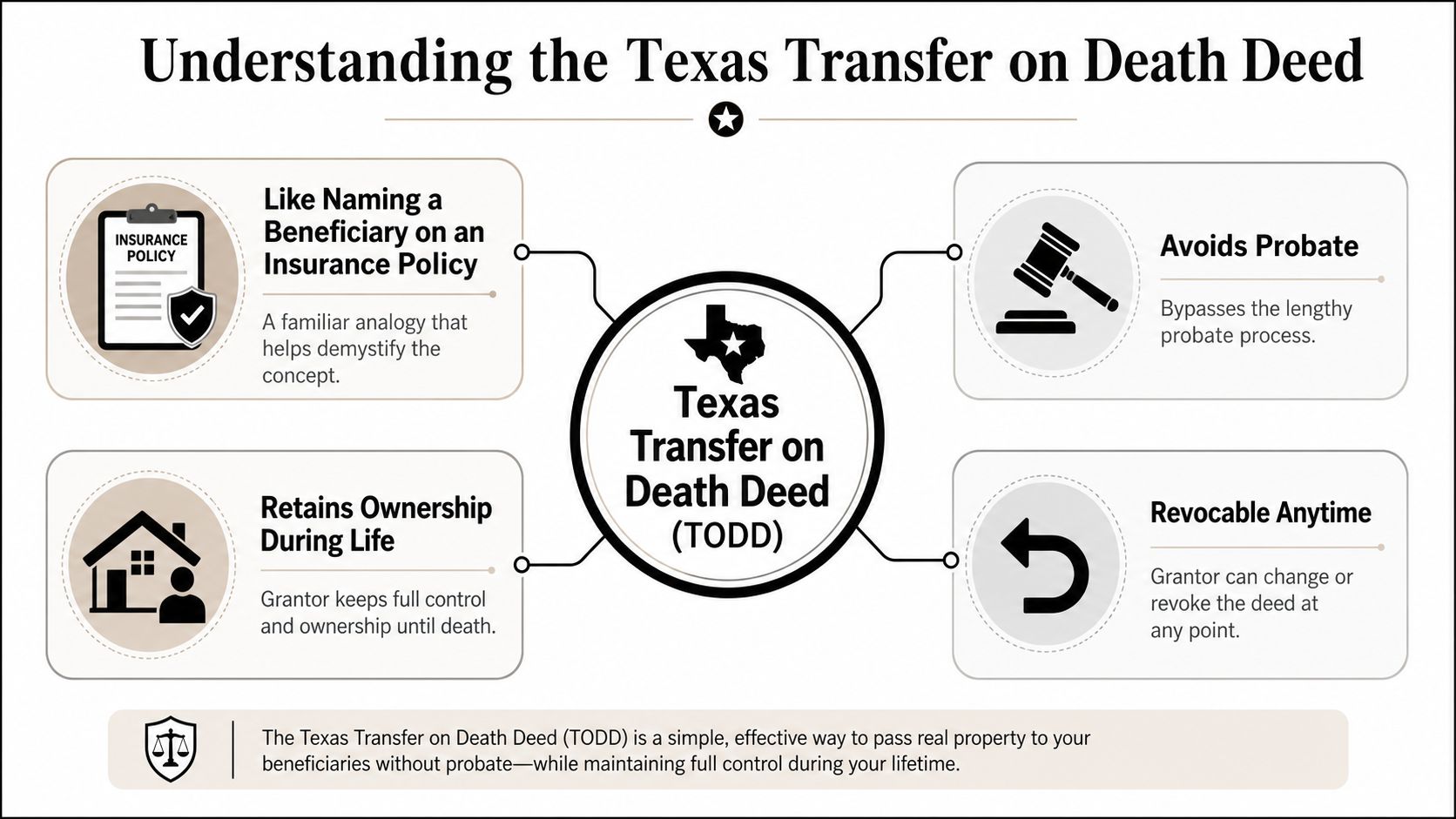
A Texas Transfer on Death Deed is easiest to understand if you compare it to naming a beneficiary on a bank account or life insurance policy, except this one applies to real estate. You still own the property while you're alive. The named beneficiary has no present ownership just because their name appears in the deed.
Under Texas Estates Code Section 114.001, a Transfer on Death Deed is a revocable instrument that lets property owners in Harris County, including Humble, Atascocita, and Kingwood, keep complete ownership and control of their real estate during life while automatically transferring it to named beneficiaries at death without probate court involvement, as described by Kelly Legal Group's discussion of Texas transfer on death deeds.
How the deed works in plain language
Think of it this way:
- You stay in charge: You can still live in the home, sell it, mortgage it, or revoke the deed during your lifetime.
- The beneficiary waits: They don't have ownership rights while you're alive.
- The goal is probate avoidance: If the deed is done correctly, the property can pass outside the standard probate process.
That probate point matters. Many families first start reading about deeds because they're worried about what assets still require probate. If that's your question, this guide on what assets go through probate in Texas can help you place real estate in the bigger estate-planning picture.
Why people in Humble use TODDs
People usually choose a TODD because they want simplicity. They don't want their children waiting on court paperwork to deal with the house. They also want to avoid a situation where a will says one thing, but no one has handled title planning in advance.
That said, a TODD only addresses one category of property. It doesn't solve every estate issue. Bank accounts, retirement accounts, personal property, and family conflict still need separate attention.
If your family is already dealing with another legal process, local procedural guides can be helpful. For example, Harris County Family Courts: A Humble Resident's Guide explains how family law cases proceed in the Harris County courts serving Humble. Estate planning often overlaps with family transitions, especially after divorce, remarriage, or custody changes.
Practical rule: A TODD is a deed tool, not a complete estate plan.
How to Create a Valid TODD in Harris County
A Transfer on Death Deed only works if you get the details right. Small mistakes can turn a document that looks complete into a document that does nothing.
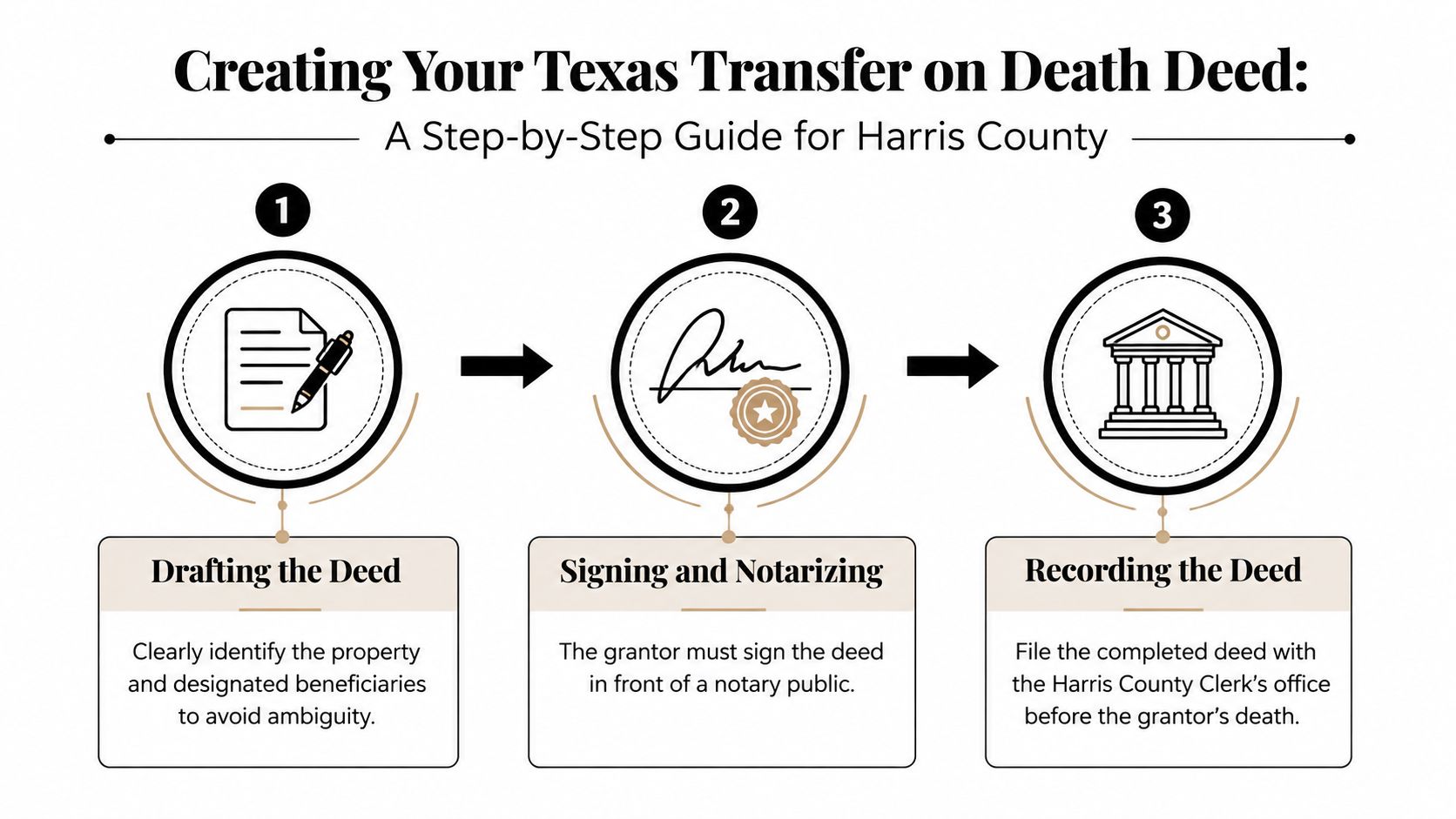
Here's the visual overview first.
Step one is the deed itself
The deed needs to identify the property correctly. Texas guidance on transfer-after-death deeds explains that the instrument must include the precise legal description from the current deed, not tax roll information, and must use the grantor's name exactly as it appears on title. It also must clearly identify itself as a transfer on death deed. The Texas State Law Library's guide explains that a TODD is legally ineffective unless it is recorded with the county clerk in the property's county before the grantor's death, and if it is recorded after death, it fails and the property goes to probate through the Texas State Law Library's transfer property after death guidance.
That legal description point trips people up all the time. Your mailing address is not enough. Tax appraisal records can also contain shorthand or outdated information. The safest starting point is the current recorded deed.
Step two is signing and notarizing
The owner has to sign the deed in front of a notary. If the deed isn't properly signed and notarized, the county clerk won't record it as required.
This is one reason estate planning often overlaps with marital property issues. If the home is separate property, community property, or tied to a prior agreement, the title review matters before anyone signs. In some families, that connects with issues covered by Prenuptial & Postnuptial Agreements in Humble, which involves drafting and review of marital property agreements for Humble clients.
A short video can help if you want a quick visual explanation of the process.
Step three is recording with the Harris County Clerk
This is the part you cannot miss. A signed deed sitting in a drawer is useless if it never gets recorded before death.
Use this checklist:
- Confirm the county: Record it in the county where the property is located.
- Review the deed before filing: Check names, legal description, and beneficiary information carefully.
- Record before death: If filing happens after the owner dies, the deed fails.
- Keep proof: Maintain a recorded copy with estate records so your family can find it.
If your broader goal is to keep property out of probate, our page on how to avoid probate in Texas explains how TODDs fit with other planning tools.
TODD vs Other Texas Estate Planning Tools
A TODD works well in some situations, but it isn't the only path. Families in Humble, Kingwood, and Atascocita often compare it with a will, a revocable trust, or a Lady Bird Deed.
Texas estate planning tool comparison
| Feature | Transfer on Death Deed | Will | Revocable Trust | Lady Bird Deed |
|---|---|---|---|---|
| Main purpose | Transfer real estate at death | Direct who receives property at death | Manage and transfer assets through a trust structure | Transfer real estate at death while retaining lifetime control |
| Probate avoidance for real estate | Yes, if properly completed and recorded | No, property generally passes through probate | Generally yes, if property is properly placed in trust | Generally used to avoid probate |
| Control during lifetime | Owner keeps full control | Owner keeps full control until death | Creator usually controls trust assets as trustee during life | Owner keeps strong lifetime control |
| Can be changed | Yes, by proper revocation or replacement before death | Yes, while the person has capacity | Yes, typically while revocable | Often flexible, depending on drafting |
| Covers non-real-estate assets | No | Yes, in the estate plan sense | Yes, if assets are titled into the trust | No |
| Good for simple home transfer | Often yes | Sometimes, but probate may still be needed | Sometimes, especially for more complex estates | Often yes |
| Creditor and recovery concerns | Important concerns exist | Estate debts are handled in probate | Depends on structure and administration | Different analysis applies than a TODD |
| Best fit | A straightforward property transfer with limited complexity | Basic estate instructions | Families wanting more coordination and control | Owners comparing probate avoidance tools for real estate |
When each tool tends to fit
A will is often the starting point, but it doesn't by itself keep a house out of probate. A revocable trust can offer more coordination if you have multiple assets, a blended family, or concerns about how property should be managed after death.
A Lady Bird Deed often comes up in the same conversation as a TODD because both can avoid probate for real estate. The legal consequences are not identical, though. That difference becomes important when people start asking about creditors and recovery claims.
For families comparing several routes at once, Estate Planning Attorney in Humble is a useful starting point for understanding wills, trusts, and estate plans for Humble families.
A good estate plan doesn't just answer “who gets the house?” It also answers “what could go wrong before they get clear title?”
Critical Risks and Common Pitfalls of TODDs
Many online articles fall short. They explain the convenience of a TODD and stop there. In practice, the risks often matter more than the setup.
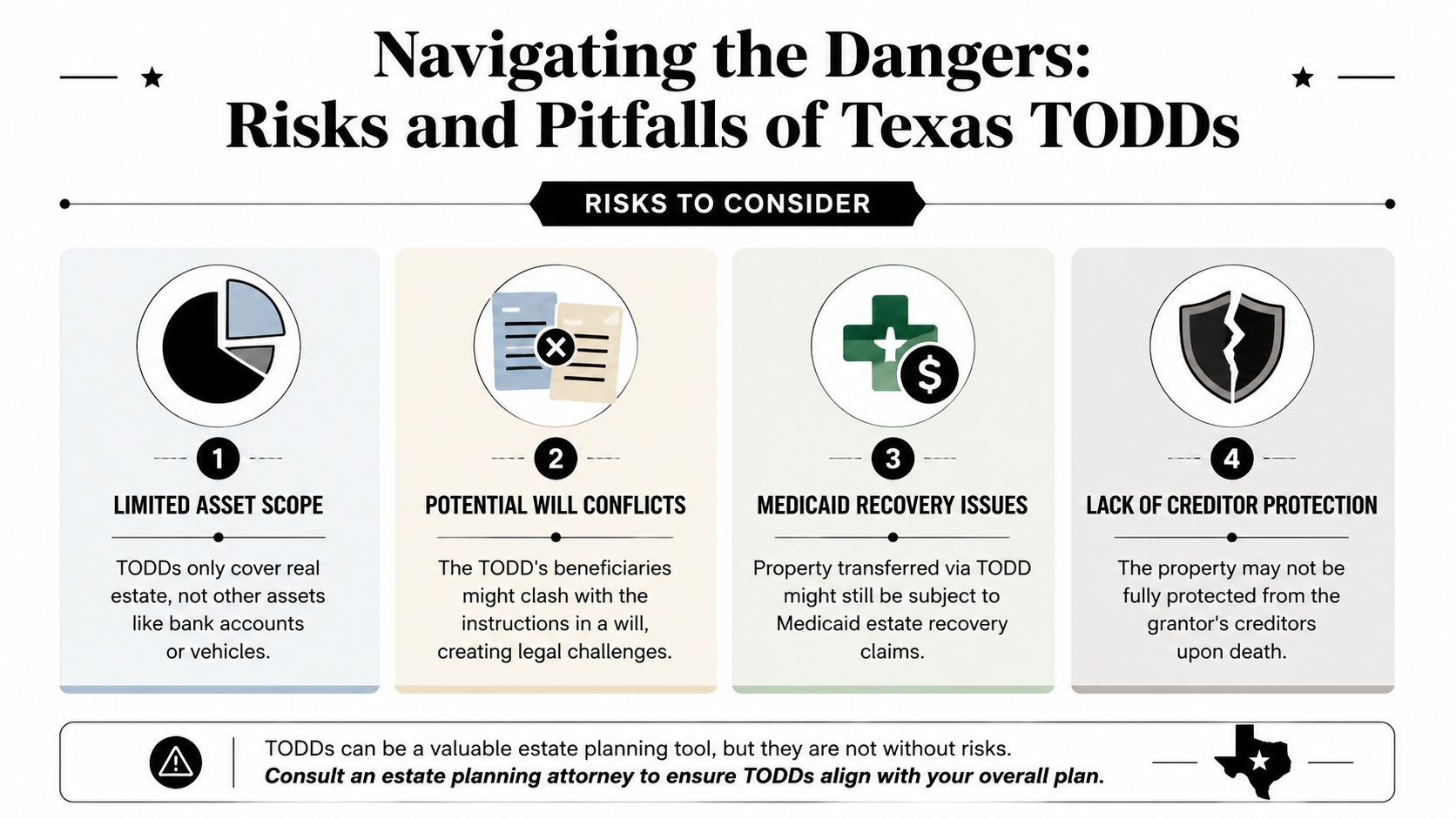
The Medicaid recovery trap
A common misunderstanding is that a TODD protects the home from Medicaid Estate Recovery Program claims. It doesn't. Texas law allows MERP to pursue claims against property passed through a TODD, which means the deed offers no shield against Medicaid recovery, as explained in this discussion of Texas transfer on death deeds and MERP.
That catches families off guard. They hear “avoids probate” and assume “protected from recovery.” Those are not the same thing. If long-term care planning is part of your concern, a deed alone may be the wrong tool.
The two-year creditor window
A Texas TODD also comes with a major creditor issue. Under Texas Estates Code § 114.106, a TODD is subject to a mandatory two-year creditor clawback window, meaning creditors can force the property back into the deceased owner's estate to satisfy debts even after title has transferred, as described in Silverleaf Legal's review of Texas TODD creditor risks.
That means the beneficiary may feel like they own the property, but the title isn't as clean and settled as many people expect right after death.
Other practical problems families run into
Here are the pitfalls I see confuse people most:
- Beneficiary assumptions: People think naming one child on the deed will somehow “work out fairly” with the others later. Sometimes it does. Sometimes it creates a major family conflict.
- Minor beneficiaries: A child can be named, but that doesn't make later management simple.
- Mismatch with the rest of the estate plan: A deed can conflict with what the family thinks a will says or what everyone thought was the plan.
- Sale timing issues: If the beneficiary wants to sell soon after death, title review becomes especially important. A practical background resource is this 2026 Texas title insurance guide, which helps explain why title concerns matter in post-death property transfers.
For estates that do end up needing court supervision, Probate Lawyer in Humble, TX covers probate administration and estate settlement in Harris County.
A TODD can avoid probate and still leave a family with real legal exposure.
What a Beneficiary Must Do After the Owner Dies
A common Harris County scenario goes like this. A parent dies, the family knows a transfer on death deed was signed, and everyone assumes the house now belongs to the named child automatically. Then the child tries to deal with insurance, utilities, or a future sale and learns there is still paperwork to finish.
That surprise causes a lot of confusion. A Texas TODD works more like a set of instructions that activates at death than a house key that instantly solves every title issue.
TexasLawHelp explains two rules that matter at the start. The beneficiary must survive the owner by at least 120 hours, or five days. The beneficiary also must file a notarized Affidavit of Death in property records to complete the transfer, as explained in TexasLawHelp's guide to Transfer on Death Deeds.
Here is the practical order I would want a family to follow:
- Confirm the survival rule applies: If the named beneficiary did not outlive the owner by the required period, the deed does not transfer the property to that person.
- Find the recorded deed: Use the actual recorded document, not an unfiled draft or a photocopy from a home file.
- Prepare the Affidavit of Death carefully: It needs to be notarized before it is filed.
- File it with the county clerk: In Harris County, recording that affidavit is the step that updates the deed records after death.
- Check title before making big decisions: If the beneficiary plans to sell, refinance, or even add a new owner, a title company may ask for more review before treating title as marketable.
That last point gets missed in a lot of generic articles. Recording the affidavit is often necessary, but it is not the same thing as proving the property is free from later problems.
For local families, two risks deserve special attention. First, a TODD does not erase the possibility of creditor claims during the two-year period discussed earlier. Second, Medicaid estate recovery can still become an issue in the right set of facts, even when the home passed outside probate. In plain English, the beneficiary may have the house in the records and still face claims that affect whether the property can be kept or sold cleanly.
That is why beneficiaries should pause before treating the home like fully settled property. Change the insurance. Secure the home. Keep paying taxes and the mortgage if there is one. But before listing the property for sale, signing a deed, or distributing sale proceeds among siblings, get clarity on whether any creditor, Medicaid, or title issue is still hanging over the property.
The filing itself is usually the simple part. The hard part is understanding what the filing does, and what it does not do, during a stressful time.
Answering Your Questions About Texas TODDs
A Humble parent signs a transfer on death deed, feels relieved, and assumes the house is now fully “handled.” Then life changes. The named child is still a minor. A beneficiary dies first. A will gets updated later and says something different. These are the questions that usually show up after the deed is signed, not before.
Can I name a backup beneficiary
Often, yes, but the wording has to be precise. A TODD is a title document, so small language choices can create big confusion later. In blended families, second marriages, or situations where a beneficiary has health problems, that detail matters even more.
A good way to think about it is this. The deed needs to answer the "what if" question before a crisis does. If it does not, the family may end up arguing over who owns the house or whether probate is still needed.
What if I name my minor child
You can name a minor child, but that does not make the transfer simple. A minor cannot easily handle the practical tasks that come with a house, such as signing sale papers, dealing with insurance, or coordinating repairs.
That is where many Harris County families need more than a stand-alone deed. If the child is young and the home might need to be sold or managed for years, a broader estate plan often gives the family a cleaner path.
Can I change my mind later
Yes. A Texas TODD can be revoked or replaced during your lifetime if the correct document is signed and recorded before death.
That last part matters. Recording is what puts the change into the land records. If your will says one thing but your recorded TODD says another, the recorded deed usually controls the house. Families are often surprised by that.
Does a TODD fully protect the beneficiary from claims
No. As noted earlier, Texas law gives creditors a two-year window to pursue certain claims tied to the property after the owner dies. So the beneficiary may appear on the deed records and still face a problem that affects a sale, refinance, or long-term ownership.
There is also a risk generic articles often skip. Medicaid estate recovery can still come into the picture in some situations, even if the home passed outside probate. For Harris County families trying to protect a parent's house, that is one of the easiest traps to miss.
So when does a TODD make sense
A TODD often works best when the facts are straightforward. One home. Clear title. One clear beneficiary. No major concern about Medicaid recovery, creditor exposure, or conflicts among family members.
Once the facts get messier, the deed may still be part of the plan, but it should not be the whole plan. A family may need a will, a trust, or a closer review of title and long-term care issues so the home does not create problems later.
The Law Office of Bryan Fagan handles estate planning matters for Humble-area families, including wills, trusts, probate, and deed-based planning. That kind of review can help a family decide whether a TODD is a helpful shortcut or a risky oversimplification.
If you live in Humble, Atascocita, Kingwood, or elsewhere in Northeast Houston, be careful about treating a TODD like a one-size-fits-all fix. A small drafting error can leave the house tied up in probate. A larger planning mistake can leave your family dealing with the two-year creditor window or a Medicaid recovery issue they did not expect.