Skip to content

Your son in Atascocita is lining up cap-and-gown photos. Your daughter in Kingwood just told you the graduation rehearsal date. You're proud, relieved, and probably doing practical math in your head at the same time. One question keeps coming up: When can you stop paying child support in Texas?
That question sounds simple, but for many parents in Humble, Northeast Houston, and across Harris County, the answer gets tangled fast. A child turns 18, but they're still in high school. A graduation date changes. Wage withholding keeps coming out even though you thought the obligation should be over. Parents often assume the calendar controls everything. In reality, the calendar matters, but so does the court process.
I've seen how stressful that gap can feel. You want to follow the law, avoid overpaying, and protect yourself from future problems. You also don't want to make a move that creates arrears or puts you back in court over a misunderstanding.
Navigating the End of a Financial Chapter
For many parents, this stage arrives with mixed emotions. You may be celebrating a milestone while also wondering whether your monthly support obligation is finally ending. That's especially common for parents in Humble, Kingwood, and Atascocita who've been paying under an order for years and expect the process to end automatically.

A typical example looks like this. A parent lives in Northeast Houston, support has been withheld from each paycheck, and the child is finishing senior year. The parent assumes the last payment will line up with graduation day. Then another paycheck is deducted, and another. By then, frustration sets in because the parent thought the legal duty had already expired.
Why parents get tripped up
Texas law has a basic rule, but real life doesn't always fit neatly inside it. Some children turn 18 before graduation. Some stay enrolled longer. Some parents are dealing with a child who has a disability. Others face less common situations, such as early emancipation.
On top of that, there's a major procedural issue in Harris County and elsewhere. The event that ends support and the act that stops withholding are not always the same thing. That's where many costly mistakes happen.
Practical rule: Never assume your employer, the other parent, or the payment system will stop child support on its own.
If you're searching for clear answers about when can you stop paying child support in Texas, the safest approach is to separate the issue into two parts:
- The legal end date: When the support obligation should end under Texas law.
- The enforcement end date: When wage withholding stops because the court signed the right order.
That distinction can save a lot of trouble.
The Standard Rules for Ending Child Support in Texas
The starting point is Texas law's general rule. Under Texas Family Code § 154.001, child support ends on the later of the child turning 18 or graduating from high school. Texas law also creates a hard cap at age 19 for non-disabled children if the child doesn't meet enrollment requirements under § 154.002(a). The Texas State Law Library's child support guide explains that support continues only until the earlier of graduation or age 19 if the child remains in high school past 18, and noncompliance with attendance requirements can trigger termination under § 154.006(4)(A-B) (Texas child support guide).
Think of it like two gates
A simple way to understand the rule is to think of two gates. One gate is the child's 18th birthday. The other gate is high school graduation. In most cases, support doesn't end until the child has passed the later gate.
If your child graduates before turning 18, support usually keeps going until age 18. If your child turns 18 during senior year, support usually keeps going until graduation. If the child is still in school after 18, the law still limits how long support can continue for a non-disabled child.
Texas child support termination triggers
| Scenario | Child Support Termination Date |
|---|---|
| Child turns 18 after already graduating high school | Generally when the child turns 18 |
| Child turns 18 while still enrolled in high school and continues meeting enrollment requirements | Generally at graduation |
| Child remains in high school past 18 but does not reach graduation before the statutory cap applies | Earlier of graduation or age 19 for a non-disabled child |
| Child fails required enrollment or attendance standards while still in high school past 18 | Support may terminate based on noncompliance findings under the statute |
A few examples parents often ask about
A Humble parent may ask, “My child turns 18 in February but graduates in May. Do I stop in February?” Usually, no. Under the general rule, support continues until the later event.
A Kingwood parent may ask, “My child is still in high school after turning 18. Does support just go on indefinitely?” Again, no. For a non-disabled child, the law places a limit tied to graduation, age 19, and enrollment compliance.
If you're dealing with establishing, modifying, or enforcing support in Harris County, a Child Support Attorney in Humble handles those matters locally.
The age rule is only half the answer. The paperwork matters just as much.
That's where many parents in Northeast Houston get caught off guard. They identify the correct end date, but they don't take the legal steps needed to stop withholding.
When Support Can End Before Graduation
Not every case follows the standard path of age and school status. Sometimes child support can end earlier because the child's legal status changes in a major way. When that happens, parents often think the duty disappears on its own. That assumption can create trouble.
Life events that may end support early
Texas parents commonly hear the word emancipation, but they aren't always sure what it means in practice. In plain terms, it refers to situations where the child is no longer legally treated as dependent in the same way.
Examples can include:
- Marriage: If the child marries before adulthood, that may end the support obligation.
- Military service: If the child joins the armed forces, that can change the analysis.
- Court-declared emancipation: A judge can issue an order that changes the child's legal status.
- Death of the child: In that heartbreaking situation, support ends.
These events are significant because they can cut off the need for future support before the usual age or graduation point.
The trap of informal assumptions
Parents sometimes rely on conversation instead of court action. One parent says, “Don't worry about it anymore,” and the other stops paying. That can backfire if the order remains in place and wage withholding or enforcement continues.
A safer way to think about it is this: the life event may create the reason support should end, but the court process still controls how that change is recognized and enforced.
If your case also involves compliance issues with prior orders, Enforcement of Court Orders in Humble covers enforcing divorce decree and custody order provisions in Harris County.
What you should do if one of these events happened
If you believe support should end early, take these steps promptly:
- Collect proof of the event. That may include a marriage record, military paperwork, or a court order.
- Review the wording of your current order. The exact language matters.
- Move quickly to update the court record. Waiting can leave old withholding in place.
- Keep paying until the order is addressed. Self-help usually creates more problems than it solves.
If the written order still exists, treat it as active until a judge changes it.
That may feel overly formal, but it's how parents protect themselves. In family law, the difference between “this should be over” and “this is legally over” matters a great deal.
Special Rules for a Child with a Disability
Families caring for a child with a disability face a different legal reality. The usual end point doesn't always apply, and parents on both sides of the support order need clear guidance early.

Texas law permits continued support beyond high school and beyond age 18 when a child has a physical or mental disability that is indefinite in duration. That rule is recognized under Texas Family Code Sections 154.001 and 154.002 (Texas disability-related child support overview).
What this means in everyday terms
This isn't about a short-term condition or a temporary setback. The court looks at whether the child's physical or mental disability is ongoing and whether continued support is appropriate under the law.
For parents in Humble and Atascocita, that often raises hard questions:
- Will support continue after graduation?
- Does the original order already address disability?
- Does someone need to file for modification?
- Should support connect with broader planning for long-term care?
Those questions matter because families often need a coordinated plan, not just a narrow support order. In some situations, a special needs trust in Texas may become part of the larger planning picture.
Why planning early matters
Some parents assume they can wait until the child is close to age 18 and sort it out then. That delay can create conflict, confusion, and pressure when everyone is already managing school transitions and medical concerns.
A better approach is to address disability-related support before the standard end date becomes an immediate issue. That gives the court time to evaluate the circumstances and gives the family time to organize records, care plans, and financial expectations.
Families dealing with disability-related support usually need both legal clarity and practical planning.
For Northeast Houston families, this area deserves careful attention. It touches not only child support but also guardianship concerns, benefit protection, and long-term caregiving arrangements.
How to Legally Stop Child Support Payments in Harris County
The biggest misunderstanding I see is simple. Parents think support stops when the child “ages out.” In many cases, that's when the obligation should end, but withholding usually doesn't stop until the court process is completed.
A Harris County parent needs to treat this as a legal task, not just a calendar event.
The rule that surprises most parents
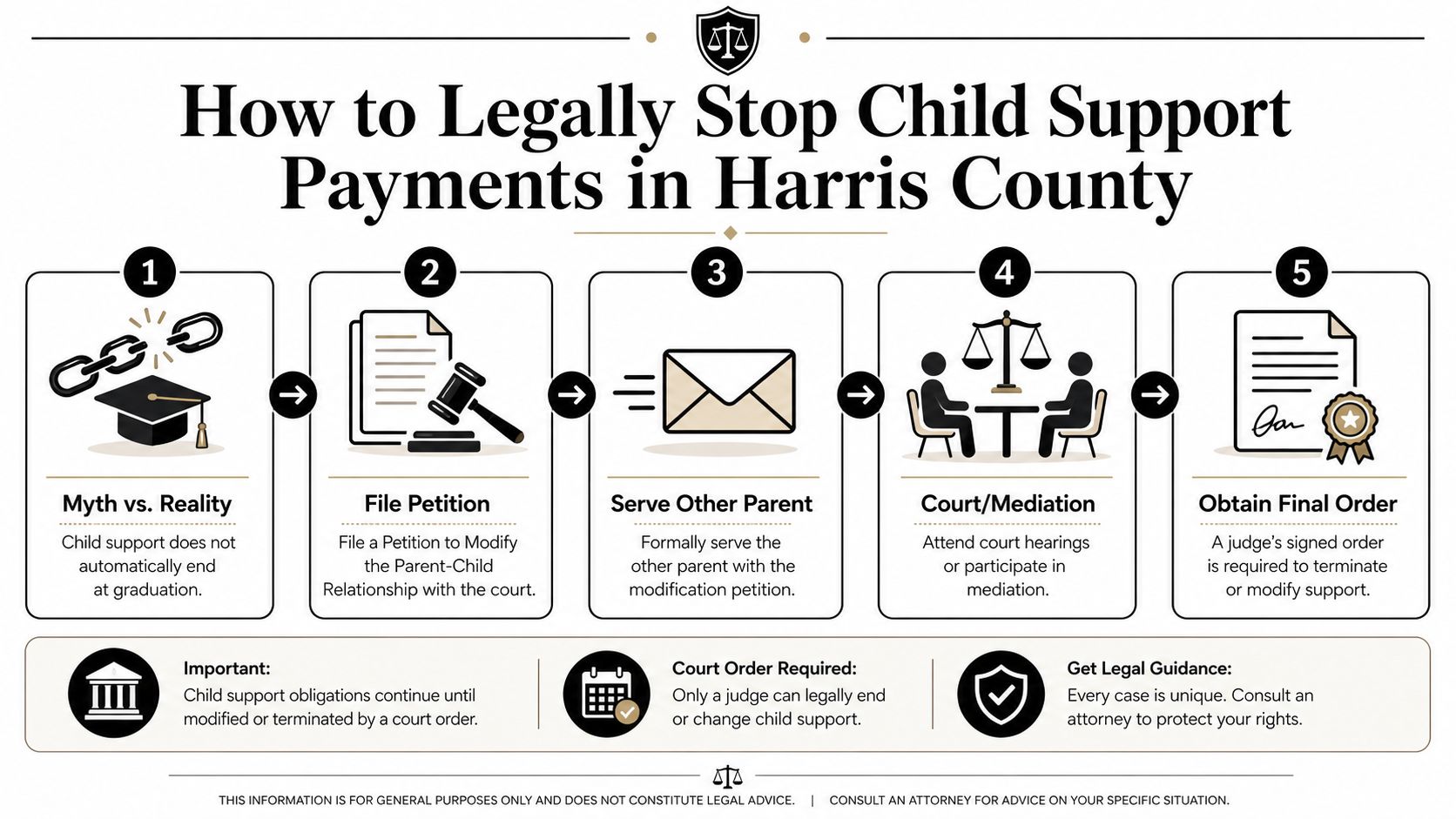
Child support does not automatically terminate for withholding purposes just because the child reaches the age of majority or graduates. The obligor must file a formal Motion to Terminate Withholding for Child Support in the original court, serve the obligee, and obtain a signed judicial order before withholding stops. The same source explains that systems such as the State Disbursement Unit continue processing payments unless the court intervenes, and it warns that delay can create a gap in which payments continue and arrears issues may develop, including risk if the obligor doesn't act within 30 days of the qualifying event (Texas motion to terminate withholding guidance).
A practical Harris County action plan
If you live in Humble, Kingwood, Atascocita, or nearby Northeast Houston, use a checklist like this.
- Confirm the triggering event
Before filing anything, make sure the legal end date has arrived. That may be graduation, the child's 18th birthday, or another qualifying event tied to your order.
Pull the original order
Read the existing decree or support order carefully. The court that issued that order is usually the place where you'll need to file.
Prepare the motion
In many cases, the document used is a Motion to Terminate Withholding for Child Support. The paperwork needs to match the facts of your case and the court's prior orders.
Serve the other parent
The other parent has to receive proper legal notice. This step is not optional just because everyone already knows the child graduated.
Get a signed order
Wage withholding doesn't stop because a motion was filed. It stops when the judge signs the order and the withholding instructions are updated.
Here's a helpful visual overview before moving further into the details:
Why the SDU and payroll may keep taking money
Many parents assume their employer will automatically stop deductions once the child graduates. Employers usually don't make that call. They follow the active withholding order on file. The State Disbursement Unit also keeps processing payments until the legal paperwork changes.
That's the procedural gap many parents miss. The child may have reached the legal milestone, but the collection system hasn't received a new signed order yet.
Local help and the right type of filing
Some parents need a narrow termination filing. Others need a broader review because the facts are disputed, multiple children are covered, or the support amount changed over time. In those situations, a modification analysis may be part of the process. For that issue, how to modify child support in Texas is closely related.
The Law Office of Bryan Fagan's Humble office works on local family law matters such as child support, custody, and related court filings in Harris County. For many parents, that means handling the paperwork, service, and court order required to stop withholding the right way.
What to gather before you file
Bring together the documents that answer the court's basic questions:
- Your current order: The judge needs the exact language already in place.
- Proof of the ending event: Graduation records or other supporting documents may matter.
- Payment records: Keep track of what was withheld and when.
- Employer information: If withholding runs through payroll, accurate details help with implementation.
A careful filing now can prevent a messy dispute later. That matters whether you live right in Humble or commute from Kingwood into downtown Houston and need your payroll deductions corrected without delay.
Risks Arrears and Your Next Steps
Stopping payments on your own is one of the most expensive mistakes a parent can make in a child support case. Even if you believe support should be over, the court order remains dangerous if you ignore it. In Texas family law, arrears are past-due support amounts that remain legally collectible.
Ending future support doesn't erase unpaid support from the past. If money is still owed under an existing order, that balance can continue to follow you.
Why self-help creates bigger problems
A parent may think, “My child is grown. I'm done.” Then payroll stops because the parent changed jobs or canceled direct payment on their own. The court, however, may still see an enforceable order and missed payments.
That can lead to serious consequences, including:
- Growing debt: Unpaid support can continue as an enforceable balance.
- Enforcement actions: The other parent or the state may still pursue collection.
- Court exposure: A judge may view nonpayment as failure to follow the order.
- Personal disruption: Child support problems often spill into credit, licensing, and employment stress.
For parents trying to understand an unpaid balance, how to calculate child support arrears in Texas is a useful starting point.
Timing matters in Harris County
There's another procedural detail parents often miss. To legally stop withholding, the obligor must contact the Domestic Relations Office at least 45 days before the intended last payment date, and the other parent gets 15 days to object before enforcement officials review the matter (Texas DRO timing guidance).
That doesn't mean every case is simple if you call on time. It means waiting until the last minute can make a routine transition harder than it needs to be.
Parents who act early usually have more room to correct paperwork, respond to objections, and avoid unnecessary withholding.
Quick answers to common questions
Does a private agreement with the other parent end support
No private conversation is a safe substitute for a court order. Even if both parents agree, the written order still controls until the court changes it.
What if my child has a job
A child getting a job doesn't automatically end support. Employment may matter in some broader factual discussions, but the court order and Texas law still control the actual obligation.
What if there are multiple children on the same order
That situation often needs a careful review of the existing terms. One child aging out doesn't always mean all withholding should stop. Sometimes the amount needs adjustment instead of full termination.
I live in Kingwood or Atascocita. Do I still handle this through Harris County
If your case was filed in Harris County, the originating court usually remains central to the process. The exact filing path depends on your order and any transfer history.
What should I do first if I'm not sure whether support already ended
Start by reviewing the signed order, the child's school status, and the date of the triggering event. Then check whether a separate order has been signed to stop withholding. If not, don't assume the system has caught up.
When people ask when can you stop paying child support in Texas, the safest answer is this: when the law says the obligation has ended and the court has properly entered the order that stops withholding. Both parts matter.
If you live in Humble, Atascocita, Kingwood, or Northeast Houston and need help sorting out the end of a child support order, schedule a free consultation with Law Office of Bryan Fagan. Our Humble office works with local families on family law, criminal defense, and estate planning matters, and we can help you understand your next legal step with clarity and care.