Skip to content

If you're sitting at a kitchen table in Humble, Kingwood, or Atascocita with old bank statements, text messages, and a child support order in front of you, you're probably asking a simple question that doesn't feel simple at all: how much is owed?
That question usually comes after months, or longer, of stress. Groceries still have to be bought. School costs still show up. Life in Northeast Houston doesn't pause because the other parent stopped paying. What makes this harder is that child support arrears in Texas aren't just a stack of missed payments. The total can involve the original amount due, credits for payments that were made, and interest that keeps building.
For many families, the hardest part is getting organized enough to see the number clearly. Once you do, the situation becomes more manageable. You can compare your records with court records, decide whether to work through the Office of the Attorney General, and figure out whether a Harris County enforcement case makes sense.
Facing Unpaid Child Support in Humble
Many parents first notice a problem gradually. One payment is late. Then a partial payment arrives. Then nothing. By the time you're trying to total everything up, the paper trail may already feel messy.
That is common. In Humble and nearby communities like Atascocita, Kingwood, and Northeast Houston, parents often juggle work, school schedules, and transportation while also trying to understand a court order written in legal language. Child support arrears calculations can feel intimidating because the law uses terms that sound financial and technical, even though the underlying issue is basic family stability.
Start with the right question
The question usually isn't just, "How behind is the other parent?" A better starting point is, "What does the court order require, what was paid, and what has accumulated since then?"
That difference matters. Some cases involve a straightforward list of missed monthly payments. Others involve modified orders, partial payments, or periods where income changed and the court has to sort through records carefully.
When parents bring clear payment records to court, the conversation shifts from confusion to proof.
If you're trying to sort that out locally, unpaid child support issues in Humble often involve both practical math and Harris County procedure. Both matter.
What usually helps
A manageable approach looks like this:
- Find the controlling order. That tells you what was due and when.
- Match the order against payment history. This shows the unpaid principal.
- Review whether the amount needs a guideline calculation. That matters in some arrears and retroactive support disputes.
- Add statutory interest where required. The final debt is often higher than parents expect.
- Prepare for enforcement. A number on paper only helps if you can present it clearly.
Parents don't need to solve everything in one sitting. They do need a method. That's how you turn a stressful unknown into something the Harris County courts can evaluate.
Understanding the Core Components of Arrears
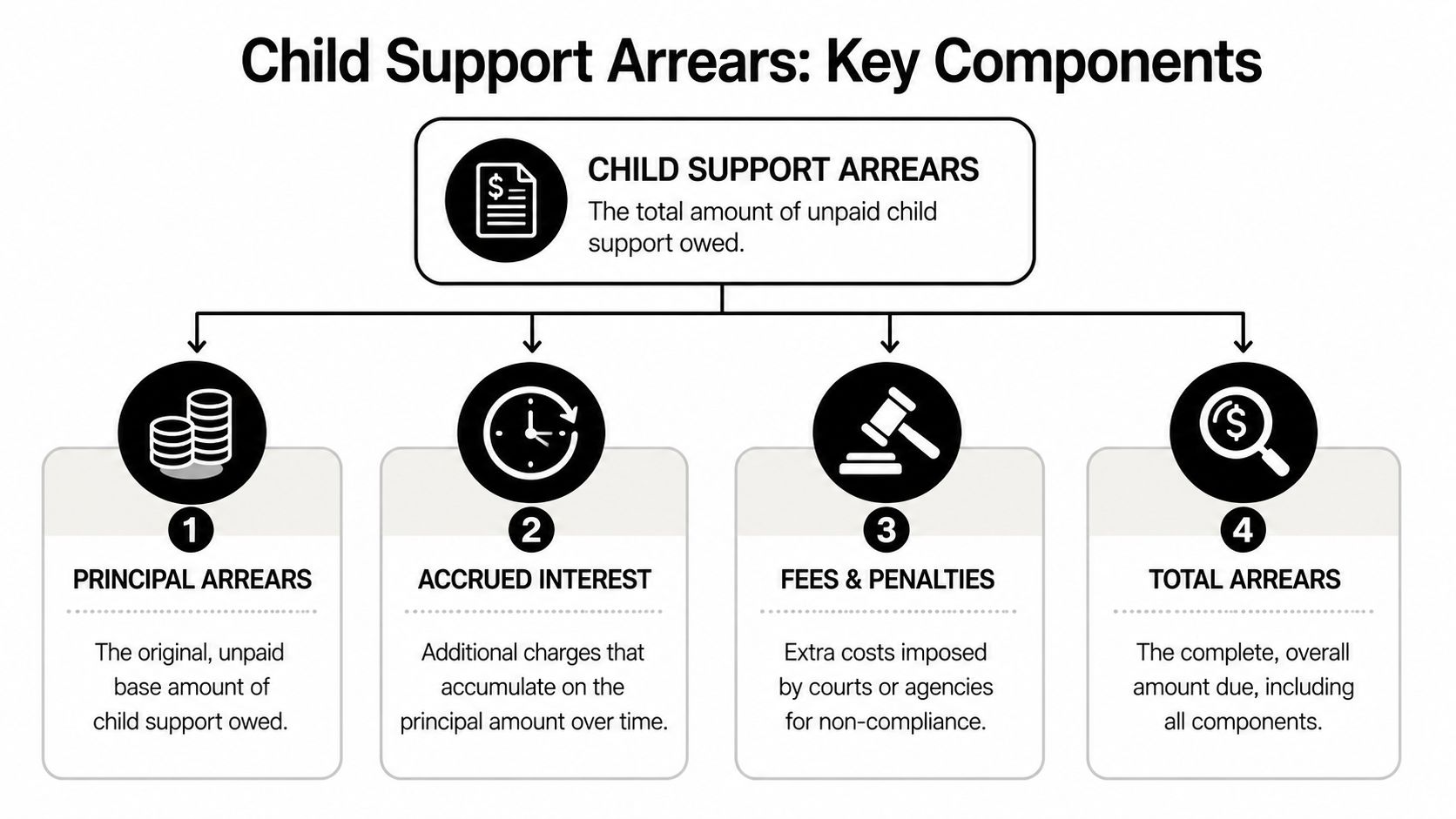
Before doing any math, it helps to separate the moving pieces. Most arrears disputes become less overwhelming once you know what each part means.
Principal arrears
Principal arrears is the base amount of unpaid child support. Think of it as the original bill that should have been paid under the court order.
If the order required monthly support and those payments weren't made in full, each unpaid amount adds to principal. If partial payments were made, those credits reduce the principal balance. This is the foundation of the calculation.
Statutory interest
Statutory interest is the additional amount Texas law adds to unpaid support over time. A useful analogy is a debt that keeps costing more the longer it stays unpaid.
Interest matters because old missed payments don't stay frozen. They continue to carry legal consequences until they are paid or reduced through proper court action. Parents are often surprised that the balance they're seeing is higher than the missed checks alone.
Practical rule: Always separate the unpaid support itself from the added interest. If you combine them too early, it's much easier to make mistakes.
Retroactive child support
Retroactive child support is different from arrears. Arrears usually involve support that a court already ordered but the obligor didn't pay. Retroactive support concerns periods before a support order was in place.
That distinction matters in litigation. A parent may be dealing with missed court-ordered payments, a request for retroactive support, or both. The labels are different because the legal analysis is different.
Total arrears
The final amount a court may enforce can include several layers. A simple way to view it is this:
| Component | Plain-English meaning |
|---|---|
| Principal arrears | The unpaid support that should have been paid |
| Interest | The additional amount Texas law adds over time |
| Credits | Payments already made that reduce the balance |
| Total arrears | What remains after the court applies the full calculation |
One caution here. You may hear people refer broadly to "fees and penalties." In real cases, that language gets used loosely. The legally dependable core calculation usually starts with unpaid support, applies required interest, and gives credit for payments made.
Why definitions matter in Harris County
In Harris County family court, precision matters more than frustration. Judges need a clean record. That means dates, amounts, and the legal basis for each number.
For parents searching online for how to calculate child support arrears Texas, the most useful first step isn't a calculator. It's knowing which category each amount belongs in. Once you understand the categories, the rest of the process becomes much easier to check and explain.
Gathering Your Essential Documentation
Most arrears problems aren't lost because the parent was wrong. They're lost because the records were incomplete, scattered, or hard to follow.
If you're preparing for a Harris County case from Humble, Kingwood, or Atascocita, organize your file before you do detailed math. A court can only work with what you can show.
The documents that usually matter most
Start with the paperwork that sets the legal baseline:
- The original child support order. This establishes the amount due, the payment schedule, and the official start date.
- Any later modification orders. If support changed, the old amount may apply for one period and the new amount for another.
- Payment records. Bank statements, canceled checks, payment confirmations, and Office of the Attorney General records help prove what was or wasn't paid.
- Communication records. Messages aren't a substitute for payment proof, but they can help explain timing disputes or claimed side payments.
- Income records, if the calculation requires them. Pay stubs, tax returns, and similar documents can matter when the court is evaluating support based on net resources during a period of nonpayment.
Why each item changes the math
The original order tells you where to begin. Without it, you're guessing.
Modification orders matter because support doesn't stay static in every case. Parents often make the mistake of multiplying one monthly figure across the entire missed period, even though a later court order changed the amount.
Payment proof matters for another reason. Texas courts don't just ask what was due. They also ask what has already been paid. If the obligor made partial payments, those credits have to be accounted for accurately.
Keep your records in date order. A judge or attorney should be able to follow the story month by month without hunting through a pile of papers.
Organize it the way a court would read it
A practical file often includes:
- Orders first
- Payment ledger second
- Supporting bank records third
- Income documents last
This is also where local procedure matters. A resource like Harris County Family Courts: A Humble Resident's Guide can help you understand how family law cases proceed in the Harris County courts serving Humble.
If you're using an online calculator, these same records keep the estimate grounded in reality. If you're meeting with counsel in Humble, organized documents save time and reduce the risk of missing an important date or payment credit.
Calculating the Principal Arrears Amount
This is often the aspect referred to when asking how to calculate child support arrears Texas. The principal arrears amount is the unpaid base support before interest is added.
In some cases, the monthly obligation is already written clearly in the order. In others, the court may need to evaluate the obligor's net resources during the nonpayment period and apply Texas guideline percentages. According to the Texas child support guideline discussion at Texas child support calculator guidance, Texas applies the same statutory percentages used for current support to arrears calculations under Tex. Fam. Code § 154.125: 20% for one child, 25% for two, 30% for three, 35% for four, and 40% for five or more children. That same source states that, effective September 1, 2025, the net resources cap increases from $9,200 to $11,700 per month, which means the maximum guideline arrears calculation for one child would be based on $11,700, producing a maximum monthly arrears principal of $2,340 if no payments were made.
Step one, identify the monthly amount due
Sometimes this is easy. The order says a set monthly amount, and that amount stayed the same during the unpaid period.
Other times, the court has to determine what support should have been during the months of nonpayment by looking at net resources and applying the Texas percentages. That requires better documentation and usually more careful analysis.
Here is the guideline table in a simple format:
| Number of Children | Percentage of Net Resources |
|---|---|
| 1 | 20% |
| 2 | 25% |
| 3 | 30% |
| 4 | 35% |
| 5 or more | 40% |
Step two, count the missed months
Once you know the monthly amount, identify each month in which support was not paid in full. Use actual due dates from the order if possible.
A simple example helps. If the court-ordered monthly support was $800 and the obligor missed 12 payments, the starting principal arrears would be $9,600.
That example is basic on purpose. It shows the logic without adding extra variables.
Step three, subtract any payments that were made
Many arrears cases involve partial compliance, not total nonpayment. If the obligor paid some money during the period in question, those amounts usually reduce principal.
For example, if the starting principal is $9,600 and the obligor made partial payments totaling $1,200, the remaining principal arrears would be $8,400.
The fastest way to create a bad arrears number is to ignore credits. Courts expect the math to reflect both missed payments and payments actually received.
Where parents get tripped up
The formula sounds simple, but real cases often aren't. Problems come up when:
- Income changed over time. The court may need to evaluate different periods separately.
- There was a modification order. One amount may apply before the modification and another after.
- Payments were informal. Cash, direct transfers, or undocumented side payments can create disputes.
- The payment history from one source doesn't match another. Bank records, OAG records, and personal ledgers don't always line up cleanly.
The Texas Office of the Attorney General offers a free calculator at csapps.oag.texas.gov, and the source above notes that it applies the statutory percentages to estimated net resources. That can be useful for a preliminary estimate before litigation. It is still only as good as the information entered.
A practical local point
For many Harris County families, the actual work isn't multiplication. It's proving which monthly amount applies, which months were missed, and which credits should count. That is where case preparation becomes legal work, not just spreadsheet work.
If your matter involves establishing, modifying, or enforcing child support in Harris County, a Child Support Attorney in Humble handles those kinds of disputes. That becomes especially important when the obligor is self-employed, paid irregularly, or disputes income history.
Adding Statutory Interest to the Total
Once principal is calculated, Texas law requires a second layer of analysis. Unpaid child support arrears carry interest, and that can materially change the amount at stake.
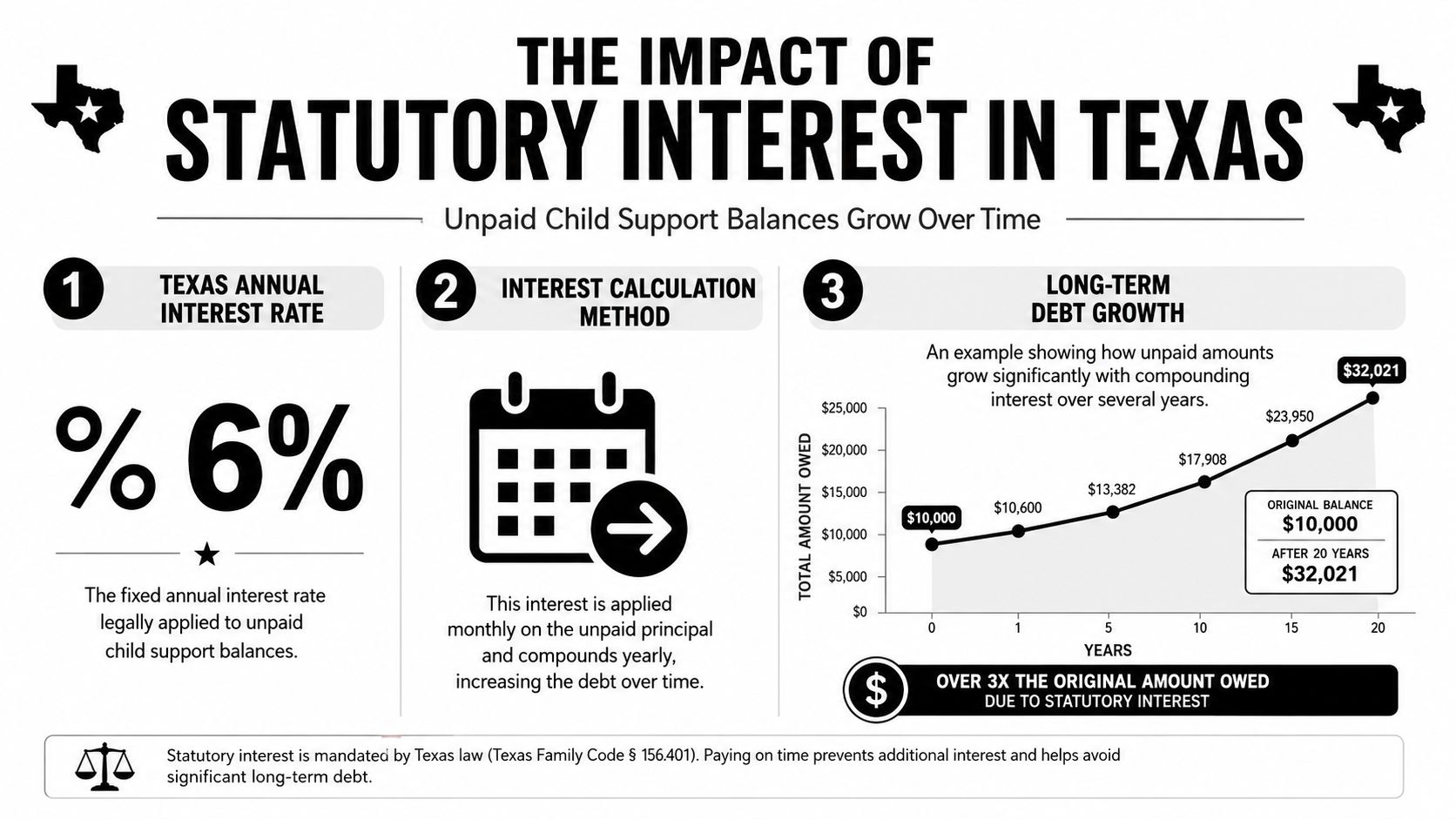
According to Texas child support arrears interest guidance, Texas imposes a mandatory 6% annual interest rate on unpaid child support arrears, accruing continuously from the date each payment becomes due until full repayment. The same source states that the formula is Interest = Principal × 0.06 × (number of days since last transaction / days in year).
What interest does to the balance
Take the simple example from above. If principal arrears are $9,600, one year of interest at 6% would add $576 to that amount.
That illustration is helpful, but real cases are usually more detailed because interest starts from the due date of each missed payment, not from one single date for the entire balance. A missed payment from earlier in the case has had more time to accrue than a missed payment from last month.
Old arrears don't sit still. Each missed due date can carry its own interest timeline.
The same source gives a larger example. If an obligor misses $1,500 per month for 36 months, the principal arrears total $54,000, and after one additional year of nonpayment the accrued interest would be approximately $3,240.
Why long-running cases become expensive fast
This is the point many parents in Humble and Northeast Houston don't see until they request a formal payment history. A support case that seemed manageable years ago may now involve a much larger debt because every unpaid amount kept accruing.
That doesn't mean every number in an agency record is automatically correct. It does mean you shouldn't assume the principal figure is the whole story. Interest often explains why the total balance is much higher than a parent expected.
A common deadline issue
The same source explains that Texas allows parents to pursue arrears suits for up to four years after the child's 18th birthday, even if the child is no longer a minor. That four-year post-emancipation window causes confusion because people often assume they lose all rights once the child turns eighteen.
The better rule is simpler. If arrears exist, don't wait to get clarity. Delay creates both legal risk and accounting problems.
When the math needs extra care
Some parents rely on Office of the Attorney General records for the interest figure, and those records can be very useful. Still, if the case includes gaps, disputed credits, or old payment adjustments, the final interest total may need a closer review.
A careful check usually focuses on:
- Due dates for each unpaid installment
- Credits applied after partial payments
- Changes in principal over time
- Whether the ledger reflects the correct order
For many families, a rough estimate becomes insufficient. Once interest enters the picture, precision matters much more.
Enforcement Options and When to Consult an Attorney
After you've done the calculation, the next question is practical. What do you do with that number?
In Texas, support orders can be enforced through the courts and through state child support processes. Parents in Humble, Kingwood, Atascocita, and Northeast Houston usually need to decide whether their case is straightforward enough for agency help or complex enough to justify private enforcement work.

What enforcement can look like
Texas can use several enforcement tools in child support matters. Depending on the facts, that may include wage withholding, license suspension, and liens against property. In Harris County, those remedies usually depend on having a clear order, a clear arrears history, and a request presented in the proper form.
If you're looking at whether a private enforcement case makes sense, suing for back child support is one route families consider when collection efforts need court involvement.
Key point: An accurate arrears calculation is your most powerful tool in court.
When self-calculation usually isn't enough
Some cases can be estimated at home well enough to begin the conversation. Others need legal help early.
That usually includes situations like these:
- Self-employment issues. Income may be irregular, underreported, or mixed with business records.
- Out-of-state parents. Jurisdiction and enforcement steps can get more complicated.
- Disputed payment credits. One side claims direct payments that don't appear in official records.
- Multiple orders or modifications. The amount due may change across different periods.
- Hidden assets or evasive conduct. Collection may require a more aggressive court strategy.
Parents often benefit from seeing how enforcement discussions work in practice before taking the next step. This overview may help:
Choosing the right level of help
The Office of the Attorney General can be a useful path in many cases. But agency systems are built for volume. If your case is document-heavy, contested, or urgent, a more customized approach may be appropriate.
A Child Custody Lawyer in Humble, TX or a family law attorney handling enforcement can also look at the broader picture, especially when child support disputes overlap with possession, conservatorship, or prior enforcement orders. In some matters, the issue isn't just collecting old support. It's making sure the next order is structured clearly enough that the same problem doesn't repeat.
Let Our Humble Family Law Team Help
A child support arrears case rarely feels like a math problem in real life. For many parents in Humble and across Harris County, it feels like rent that went unpaid, school costs that landed at the wrong time, or years of trying to piece together what should have been provided in the first place.
The calculation matters, but so does getting it right in a way the court will accept. A small mistake in payment credits, the dates used for interest, or the version of the order applied to a given period can change the total and create avoidable delays. In Harris County courts, those details often matter just as much as the bottom-line number.
Some cases are straightforward. Others are not. Older orders, changed employment, missing records, informal payments between parents, and prior enforcement actions can all affect how arrears should be presented. That is usually the point where legal help saves time, stress, and sometimes a costly miscalculation.
If you need someone to review the order history, compare it against the payment record, and explain your options in plain English, a child support arrears lawyer in Humble can help. That includes cases involving Humble, Kingwood, Atascocita, and Northeast Houston, where families often need practical guidance tied to how Harris County enforcement works in practice.
If you need practical guidance on child support arrears, divorce, custody, criminal defense, or estate planning in Humble, Atascocita, Kingwood, or Northeast Houston, schedule a free consultation with Law Office of Bryan Fagan. Our Humble team helps local families understand their options and decide on the next step with a clear plan.