Skip to content

If you own a home in Humble, Atascocita, Kingwood, or elsewhere in Northeast Houston, you may already know the feeling. You want the house to stay in the family, you want life to stay simple for your children, and you don't want them dealing with court paperwork while they're grieving.
A lot of Texas families come in with the same question. "Can I keep full control of my home now, but make sure it passes smoothly later?" In many cases, the answer may be a Lady Bird deed in Texas.
This tool isn't for every situation. But for the right homeowner, it can be a practical way to protect a home, avoid probate for that property, and reduce headaches for loved ones. Around Harris County, that matters. Families in Humble and nearby communities often want a plan that's clear, efficient, and realistic, not something bulky or hard to maintain.
Planning Your Legacy in the Humble Community
A homeowner in Kingwood once described the problem in the simplest possible way. She didn't want her house "stuck in court" after she passed away. She wanted her daughter to receive the home without a long legal process, but she also didn't want to give up control while she was alive.
That's a common concern in Humble and Atascocita too. People work hard for a home. They pay the mortgage, maintain the property, and build family memories there. When it's time to plan ahead, they aren't looking for fancy language. They want a way to pass that home on without creating extra work for the people they love.
A Lady Bird deed often enters the conversation right there. In Texas, it can let a homeowner keep control during life and arrange for the home to pass automatically at death outside probate. That combination is why so many families ask about it.
Practical rule: The best estate plan is the one your family can actually use when the time comes.
Probate isn't always a disaster, but it can be slower and more formal than many families expect. If your main goal is to keep one house out of that process, this deed may be worth discussing with an attorney. If your goals are broader, such as planning for multiple properties, blended family issues, or incapacity, another tool may fit better.
For local families, the question usually isn't just legal. It's personal.
- Parents in Humble often want to spare adult children from court filings.
- Retirees in Atascocita may want to preserve flexibility in case they need to sell later.
- Homeowners in Kingwood often want a simple transfer plan without rebuilding their entire estate plan from scratch.
That practical mindset is exactly where a Lady Bird deed makes sense to explore.
What Is a Texas Lady Bird Deed
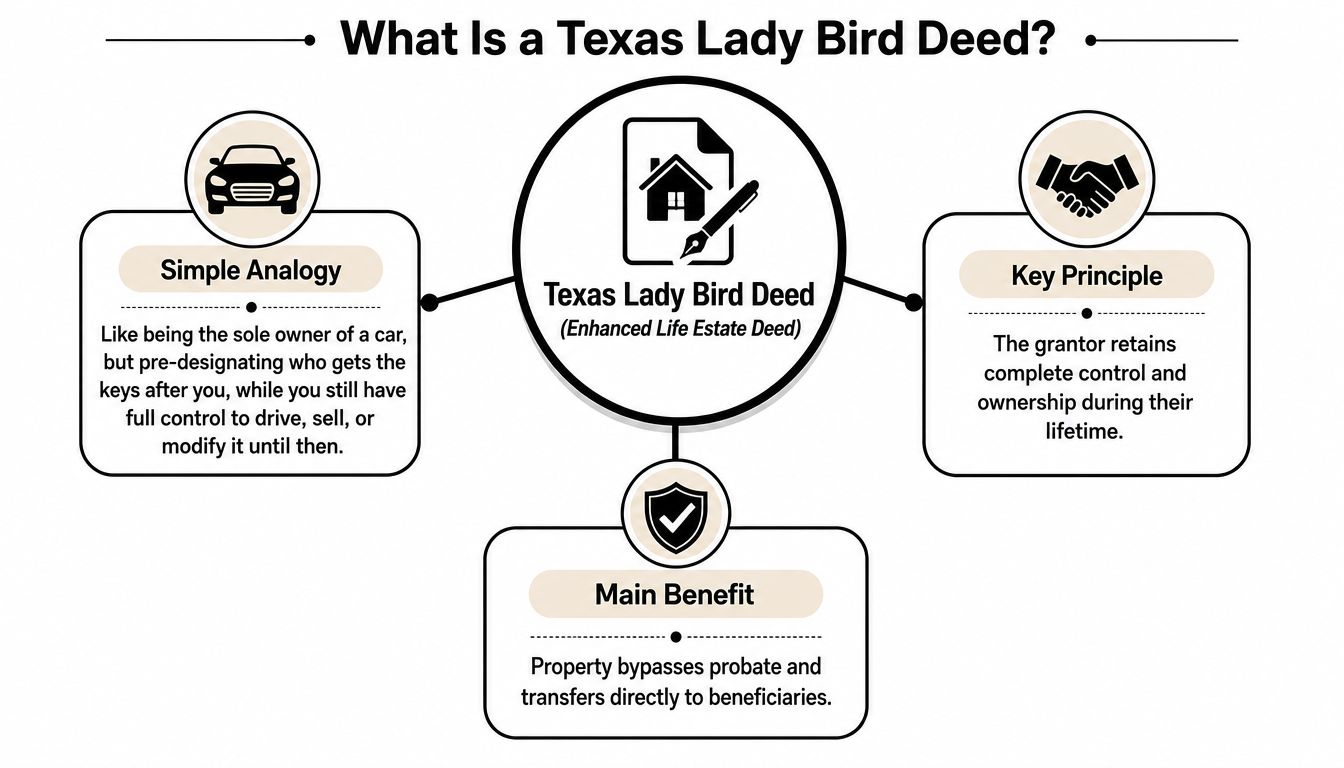
A Texas Lady Bird deed is legally classified as an enhanced life estate deed under which the grantor retains a full life estate with the explicit, reserved power to sell, mortgage, or revoke the property during their lifetime without the remainder beneficiary's consent, which is what distinguishes it from a standard life estate, as explained by the Texas State Law Library on Lady Bird deeds.
The simple way to think about it
A Lady Bird Deed provides a flexible approach to managing your home's future. You still own the house. You still decide whether to live there, refinance it, sell it, or change your mind entirely. But you've also set up instructions so that when you die, the property passes to the person you named.
That person is usually called the remainder beneficiary. You, as the homeowner, are the grantor.
The key point is control. With a true Lady Bird deed, the beneficiary doesn't get to boss you around during your lifetime. They don't need to approve a sale. They don't need to approve a mortgage. They hold a future interest, not present control.
Why the word enhanced matters
Readers often get confused; a regular life estate and a Lady Bird deed are not the same thing.
With a traditional life estate, the future beneficiary may have to be involved if the property is sold or otherwise transferred. With a Lady Bird deed, the deed is drafted so the owner keeps the power to act alone. That's the "enhanced" part.
If you're also comparing options, it helps to read about a Texas transfer on death deed because some families are deciding between those two tools. They can look similar on the surface, but the details matter.
The best explanation is often the simplest one. You keep the steering wheel while you're alive, and the property has a built-in direction for what happens after death.
For many Humble-area households, that's easier to understand than a stack of trust documents. Still, simple doesn't mean casual. The deed language has to be right.
A local Estate Planning Attorney in Humble handles wills, trusts, and estate plans for Humble families, and this kind of deed usually belongs in that broader planning conversation rather than being treated like a fill-in-the-blank form.
Key Benefits for Northeast Houston Families
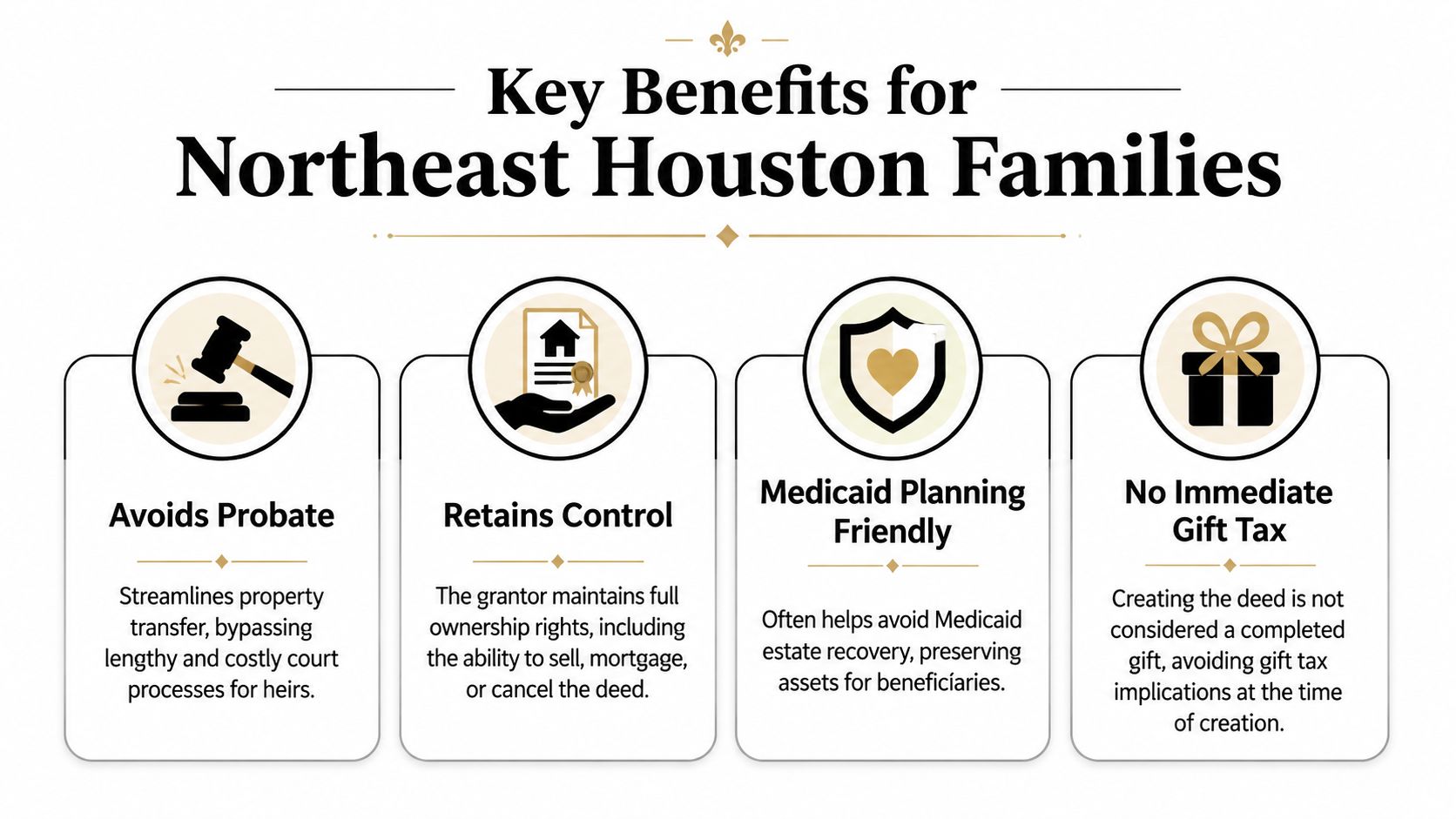
The biggest reason people ask about a Lady Bird deed in Texas is peace of mind. They want a practical result. Keep control now, make the transfer smoother later, and avoid unnecessary complications for family members.
Probate avoidance for the home
A Lady Bird deed can transfer the home automatically at death without probate for that property. In plain terms, the house doesn't have to pass through the usual court-supervised estate process before the named beneficiary receives it.
For a family in Humble, that can mean less delay and less stress during a hard season. If the home is the main asset people are worried about, this single feature often gets their attention first.
Control stays with the owner
This benefit matters just as much as probate avoidance. Many homeowners don't want to sign something today that ties their hands tomorrow.
With a properly drafted Lady Bird deed, the owner keeps the right to deal with the property during life. If a Kingwood homeowner decides to downsize, refinance, or move closer to children, the deed is designed not to trap them.
That flexibility also matters after a divorce or property settlement. In those cases, ownership questions can overlap with estate planning goals. A Property Division Lawyer in Humble handles division of community property and complex assets for Humble divorces, which is often a separate but related issue when a home changes hands in family transitions.
Medicaid and tax advantages
A primary advantage of the Lady Bird deed in Texas is its ability to preserve the owner's homestead tax exemption benefits while simultaneously shielding the property from Medicaid Estate Recovery claims, and it also allows the beneficiary to receive a step-up in fair market value upon the grantor's death, potentially eliminating capital gains tax, according to this Texas Lady Bird deed overview.
That doesn't mean every Medicaid issue disappears. It also doesn't mean every estate should use this deed. It does mean the tool can be helpful where protecting the home is a top concern.
A good estate plan doesn't just say who gets the house. It also considers taxes, public benefits, and whether your family can carry out the plan without friction.
Why local families often like this option
For Northeast Houston families, the appeal usually comes down to four practical points:
- Less court involvement: If the goal is to keep the home out of probate, this deed is designed for that purpose.
- Daily ownership stays intact: You can still act like the owner because you are the owner during your lifetime.
- Better fit for some long-term care planning: Families worried about Medicaid estate recovery often ask about this tool early.
- Cleaner tax outcome for heirs: The step-up in value can be an important benefit if the beneficiary later sells.
That mix is why this deed keeps coming up in estate planning conversations across Humble, Atascocita, and Kingwood.
How to Create a Lady Bird Deed in Harris County
The process sounds simple when people describe it casually. In practice, the details matter. A Lady Bird deed has to be drafted with precision so it works the way you intend.
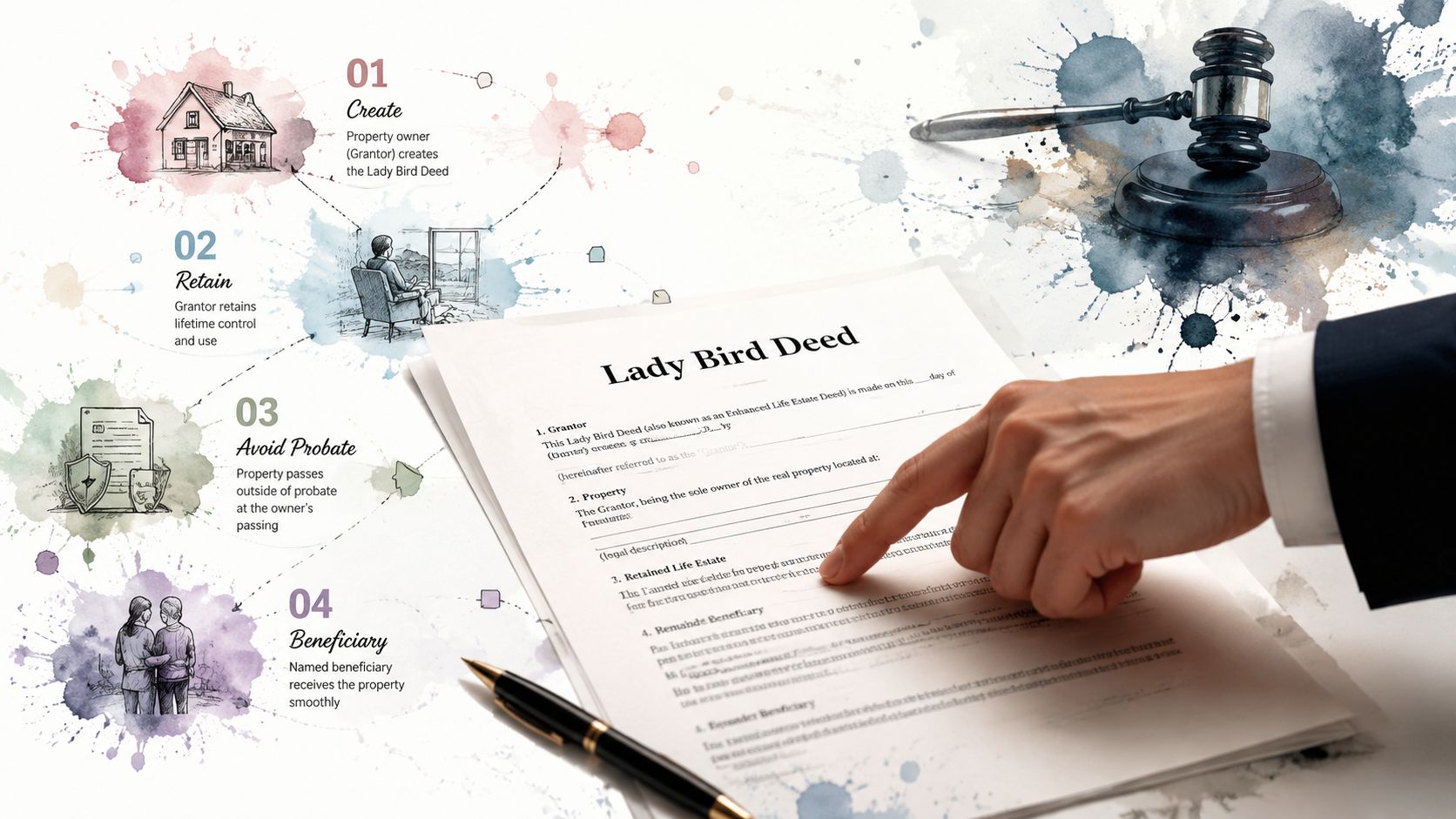
Step one: identify the property correctly
The technical execution requires a precise legal description of the property. For the deed to be legally enforceable and provide public notice, Texas law requires the grantor to sign it in the presence of a notary and file it with the county clerk in the county where the property is located, such as Harris County, as summarized in this guide on understanding Lady Bird deeds in Texas.
DIY mistakes are common. People use the street address, shorten the legal description, or copy old language that doesn't match the current deed. That can create problems later.
Step two: name the right beneficiaries
The deed should clearly state who receives the property when the owner dies. It also makes sense to think through what happens if the first named beneficiary dies before the owner.
Families in Atascocita and Kingwood often need to slow down here. If you have more than one child, a remarriage, or a blended family, naming beneficiaries can raise practical questions fast. Equal shares may sound simple, but future disagreements over a house can turn that simplicity into conflict.
If you're looking at other family transfer options too, this page about transferring property to family members in Texas can help frame the broader decision.
Step three: use the enhanced language
This is the heart of the deed. The document has to reserve the owner's right to sell, mortgage, or revoke during life. If that language is missing or sloppy, the deed may not function as the owner intended.
That drafting issue is one reason people who are comfortable handling their own paperwork in other areas still pause here. For example, someone might feel fine using a guide like The Divorce Process in Humble: What to Expect for a general overview of court procedure, but title transfer documents are much less forgiving when a key phrase is omitted.
A short video can help if you're trying to visualize how these deed choices work in real life.
Step four: sign, notarize, and record
Once the deed is drafted, the owner signs before a notary. Then it needs to be recorded with the Harris County Clerk in the county's real property records.
That filing step matters because recording gives public notice. If the deed sits unsigned, unnotarized, or unrecorded in a drawer, it may fail to deliver the protection the family expected.
Lady Bird Deed vs Other Estate Planning Tools
A Lady Bird deed is useful, but it isn't the only path. Some families in Humble need a will. Others need a revocable trust. Some may need a transfer-on-death deed or a fuller probate-avoidance plan.
The best choice depends on what you're trying to solve. If the goal is one house and continued owner control, a Lady Bird deed may fit well. If the goal is managing several assets or planning for incapacity, a trust often deserves a closer look. If you want a broader primer on trust creation, Coveredly has a plain-language guide on how to make a trust.
Estate Planning Tool Comparison for Texas Homeowners
| Feature | Lady Bird Deed | Will | Revocable Trust | Traditional Life Estate |
|---|---|---|---|---|
| Probate for the home | Usually avoids probate for the property | Does not avoid probate for property passing under the will | Can avoid probate for assets properly placed in the trust | Often used to transfer property outside probate, but structure is less flexible |
| Owner control during life | Owner keeps power to sell, mortgage, or revoke | Owner keeps control until death, but will only works at death | Owner usually keeps control while acting as trustee | Control is more limited because the future interest can restrict later actions |
| Ease of use for a single home | Often a focused option for one property | Simple to understand, but not enough to avoid probate by itself | Broader planning tool, often better for multiple assets | More rigid than a Lady Bird deed |
| Medicaid estate recovery planning | Often discussed for this purpose in Texas | Usually not the main tool for this issue | May help in a broader plan, depending on structure | Not the same as an enhanced life estate deed |
| Tax treatment for heirs | Can preserve step-up in value at death | May also preserve step-up depending on the asset and estate structure | Often preserves step-up when structured properly | Needs careful analysis and is often less attractive than the enhanced version |
| Best fit | Homeowner focused on one house and lifetime flexibility | Person who needs a basic estate document but accepts probate | Family with multiple assets or incapacity planning needs | Narrow situations where the owner accepts reduced flexibility |
When a will is enough and when it isn't
A will still matters. It names an executor, states your wishes, and can cover assets that don't pass another way. But a will doesn't keep the home out of probate by itself.
That's the key difference many families in Kingwood miss at first. If your only plan is a will, your loved ones may still need to go through court to deal with the house.
When a trust makes more sense
A revocable trust often shines when the estate is broader than one residence. If you own several properties, want stronger planning for incapacity, or need tighter coordination across accounts and assets, a trust may be the better tool.
For some readers, the right answer isn't Lady Bird deed versus trust. It's Lady Bird deed for one concern and a broader estate review for everything else.
Some plans fail because the family picked the wrong document. Others fail because they picked the right document for the wrong goal.
Where a Lady Bird deed stands out
A Lady Bird deed usually stands out when all of these are true:
- The home is the main concern: You want one property to pass cleanly.
- You want to keep freedom: Selling or refinancing later still matters to you.
- You value a lighter approach: You don't necessarily want a full trust administration structure.
- You want to avoid probate for the house: That's the central objective.
If that's your situation, you may also want to review ways to avoid probate in Texas because a deed is only one piece of the larger probate-avoidance picture.
Potential Risks and Common Pitfalls to Avoid
A Lady Bird deed is powerful, but it isn't magic. The most common mistake is assuming that because the idea is simple, the drafting must be simple too.

Acceptance can vary
Texas courts and title companies may vary in their acceptance of the instrument, which is why careful preparation and attorney consultation matter. The deed must expressly reserve the owner's right to sell, mortgage, or revoke during life so it keeps its enhanced status and isn't misread as a standard life estate, as noted in the earlier linked Texas Lady Bird deed source.
That issue may not show up when the deed is signed. It may show up years later, when the house is being sold, refinanced, or reviewed in a title exam.
Family facts can complicate a good plan
The deed itself may work exactly as drafted, but the people involved may still create problems. Multiple children may disagree about whether to keep or sell the home. A beneficiary may die first. A later marriage may raise fresh questions about the owner's intent.
Those aren't reasons to panic. They're reasons to plan carefully.
- Name alternates: If the first beneficiary dies before you, a backup plan helps prevent uncertainty.
- Review mortgage issues early: If the property is financed, lender and title questions are easier to address before a crisis.
- Match the deed to the full estate plan: The home shouldn't be planned in isolation if your family situation is complicated.
"Simple on paper" and "simple in real life" are not always the same thing.
Common drafting and signing mistakes
A few errors show up again and again:
- Wrong legal description. Even a small mismatch can create title problems.
- Missing enhanced powers. Without clear reservation language, the deed may not work as intended.
- Failure to record. An unrecorded deed can leave the family in a weak position.
- No capacity review. If someone later questions the owner's understanding, disputes can follow.
This is one area where careful legal help often costs less than cleaning up a title problem later.
Take the Next Step to Protect Your Texas Home
For many families in Humble, Atascocita, Kingwood, and across Northeast Houston, a Lady Bird deed offers something very appealing. It can keep the house from becoming a court problem while letting the owner stay fully in charge during life.
The smart next step is usually a short checklist.
A practical checklist
- Confirm your goal: Are you mainly trying to transfer one home, or do you need a wider estate plan?
- Check the family details: Beneficiaries, alternate beneficiaries, marital issues, and future sale plans all matter.
- Draft it carefully: The legal description, reserved powers, notarization, and recording all need to be right.
- Coordinate documents: Your deed, will, trust, and beneficiary designations should work together.
If you're gathering deeds, property records, or scanned forms before a meeting, practical document organization helps. Some readers also like this resource on PDF tools for real estate professionals for managing and reviewing property-related files more efficiently.
A Lady Bird deed isn't the right answer for every Texas homeowner. But when it fits, it can bring real peace of mind. It turns a vague intention into a working plan.
One straightforward option is to speak with the Law Office of Bryan Fagan, which serves Humble-area clients in estate planning, wills, trusts, and probate matters. A local conversation can help you sort out whether a Lady Bird deed, a will, a trust, or another approach better fits your family.
If you're ready to protect your home and make a clear plan for your family, schedule a free consultation with our Humble office. We work with residents in Humble, Kingwood, Atascocita, and Northeast Houston who want practical answers about estate planning, probate, family law, and related legal concerns. A conversation now can help you avoid confusion later and create a plan that fits your goals, your property, and your family.