Skip to content
For so many families here in the Humble, Atascocita, and Kingwood area, the family home isn't just another asset. It's the heart of the family, a place filled with memories. Deciding how to pass that home on to the next generation is a huge decision, one that's packed with both emotion and serious financial implications.
As a local attorney dedicated to serving our community, my goal here is to walk you through your options in a clear, supportive way. We'll clear up the confusion and help you sidestep the common pitfalls we see all too often, ensuring you feel confident in your choices.
Your Family Home’s Future: A Humble Perspective
Whether it’s your longtime primary residence in Northeast Houston or a rental property you’ve managed in Kingwood for years, making the decision to transfer it is a major milestone. We've worked with families doing this for all sorts of reasons. Some are looking to give a child a much-needed leg up in a tough housing market. Others are planning ahead for long-term care needs, and many simply want to make their estate less complicated for their loved ones to handle later.
It's important to realize that each of these goals calls for a different strategy. The path you take will have real, lasting consequences from a legal and financial standpoint for you and your family here in Humble.
Key Factors to Consider Early On
Before you sign a single document, it’s critical to get the lay of the land. We've seen families rush into this, only to create messy title issues, trigger unexpected tax bills, or even spark disagreements down the road. A little planning upfront can save a world of trouble.
Here are the foundational pieces you absolutely need to think through:
- Finding the Right Legal Method: Texas law provides several ways to transfer property. You could use a simple deed, or you might need a more sophisticated tool like a trust. The best fit truly depends on what you're trying to accomplish for your family.
- Understanding the Tax Impact: Gifting a property can have tax consequences, not just for you now with federal gift taxes, but also for your family member later on with capital gains. You can't afford to ignore these rules.
- Protecting Your Own Interests: How does this transfer affect your own financial security? We need to consider things like your potential eligibility for Medicaid and how to preserve your valuable Texas homestead rights.
- Knowing the Property's True Value: An accurate valuation is non-negotiable. It's essential for tax purposes and for ensuring the transfer is fair to everyone involved. To get a handle on this, it's wise to understand the complete home appraisal process.
Working through these complexities is all about careful planning and getting sound legal advice. Let's demystify this journey so you can feel confident you're making the right call for your family's future.
Understanding Your Property Transfer Options in Texas
When you decide to transfer property to a family member, how you do it is just as critical as the decision itself. Each method comes with its own set of legal and financial consequences for both you and your loved one. Let’s walk through the most common paths families in Humble, Kingwood, and Northeast Houston take.
The best approach always starts with your end goal. Are you trying to gift a home now, make things easier for your heirs later, or something else entirely?
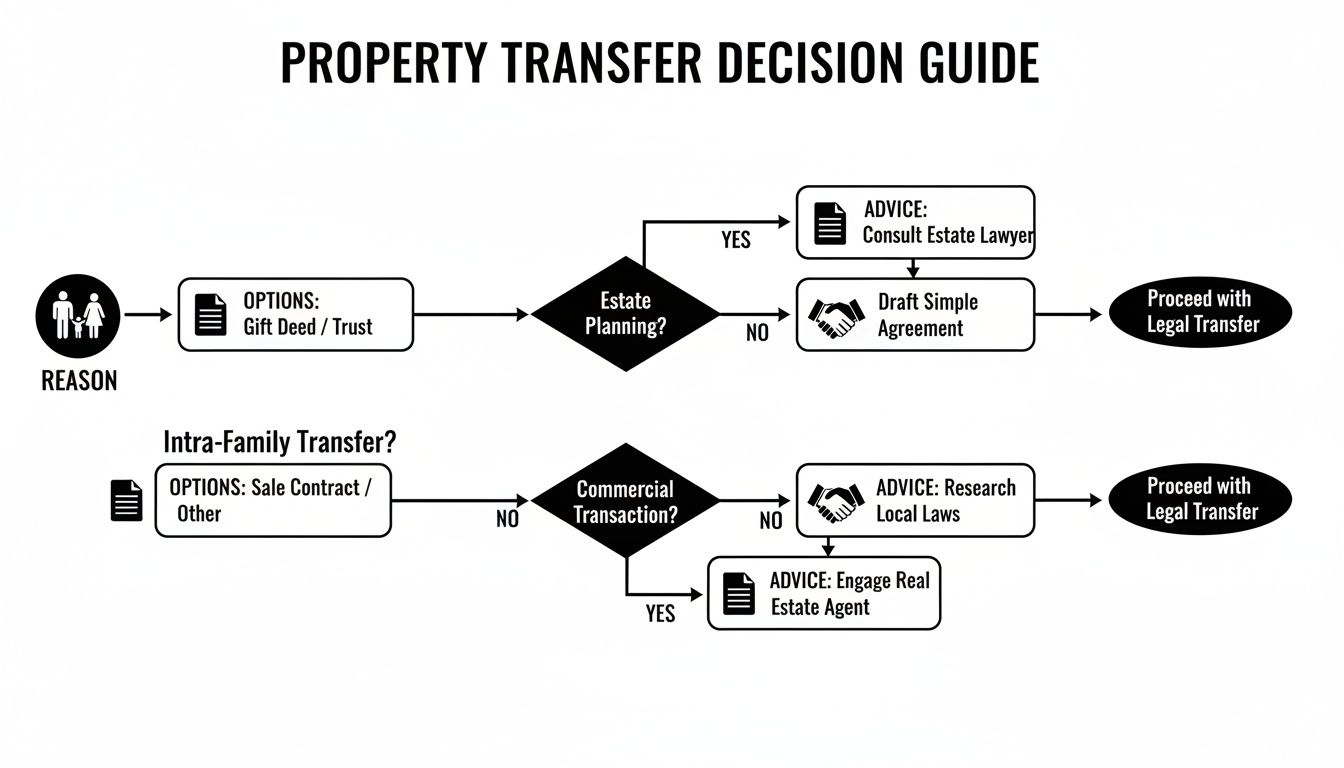
This flowchart mirrors the conversations we have with clients every day. It's all about matching the legal tool to your family's unique situation.
Deeds: The Foundation of Any Property Transfer
At the heart of any real estate transfer is the deed—the official paper that moves ownership from one person to another. It's the equivalent of a car title, but for your house. The type of deed you use is incredibly important because it dictates how much protection your family member gets down the road.
- General Warranty Deed: This is the gold standard of deeds. It provides the strongest protection, essentially guaranteeing that the title is free and clear of any claims throughout the property's entire history.
- Special Warranty Deed: This one is a bit more limited. It only guarantees a clear title for the time you owned the property. It offers no protection against claims that might have come up before you bought the home.
- Quitclaim Deed: Use this one with extreme caution. A quitclaim offers zero guarantees or protections. It simply transfers whatever interest you have in the property—if any—to someone else. We typically only see these used to clear up a minor title issue between family members who have complete trust in one another.
For most family transfers, a General or Special Warranty Deed is the only way to go. It gives the new owner real peace of mind.
Gifting Equity: A Practical Way to Help Family Buy Your Home
Sometimes the plan isn't a straight-up gift but helping a child or relative buy your property at a more manageable price. This is where a Gift of Equity becomes a fantastic tool.
Here's a common scenario for a local family: A Kingwood couple wants to sell their $400,000 rental property to their daughter. Instead of making her come up with a huge down payment, they agree to sell it to her for $300,000. That $100,000 difference is the "gift of equity."
This gift can often be used as her entire down payment, making it much easier to get a mortgage. It’s a powerful strategy, but it’s crucial to document it properly for both the lender and the IRS.
Planning Ahead to Skip Probate
For many families we work with, the main goal is simple: make life easier for the kids when they're gone. A big part of that is avoiding probate, the court process for settling an estate. Probate in Harris County can be slow, public, and expensive.
Thankfully, Texas law gives us two excellent tools to bypass it entirely: the Transfer on Death Deed (TODD) and the Enhanced Life Estate Deed, which most of us call a "Lady Bird Deed."
The magic of these deeds is that the property automatically passes to your chosen beneficiary the moment you pass away—no court, no lawyers, no delay. This saves your family a significant amount of time, money, and stress.
Let's see how they work in the real world.
Transfer on Death Deed (TODD)
A TODD is a straightforward and effective way to name your heir. You sign and file the deed with the county clerk today, but it doesn't actually do anything until you pass away. In the meantime, you maintain complete ownership and control. You can sell the property, refinance it, or even change your mind and revoke the TODD.
Real-World Example: An Atascocita homeowner wants her house to go directly to her son. She files a TODD naming him as the beneficiary. Years later, she decides to sell the home and downsize. She can do so without his permission because the TODD only takes effect upon her death.
Lady Bird Deed (Enhanced Life Estate Deed)
The Lady Bird Deed is very similar to a TODD but offers a little more flexibility, especially when thinking about long-term care and Medicaid. Just like a TODD, it names a beneficiary who will inherit the property automatically, outside of probate.
The key difference is that a Lady Bird Deed explicitly reserves your right to sell, mortgage, lease, or gift the property during your lifetime without your beneficiary's consent or knowledge. This retained control can be very important for Medicaid eligibility and estate recovery rules.
Comparing Common Property Transfer Methods in Texas
To make sense of these options, it helps to see them side-by-side. This table offers a quick comparison to help you understand which method might align best with your family's goals.
| Transfer Method | Level of Protection for Recipient | Probate Avoidance | Best For |
|---|---|---|---|
| General Warranty Deed | Highest | No | Gifting or selling a property with a clean title history, providing maximum security for the new owner. |
| Gift of Equity | Varies (depends on deed used) | No | Helping a family member buy your property by using your equity as their down payment. |
| TODD | Varies (depends on deed used) | Yes | Simple, direct transfer of property upon death to a named beneficiary, while retaining full control during life. |
| Lady Bird Deed | Varies (depends on deed used) | Yes | Avoiding probate and preserving flexibility for Medicaid planning, retaining life estate and power to sell. |
Each of these tools has its place, and the "best" one is entirely dependent on your personal and financial circumstances.
While these deeds are powerful, they aren't a silver bullet for every situation. If you have multiple properties, blended families, or complex assets, a trust might be a more robust solution. You can get a better sense of how they work by reading our guide on what a living trust is.
Navigating the Tax and Financial Realities
Handing over the keys to a family member is a huge milestone, but it's far more than a simple signature on a deed. It's a major financial move with ripples that can affect everyone involved for years. For families here in Humble and across Northeast Houston, getting a handle on these financial realities is the only way to make a smart choice—one that protects your legacy, not complicates it.
Let's walk through the most important money matters you need to think about, in plain English.
The Federal Gift Tax Explained
One of the first questions we always get from clients in Kingwood or Atascocita is, "Am I going to get hit with a giant tax bill for this?" It's a valid concern.
The good news? Probably not, but you absolutely have to play by the IRS's rules.
Each year, you can give a certain amount to any person without even having to tell the IRS. This is the annual exclusion. For 2025, that magic number is $19,000 per person. If you’re married, you and your spouse can combine your exclusions to gift up to $38,000 to your child, grandchild, or anyone else.
Now, what if your property is worth more than that? You’ll probably have to file a gift tax return (Form 709). But hold on—that doesn't mean you have to write a check. The amount over the annual limit just gets subtracted from your lifetime gift and estate tax exemption.
This is a massive, multi-million dollar shield that protects most people from ever paying federal estate taxes. But there's a catch. Right now, in 2025, the exemption is at a historic high of $13.61 million per person. This is set to get slashed in half in 2026. For families planning ahead, this creates a unique, time-sensitive window to secure assets and minimize future taxes.
Capital Gains Tax: A Tale of Two Bases
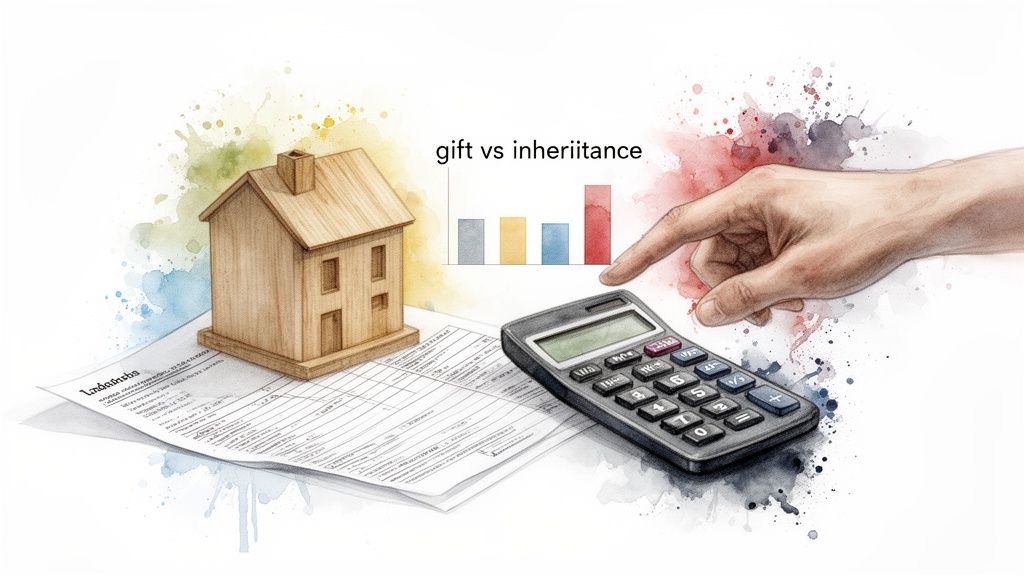
This is where things get really interesting, and it’s a detail that can save—or cost—your loved one a fortune down the road. The amount of tax they’ll owe when they eventually sell the house hinges entirely on how they received it.
Carryover Basis (The Gift): When you gift a property, the recipient inherits your original cost basis. Let's say you bought your Humble home for $50,000 back in the day, and now it's worth $350,000. If you gift it to your son, his basis is that same $50,000. If he turns around and sells it for $350,000, he's looking at a potential capital gains tax on $300,000 of profit. Ouch.
Stepped-Up Basis (The Inheritance): On the other hand, if he inherits that same house after you pass away, the basis is "stepped up" to its fair market value at that time. If it’s worth $350,000 on that date, his new basis is $350,000. If he sells it for that price, there's zero capital gain. That means zero capital gains tax.
This difference between a carryover and a stepped-up basis is one of the single most important financial levers in estate planning. What feels like a generous gift today could create a massive tax headache for your family tomorrow.
In all these scenarios, understanding fair market value is absolutely essential, as it’s the number that drives nearly all of these tax calculations.
Other Financial Considerations to Keep in Mind
The financial picture doesn't stop with federal taxes. There are local and personal factors that can have a big impact.
Property Taxes
Here in Harris County, changing the name on a deed can trigger a reassessment of the property's value. This could mean a much bigger annual property tax bill for the new owner. It’s also critical to make sure any existing homestead exemptions are properly transferred or reapplied for to keep those taxes manageable.
Medicaid Eligibility
This is a big one. If there's any chance you or your spouse might need long-term care down the line, giving away a major asset like your home can cause serious problems. Medicaid has a five-year "look-back" period in Texas. Any gifts or transfers for less than fair market value during that window can lead to a penalty period, potentially disqualifying you from receiving benefits when you need them most.
These moving parts—gift tax, capital gains, property tax, and Medicaid—are all connected. Making the right move means seeing the whole board, not just the next play. We can help you get that clarity, ensuring your generosity today doesn't create a burden for tomorrow.
Essential Texas Laws Every Humble Family Should Know
When you're thinking about passing property to a family member here in Texas, it's never as simple as just signing a piece of paper. Our state has some unique laws that can really trip people up, especially for families right here in Humble and the greater Northeast Houston area. We’ve seen firsthand how overlooking these rules can create serious title problems and a lot of family stress down the road.
Let's walk through the two biggest legal concepts you absolutely have to understand: community property and homestead rights.
Understanding Community Property in Texas
Texas is a community property state. What that means, in plain English, is that almost any property a couple acquires during their marriage is considered to be owned 50/50 by both of them. This is true no matter whose name is actually on the deed or the mortgage.
Think about a couple in Atascocita who bought their home after they got married. Even if only the husband's name is on the title, the law presumes his wife has a 50% ownership interest. This is a critical detail. It means one spouse can't just decide to sell, gift, or transfer the entire property without getting the other spouse's full, written consent.
Trying to transfer property without both signatures can result in what's called a "clouded title." That's a huge legal headache for the family member who receives the property, making it nearly impossible to sell or refinance later on without going through an expensive court process to clear it up.
The Power of Texas Homestead Rights
Another concept that’s uniquely Texan is our incredibly strong homestead protection. These laws are in place to shield your primary home from being taken by most creditors. For a family in Kingwood, this is a powerful protection, ensuring their home is generally safe even if they hit a rough financial patch.
But this shield also adds another layer of complexity to property transfers. Here's why it matters so much:
- Both Spouses Must Consent: Even if the home is technically one spouse's separate property (maybe they owned it before the marriage), if it's the couple's homestead, both spouses must sign off on any transfer.
- Surviving Spouse Rights: When a homeowner passes away, the surviving spouse has a legal right to live in the homestead for the rest of their life. This is true even if the deceased person's will left the house to someone else, like their children from a prior marriage.
- Minor Children's Rights: The law also gives minor children certain rights to the homestead property that have to be legally addressed before any transfer can happen.
These homestead protections are automatic and deeply woven into Texas law. You can't just ignore them or try to write them away in a simple deed. Failing to properly handle homestead rights is one of the most common—and costly—mistakes we see families make when they try to do this without legal guidance.
These aren't just legal technicalities; they are foundational principles of Texas property ownership. Getting them wrong can completely invalidate a transfer, open your family up to legal challenges, and undermine the very legacy you're trying to build.
Planning for a Smooth Transfer
Navigating these Texas-specific rules takes careful, forward-thinking planning. For Humble families, the Law Office of Bryan Fagan specializes in using tools like wills and trusts to transfer homesteads or investment properties without the typical 12-18 month delays and 4-7% fees of probate court. The upcoming 2025 estate tax cliff—where the exemption is expected to drop from $13.61 million to around $7 million—makes proactive planning more urgent than ever. Proper local planning ensures Texas homestead exemptions protect your home's equity from creditors. As this decade sees a massive $2.4 trillion transfer of real estate wealth, working with professionals is key to navigating taxes, securing clear titles, and preventing family rifts, turning an inheritance into an enduring legacy. Learn more about the great wealth transfer from wipfli.com.
Understanding how community property and homestead laws apply to your specific situation is the first step toward a successful and legally sound property transfer.
Protecting Your Legacy in the Great Wealth Transfer
When you think about passing your home down to your children or grandchildren, you’re doing more than just making a family decision. You’re actually part of a massive shift economists have dubbed the "Great Wealth Transfer," where trillions of dollars in assets—mostly real estate—are moving from one generation to the next.
For families right here in Humble and across Northeast Houston, this isn't some abstract financial news. It's a real opportunity for those who plan carefully, but it can create serious headaches for those who don't. That's why we always say that smart estate planning isn't just for the wealthy anymore; it's a must-have for any local family wanting to protect their hard-earned property and keep the peace.

Why Proactive Planning Matters Now More Than Ever
The sheer scale of this wealth transfer is mind-boggling. By 2025, an estimated $6 trillion in inherited wealth is expected to change hands, a trend that's already making waves in real estate markets. For families in our local communities like Kingwood and Atascocita, this makes having a solid plan more urgent than ever. Without the right legal tools, like a will or a trust, that beloved family home could become the center of a family feud or trigger a surprise tax bill. You can learn more about how this trend is impacting real estate from realtor.com.
This is exactly why we stress being proactive. It's about thinking ahead and being strategic, not just reacting when a crisis hits. It’s about making sure the home you worked so hard for is a blessing to your loved ones, not a burden.
The Cost of Inaction in Harris County
Putting off planning can have some really steep consequences, especially here in Harris County. An estate without a clear plan almost always ends up in probate court. And while probate is sometimes unavoidable, it’s a process most families are wise to steer clear of.
Here’s why:
- It's slow: Probate can easily drag on for months, sometimes over a year, leaving your family and the property in a state of limbo.
- It's expensive: Legal fees, court costs, and other administrative bills can eat away at the value of your estate.
- It's public: Every document filed with the probate court becomes a public record. This means your family's private financial matters are out there for anyone to see.
By creating a thoughtful plan now, you can help your loved ones sidestep this entire ordeal, saving them a great deal of time, money, and stress down the road.
Using Trusts to Ensure a Smooth Transition
One of the most effective tools we have for helping families protect their legacy is the living trust. The best way to think of a trust is as a private instruction manual for your assets. You transfer your property into the trust's name, but you stay in the driver's seat as the trustee during your lifetime, managing it just like you always have.
The real magic happens when you pass away. A successor trustee you've chosen simply steps in and distributes the assets exactly as you’ve instructed, all without ever setting foot in a probate court.
A well-drafted trust is so much more than a legal document—it's a shield for your family. It makes sure your property is transferred efficiently, privately, and on your terms, preserving both your assets and family harmony.
A trust is also incredibly flexible and can be customized to your family’s unique situation. You can set up staggered distributions for young beneficiaries, protect assets from a child's creditors or a future divorce, or provide for a family member with special needs. We've put together a detailed guide that explains how to avoid probate in Texas using trusts and other smart strategies.
Your legacy is worth protecting. Taking the time now to think strategically about how you'll pass on your property is one of the most meaningful gifts you can ever give your family.
When You Need a Humble Estate Planning Attorney
Trying to navigate the maze of property transfers on your own can feel overwhelming. You’re juggling deed types, tax laws, and unique Texas rules like homestead rights, all while trying to avoid the headache of probate. It’s a lot to handle, and a simple mistake can have lasting consequences for your loved ones.
This is why getting professional guidance isn’t just a good idea—it’s essential for protecting your family and your most valuable asset. While we’d argue that every property transfer should be reviewed by a lawyer, certain situations are definite red flags that you need to pick up the phone right away.
Critical Scenarios Requiring Legal Counsel
If any of these scenarios sound familiar, it's time to bring in an expert who understands the needs of families in Humble, Atascocita, and Kingwood.
You Still Have a Mortgage: Transferring a mortgaged property can trip a “due-on-sale” clause. If that happens, your lender could demand the entire loan balance be paid immediately. An attorney can walk you through safer alternatives, like a loan assumption or refinancing.
You Want to Set Conditions: Do you want to ensure the house stays in the family for a generation? Or maybe you want to let a sibling live there for life? A simple deed can't enforce these kinds of wishes. You'll likely need a trust to create specific, legally-binding rules.
You Might Need Medicaid Later: Gifting your home seems simple, but it can make you ineligible for long-term care benefits. Medicaid has a five-year look-back period, and an improperly timed transfer can have devastating financial consequences down the road.
You Foresee Family Friction: Let's be honest—family dynamics can be complicated. In blended families or situations where siblings don’t agree, a clear, professionally structured plan is your best defense against arguments, resentment, and expensive legal fights later on.
Your home is probably your biggest asset. Trying to manage its transfer without experienced legal advice can backfire, jeopardizing your family’s financial security and straining relationships.
We want you to feel confident and secure in the choices you're making. A huge part of that is knowing you have the right person in your corner. That means understanding how to choose the right estate planning attorney who truly gets your family’s needs.
The Law Office of Bryan Fagan has deep roots right here in the Humble community. We offer a free consultation at our local office because we believe you should get your questions answered without any pressure or obligation. Let our team help you build a solid plan to protect what matters most.
Questions We Hear All the Time
When you're thinking about passing property to your family, a lot of "what ifs" and "how do I's" pop up. It's completely normal. In our Humble office, we’ve pretty much heard them all. Here are some of the most common questions families ask us, with some straight-to-the-point answers.
Can I Give My House to My Son or Daughter if I Still Have a Mortgage?
Technically, yes, but you have to be incredibly careful here. Almost every mortgage has a nasty little provision called a "due-on-sale" clause. It's exactly what it sounds like: if you sell or transfer the title, the lender can call the entire remaining loan balance due right then and there.
To get around this, you have a couple of viable paths. Your child could try to refinance the mortgage in their own name, which essentially pays off your loan and creates a new one for them. Another option is asking your lender for permission to let your child formally assume the existing loan. This is less common and depends entirely on the lender's policies. We can walk you through which approach makes the most sense and protects you from triggering that clause.
What’s the Real Difference Between Adding My Kid to the Deed vs. Gifting the House Outright?
This is a fantastic question, and the answer has huge implications.
When you simply add a family member to your deed, you're creating a form of co-ownership, often a joint tenancy. They immediately have a legal stake in the property. This means you share control, you share liability, and you both have a say in what happens to it. It can also create a complicated tax situation for them down the road when the property is eventually sold.
Gifting the house, on the other hand, is a clean break. You're transferring 100% of your ownership rights and control. You're off the title completely. The best choice really boils down to what you want to achieve for your family and the property in the long run.
How Much Should I Expect to Pay to Transfer a Deed in Harris County?
The final number will depend on your specific situation, but you can count on a few core costs. Here’s a quick rundown of what to budget for:
- Attorney Fees: This covers the professional drafting of the new deed, making sure it’s ironclad under Texas law, and a thorough review of everything to avoid title headaches later.
- Harris County Filing Fees: The county clerk’s office charges a recording fee to make the new deed part of the official public record. This is what makes the transfer legally binding.
- Appraisal Fees: If you're gifting the property, you'll likely need an official appraisal to establish its fair market value for gift tax purposes.
A quick chat with an attorney can give you a much more precise estimate based on the specifics of your property and transfer method.
At The Law Office of Bryan Fagan, we are dedicated to helping our neighbors in Humble, Atascocita, and Kingwood protect what they've built. We understand these decisions are deeply personal, and we're here to provide the clear, compassionate guidance you deserve. Schedule a free consultation with our Humble team, and let's talk through your goals. We will give you the practical advice you need to secure your family's future with confidence.