Skip to content
Fighting a DWI charge is a battle that begins the moment you see flashing lights in your rearview mirror. What you do right then and there, and in the days immediately following an arrest, can make or break your case. For our neighbors here in Humble, Texas, understanding your rights and taking swift, decisive action is the first step toward protecting your future. The most critical first steps are to invoke your right to remain silent, write down every single detail you can remember, and most urgently, request your Administrative License Revocation (ALR) hearing to save your driver's license. These aren't just suggestions; they are the foundation of a strong defense.
Your First Moves After a DWI Arrest in Humble
Getting pulled over on U.S. 59 or a quiet side street in Atascocita can flip your world upside down in an instant. The moments that follow are confusing and intimidating, but your actions carry immense weight. This isn't about being difficult with law enforcement; it's about being smart and protecting your constitutional rights from the get-go.
For families here in Humble, Kingwood, and across Northeast Houston, a DWI charge is deeply personal. It threatens your ability to drive to work, get your kids from school, and maintain your standing in the community. That's why knowing exactly what to do first is so crucial.
Invoke Your Right to Remain Silent
From the second an officer is at your window, remember this: you have the right to remain silent. You're required to provide your license, registration, and proof of insurance, but that's it. You do not have to answer their questions about where you were, what you were doing, or if you've been drinking.
Simply and politely say, "Officer, I am choosing to remain silent and I would like to speak with an attorney." This is not an admission of guilt. It's your constitutional right, and it's the single best way to avoid accidentally giving them the evidence they need to build a case against you.
Document Everything You Remember
As soon as you possibly can, grab a pen and paper or open the notes app on your phone and write down everything. Your memory of the event will start to fade almost immediately, but these details could become the key pieces of evidence your attorney uses to defend you.
Try to capture these specifics:
- The Traffic Stop: What reason did the officer give for pulling you over? Did they mention a traffic violation like speeding or weaving? Pinpoint the exact location, whether it was in Humble, Atascocita, or elsewhere in Northeast Houston.
- Field Sobriety Tests: What were the conditions like? Was the ground flat and well-lit, or was it a sloped, gravel shoulder at night? Was it windy or raining? Do you have any injuries or medical issues that affect your balance?
- The Officer’s Conduct: Was the officer acting professionally? Crucially, did they read you your Miranda rights? Did they explain the instructions for the tests clearly?
- Timelines: Jot down the time you were stopped, when the tests were performed, and the time of your arrest. Any significant gaps or weird inconsistencies can be very important later on.
This flowchart breaks down the three essential actions to take right after a DWI arrest.
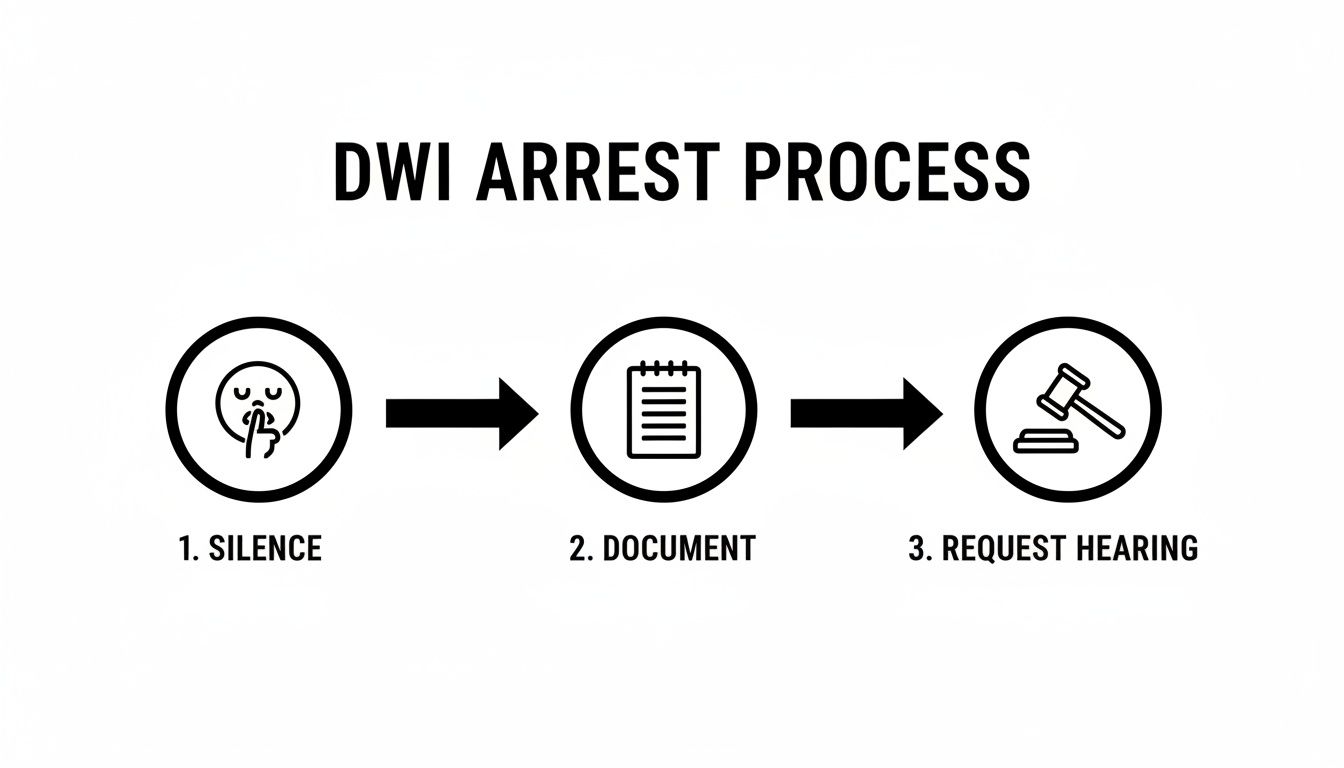
It’s a simple but powerful sequence: protect yourself by staying silent, preserve the facts by writing them down, and take decisive legal action by demanding your hearing.
Request Your ALR Hearing Immediately
This is the most time-sensitive and easily missed step in the entire process. A DWI arrest in Texas triggers two separate cases: the criminal charge and a civil action against your driver's license, known as the Administrative License Revocation (ALR) process.
You have only 15 days from the date of your arrest to formally request an ALR hearing. If you miss this deadline, your license will be automatically suspended, no questions asked.
Requesting the hearing is a game-changer. It temporarily stops the suspension and gives your lawyer an early chance to question the arresting officer under oath and challenge the state's evidence. To get a fuller picture of the entire post-arrest timeline, you can review our guide on what happens when you get arrested.
Of course, one of the first hurdles is getting out of jail. Getting a handle on potential costs ahead of time can relieve a lot of stress. A resource like this guide on understanding DUI bail cost can be incredibly helpful, allowing you to prepare for that expense and turn your full attention to building a solid defense.
Why Pleading Not Guilty is Almost Always the Right Move

After you've been arrested for a DWI in Humble or Atascocita, your first time in front of a judge is usually for the arraignment. This is where they'll ask you for your plea: guilty or not guilty. I’ve seen it time and again—the pressure is on, and the urge to plead guilty just to make it all go away can feel overwhelming.
But here’s some advice from someone who has been in that courtroom countless times: Pleading guilty right away is a critical mistake.
When you plead guilty at this early stage, you’re slamming the door shut on your own defense. It's an immediate acceptance of the conviction and every single consequence that comes with it. The judge moves straight to sentencing, and suddenly you have a permanent criminal record that can haunt your job prospects, housing applications, and your standing in the Humble community.
On the other hand, pleading "not guilty" is the key that unlocks the entire defense process. It’s not about being defiant; it's a procedural step that buys your attorney the time and leverage needed to actually defend you.
It's a Strategic Move, Not a Lie
Let's be clear: when you plead not guilty, you are not lying to the court. You are simply exercising your constitutional right to make the State of Texas prove its case against you beyond a reasonable doubt. This one simple act gets the ball rolling on your defense.
An initial "not guilty" plea gives your legal team the green light to:
- Demand all the evidence. This isn't just the police report. We’re talking body cam footage, dashcam videos, and the maintenance and calibration logs for the breathalyzer machine they used.
- File motions to suppress. Was the traffic stop even legal? Were your rights violated during the arrest? If so, we can file motions to get the evidence thrown out before it ever sees a jury.
- Negotiate from a position of strength. When the Harris County prosecutor sees we’re ready to fight, it opens up a real conversation about reducing the charge or even dismissing the case entirely.
This plea is your most powerful tool at the very beginning. It puts you back in the driver's seat.
An Arrest is Not a Conviction
So many people in Northeast Houston think that just because they were arrested for DWI, a conviction is a foregone conclusion. That's just not how Texas law works. Every case has its own unique set of facts and, very often, its own set of weaknesses.
Think about a common scenario I see all the time. A person gets pulled over late at night in Kingwood for supposedly swerving. The road shoulder is dark and uneven, but the officer has them do the field sobriety tests right there. They don't do well, and they're arrested. It looks bad.
But pleading "not guilty" allows an attorney to dig deeper. We get the dashcam video and see that the "swerve" was just a driver correcting to avoid a massive pothole. The video might also show the officer mumbling the instructions for the sobriety tests, making the results completely unreliable. These are the details that can turn a "slam dunk" for the prosecution into a dismissal.
Pleading guilty is a final decision. Pleading not guilty is the first step in a strategic process designed to protect your future. It preserves every single one of your legal options.
What the Numbers Say
This isn't just theory; the data backs it up. According to Texas Department of Public Safety statistics from 2020, there were 83,088 DWI arrests across the state. While many people assume they have no choice but to plead guilty, those who choose to fight see far better outcomes.
Data from recent years shows that entering a "not guilty" plea can significantly improve your odds. It can boost the chance of getting a case dismissed to around 15% and increase the likelihood of getting the charge reduced to something less severe in nearly 30% of cases. You can explore more insights on DWI statistics in Texas to see the full breakdown.
Pleading not guilty is the essential first move. It gives you a fighting chance and buys the time we need to build a defense tailored to your situation. If you or someone you care about is facing a DWI charge in the Humble area, your future is worth fighting for. The Law Office of Bryan Fagan is here to help you do just that. Contact our Humble office today for a free, confidential consultation to go over your case.
Effective DWI Defense Strategies in Harris County
When you're facing a DWI charge in Harris County, it's natural to feel like the deck is stacked against you. Many people see a failed breathalyzer or a shaky roadside test as an open-and-shut case. But that’s rarely the whole story.
An arrest is just the beginning. At The Law Office of Bryan Fagan, we view a DWI charge as a series of claims made by the state—claims that must be proven beyond a reasonable doubt. For our clients in Humble, Atascocita, and across Northeast Houston, this means we scrutinize every single piece of evidence. From the moment those red and blue lights flashed in your rearview mirror to the final blood draw, every action taken by law enforcement is a potential point for a strong defense.
Challenging the Initial Traffic Stop
The entire case against you rests on one simple question: Was the traffic stop legal in the first place? A police officer can't just pull you over because they have a hunch. The Fourth Amendment protects you, meaning an officer must have reasonable suspicion that you've broken a law.
This isn't just a legal technicality; it's often where cases fall apart.
- The officer might claim you were "weaving," but what if the dashcam footage shows you were just moving within your lane to dodge a pothole on a poorly lit Kingwood road?
- They might say you didn't signal a lane change, but the video could prove you did and the officer simply wasn't in a position to see it.
- Sometimes, the stop is based on nothing more than a vague, anonymous 911 call, which often isn't enough to justify the stop.
If we can show the stop was unlawful, any evidence collected afterward—the field sobriety tests, the breath or blood results—can be suppressed. It can end the case right there.
Scrutinizing Field Sobriety Test Results
Those roadside "tests" are anything but simple. Standardized Field Sobriety Tests (SFSTs) are a set of highly specific physical and mental exercises that officers are notorious for administering incorrectly. The National Highway Traffic Safety Administration (NHTSA) has very strict rules for a reason, and any slip-up by the officer can make the results completely unreliable.
We dig into the details that matter:
- Improper Instructions: Did the officer mumble the instructions or fail to demonstrate the test correctly? A sober person can easily "fail" if they don't know exactly what's expected of them.
- Unsafe Conditions: Were you asked to perform these balance-sensitive tests on a sloped shoulder, on loose gravel, or with blinding patrol car lights flashing in your eyes? These conditions make it impossible to get a valid result.
- Medical and Physical Issues: Do you have an old knee injury? An inner ear problem? Are you over 65 or significantly overweight? Officers often ignore these factors, which can make it physically impossible to pass the tests, regardless of sobriety.
An officer’s opinion that you "failed" a field sobriety test isn’t the final word. It's a subjective judgment call, and it's one we can—and frequently do—take apart in court.
Demystifying Breath and Blood Test Evidence
The so-called "scientific" evidence from a breath or blood test can feel intimidating, but it is far from foolproof. These machines and the procedures surrounding them are riddled with potential for error.
Most departments in our area, including those serving Humble and Northeast Houston, use the Intoxilyzer 9000 breathalyzer. Here's how we challenge its readings:
- Was the machine properly calibrated? These devices need constant maintenance. We pull the logs to see if the machine used in your arrest has a history of malfunctions or wasn't recently calibrated.
- Did the officer follow the 15-minute observation period? Before the test, the officer must watch you for 15 continuous minutes. If they were distracted or didn't do it, the test is invalid. A simple burp or hiccup can bring up "mouth alcohol" and create a falsely high reading.
- Do you have a medical condition? Things like GERD (acid reflux) or even being on a keto diet can create chemical compounds that these machines mistake for alcohol.
Blood tests have their own weaknesses, too. The "chain of custody" is everything. Was the blood drawn by a qualified phlebotomist? Was it stored at the right temperature? Was it properly labeled and tracked from your arm to the lab? Any mistake along the way can contaminate the sample and render the result useless in a Harris County court.
To see how these and other challenges can dramatically change the outcome of a case, you can learn more about how a DWI case can be dismissed. It's all about finding the weaknesses in the state's argument.
Potential Weaknesses in a Texas DWI Case
Every DWI case has potential vulnerabilities. An experienced attorney knows how to meticulously review every stage of the process, from the reason you were pulled over to the handling of chemical evidence. This table highlights just a few of the critical areas we investigate to build a strong defense for Humble residents.
| Phase of Arrest | Potential Legal Challenge | Why It Matters for Your Case |
|---|---|---|
| Initial Stop | Lack of Reasonable Suspicion | If the officer had no legal basis to pull you over, all subsequent evidence can be thrown out. |
| Roadside Investigation | Improper SFST Administration | If tests weren't conducted by the book, their "results" are unreliable and can be challenged. |
| Arrest | Lack of Probable Cause | The officer must have sufficient facts to justify an arrest, not just a hunch. |
| Chemical Testing | Machine Malfunction / Operator Error | Breathalyzer machines need precise calibration and operation; failure to do so invalidates the reading. |
| Blood Draw | Chain of Custody Issues | Any break or error in handling the blood sample from collection to analysis can contaminate it. |
| Video Evidence | Contradictory Footage | Dashcam or bodycam video often contradicts the officer's written report, undermining their testimony. |
Ultimately, the prosecution's case is a chain, and our job is to find and break the weakest link. A single procedural error or a piece of contradictory evidence can be all it takes to protect your freedom.
Don't Underestimate the Power of Negotiation in a DWI Case
When people think about fighting a criminal charge, they often picture a dramatic courtroom trial. But the truth is, many DWI cases are won long before a jury is ever selected. Skilled negotiation is one of the most powerful tools in a defense attorney's arsenal, and it’s a critical part of how we protect our clients in Humble, Atascocita, and Kingwood.
This behind-the-scenes work is where an experienced local lawyer creates tremendous value. We don't just passively accept the prosecutor's first offer. Instead, we use every weakness we've uncovered in their case as leverage to push for a much better result.
What Gives Your Attorney Leverage?
Effective negotiation isn't about asking for a favor—it's about presenting the prosecutor with problems. The more legitimate issues we can raise with their evidence, the more motivated they become to offer a favorable plea deal rather than risk losing the case entirely at trial.
So, where does our leverage come from? It's built on the foundation of the defense strategies we've developed from day one.
- A questionable traffic stop: If we can show the officer had no valid legal reason to pull you over in the first place, the prosecutor knows their entire case could get thrown out.
- Improperly administered sobriety tests: Presenting dashcam or bodycam video of a field sobriety test conducted on an unsafe surface or with confusing instructions severely damages the officer's credibility.
- Errors in chemical testing: Evidence that the Intoxilyzer 9000 was out of calibration or that a blood sample's chain of custody was broken introduces serious doubt about the results.
- A clean record: For first-time offenders in Northeast Houston, a clean background and strong ties to the community can be a surprisingly powerful factor in persuading a prosecutor to agree to a reduction.
Each of these points creates uncertainty for the prosecution. That uncertainty is exactly what opens the door for us to start a meaningful conversation about a better outcome for you.
The Goal: Getting the Charge Reduced
For many of our clients, the primary goal of negotiation is to secure a plea to a lesser, non-alcohol-related offense. One of the best possible outcomes in Texas is getting a DWI reduced to a charge like Obstruction of a Highway.
This isn't just a simple name change; it's a completely different class of offense. Obstruction of a Highway is a Class B misdemeanor that avoids the devastating, long-term consequences that follow a permanent DWI conviction.
Key Takeaway: Securing a reduction to a charge like Obstruction of a Highway can protect your driving record, prevent your insurance rates from skyrocketing, and safeguard your professional licenses and career.
How Harris County Prosecutors Approach DWI Cases
Make no mistake, Harris County prosecutors handle thousands of DWI cases every year. They are often looking for ways to resolve their caseloads efficiently, especially when they know their evidence isn't rock-solid. A local attorney who regularly works with these specific prosecutors understands which arguments are the most persuasive.
We know what kind of evidence they value and, more importantly, what weaknesses make them hesitate to go to trial. This familiarity with the legal landscape in Northeast Houston gives our clients a distinct advantage. It lets us frame our arguments in a way that aligns with the prosecutor's own goals and pressures, making a favorable plea agreement far more likely.
Plea bargaining is how the vast majority of DWI cases are actually resolved. An American Bar Association study found that roughly 90% of criminal cases nationwide end with a plea. Digging into Texas data from 2021, we see that defendants who plead not guilty and actively fight their charges have about 15% of cases dismissed and another 30% reduced to lesser convictions. For a first-time offender with a weak case against them, those odds can improve even more. You can discover more insights about these DWI statistics and see the real impact of a strong defense.
If you are facing a DWI charge in the Humble area, don't just assume a conviction is your only option. The Law Office of Bryan Fagan can meticulously evaluate the state's case against you and fight for a better outcome. Call our Humble office today for a free consultation to discuss your case.
Why a Local Humble DWI Attorney Is Essential
When you're staring down a DWI charge, the legal system can feel like it's designed to confuse you. It’s an intimidating world of complex procedures and unspoken rules, and trying to navigate it alone in Harris County is a massive gamble with your future.
That’s why having a dedicated local attorney isn't just a good idea—it's absolutely critical.
For folks here in Humble, Atascocita, and Kingwood, a DWI conviction can unravel everything you've built. It puts your job at risk, threatens your freedom to drive, and can damage your reputation in the community. Our firm, The Law Office of Bryan Fagan, is here to even the odds and protect what matters most to you.
The Home-Field Advantage in Court
Fighting a DWI charge is about so much more than just quoting Texas law. It’s about knowing the people and the local legal landscape. An attorney from outside the area won’t have a clue about the specific tendencies of a certain Harris County judge or the negotiating style of a particular prosecutor. That kind of insider knowledge can be the difference between a conviction and a dismissal.
We are in these Humble-area courtrooms day in and day out. We’ve learned which arguments resonate with local judges and which prosecutors are more likely to negotiate a charge down to something less severe. This familiarity lets us build a defense strategy that’s actually built for the Northeast Houston legal environment, not some generic, one-size-fits-all plan.
We Aren't Just Lawyers—We're Your Shield
Beyond courtroom tactics, a local attorney serves as your personal advocate and your shield through this entire overwhelming ordeal. We take care of all the paperwork, file the right legal motions on time, and stand right next to you at every single court appearance. You will never have to face the judge or the prosecutor by yourself.
Hiring an attorney right away sends a powerful signal to the prosecution: you are taking this seriously and you will fight this charge. That simple act can completely shift the dynamic of your case, opening up avenues for negotiation that might have otherwise been shut.
We handle the legal heavy lifting so you can keep your focus on your family and your life. From that first crucial ALR hearing to save your driver's license to the final resolution of your criminal case, we’re with you at every turn. Need more guidance on making this choice? Take a look at our guide on how to choose the right criminal defense lawyer for your specific situation.
Turning Statistics into Your Success Story
The impact of having a skilled lawyer on your side isn't just a feeling; the numbers back it up. National data reveals that when a person has expert legal counsel for a DWI, their chances of a good outcome go up dramatically. In fact, roughly 40% of DWI cases defended by an experienced attorney result in a dismissal or a reduction to a lesser charge.
How does this happen? A good lawyer knows exactly where to look for weak evidence, procedural screw-ups, and holes in the prosecution's case. Here in Harris County, where thousands of DWI cases are filed every year, that local expertise is what helps us turn those intimidating statistics into a personal victory for you.
Benefits of a Local Humble DWI Attorney
To make it crystal clear, here’s a look at what facing a DWI charge is like with and without a dedicated local firm fighting for you.
| Aspect of Your Case | Without a Local Attorney | With The Law Office of Bryan Fagan |
|---|---|---|
| Court Procedures | You're on your own, trying to learn unfamiliar rules and deadlines, which often leads to costly mistakes. | We handle all filings, manage every deadline, and attend all court dates, making sure everything is done right. |
| Evidence Review | You might only get to see the police report, completely missing the key weaknesses in the case against you. | We dig deep into all evidence—dashcam video, breathalyzer logs, and arrest reports—to find every flaw. |
| Negotiations | You're left to bargain directly with a trained prosecutor, putting you at a significant disadvantage from the start. | We use our local relationships and deep knowledge of the evidence to negotiate for a charge reduction or dismissal. |
| Your Future | A single misstep can result in a permanent conviction, impacting your career, license, and reputation for years. | Our primary goal is to protect your future by fighting for the best possible outcome and keeping your record clean. |
A DWI arrest is one of the most stressful things anyone can go through. But you don't have to face it by yourself. At The Law Office of Bryan Fagan, we don't see case numbers; we see our neighbors. If you or someone you care about has been arrested, we are here to provide the focused, local representation you deserve.
Don’t wait and risk your rights. Contact our Humble office today for a free, completely confidential consultation to discuss your case.
Common DWI Questions Answered

When you’re staring down a DWI charge in the Humble area, the questions can feel overwhelming. It’s a confusing process, and every decision seems to carry huge weight for your future. Let’s cut through the noise and get straight to some of the most common concerns I hear from clients, so you can start making sense of your situation.
While every case has its own unique wrinkles, getting a handle on the basics is your first move in figuring out how to fight a dwi charge. What you do right now truly matters.
Should I Refuse the Breathalyzer Test in Texas?
This is the big one, and it's a decision you have to make under immense pressure. Texas has an "implied consent" law, which means that by having a driver's license, you’ve already agreed to a breath or blood test if you’re lawfully arrested for DWI. Saying no to the test triggers an automatic driver's license suspension—that's 180 days gone for a first-time refusal.
But here's the other side of the coin: giving a sample hands the prosecutor a powerful piece of evidence to build their case against you. Refusing the test starves them of that evidence, which can make it much tougher for them to prove you were intoxicated.
Refusing the test does mean an automatic license suspension, but a good lawyer will immediately challenge it at what’s called an Administrative License Revocation (ALR) hearing. There's no one-size-fits-all answer here; it depends entirely on your situation. That's why getting an attorney on the phone is so critical.
Your best move is often to politely and calmly state that you won't consent to any tests without speaking to your lawyer first. This asserts your rights without coming across as uncooperative.
How Much Does It Cost to Fight a DWI?
The cost of a solid DWI defense isn't fixed; it really depends on how complex your case is and whether we end up going to a full-blown trial. It’s a serious investment, but you have to measure it against the massive, long-term costs of having a DWI conviction on your record.
Think about the financial fallout of a conviction:
- Hefty court fines and administrative fees.
- Costs for mandatory DWI education classes.
- Sky-high car insurance premiums that can follow you for years.
- The risk of losing your job or missing out on future career opportunities.
- The expense of installing and maintaining an ignition interlock device.
At The Law Office of Bryan Fagan, we’re up-front about legal fees and are deeply committed to serving our Humble community. We offer a completely free consultation where we can go over the details of your case and give you a clear picture of what it will take to protect your future.
Can a First-Time DWI Be Dismissed in Harris County?
Absolutely. Getting a first-time DWI dismissed in Harris County is not just wishful thinking; it's a realistic goal, especially with a sharp, proactive legal defense. Remember, an arrest is just the beginning of the story, not the end. Many cases are built on shaky ground.
A dismissal is possible if your attorney can successfully show that:
- The police had no legal reason (reasonable suspicion) to pull you over in the first place.
- The field sobriety tests weren't done correctly or were administered on a dangerous, uneven surface.
- The breathalyzer machine was out of calibration, or the chain of custody for your blood sample was broken.
Sometimes, a dismissal can be negotiated simply because the prosecutor’s case has too many holes. Your odds of getting a positive outcome go way up when you have a local lawyer who knows the courts and the system fighting in your corner from day one.
Facing a DWI charge is serious, but it’s a fight you don’t have to go through by yourself. The right legal strategy can change everything. At The Law Office of Bryan Fagan, we focus on defending the rights of our neighbors in Humble, Atascocita, and Kingwood. We bring the local experience and courtroom know-how needed to challenge the prosecution’s case from every angle. Schedule your free, no-obligation consultation with our Humble office today to see how we can protect your future. Visit us at https://www.humbletxlawyers.com.