Skip to content
Deciding to pursue legal guardianship is a profound step, one almost always born from love and a deep desire to protect someone you care about. Whether it’s for a child in your family who needs a safe, stable home or an adult who can no longer manage their own affairs, the goal is the same: to provide unwavering care and protection.
Here in Humble, Texas, the legal path involves a few key milestones: you’ll need to file an application with the correct Harris County court, provide clear proof that a guardian is necessary, and ultimately attend a hearing where a judge will make the final decision. The entire system is structured to safeguard our community's most vulnerable people by appointing a responsible person to look after their best interests.
Understanding When Guardianship Is Necessary in Texas
For most families I work with here in Humble and the greater Northeast Houston area, the conversation about guardianship starts from a place of real concern. It’s a legal tool you turn to when someone simply can’t make safe or sound decisions for themselves anymore, either personally or financially. While the process can seem daunting, knowing exactly when it applies can provide a lot of clarity.
Guardianship isn’t an abstract concept; it’s for real-life situations right here in our community. Think of a grandparent in Atascocita who needs to take over care for their grandchild because the parents are no longer in the picture or can't provide a safe environment. Or consider an adult child in Kingwood whose elderly parent is struggling with dementia, making them vulnerable to scams and unable to manage their own medical needs. These are the moments when guardianship becomes essential for a family's well-being.
Defining Key Roles in Guardianship
Under Texas law, the person who needs protection is officially called the 'ward,' and the individual the court appoints to care for them is the 'guardian.' These are more than just legal terms; they establish a formal relationship built on a foundation of trust and serious responsibility. The court's number one priority, always, is to protect the ward's best interests.
To help Humble families quickly identify their needs, let's look at the key differences between the two main types of guardianship.
Guardianship at a Glance Key Differences in Texas
| Aspect | Guardianship for a Minor | Guardianship for an Incapacitated Adult |
|---|---|---|
| Primary Goal | Provide a stable, safe environment when parents cannot. | Protect an adult who can no longer make decisions for themselves. |
| Triggering Event | Parental death, incapacitation, or unfitness. | A medical condition like dementia, stroke, or severe injury causing incapacity. |
| Duration | Typically ends when the child turns 18. | Usually permanent, lasting for the rest of the ward's life unless capacity is restored. |
| Legal Standard | Proving it is in the child's best interest. | Proving with "clear and convincing evidence" that the adult is incapacitated. |
| Key Documents | Birth certificate, parents' death certificates (if applicable). | A recent physician's certificate detailing the person's condition and incapacity. |
As you can see, the court's approach and the required evidence change depending on whether you are seeking guardianship for a child or an adult.
This brings us to two distinct roles a guardian can have:
- Guardian of the Person: This person is in charge of the ward’s physical well-being. They make crucial decisions about healthcare, living arrangements, and day-to-day personal care.
- Guardian of the Estate: This individual is responsible for the ward’s financial life. They manage property, pay bills, handle income, and protect assets.
A judge can appoint one person to handle both roles, or they might split the duties between two different people if the situation calls for it.
Guardianship vs. Other Legal Tools
It's easy to confuse guardianship with other legal arrangements, but the differences are critical. For a minor, guardianship isn't the same as adoption—it doesn’t permanently sever parental rights and can be modified if the parents' situation improves.
It’s also fundamentally different from a power of attorney. A power of attorney is a document someone creates while they still have the mental capacity to choose an agent to act on their behalf. Guardianship, on the other hand, is a court-imposed solution for when that capacity is already lost. You can get a deeper understanding of this by reading about the guardianship vs a power of attorney.
When seeking guardianship for an adult, the court will need solid proof of their inability to make decisions. This is where professionals like capacity assessors come in. Their expert evaluation provides the critical medical evidence a judge needs to see.
Guardianship is also a vital permanency option for children in the foster care system. In FY 2024, of the 176,730 youth who exited foster care nationwide, only 11% were placed in a guardianship. Here in Texas, the state often uses the term 'managing conservatorship,' which functions similarly to guardianship. To get there, you have to provide clear evidence of parental consent or unfitness. For families in Humble on this journey, having an expert guide you through the paperwork can make all the difference in securing a child’s future.
Your Practical Roadmap for Filing in Harris County
Navigating the Harris County court system can feel like you've been dropped into a maze without a map. But for families in Humble, Atascocita, and Kingwood, understanding the local process is the first, most empowering step you can take. Let's walk through the actual journey of establishing legal guardianship, from filing that first piece of paper to standing before the judge.
It all starts with one critical document: the Application for Appointment of Permanent Guardian. This isn't just another form. It’s your formal request to the court, laying out exactly why a guardian is needed and who is the best person for the job. Filing this application is what officially kicks off the entire legal process.
This visual shows how the paths for child and adult guardianship, while different, both lead to a final court decision.
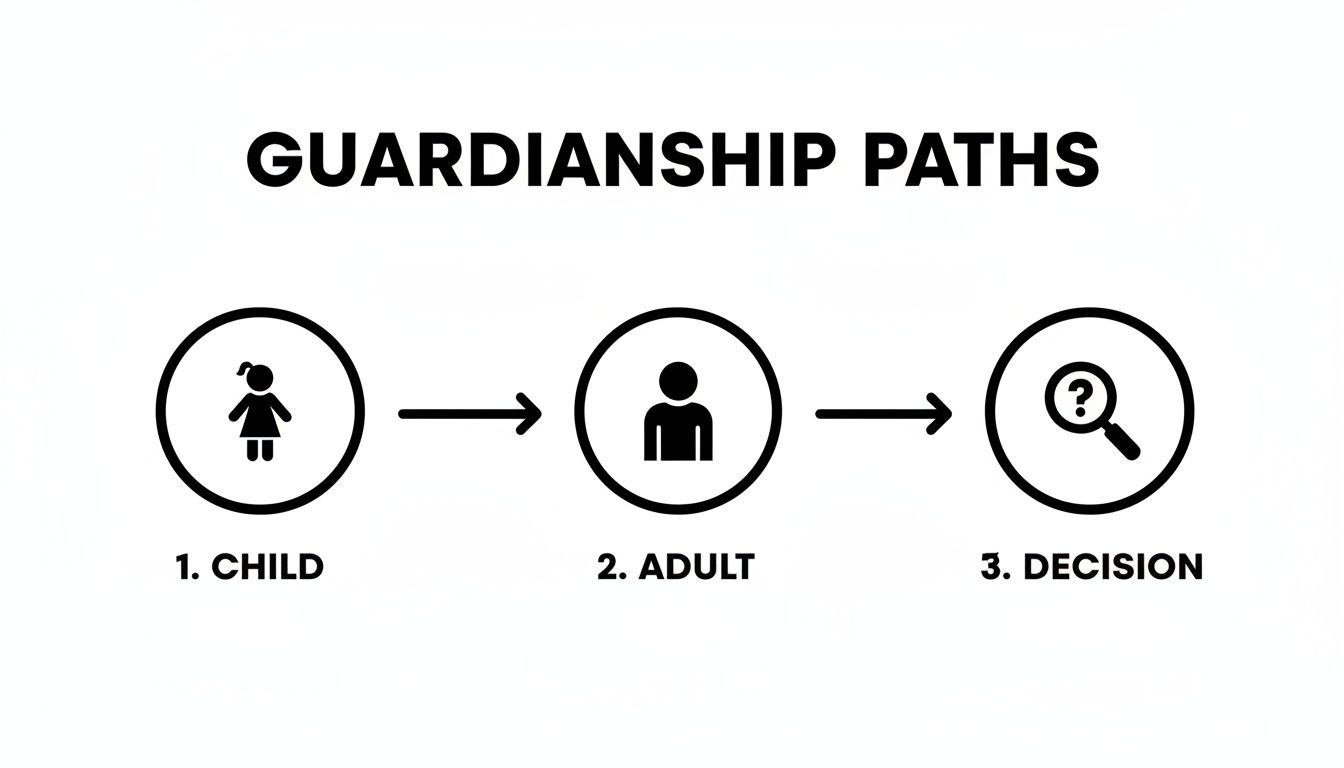
Whether you're seeking guardianship for a minor or an adult, the journey ultimately ends with a judge's evaluation and a formal court order.
The Initial Steps in the Guardianship Process
Once you've filed the application, the court's immediate goal is to get objective information. If you're seeking guardianship over an adult, the most important piece of evidence is the Physician's Certificate of Medical Examination. This is a sworn statement from a doctor, completed within the last 120 days, detailing the proposed ward’s condition and confirming they lack the capacity to manage their own affairs.
This isn't about prying into your loved one’s privacy. It’s about giving the judge the clear, convincing evidence required under Texas law to make such a monumental decision. It validates your claim that your loved one can no longer make critical decisions for themselves.
Think of it as the bedrock of your case. Without a solid medical opinion, the court simply has no legal basis to determine a guardian is even necessary. For families in Northeast Houston, working with a local attorney can be invaluable here, just to make sure the document is filled out perfectly and submitted on time to avoid frustrating delays.
The Role of the Ad Litem Attorney
After your application is accepted, the Harris County court will appoint an attorney ad litem. This is an independent lawyer whose sole job is to represent the best interests of the person you're seeking to protect (the proposed ward). Essentially, they become the court's eyes and ears.
The ad litem's investigation typically involves a few key actions:
- Visiting the proposed ward for a direct conversation.
- Interviewing you, other family members, and medical staff.
- Reviewing all the medical records and legal documents submitted.
- Writing a formal report for the judge summarizing their findings and making a recommendation.
This appointment is a crucial safeguard. It ensures the proposed ward's rights aren't being overlooked. The ad litem is a neutral party, giving the judge an unbiased perspective on the entire situation, and their report carries significant weight in the final decision.
What to Expect at the Guardianship Hearing
The final step is the court hearing. This is when you, your attorney, and the attorney ad litem will appear before a judge in one of the Harris County Probate Courts. This hearing is your chance to formally present your case and answer any questions.
The judge will ask questions to confirm the information in your application and the ad litem’s report. They want to be certain that guardianship is the least restrictive option available and that you are the right person for the role. It’s less of an interrogation and more of a conversation to ensure every legal standard has been met.
The process universally begins with a petition that details the need for guardianship, which is then investigated by the court. In Texas, the Probate Code requires the appointment of a guardian ad litem in 95% of contested cases, which helps resolve 70% of them within 120 days. For Humble families filing in Harris County, proving the 'best interest' of the ward often involves home studies that can cost between $1,500 and $3,000. The good news? Approval rates for family guardianships are high, exceeding 85%. You can learn more about these national trends and how they impact local courts by exploring insights from the National Center for State Courts.
If the judge agrees that all requirements are met, they will sign an order appointing you as guardian. This final court order is the legal document that gives you the authority to begin your responsibilities. While the journey may seem complex, each step is designed with one purpose: to protect your loved one.
The process can feel intimidating, but you don't have to face it alone. The Law Office of Bryan Fagan is deeply rooted in the Humble community, and we are here to guide you through every step. Schedule a free consultation with our Humble office today to discuss your situation and get the clear, compassionate advice you deserve.
Gathering Your Essential Documents and Information
When you decide to pursue guardianship, the first, most crucial step is gathering your paperwork. I’ve seen countless families get bogged down by this part of the process, but getting your documents in order from the start can save you a world of stress and prevent frustrating delays with the Harris County court.
This isn’t just about checking boxes on a form. It's about building a clear, compelling case for the judge, showing that you are organized, responsible, and fully prepared to step into this critical role.

Key Documents for the Proposed Ward
Whether you're seeking guardianship for a child or an adult, the court has to verify their identity and current situation. There’s no getting around this; it’s the foundation of your entire case.
You'll need to track down the following items:
- Birth Certificate: This is the primary proof of their age and identity.
- Social Security Card: Essential for managing any government benefits or financial accounts on their behalf.
- Relevant Medical Records: These documents provide a snapshot of the person's health, any disabilities, and their specific care needs.
For families in Atascocita and Kingwood, just getting official copies of these records can sometimes feel like a full-time job. My advice? Start on this immediately. It's not uncommon to face bureaucratic hurdles, and modern tools are emerging to help with the challenge of Democratizing Access to Legal Documents with AI-Powered Simplicity.
In my experience, the one document that can make or break an adult guardianship case is the Physician's Certificate of Medical Examination. This isn't just a suggestion—it's an absolute requirement. A doctor must have completed this form within the last 120 days, as it's the core medical evidence the court uses to determine incapacity.
Let me be clear: without this specific, up-to-date certificate, your application will stall in the Harris County probate courts. It has to detail precisely why your loved one is unable to manage their own affairs.
Information Required for the Proposed Guardian
Now, let's talk about you. The court needs to be certain that you are a suitable and trustworthy person for this huge responsibility. This means you'll have to provide some personal information to prove your fitness for the role.
Be prepared to submit:
- A Completed Application Form: This is the official court document where you explain your relationship to the proposed ward and lay out the reasons why guardianship is necessary.
- A Criminal Background Check: Texas law mandates this check. It's a non-negotiable step to protect the ward's safety.
- Personal Identification: You’ll need to provide a copy of your driver’s license or another valid government-issued photo ID.
These requirements exist for a very good reason—to protect the most vulnerable people in our community. The court's primary duty is to the ward, and thoroughly vetting potential guardians is how they fulfill that duty.
Tailoring Your Documentation to the Case Type
The exact paperwork you'll need depends on whether you're establishing guardianship for a minor or an adult. The needs are different, so the evidence has to be, too.
To help you stay organized, I’ve put together a checklist that breaks down the essentials for Humble residents.
Essential Guardianship Application Checklist for Humble Residents
This table outlines the core documents you'll need based on the type of guardianship you are seeking in Harris County.
| Document or Information | For Guardianship of a Minor | For Guardianship of an Adult |
|---|---|---|
| Proof of Parental Status | Evidence of parental unfitness, consent, or death certificates. | Not Applicable |
| Physician's Certificate | Not typically required. | Mandatory and must be recent. |
| Financial Statements | Information on the minor’s assets or inheritance, if any. | Detailed list of the proposed ward’s assets, income, and property. |
| Proposed Guardian's Info | Background check and personal identification. | Background check and personal identification. |
Putting all these documents together is a huge first step on this journey. If you're feeling overwhelmed or just aren't sure where to begin, please know that you don't have to do it alone. The Law Office of Bryan Fagan is here to help families in Humble and across Northeast Houston. Schedule a free, no-obligation consultation with us, and we'll make sure you have everything you need for a smooth and successful process.
Navigating the Guardianship Court Hearing
Let's be honest, stepping into any courtroom can be nerve-wracking, especially one in downtown Houston. But when you’re there for a guardianship hearing, it's helpful to know what’s coming. This isn't a high-drama trial; it's a structured, often compassionate process. Knowing the ropes can turn that anxiety into confidence, whether you're coming from Humble, Kingwood, or anywhere in between.

Think of the hearing as the final checkpoint. It’s where the judge officially reviews everything, listens to key testimony, and makes the final call. The goal is simple: confirm that a guardianship is truly necessary and that you are the right person for the job.
What to Expect Inside the Courtroom
When your hearing begins, you’ll see a few key players in the Harris County probate court. You and your attorney will be there, of course. You'll also see the attorney ad litem—an independent attorney the court appointed to represent your loved one’s best interests. The judge will run the show, asking questions to confirm all the details in your application.
The judge’s questions are usually direct and to the point. They’ll likely ask about your relationship to the person needing guardianship, your understanding of what a guardian does, and your specific plans for managing their personal and financial life. This is your chance to show the court you’re ready and committed.
A huge part of the hearing revolves around the report from the attorney ad litem. This neutral attorney has already done their homework—they’ve met with your loved one, gone through medical records, and likely talked to other family members. Their unbiased report and recommendation carry a lot of weight with the judge. You can get a deeper understanding of what a guardian ad litem is and why their role is so critical in our detailed guide.
In Texas, a guardian is considered a fiduciary. That’s a legal term for someone who holds a relationship of trust and is legally bound to act solely in the best interests of another person. The court takes this duty very, very seriously.
From Family Member to Appointed Guardian
The moment the judge signs the order appointing you as guardian, your legal role officially begins. It’s a major shift. You’re no longer just a concerned family member; you are now a court-appointed fiduciary with duties outlined in the Texas Estates Code.
Your ongoing responsibilities will typically include:
- Making Healthcare Decisions: This means you'll be the one consenting to medical treatments, choosing doctors, and making sure all of your loved one's health needs are addressed.
- Managing Living Arrangements: You’ll decide the best place for the ward to live. That could be at home with you in Atascocita, in an assisted living facility, or another setting that suits their needs.
- Handling Financial Matters: As guardian of the estate, you’ll be in charge of managing their income, paying bills, protecting their assets, and making sound financial decisions on their behalf.
This isn’t a one-and-done deal. It’s a genuine, long-term commitment.
The Work After the Hearing: Court Supervision and Reporting
Your job doesn't end when you leave the courthouse. The court stays involved to make sure the ward is always protected. For you, this means keeping up with some important reporting requirements to stay in good standing.
One of your most crucial ongoing tasks is filing an Annual Report on the Condition and Well-Being of the Ward. This is essentially an update for the court on your loved one’s physical and mental health, their living situation, and any big changes from the past year.
If you’re also the guardian of the estate, you have another report to file: the Annual Account. This is a detailed financial breakdown of every dollar that came in and went out of the ward's estate.
For families all across Northeast Houston, it’s vital to understand these long-term duties before you even begin. Guardianship is an incredibly powerful way to protect someone you love, but that power comes with a significant and lasting responsibility—both to them and to the court.
Exploring Alternatives to Full Guardianship
When families in Humble and Northeast Houston start looking into legal guardianship, there's often a misconception that it's an all-or-nothing situation. While guardianship is a necessary tool in many cases, it’s also a very serious one. Texas law actually pushes for the least restrictive option available to protect a loved one, meaning we should always explore alternatives that provide support without completely stripping someone of their legal right to make their own choices.
Make no mistake, guardianship is a huge legal step. It removes a person's most fundamental rights. Before you even think about heading down that path, the Harris County courts will expect you to have considered other, less drastic measures. The goal is always to honor your loved one's autonomy as much as the situation safely allows.
When a Power of Attorney Might Be the Right Fit
One of the most common—and effective—alternatives is a Power of Attorney (POA). This is a legal document where an individual, known as the "principal," appoints a trusted person, or "agent," to make decisions for them. The biggest difference between this and a guardianship is that a POA is put in place by choice while the person still has the mental capacity to make that decision. A guardianship is court-imposed.
For most families, two types of POAs are incredibly useful:
- Durable Power of Attorney: This gives your chosen agent the power to handle financial matters, like paying bills from a bank account, managing investments, or even selling property. The word "durable" is what matters most; it means the agent's authority stays in effect even if the principal becomes incapacitated later on.
- Medical Power of Attorney: This document appoints a healthcare agent to make medical decisions if the principal can't communicate their own wishes. This is absolutely critical for situations involving end-of-life care or other serious health choices.
Think about a common scenario here in Kingwood: an elderly parent is still mentally sharp, but they’re physically frail and find it hard to get out to manage their finances. A durable power of attorney is a perfect solution. It lets their adult child pay the bills and handle banking without taking away the parent's independence. You can learn more about what a power of attorney is and how it stacks up against guardianship in our detailed article.
Exploring Supported Decision-Making Agreements
Another fantastic alternative that's gaining ground in Texas is the supported decision-making agreement. This is a more collaborative approach. It’s a formal tool that lets a person with a disability choose trusted advisors—family, friends, professionals—to help them understand their options and make their own life decisions.
This is a great fit for, say, an adult with developmental disabilities in Atascocita who is capable of making choices but might need some help processing complex information. Instead of a guardian making decisions for them, their chosen supporters simply help them make decisions for themselves. It’s a way to provide a crucial safety net while fully preserving their dignity and right to self-determination.
This shift toward less restrictive options isn't just a local trend. Legal reforms worldwide are emphasizing alternatives like supported decision-making. In the U.S., 41 states now require annual well-being reports for guardianships. The National Center for State Courts (NCSC) even noted that limited orders for specific needs, like finances, saw a 20% surge after 2020 as families looked for ways to avoid a total loss of control for their loved ones.
Making the Right Choice for Your Family
So, how do you choose? It all comes down to your loved one’s specific needs and capabilities. Is the issue a temporary setback, or is their incapacity permanent and total? Can they still participate in the decision-making process at all? Answering these questions honestly is the very first step.
Sometimes, a combination of these tools is the best approach. For other families, a full guardianship is truly the only way to ensure their loved one's safety. The most important thing is to make an informed decision. At the Law Office of Bryan Fagan, we're dedicated to helping Humble families find the solution that best protects their loved ones while respecting their rights.
Schedule a free consultation with our Humble office, and let's explore all your options together.
Answering Your Top Texas Guardianship Questions
If you're thinking about guardianship, your head is probably swimming with questions. That's completely normal. Over the years, our firm has walked countless families in Humble, Atascocita, and Kingwood through this exact process, and we've found that most people have the same core concerns. Let's tackle them head-on.
We want to pull back the curtain on the legal process, give you a real sense of what's involved, and let you know that you're not the first person to ask these things.
How Long Does the Guardianship Process Usually Take in Harris County?
This is almost always the first question we get: "How long is this going to take?" While no two cases are identical, you can generally expect an uncontested guardianship in Harris County to take about two to four months. That's from the day we file the application to the day you stand before the judge for the final hearing.
But that timeline isn't set in stone. Several things can speed it up or slow it down:
- The Court's Calendar: The Harris County Probate Courts are incredibly busy. Just getting on the docket for a hearing can take a few weeks.
- The Ad Litem's Work: The court will appoint an independent attorney, called an "ad litem," to investigate. They need time to do their job right, which means meeting your loved one, reviewing medical records, and preparing a report for the court.
- A Complete Application: This is huge. If your application is missing information or has errors, it will get kicked back, causing serious delays. Honestly, this is one of the biggest reasons to work with an attorney—we make sure it's done right the first time.
Now, if another family member decides to fight the guardianship, all bets are off. A contested case can easily stretch on for many months, even a year, as the court has to sort through the dispute.
What Are the Typical Costs Involved in Establishing Guardianship?
It’s crucial to have a clear picture of the financial side. The costs for a Texas guardianship really fall into a few key buckets.
You have the court filing fees, which in Harris County are typically around $300 to get the case started. Then there's the cost for the attorney ad litem—the independent lawyer the court appoints. Their fees are usually paid from the proposed ward's estate, if possible. Finally, you have the fees for your own attorney, who will be your guide through the entire maze.
I always tell clients to think of these costs as an investment. It’s an investment in your loved one’s safety and future. A proper guardianship shields them from fraud, neglect, and bad decisions, and the peace of mind that brings is truly priceless.
What Happens If a Family Member Objects to the Guardianship?
This is where things can get complicated and emotionally charged. If someone in the family formally objects to your application, the case becomes a "contested guardianship."
The court will then schedule hearings to hear from everyone involved. The person objecting might claim a guardianship isn't needed at all, or they might argue that they would be a better choice for guardian. It can get messy.
The judge's job is to cut through the noise and figure out what is genuinely in the best interest of the person who needs protection. This means more testimony, more evidence, and a much deeper dive by the attorney ad litem. Contested cases are precisely why having a skilled lawyer in your corner is non-negotiable. You need someone who can build a strong case and advocate effectively for your loved one in court.
Knowing how to handle these situations is more important than ever. With 1 in 9 Americans over 65 living with conditions like Alzheimer's, more and more families are facing these tough decisions. The entire legal process, right down to the annual reports you must file with the court, is designed to create a safety net for the most vulnerable members of our community. You can find more data on guardianship practices and trends on guardianship.org to see how this works on a larger scale.
Trying to figure out the world of guardianship can feel like a heavy burden, but you don't have to carry it alone. At The Law Office of Bryan Fagan, we're here to give families in Humble, Atascocita, and Kingwood the clear, straightforward advice they deserve.
If you believe a loved one needs this protection, let's talk. We're committed to helping our neighbors navigate these sensitive family matters with confidence. Schedule a free, no-pressure consultation with our Humble office today, and let us help you protect the people who matter most.