Skip to content

The payment was supposed to hit on Friday. By Monday morning, you're checking your account again in the school pickup line in Humble, doing quick math in your head. Rent. Groceries. Gas. After-school costs. Then the same question lands all over again. How are you supposed to keep things steady for your child when the other parent keeps ignoring a court order?
That stress is real for families across Humble, Atascocita, Kingwood, and Northeast Houston. Child support isn't extra money. It's usually the money that keeps a household moving. When it doesn't arrive, the problem isn't just financial. It affects routines, co-parenting, and your sense of control.
Texas law gives parents real enforcement tools. The hard part is knowing which tool fits your situation, what proof the court needs, and whether you're better off using the state system or hiring private counsel to push the case forward.
The Weight of Unpaid Child Support in Humble
A child support order can look solid on paper and still fail where it counts. The money does not arrive. The rent is due anyway. School costs still hit. The child still needs dinner, shoes, and a stable week.

In Humble, Kingwood, and Atascocita, I see the same pattern often. One missed payment turns into a partial payment. Then excuses. Then silence. By the time a parent calls a lawyer, the problem is rarely just the amount owed. It is the strain of carrying the household alone while wondering whether the order means anything at all.
That stress wears people down.
Parents usually do not rush into enforcement. They give extra time. They accept promises to catch up. They try to avoid another fight for the child's sake. Those instincts are understandable, but delay has a cost. Arrears grow, records get harder to organize, and the other parent may start treating the order like a suggestion instead of a court command.
The legal system can address unpaid support, but results usually depend on how quickly and how deliberately the case is pushed. That is one reason the choice between waiting on the state process and hiring private counsel matters so much in Humble enforcement cases. Speed matters. Preparation matters. In some cases, asking the court to order the other side to pay attorney's fees matters too.
A practical overview of that process is available in this guide to navigating unpaid child support in Humble, Texas. For parents dealing with repeated missed payments, the main point is simple. There is a path forward, and it usually starts with treating the problem like a case that needs proof and a plan, not one more warning text.
Enforcement does not have to turn into chaos. Good enforcement is focused. It puts the payment history, the order, and the missed obligations in front of the court in a way that is hard to dodge. For many parents, that shift brings real relief because they stop chasing promises and start using the order they already have.
Deciding Between the Attorney General and a Private Attorney
A lot of parents in Humble reach this point after the same frustrating cycle. Payment is late. Then partial. Then another promise. By the time they start asking whether to call the Office of the Attorney General or hire private counsel, they are not looking for theory. They want to know which path is more likely to get results.
The short answer is that both options can work, but they do very different jobs.
The Texas Office of the Attorney General is a real enforcement resource, and for some families it is the right starting point because there is no attorney's fee upfront to hire private counsel. The trade-off is pace and personalization. The OAG handles a very high volume of cases, so your matter usually moves through a larger system with less room for case-specific strategy. A private attorney can often push the case more directly, prepare the evidence with you, and set the enforcement request around the facts that matter most in your home.
That difference matters more than many parents expect.
When the OAG may be the practical choice
The OAG often makes sense in a narrower set of cases, especially where the facts are simple and the parent seeking enforcement mainly needs the state process to do its work.
- The payment issue is straightforward: The other parent has regular wages and the main goal is getting withholding enforced.
- Cost is the deciding factor: Private representation may not fit the budget right now.
- There is no urgent deadline: Some parents can wait longer if the case does not involve repeated evasive conduct or immediate financial strain.
For those situations, the state route can still be useful. It is just important to go in with realistic expectations about timing and individual attention.
When private counsel usually changes the case
Private representation tends to make the biggest difference when delay keeps hurting the child, the facts are messy, or the other parent has learned how to stay just vague enough to avoid consequences.
That includes cases involving self-employment, cash income, job-hopping, prior broken agreements, disputed payment credits, or a parent who responds only when court pressure becomes real. In those cases, a lawyer is not just filing paperwork. A lawyer is building a record that is harder to dodge and presenting the judge with a cleaner enforcement story.
Parents who want a better sense of what to look for in counsel can review this guide to finding a child support attorney in Humble, TX.
There is also a financial point that state-process summaries often skip. In many Texas enforcement cases, the court can order the nonpaying parent to pay the other side's reasonable attorney's fees if enforcement is granted. That does not mean fees are guaranteed, and it does not mean every case belongs in private hands. It does mean the cost analysis is more nuanced than many parents assume at the start.
Services like Child Support Attorney in Humble are one example of the private-lawyer option available to local families who want direct representation.
If you are deciding between the two, ask a practical question. Do you need a no-cost process with less individual control, or do you need speed, preparation, and a strategy built around your specific facts? In my experience, that is usually the choice that decides the right path.
Gathering the Right Evidence for Your Enforcement Case
A parent can walk into my office knowing the other side has missed months of support and still feel stuck because the paperwork is a mess. That is common. The court cannot fix what it cannot clearly see, so the quality of your evidence often affects how fast an enforcement case can be prepared and how much pressure it puts on the other parent.
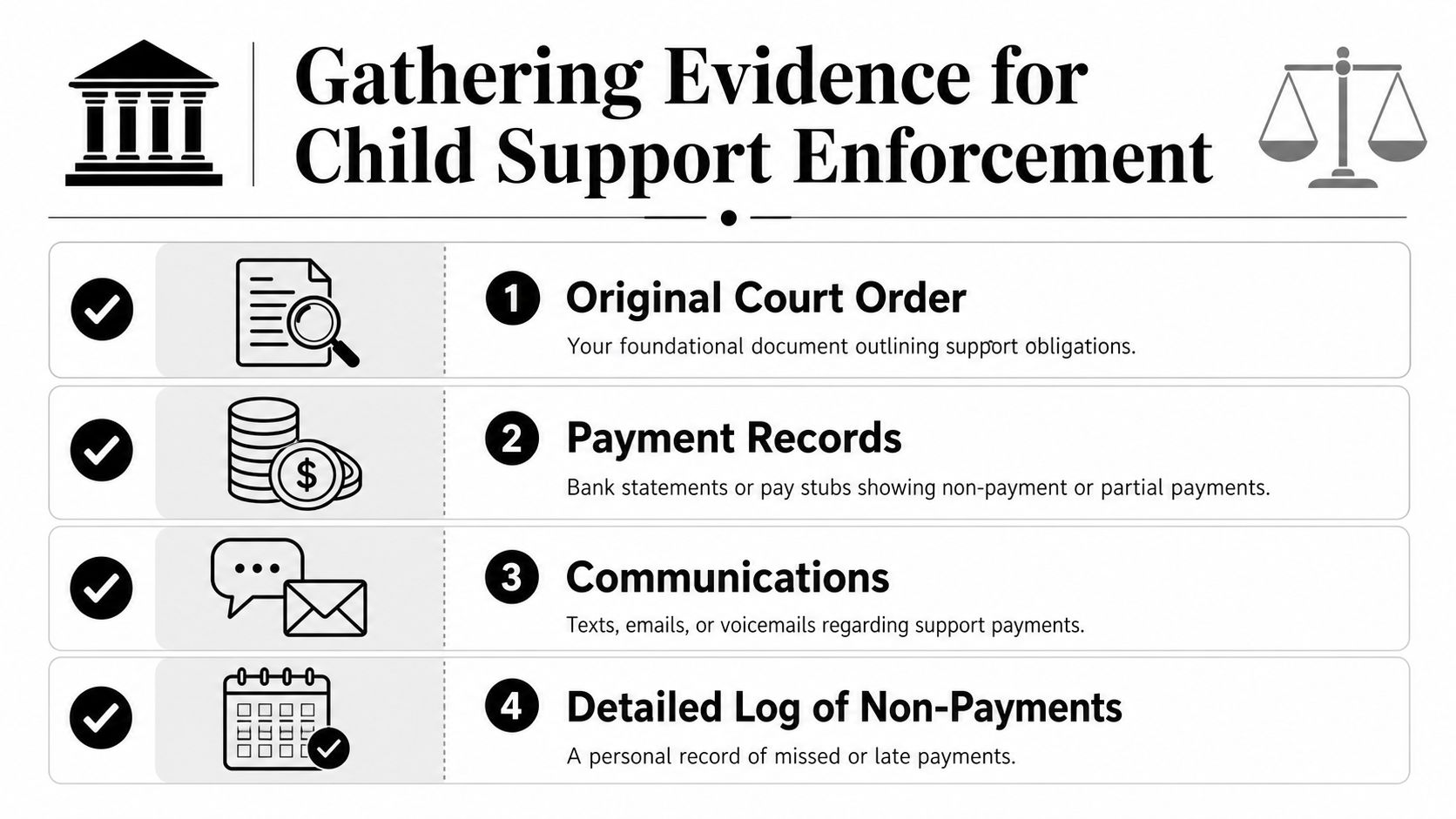
Texas judges want details, not a general statement that support was not paid. If contempt is part of the request, the filing needs to spell out what the order required, what was paid, and the amount still owed by date. Divorcenet gives a useful summary of those pleading requirements in its overview of Texas child support enforcement filing requirements.
That is why I tell parents to build a timeline before we ever get to the hearing.
Your evidence checklist
Keep the records in one place. A phone folder, a binder, or both is fine. What matters is that the information is easy to follow.
- Your signed court order: The judge starts here. The order shows the support amount, due date, medical support terms, and any prior arrears findings.
- Payment records: Gather bank statements, Zelle or Cash App screenshots, canceled checks, money order receipts, wage withholding records, and the official OAG payment history if one exists.
- Messages between parents: Save texts, emails, and app messages that mention missed payments, partial payments, excuses, promises to catch up, or arguments over credits.
- A payment-by-payment log: List each due date, the amount due, the amount received, the date received, and the running arrears total.
- Proof of disputed credits: If the other parent claims they paid in cash, bought groceries instead, or covered school costs in place of support, keep records showing what was agreed and what was not.
Judges enforce orders. They do not reconstruct a scattered story from memory.
Detail matters even more if your case has complications. Self-employment income, irregular cash payments, direct transfers outside the state disbursement unit, and old informal side agreements can all slow a case down if nobody organizes the proof. A private attorney can usually help sort those issues sooner and present them in a cleaner format than a parent trying to piece it together alone through a large system.
Texas law requires precision in an enforcement case, especially if contempt is requested. As noted earlier, weak records can undercut an otherwise valid claim. If you want a clearer picture of how attorneys turn those records into a court-ready filing, this guide on how to enforce child support in Texas walks through the process in practical terms.
This video gives a helpful overview of the enforcement process:
The parents who usually stand in the strongest position are the ones who can show the court a clean payment history, a clear arrears calculation, and the order that was violated.
If some records are missing, start anyway. Get the order, gather what you can, and fill gaps next. That alone can save time and help your lawyer focus on building a case the court can act on.
Understanding Your Legal Enforcement Options in Texas
A missed support payment can feel like a budgeting problem at first. After a few missed months, it becomes a court problem. Texas gives judges several ways to enforce support, but the right remedy depends on one practical question. What will get money flowing again and hold the other parent accountable?
Some cases call for pressure. Others call for collection tools. In many Humble cases, the strongest approach is a combination of both.
The enforcement tool that works most often
Wage withholding is still the most reliable collection method when the paying parent has a regular job and traceable income. As explained by Texas Law Help's child support overview, wage withholding is the primary driver of collections in many enforcement cases. If the employer can be identified and the paperwork is in place, this is often the cleanest route to steadier payments.
Texas courts can also use contempt remedies in the right case. That may include jail time for violations proven with the level of detail Texas law requires. Courts may also order suspension of driver's and professional licenses, which can put real pressure on a parent who has ignored the order for a long time.
Other tools that matter in the right case
License suspension can get attention fast, especially when the other parent has been able to work, drive, or maintain professional credentials while support goes unpaid. The OAG works with more than 60 licensing agencies through its child support enforcement process, which gives the state real reach in the right file.
Property liens, bank account seizure, and tax refund intercepts can also help collect arrears. Those remedies tend to work better for past-due balances than for fixing a month-to-month payment problem. Texas also allows enforcement of child support judgments for years after the support obligation ends, as described in this federal brief on child support enforcement tools.
One point causes confusion in almost every enforcement practice. Denied visitation does not cancel child support. A parent who is being kept from the child has to file for access enforcement separately, as explained in this discussion of common Texas child support enforcement misunderstandings.
Child Support Enforcement OAG vs Private Attorney
The OAG is a useful option for many parents, especially if cost is the main concern and the facts are straightforward. But in Humble, the trade-off is often speed and personal attention. A private attorney can usually move with more urgency, prepare the case around your specific payment history, and ask the court for a broader set of remedies in one focused hearing.
That difference matters most when the file is messy. If the other parent is self-employed, paid in cash, working job to job, hiding income, or claiming credits that do not show up clearly in the state records, a private enforcement case usually gives you more control over how the evidence is presented. In the right case, the court may also order the other side to pay reasonable attorney's fees, which is something many general state-process guides barely mention.
| Factor | Office of the Attorney General (OAG) | Private Humble Attorney |
|---|---|---|
| Cost to start | Free state enforcement services are available | Private legal fees may apply, and fee recovery may be requested in appropriate cases |
| Case volume | Handles a very large statewide docket | Focuses on your specific file and hearing strategy |
| Speed | Can move more slowly because of volume | Often a better fit when time matters |
| Wage withholding | Common and effective when employment is traceable | Also used, often as part of a broader case plan |
| Complex facts | Can be harder to individualize | Better suited for self-employment, hidden income, and heavily disputed facts |
| Court preparation | State-driven process | Direct attorney preparation for testimony, exhibits, and requested remedies |
| Strategic control | More limited individual control | More specific decisions about what relief to request and when |
If you want a practical look at how these cases are filed and proven, this guide on how to enforce child support in Texas explains the process in plain terms for Humble-area families.
How a Humble Enforcement Attorney Builds Your Strategy
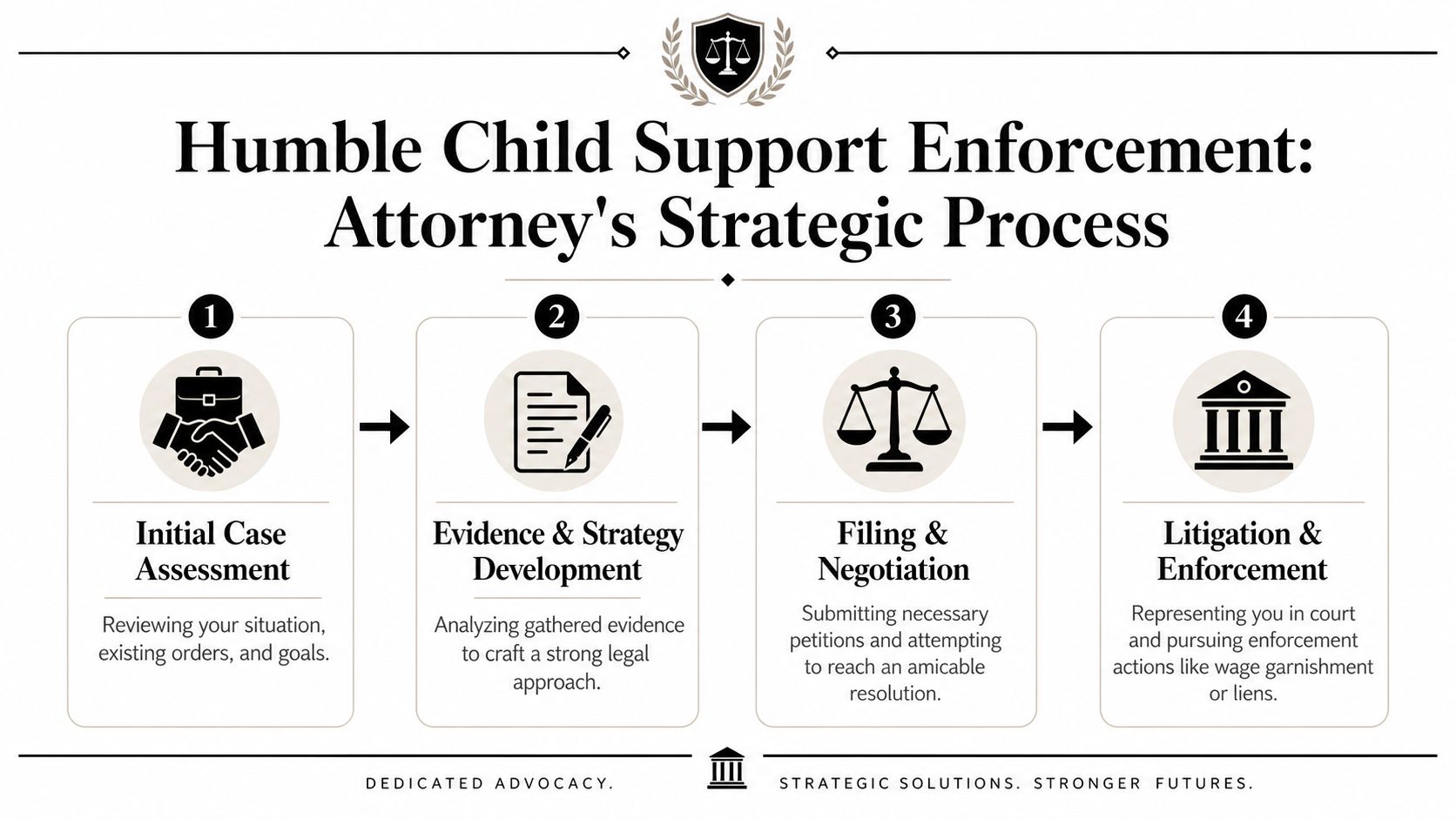
A strong enforcement case isn't just about filing paperwork. It's about choosing the right remedy, presenting the violations clearly, and asking the court for relief that changes behavior.
The motion has to be built carefully
The first job is evaluating the order and the payment history side by side. If the numbers don't line up, the motion for enforcement needs to show that clearly. In many cases, the strategy includes a request for contempt, a request for judgment on arrears, and targeted remedies designed to improve future compliance.
Private counsel also has room to be more deliberate about court preparation. That means reviewing your exhibits, tightening testimony, and thinking ahead about what the other side is likely to say. In a busy Harris County court setting, preparation matters.
Remedies that can change the case
One important issue is interest. In Texas, unpaid child support accrues interest at a fixed rate of 6% annually, and that amount should be included in the total sought, as explained in this discussion of enforcing a Texas child support order. If nobody calculates it, the child may recover less than the law allows.
Another strategic point is fee recovery. Texas enforcement practice often allows the court to order the nonpaying parent to pay the other side's reasonable attorney's fees in a successful action. That matters because it changes the conversation from "Can I afford to enforce this?" to "What remedies should I ask the court to award?"
A good enforcement strategy doesn't just ask the judge to confirm that support is late. It asks for orders that make future nonpayment harder and more expensive.
Some cases also call for requesting a cash bond, especially if the other parent has a history of dodging hearings or ignoring obligations. And if the obligor fails to appear after personal service, experienced counsel will look closely at follow-up tools such as a capias-related request so the case doesn't stall out on avoidable procedural mistakes.
Why local strategy matters
Humble families don't need abstract advice. They need someone who understands how these cases are presented in Harris County and what details judges expect to see. That includes knowing when a case should push toward negotiated compliance and when it needs a firmer court response.
One local option for this kind of work is Enforcement of Court Orders in Humble, which handles enforcing divorce decree and custody order provisions in Harris County. In practice, that kind of service can fit alongside broader family-law representation from the Law Office of Bryan Fagan when a parent needs focused help enforcing existing orders.
Your Next Steps to Securing Your Child's Support
You open your banking app, see that the payment still has not come in, and start doing the math again. Rent, school costs, groceries, gas. By the time child support is late more than once, the problem is rarely just financial. It affects your routine, your stress level, and your child's stability.
The next step is not guessing. It is getting organized and choosing the enforcement path that fits the facts.
Start with your order and your payment record. Put the missed payments in date order. Save texts, emails, app messages, and anything else that shows excuses, partial payments, or repeated promises. A messy file is still usable if you start cleaning it up now.
Then look at the practical question many parents in Humble ask too late. Should you go through the Office of the Attorney General, or hire a private attorney?
The OAG can be a good fit when cost is the main concern and you can tolerate a more standardized process. A private attorney usually makes more sense when time matters, the facts are complicated, the other parent is playing games with income or service, or you want a strategy built around your case instead of a large system's timeline. In some enforcement cases, the court can also order the other parent to pay reasonable attorney's fees. That possibility is one reason many parents at least want a private case review before deciding how to proceed.
Three practical moves usually put a case on better footing:
Collect the core documents. Get your signed order, payment ledger, and any proof of what has and has not been paid.
Write down the pattern. Note when support stopped, how often it has been missed, and whether the other parent is employed, self-employed, paid in cash, or changing jobs often.
Get a legal read on the facts. A short consultation can tell you whether the issue is simple arrears, a contempt case, an income withholding problem, or a situation that needs faster court action.
One caution matters here. Do not wait on another verbal promise if the pattern is already clear. Delay usually gives the other side more time to fall further behind, switch jobs, ignore notice, or make collection harder.
If money is tight, the state system remains an option. The Texas Attorney General provides enforcement services through its child support enforcement page. But free is not the same as fast, and statewide process is not the same as personal strategy. That trade-off deserves an honest look before you commit to one route.
Families in Humble, Atascocita, Kingwood, and across Northeast Houston need support orders that are enforced in real life. A clear record, a realistic plan, and local guidance can turn a frustrating situation into a case with direction.
If your child support order isn't being followed, schedule a free consultation with Law Office of Bryan Fagan. Our Humble office works with families in Humble, Atascocita, Kingwood, and Northeast Houston to review enforcement options, explain Harris County court procedure in plain English, and help you decide on the next practical step.