Skip to content
When a child support payment you're counting on doesn't arrive, the stress can be immediate and overwhelming. For families here in Humble, Kingwood, and Atascocita, this isn't just an inconvenience—it's a direct threat to your household's stability. While it’s natural to feel frustrated or angry, the most productive response is to be methodical and take clear, decisive steps.
Taking the right approach from the very beginning can often resolve the issue without a major fight, or at the very least, build a rock-solid case for legal action down the road. We understand the challenges you're facing, and we're here to explain the process in a way that makes sense for our local families.
Your First Move When a Payment Is Missed
The moment you notice a payment is late, your role shifts to that of a careful record-keeper. This isn't about looking for a battle; it's about protecting your child's rights with clear, objective facts.
Document Everything with Precision
Grab a notebook or open a spreadsheet. For every single missed or partial payment, you need to log the date it was due and the exact amount that was supposed to be paid. Maintain a running total, because this figure—the "arrearage"—is the foundation of any enforcement case.
It’s also crucial to track your communication with the other parent. Note the date, time, and how you reached out (text, email, phone call). Briefly summarize what was said, or simply note if they didn't respond. This detailed log is more than just good practice; it's essential evidence.
This detailed log accomplishes two key things:
- It gives you a precise, up-to-the-minute total of what you're owed.
- If you end up in a Harris County courtroom, this log becomes compelling evidence of the ongoing non-payment.
This process—document, communicate, then enforce—is the standard pathway for getting things back on track and ensuring your child receives the support they are legally entitled to.
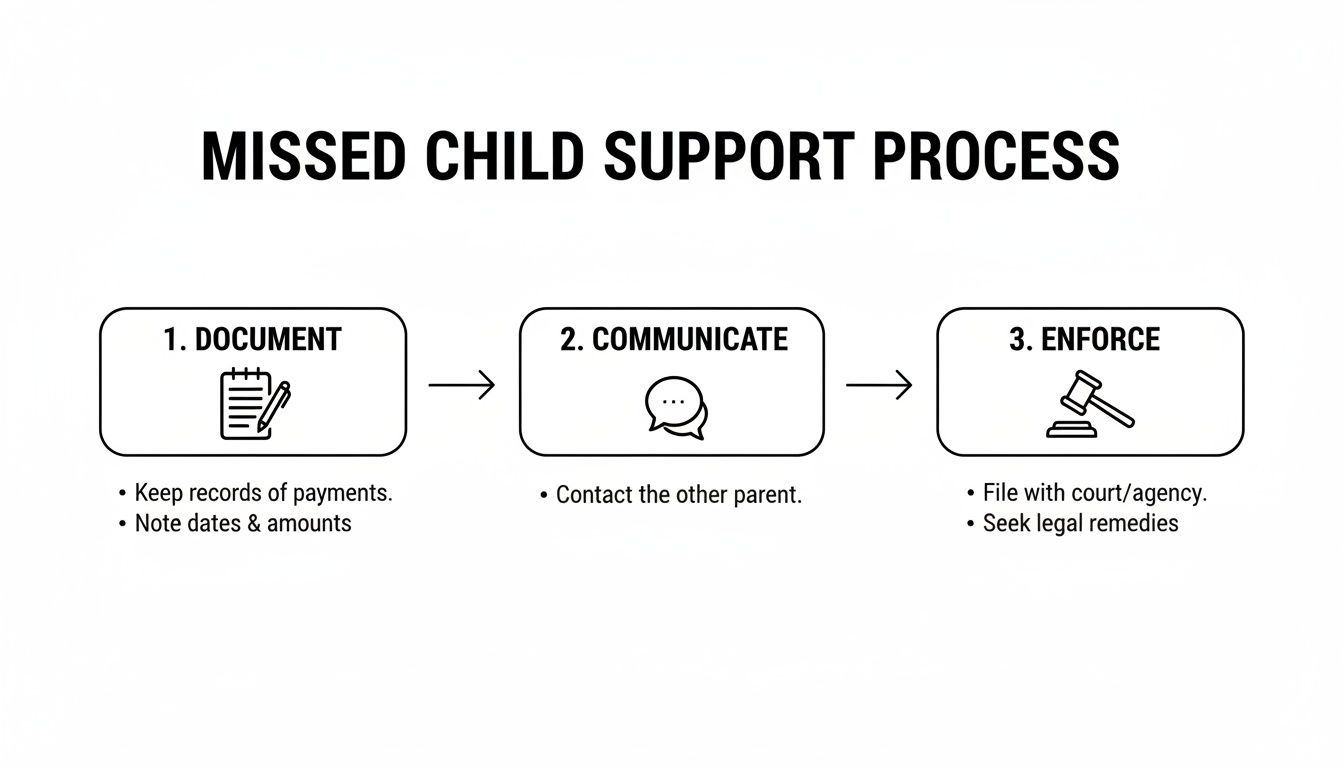
As you can see, formal enforcement is the final step, taken only after you’ve documented the problem and made a good-faith effort to resolve it directly.
Choosing Your Enforcement Path in Harris County
Once your records are organized, you have a critical choice to make. For those of us in Northeast Houston, there are two primary avenues for enforcement: working through the Texas Office of the Attorney General (OAG) or hiring a private family law attorney.
The Attorney General's Child Support Division is a powerhouse. They handle an incredible 1.5 million cases for 1.7 million children across Texas. Their efficiency is remarkable—they collect $11.34 in child support for every $1 spent on the program, a statistic that makes Texas the most cost-effective state for enforcement.
The OAG’s services are free, and they have unique administrative powers. However, their massive caseload can sometimes mean your case moves slowly. Hiring a private attorney, on the other hand, gives you direct, personalized attention and can often accelerate the process through the Harris County courts.
Comparing Child Support Enforcement Options in Harris County
Deciding between the OAG and a private firm can feel daunting. Each path has distinct advantages and disadvantages depending on your specific circumstances, timeline, and the complexity of your case. This table breaks down the key differences to help you, as a resident of the Humble area, make an informed choice.
| Feature | OAG Enforcement | Private Attorney (Law Office of Bryan Fagan) |
|---|---|---|
| Cost | No cost for services. | Requires retainers and hourly fees. |
| Caseload | Very high; one attorney handles thousands of cases. | Dedicated attention; your case is a priority. |
| Timeline | Can be slow due to administrative backlog. | Generally much faster; can file motions immediately. |
| Communication | Often difficult to reach a specific person; communication can be limited. | Direct access to your attorney and paralegal. |
| Scope of Action | Limited to child support enforcement and modifications. | Can address all related family law matters (custody, visitation, etc.). |
| Legal Strategy | Follows a standardized, high-volume process. | Tailors the legal strategy specifically to your situation and goals. |
While the OAG is an excellent and powerful resource, a private attorney provides a level of service and speed that a state agency simply can't match. If getting the money you are owed as quickly as possible is your top priority, the private route is often more effective.
At the end of the day, the goal is to secure the financial support your child is legally owed. We can help you understand the nuances of collecting back-pay child support in Texas and decide on the best path forward for your family. By carefully documenting the issue and understanding your options, you're taking control of the situation.
Using the Attorney General for Enforcement

For many families in Atascocita and Northeast Houston, the first call they make when child support checks stop coming is to the Texas Office of the Attorney General (OAG). This makes a lot of sense. The OAG is a powerful state agency that offers enforcement services at no cost, making it a very accessible starting point.
The OAG’s Child Support Division is essentially a high-volume collection machine. They have a unique arsenal of tools to collect unpaid support, and one of their biggest advantages is that they can often do it without stepping foot in a courtroom. This "administrative" approach is what sets them apart.
How the OAG Enforcement Process Works
Getting the ball rolling with the OAG is pretty straightforward. You'll start by filling out an application, either online or by mail, which details who you are, who your child is, who the other parent is, and the specifics of your child support order. It’s critical to provide a copy of that order and a clear, detailed record of every single missed payment.
Once your case is active, the OAG takes the lead. Their team will tap into powerful state and federal databases to track down the non-paying parent and any assets they might have. From there, they can deploy some serious enforcement tactics.
Here are the most common tools they use:
- Income Withholding Order: This is their bread and butter. The OAG sends a legal notice straight to the other parent's employer, forcing them to deduct child support directly from the paycheck.
- Federal Tax Refund Intercept: If the parent who owes you money is expecting a tax refund, the OAG can snatch it before they ever see it and apply it to your past-due balance.
- Bank Account Levies: This is a big one. The OAG has the power to freeze and seize funds directly from the non-paying parent’s bank accounts to cover the child support debt.
- License Suspension: They can suspend a driver's license, professional licenses (like for a doctor or plumber), and even hunting and fishing licenses. The threat of not being able to drive or work is often a powerful motivator.
The real power here is that these actions don't require a judge's approval every time. The OAG can implement them administratively, which makes the whole process of collecting what you're owed much more direct.
Setting Realistic Expectations for Humble Families
While the OAG can be a fantastic resource, it’s crucial for Humble-area residents to have realistic expectations. Think of them as a massive, powerful ship—it moves with force, but it doesn't turn on a dime. The agency handles an unbelievable number of cases, which means communication can be slow and your case might not progress as quickly as you'd hope.
A key takeaway for families in Kingwood and the surrounding areas is that the OAG process is built for volume, not speed. While their tools are powerful and their services are free, you trade personalized attention for administrative efficiency.
You won't have a dedicated attorney you can call directly. Your case is managed by a team, and just getting a status update can sometimes be a frustrating experience.
What’s more, the OAG has tunnel vision—their focus is strictly on child support. They can’t help you if you also need to adjust your custody arrangement or change the visitation schedule. If your situation is complicated and involves more than just missing payments, the OAG’s narrow approach probably won’t be enough to solve all your problems.
For many people, the OAG is exactly what they need. But if time is of the essence, if the other parent is actively hiding money, or if you need to tackle other legal issues at the same time, pursuing a private enforcement action is often a much more effective strategy. At The Law Office of Bryan Fagan, we can help you weigh these options. We invite you to schedule a free, no-obligation consultation at our Humble office to talk about your specific circumstances and figure out the best path forward for your family.
Taking Matters into Your Own Hands: Filing a Private Enforcement Lawsuit
While the Office of the Attorney General (OAG) can be a helpful resource, the reality is they are completely overwhelmed. With a massive caseload, your family's urgent need for support can easily get buried in a pile of paperwork. When you need a faster, more direct approach to get the child support you're owed in Texas, filing a private enforcement lawsuit is often the most effective tool in your arsenal.
Going this route puts you and your attorney firmly in the driver's seat. You’re no longer waiting on the OAG’s timeline; you’re moving your case through the Harris County court system on your own schedule. It’s about taking proactive, decisive action to secure the financial stability your child is legally entitled to.
What is a Motion for Enforcement?
A private lawsuit kicks off when your attorney files a formal document called a Motion for Enforcement at the Harris County Civil Courthouse. Think of this as the official starting gun. It's a direct request to a judge, asking them to step in and compel the other parent to follow the child support order they’ve been ignoring.
This motion has to be incredibly specific. We don't just say, "they haven't paid." We outline every single violation, including:
- The exact date of each missed or partial payment.
- The precise amount of the past-due balance, legally known as "arrears."
- Any interest that has built up on that unpaid balance, which is mandated by Texas law.
Filing this motion puts the non-paying parent on formal notice. It tells them the time for excuses is over and that real, legal consequences are coming for ignoring their court-ordered duty.
Building an Airtight Case with the Right Evidence
A successful enforcement action comes down to one thing: undeniable proof. When we work with clients from Atascocita to Kingwood, the first thing we do is gather the hard evidence needed to present a rock-solid case to the judge. Your own records are the most powerful weapon you have.
The most critical pieces of evidence are almost always:
- Payment Logs: A simple spreadsheet or ledger tracking every payment due, the amount you actually received (if anything), and the date it came in. This creates a clear, running total of what you’re owed.
- Communication Records: Keep copies of texts, emails, or even notes from phone calls where you discussed the missed payments. This helps prove they knew they were behind.
- Bank Statements: Your own bank records can powerfully show the absence of expected deposits, confirming the non-payment.
A Harris County judge needs to see a clear, willful pattern of non-payment. Meticulous, organized evidence isn't just a "nice-to-have"—it's the foundation of your entire case. It tells a story that's impossible to ignore.
We’ll help you take this information and structure it into a compelling narrative for the court. If you are struggling with suing for back child support, having an experienced attorney present this evidence makes all the difference.
The Power of a Contempt of Court Finding
Here’s where a private lawsuit really shows its teeth: contempt of court. This is more than just a finding that the other parent is behind on payments. It’s a judge officially declaring that they have willfully and intentionally violated a direct court order. It's about choosing not to pay, not being unable to.
If a judge finds the other parent in contempt, the penalties can be life-changing:
- Jail Time: The judge can sentence the non-paying parent to jail for up to six months for each individual violation.
- Fines: Hefty fines can be added on top of the jail time.
- Community Supervision: The parent might be put on a type of probation, where they have to check in and make consistent payments to stay out of jail.
Frankly, the mere possibility of jail time is often enough to make a delinquent parent suddenly find the money they owe. This is a hammer the OAG is often slower and more reluctant to use, which makes a private lawsuit a much more formidable path for families in Northeast Houston dealing with serious non-payment.
Beyond contempt, we will also ask the judge to grant a judgment for the total amount of arrears plus interest. This judgment is a powerful collection tool, giving us the legal authority to place liens on property, seize funds directly from bank accounts, and take other aggressive steps to get the money your child deserves. The advantage of a dedicated Humble attorney is clear—we have the focus and resources to push your case forward and fight for the best possible outcome for your family.
How Arrears and Income Caps Affect Your Case

When you're trying to collect overdue child support in Texas, you'll often hear two terms that can completely change the game: arrears and the state's income cap. Grasping how these work is more than just legal trivia; it's about understanding the real-world leverage you have in an enforcement case.
Unpaid child support has a formal name: arrears. Think of it as a debt that doesn't just vanish over time. In Texas, this debt actually grows because the law tacks on interest for every month it goes unpaid.
This isn't just a number on a piece of paper. It's a legally recognized debt that can be chased for years, long after your child has grown up and left home. For families in Humble counting on that support, collecting these arrears is often the only way to cover past expenses and provide for your child's future.
Calculating Arrears and Getting a Judgment
The first real step in any enforcement lawsuit is to pin down the exact amount owed. We sit down with our clients and meticulously account for every missed or partial payment, plus all the interest that’s piled up. This final number is the cornerstone of the Motion for Enforcement we file with the court.
But our goal isn't just to get the payments started again. We aim to secure a judgment for the total amount of arrears. A judgment is the court’s official stamp, turning that past-due support into a confirmed, legally binding debt.
That judgment is a game-changer. It unlocks more aggressive collection tools than a standard wage garnishment, like slapping a lien on their house or seizing funds directly from their bank account. It makes the debt real and much harder to dodge. You can learn more about how this works by reading about Texas retroactive child support and how it ties into an enforcement action.
The Texas Child Support Income Cap
There's another huge piece of the puzzle: the state’s cap on monthly net resources. This is the maximum amount of a parent's income the court can use to calculate child support, and it’s especially important for families in areas like Kingwood, where you often see higher earners.
The income cap is adjusted periodically for inflation. The key thing to remember is that court orders don't automatically update. To benefit from a new, higher cap, one of the parents has to file for a modification.
Using Income Caps as Leverage in Enforcement
So, how does this help you collect past-due support? It opens the door for a powerful one-two punch: combining a Motion for Enforcement with a Petition to Modify. This is a smart legal strategy that tackles both the past-due balance and future payments in one go.
Here’s what that looks like for a family in the Humble area:
- You file for enforcement: This asks the court to hold the other parent accountable for the arrears, with potential consequences like jail time.
- You also file for modification: At the same time, you ask the court to recalculate their future payments, potentially using a new, higher income cap if their income has increased.
This dual approach puts the non-paying parent in a tough spot. They're suddenly facing the immediate threat of jail for the arrears and the very real possibility of paying more each month going forward.
This strategy often brings the other parent to the negotiating table in a hurry. They might become much more willing to work out a lump-sum payment on the arrears if it means they can have some say in the new monthly amount. It gives you leverage that you simply don’t have when you only file for enforcement.
At The Law Office of Bryan Fagan, we see firsthand the financial strain our Humble and Northeast Houston neighbors are under. Combining an enforcement action with a modification can be an incredibly effective way to secure your child’s financial stability. If you need to enforce your child support order and think it might be time for an update, give our Humble office a call. We’ll help you build the right strategy.
Powerful Enforcement Tools in Texas
When an income withholding order just isn't cutting it, Texas law has some serious teeth. For families in Humble who've been waiting on support payments, these more aggressive tools are often what it takes to finally force a non-paying parent to take their obligation seriously. These aren't just slaps on the wrist; they are designed to make it incredibly difficult for someone to go about their daily life while ignoring a court order.
I can't tell you how many times a client has come into our Humble office feeling completely powerless, watching the other parent get away with not paying. That's when we start talking about the significant leverage the law actually provides. Knowing these options exist can bring back a sense of control and hope.
Taking Away Key Licenses
One of the most persuasive tools we have is the ability to suspend critical licenses. And no, we're not just talking about a driver's license. The state can put a hold on a whole range of licenses until the parent starts making good on their child support debt.
This can include:
- Driver's License: This is often the first and most effective one. Suddenly, getting to work or running basic errands becomes a huge, illegal hassle, creating immediate pressure to fix the situation.
- Professional Licenses: This is a huge point of leverage. A doctor, lawyer, plumber, or real estate agent can't legally do their job without their license. It directly cuts off their income stream until they pay up.
- Recreational Licenses: While it might seem minor, suspending hunting and fishing licenses is another way the state can apply pressure to ensure compliance.
In our experience here in Harris County, sometimes all it takes is the filing of the motion to suspend licenses. That single piece of paper is often enough to get a non-paying parent on the phone, finally ready to talk about a payment plan.
Putting a Lien on Property and Assets
Another powerful, long-term strategy is placing a child support lien on the other parent's property. Think of a lien as a legal "dibs" on an asset. It prevents them from selling or refinancing that asset until your child support debt is paid in full.
A lien is a game-changer for big financial moves. The parent who owes support can't sell their house, their truck, or their boat without first paying what they owe you out of the sale money.
This is a fantastic tool for the long haul. We've helped clients in Kingwood and Atascocita file liens on all sorts of things, including:
- Real estate like houses and land
- Vehicles, from cars to boats
- Bank accounts and even retirement funds
- Lawsuit settlements or inheritances
The lien just sits there, attached to the property, until the debt is cleared. It’s a powerful way to ensure that if the other parent has any assets to their name, you will eventually get paid.
Federal Muscle: Passport Denial
When the past-due amount gets significant—we're talking $2,500 or more in arrears—the consequences can go international. The Texas Attorney General works with the U.S. State Department to block the non-paying parent's passport.
This means they can't get a new passport or renew an old one. They are grounded. For anyone in Northeast Houston whose job requires international travel, or even for someone planning a vacation, this is a massive roadblock. It sends a clear message that supporting your child is a national priority, not just a state one. When used strategically, these tools apply maximum pressure to get your child the financial support they are legally owed.
When to Partner with a Humble Child Support Lawyer

Trying to enforce a child support order can feel like a frustrating, uphill battle. Between the confusing legal paperwork and the emotional weight of it all, it's easy to feel completely overwhelmed. This is where having an experienced local attorney by your side isn't just a benefit—it's a game-changer.
An advocate who lives and breathes the Harris County court system can help you move forward with confidence, protecting your child's financial future so you can focus on what matters most: your family.
Your Local Advocate in Harris County
At The Law Office of Bryan Fagan, we're not just lawyers; we're part of the Humble, Kingwood, and Atascocita communities. We understand the specific challenges our neighbors face because we see them every day.
Our team takes the lead on all the complex parts of the process, from drafting precise legal documents to representing you in court. We know how to build a powerful case that gets a judge’s attention, using every available tool—like contempt motions and property liens—to ensure the other parent is held accountable. Child support enforcement is a specialized area within the broader field of Family Law.
We truly believe that no parent in Humble should have to navigate this fight alone. Our job is to lift the legal burden from your shoulders so we can pursue the financial support your child is owed with skill and determination.
Unpaid child support adds unnecessary stress to your life. The good news is that finding a solution often starts with a simple conversation.
We invite you to schedule a free, no-obligation consultation at our Humble office. Let's sit down, review your case, and show you exactly how we can help secure your family's financial stability.
Answering Your Top Questions About Child Support Enforcement
When you're trying to enforce a child support order, a lot of questions pop up. It's completely normal. Families here in Humble and all over Northeast Houston come to us wondering about timelines, what happens if their ex still won't pay, and how to move forward when they feel stuck. Let's tackle some of the most pressing concerns head-on.
How Long Does This Actually Take?
The timeline for enforcing a child support order in Texas can be all over the map. If you go through the Office of the Attorney General (OAG), you have to be patient. Their caseloads are huge, which often means it can take several months before your case even gets moving.
On the other hand, filing a private enforcement lawsuit is usually much faster. Here in Harris County, we can typically get a court date set within four to eight weeks of filing the initial paperwork. This allows us to get you in front of a judge quickly to start the enforcement process.
Can My Ex-Spouse Really Go to Jail for Not Paying?
Yes, absolutely. This is one of the most powerful tools we have in a private enforcement action. If a judge determines that the parent willfully ignored the court order to pay, they can be held in contempt of court.
This isn't just a slap on the wrist. The penalties are serious and can include hefty fines and even jail time—up to six months for each and every violation.
Frankly, the threat of jail time is often the single most effective way to get a non-paying parent's attention. It's a clear signal from the court that the games are over and the consequences are very real.
What If I Have No Idea Where They Work?
This is a common roadblock, but it’s one we can almost always overcome. You're not at a dead end.
Both the OAG and a private attorney have ways to track down a parent and their income sources. The OAG relies on state and federal databases, which can be effective but sometimes slow. Our firm can take a more direct approach by hiring private investigators who can quickly uncover employment details and find hidden assets. When looking for a lawyer, it's worth asking how they use modern tools to work efficiently. You can learn more about how lawyers can harness AI Front Desk to save money.
Dealing with unpaid child support is an incredible burden, but it's not a fight you have to take on by yourself. At The Law Office of Bryan Fagan, we're dedicated to helping Humble families get the financial stability their children are entitled to.
Let's talk about your situation. Schedule a free, no-obligation consultation with our Humble attorneys today, and we can map out a strategy to protect your family’s future. Visit us at https://www.humbletxlawyers.com to get started.