Skip to content
Receiving an inheritance is often an emotional experience, a final gift from a loved one. Here in Humble, Texas, when families are also facing the stress of a potential divorce, a common and urgent question arises: "How can I protect this inheritance?" The single most important rule is to keep it completely separate from your marital assets. Texas law is initially on your side, classifying an inheritance as your separate property. However, that protection can disappear the moment those funds get mixed with marital money—a process known as commingling.
At The Law Office of Bryan Fagan, we understand the sensitive nature of these situations. We're part of the Humble community, and our goal is to provide clear, supportive guidance to our neighbors in Atascocita, Kingwood, and across Northeast Houston.
Understanding Your Inheritance in a Texas Divorce

For families here in Humble, Atascocita, and Kingwood, receiving an inheritance is usually a deeply personal and emotional experience. If divorce becomes part of the picture, the first question our clients ask is, "Is my inheritance safe?"
The good news is that Texas law starts out in your favor. In a divorce, our state looks at property in one of two ways: it's either community property or it's separate property.
The Foundation of Texas Property Law
Think of community property as the "marital pot." It includes nearly everything a couple earns or acquires while married, from paychecks to the family home you bought together. During a divorce, a Harris County judge will divide this pot in a way they deem "just and right."
Separate property, on the other hand, belongs exclusively to one spouse and isn't up for grabs in the divorce. This includes things like:
- Property you owned before you ever said "I do."
- A gift received by just one spouse during the marriage.
- An inheritance received by one spouse, whether it came before or during the marriage.
This legal distinction is the bedrock of protecting your inheritance. But—and this is a big but—this protection isn't guaranteed. It can be accidentally forfeited through a very common mistake: commingling. You can dive deeper into how Texas defines these assets by checking out our guide on what is community property in texas.
Separate vs Community Property: A Quick Guide
For Humble residents, it helps to have a quick reference for how assets are typically viewed in a Texas divorce.
| Asset Type | Default Texas Classification | Most Common Risk |
|---|---|---|
| Inheritance (Cash, Stock, etc.) | Separate Property | Depositing it into a joint account |
| Salary Earned During Marriage | Community Property | Using it to pay for separate property |
| Property Owned Before Marriage | Separate Property | Adding spouse's name to the deed/title |
| Gifts to One Spouse | Separate Property | Using the gift for shared family expenses |
| Family Home Bought During Marriage | Community Property | N/A (Generally always marital) |
This table is a starting point, but remember, the way you handle an asset after receiving it is what truly matters.
The Danger of Commingling Your Inheritance
So, what is commingling? It’s simply the act of mixing your separate property with community property to the point where you can't tell what's what. Once that happens, Texas law often presumes the entire jumbled-up asset has become community property.
A common misconception is that an inheritance is untouchable simply because of its name. In reality, how you handle the asset is what truly matters. The moment it's used for the joint benefit of the marriage, its protected status as separate property is put at risk.
Let's say you inherit $50,000 from your grandmother. If you deposit that check into the joint savings account you share with your spouse, you’ve just commingled it. If you then use that money for a down payment on a family car or to pay off a shared credit card, you've essentially converted it into a marital asset.
This isn't just a Texas issue. A 2023 review of divorces found that courts nationwide often pull inherited assets into the marital pot if they were used jointly. While Texas law is firm about the definition of separate property, a judge might still consider these commingled funds when looking at the entire financial picture of a long-term marriage.
Protecting High-Value Assets
The stakes get even higher for those managing a substantial inheritance or a complex financial portfolio. The strategies you'll need are more robust, often involving specific trusts and carefully drafted marital agreements. For those navigating the complexities of large-scale asset division, this guide on finance and divorce for high net worth individuals offers some critical insights.
Grasping these foundational rules is your first step. Knowing your inheritance starts as your separate property gives you a legal advantage, but understanding the real-world risk of commingling is what shows you why having a proactive plan is non-negotiable.
Using Prenuptial and Postnuptial Agreements to Protect Assets
If you want to be proactive about protecting an inheritance, a marital agreement is one of the strongest moves you can make. For many families I work with here in Humble and across Northeast Houston, this means putting a prenuptial or postnuptial agreement in place long before divorce is ever on the table.
Let’s be clear: talking about these agreements isn't about planning for failure. It’s simply smart financial planning. You have insurance for your home and your car, right? Think of a marital agreement as a form of insurance for your separate property, especially any inheritance you’ve received or expect to in the future.
How Marital Agreements Actually Shield Your Inheritance
In Texas, prenups and postnups are contracts that let you and your spouse set your own rules for your finances, rather than relying on the state’s default property laws. One of their most common uses is to definitively classify certain assets as separate property, which puts them completely off-limits if you ever split up.
Without an agreement, the burden is on you to prove you never commingled your inheritance. A well-drafted marital agreement gets rid of that gray area. It draws a bright, legally-recognized line around your inheritance from day one.
Key Clauses Your Agreement Must Include
When the specific goal is protecting an inheritance, you can't just use a generic template you find online. A Harris County judge needs to see specific language to uphold your wishes.
Your agreement should spell out, in no uncertain terms, that:
- Any inheritance received by either spouse, whether now or in the future, will remain that person's sole and separate property.
- This protection covers any growth, appreciation, or income the inherited assets generate. So, if you inherit stock that pays dividends, the agreement should make it clear that both the original shares and all subsequent dividend payments belong only to you.
- The inheritance cannot be divided or claimed by the other spouse for any reason, including divorce or even death.
These clauses essentially build a legal fortress around your inheritance. They get ahead of the commingling risks we’ve talked about, documenting your clear intent for the assets to stay separate, no matter what happens down the road.
Having "The Talk" with Your Partner
Bringing up a "prenup" or "postnup" can feel incredibly awkward. I've had many clients in Kingwood and Atascocita worry that it sends a message of distrust. The best approach is to frame the conversation around fairness and transparency for both of you.
Don't make it about "my money" versus "your money." Frame it as "our plan for the future." Explain that it’s about creating clarity and heading off any potential arguments later on. By setting the ground rules now, you both enter the marriage with eyes wide open. It often helps to point out that the agreement protects both of your separate assets, which makes the conversation feel more balanced.
For a deeper look into how these agreements differ, check out our guide on prenuptial agreements vs. postnuptial agreements.
The Strict Legal Requirements in Texas
For a marital agreement to hold up in a Humble courthouse, it has to be done right. A judge can—and will—throw out a poorly drafted or improperly executed agreement.
Here are the absolute non-negotiables:
- It Must Be in Writing. Verbal promises mean nothing in court. The agreement has to be a physical document.
- It Must Be Signed Voluntarily. You cannot pressure, threaten, or coerce your partner into signing. A judge needs to see that both parties signed freely and willingly.
- Full Financial Disclosure is Required. Before signing, you both have to provide a complete and honest list of all assets, debts, and income. Hiding assets is a fast track to getting your agreement invalidated.
- Independent Legal Counsel is Crucial. While Texas law doesn’t strictly require it, it's practically essential. To ensure fairness, both you and your partner should have your own separate attorneys review the document. This prevents one person from later claiming they were taken advantage of or didn't understand what they were signing.
Following these steps is what turns a piece of paper into a rock-solid, defensible shield for your family's legacy.
Keeping Your Inheritance Separate Is Non-Negotiable
While a prenup or postnup provides the legal framework, your daily habits are what truly protect your inheritance. I've seen countless families in Humble and Kingwood accidentally lose their separate property not through legal battles, but through simple carelessness. This is called commingling, and it happens the moment you mix inherited assets with your shared marital finances.
Once those funds are mixed, Texas law often presumes they've become community property. Trying to untangle them later is a costly, frustrating, and frequently impossible task. The only way to prevent this is to treat your inheritance with the same discipline you'd apply to a business asset.
Set Up a Dedicated Account—Before the Money Arrives
Your very first move, ideally before you even deposit the check from the estate, is to open a brand-new bank account. This isn't just another account; it must be titled solely and exclusively in your name. Resist any temptation to add your spouse's name, even for supposed convenience. It’s a trap.
This account acts as a fortress for any cash you inherit. When you deposit the check, document everything. Make a copy of the check and the deposit slip. This creates an airtight paper trail proving the money’s origin as your separate property from day one.
This process highlights the core of asset protection: you have to discuss your intentions, disclose the assets transparently, and then draft the proper legal shields to keep your inheritance safe.
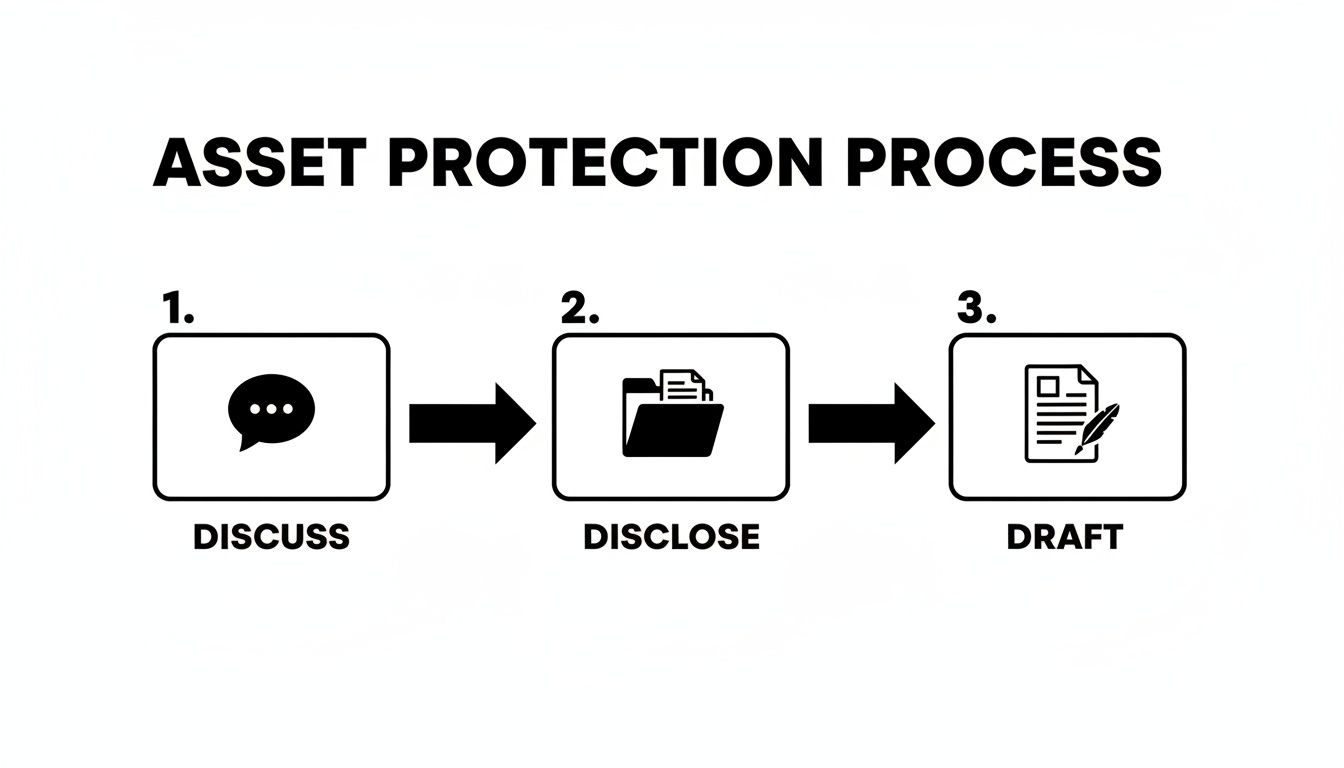
This visual is a great reminder that safeguarding your inheritance isn’t a single action. It’s a structured process that combines open communication with formal legal steps.
What Not to Do With Inherited Money
Once your inheritance is sitting safely in its separate account, the golden rule is this: leave it there. Or, at the very least, only use it for expenses that are solely your own. The second you use that money for shared marital expenses, the protective barrier begins to crumble.
Here are some real-world examples of how separate property becomes community property overnight:
- Paying Off Joint Debt: Using $10,000 from your inheritance to wipe out a shared credit card balance is a classic mistake. You’ve just made a gift to the marriage.
- Funding a Family Vacation: Buying plane tickets for a family trip with inherited cash directly commingles your separate funds with a shared marital activity.
- Renovating Your Home: Paying for that new kitchen in your Kingwood home with your inheritance invests your separate money directly into a community asset, complicating its status.
- Making a Car Payment: Even one payment from your inheritance toward a jointly titled car can start the commingling process and weaken your claim.
A helpful way to think about it is this: picture the boundary between your separate and joint accounts as a one-way street. Money can flow from joint accounts to pay for your separate property expenses, but it should never flow the other way.
Don't just take my word for it. A landmark 2023 analysis showed that when an inheritance is kept distinctly separate, courts are very willing to protect it. However, that same study found that when inherited money is used for family expenses, courts throw it into the "matrimonial pot" in roughly 75% of divorce disputes. You can read more about this legal precedent and its findings on protecting inherited wealth from divorce on kingsleynapley.co.uk.
Handling Inherited Physical Assets
The exact same rules apply to physical property. If you inherit your family’s home in Atascocita, a classic car, or valuable antiques, you have to maintain separate legal ownership.
- For Real Estate: The deed or title must remain in your name alone. Adding your spouse's name to the deed is a formal legal act that often converts the property into a marital asset on the spot.
- For Valuables: If you inherit items like jewelry, art, or furniture, find the documentation from the estate—the will, trust documents, or inventory list—that proves you were the sole inheritor. Keep these records in a safe place.
It takes diligence to maintain this strict financial and legal separation. Honestly, it can feel awkward at times. But this discipline is the most powerful and practical defense you have for ensuring your family's legacy remains yours, no matter what the future brings.
Using a Trust for Ironclad Asset Protection

While marital agreements and keeping funds separate are great first steps, a trust takes inheritance protection to a whole new level. For Humble families looking for the most bulletproof way to shield a significant inheritance, a well-drafted trust is often the best answer.
Think of a trust as a legal fortress. It's an arrangement where assets are transferred to a third party (the trustee) who then manages them for the benefit of another person (the beneficiary). By placing your inheritance into a trust, you create a clear legal separation. The assets are no longer technically yours, which makes it incredibly difficult for them to be considered part of the marital estate in a divorce.
The Power of an Irrevocable Trust
Now, not all trusts are the same, especially when divorce is a concern. A revocable trust—one you can change or cancel whenever you want—usually doesn't offer enough protection. A Harris County judge could easily argue that since you can take the assets back at any time, you still effectively control them.
This is where the irrevocable trust comes in. As the name implies, once you create this trust and put assets inside, you generally can’t take them back. That permanence is its superpower. Since you’ve given up direct control, the assets are no longer legally yours to be divided in a divorce.
This strategy isn't just theoretical; it's proven. Recent IRS data shows that of the $1.2 trillion inherited annually in the U.S., only about 15% was lost to divorcing spouses when protected by an irrevocable trust. In sharp contrast, a staggering 68% of inherited assets are divided in divorces lasting over ten years when no such protection exists. You can see more insights on parental wealth on withersworldwide.com to understand how these assets are treated.
Understanding the Key Players in a Trust
To get how a trust works, you need to know who's involved:
- Grantor: The person creating the trust and funding it. This could be you, or more often, the person leaving you the inheritance.
- Trustee: The person or institution (like a bank’s trust department) that holds legal title to the assets and manages them according to the trust's rules. They have a strict legal duty to act in the beneficiary's best interest.
- Beneficiary: The person who benefits from the trust—in this case, you.
The magic is in how these roles are structured. For maximum protection, you cannot be your own trustee. Appointing an independent third party—a trusted professional, a financially responsible relative, or a corporate trustee—is what truly separates you from the assets.
A trust lets you be the beneficiary—to receive money and enjoy the inheritance—without being the legal owner. In a Texas divorce, that distinction is everything.
A Real-World Example from Our Area
Imagine a family in Atascocita. The parents want to leave their son a substantial inheritance, but they're worried about his rocky marriage. Instead of just naming him in their will, they work with an estate planning lawyer to set up an Irrevocable Spendthrift Trust.
They name their son as the beneficiary and appoint his financially savvy older sister as the trustee.
When the parents pass, the inheritance—stocks, cash, and a rental property in Kingwood—goes straight into the trust. It never touches the son’s personal bank account. The sister, as trustee, now manages everything.
If the son needs money for his kid's college tuition or a down payment on a business, he requests a distribution from the trustee. Because he never legally owns or controls the trust's assets himself, they are shielded if he and his wife later file for divorce in Harris County. The trust simply isn't part of their marital balance sheet.
This approach ensures the family's legacy supports the son as intended, without ever being at risk of commingling or division. It's a powerful way to preserve generational wealth right here in the greater Houston area. To dive deeper into the mechanics, our guide on what a living trust is and how it functions is a great resource.
Given their complexity, trusts are definitely not a DIY project. You need an experienced estate planning attorney to draft the documents correctly so they stand up to legal scrutiny when it matters most.
What About Future Inheritances and Family Gifts?
In communities like Humble and Northeast Houston, legacy planning is a serious conversation, often spanning years or even decades. This forward-thinking brings up a common question I hear from clients: "What about the inheritance I expect to get someday? Or the big check my parents want to give me now?" It’s a smart question, because you need to understand exactly how Texas law looks at these different types of family wealth.
Here's the legal reality: a Texas court can't touch a "future" or "anticipated" inheritance. Period. An inheritance doesn't legally exist until someone has passed away and their will or trust kicks in. Before that moment, it’s just a possibility—not a real asset that can be put on the marital balance sheet.
That said, relying on this technicality alone is a gamble. The conversation can get messy. The best way to handle an inheritance you expect to receive is to spell it out in a prenuptial or postnuptial agreement. By clearly defining that any future inheritance belongs solely to the person who receives it, you eliminate any ambiguity and head off a potentially ugly legal battle later on.
The Difference Between a Gift and an Inheritance
While they might feel the same emotionally, the law draws a very clear line between a gift and an inheritance. The distinction is simple:
- An inheritance comes from someone's estate after they've passed away.
- A gift comes from someone while they are still living.
From a Texas divorce standpoint, the starting point is the same for both. They are considered the separate property of the recipient. So, a $20,000 check from your parents for a down payment is your separate property, just like a $20,000 inheritance from your grandmother’s will would be.
The problem is, gifts run the exact same risk of becoming community property through commingling. If you take that gifted money and drop it into a joint savings account or use it to pay off the shared credit card, its protected status can vanish in an instant.
A Smart Tip for Anyone Giving a Gift
Are you a parent or grandparent in the Kingwood or Atascocita area about to give a significant financial gift to your child? You can add a powerful layer of protection with one simple document: a deed of gift.
This isn't some complex legal filing. It's just a short, signed letter that makes your intentions crystal clear.
A simple letter stating, "I am giving this gift of $20,000 on this date to my son, John Doe, for his sole use and benefit. This is intended to be his separate property and is not a gift to his marriage," can work wonders.
This piece of paper creates a clear, undeniable record. It makes it incredibly difficult for a spouse to argue that the money was meant for the couple. It shores up the legal presumption that the gift was intended for your child and your child alone.
In the end, it doesn't matter if family wealth comes through a will or as a gift. The rules for protecting it are the same: plan ahead, document everything, and be incredibly disciplined about keeping those funds separate. That's how you ensure your family’s generosity remains a blessing, not a battleground.
Take Control with a Humble Divorce and Estate Planning Lawyer
Figuring out how family law and estate planning cross paths can feel like navigating a maze. The good news is you don't have to do it alone. We’ve walked through some of the most effective strategies Texas law offers to protect what's rightfully yours—from marital agreements and smart financial habits to the ironclad protection a trust can provide.
But here’s the thing: these tools aren't one-size-fits-all. They work best when they're shaped around your specific family and financial picture.
Your Local Legal Team for Humble Families
For families in Humble, Atascocita, and Kingwood, the attorneys at The Law Office of Bryan Fagan are right here in your backyard, ready to help you secure your legacy. We’re part of this community, and we know the unique challenges and opportunities that families across Northeast Houston are dealing with.
We believe that protecting your inheritance shouldn't be some confusing or stressful ordeal. Our whole approach is built on giving you clear, straightforward advice so you can make decisions for your future with real confidence. We have deep roots here and years of experience handling both the divorce and the estate planning sides of keeping assets safe.
Protecting your inheritance is about so much more than legal documents. It's about preserving your family's story and building a stable future. The proactive steps you take today are the single best investment you can make for your own peace of mind.
Don't leave something as important as your family’s legacy to chance. Let us help you put a solid legal shield around your assets.
We invite you to schedule a free, no-obligation consultation at our Humble office. We’re here to listen to your story, lay out your options in plain English, and help you take back control.
Your Top Inheritance Questions Answered
When you're facing a divorce and an inheritance is involved, the questions can feel overwhelming. Here in our Humble office, we’ve heard just about every concern imaginable from families across Northeast Houston. Let's walk through a few of the most common ones we tackle every day.
What If I Already Mixed Inheritance Money in Our Joint Account?
This is a very common situation, and it's a classic example of commingling. The good news is, it's not always a total loss, but you need to act fast.
Under Texas law, we can use a process called “tracing” to meticulously follow those separate funds from their original source, through the joint account, and identify what’s left. Think of it like a forensic accounting investigation. It’s a detailed, often expensive process that requires digging through old statements and records. Success isn't guaranteed, which is why we always say it's far easier to keep the funds separate from the start.
Does How Long I’ve Been Married Matter?
From a purely legal standpoint, no. Texas law is clear: an inheritance is separate property, whether you’ve been married for 2 years or 20. The definition doesn't change with time.
But let's be realistic. After a very long marriage, the financial lines can get blurry. A Harris County judge, when dividing the community estate, will look at the entire financial picture. The longer you've been married, the more opportunities there are for funds to get mixed up. This makes keeping that strict, documented separation we've been talking about even more critical over the long haul.
The law says your inheritance is yours, but after decades together, proving it can get complicated. Meticulous records are your best friend, no matter the length of your marriage.
Should I Add My Spouse to the Deed of the House I Inherited?
You can, but if your goal is to protect that asset, it’s a terrible idea. The moment you add your spouse’s name to the deed of an inherited property, you've legally made a “gift to the marriage.”
In the eyes of the court, that action transforms your separate property into community property, making it divisible in a divorce. The simple, safe alternative? Keep the title in your name alone. Your spouse can live there with you, and you can share the home, but keeping the legal ownership separate is the only way to preserve its status as your inheritance.
At The Law Office of Bryan Fagan, we know these questions are just scratching the surface. Protecting what your family passed down to you requires more than just good intentions—it requires a solid legal strategy. We're here to help you build one. Contact our Humble office today to set up a free consultation and get the clarity you need to secure your assets.