Skip to content
Yes, Texas law allows for alimony, but what that really means for families in Humble is often a surprise. The official term is "spousal maintenance," and frankly, it's one of the toughest things to get a judge to award in a Texas divorce. Our state sets a very high bar for this kind of support, which is a world away from how many other states handle it.
As a local attorney who lives and works in this community, I want to explain this in a way that makes sense for you and your family.
Understanding Spousal Support in Texas
When you're facing a divorce, the financial unknown is easily one of the biggest sources of stress. I hear the question "Does Texas have alimony?" all the time from my clients in Humble, Atascocita, and Kingwood. The answer isn't a simple yes or no—it's complicated. The entire system is built to provide temporary, rehabilitative support to help a spouse get back on their feet, not to create a long-term income stream.
In Texas, post-divorce financial support really comes in two flavors:
- Court-Ordered Spousal Maintenance: This is the one most people think of as traditional alimony. A judge orders it, but only if you clear some very specific and strict legal hurdles. The amount and duration are also capped by law.
- Contractual Alimony: This is a private financial agreement you and your spouse negotiate as part of your divorce settlement. It's incredibly flexible and isn't limited by the state's rigid rules, which is why it's often a more practical solution for families in our Northeast Houston communities.
It's crucial to know that the Texas Family Code puts a tight leash on what a judge can order. Court-ordered maintenance is capped at the lesser of $5,000 per month or 20% of the paying spouse's average monthly gross income. This ceiling has a massive impact on what's financially possible for families here in Harris County.
To really grasp the difference, let's put these two options side-by-side.
Court-Ordered Maintenance vs. Contractual Alimony in Texas
Here's a quick comparison of the two primary types of spousal support available to families in Humble and Northeast Houston. Getting a handle on these differences is the first step toward building a solid financial plan for your post-divorce life.
| Feature | Court-Ordered Maintenance | Contractual Alimony (Agreement) |
|---|---|---|
| Eligibility | Requires meeting strict legal criteria (e.g., 10+ year marriage, family violence). | Decided entirely by the spouses' agreement; no legal requirements to meet. |
| Flexibility | Rigid; amount and duration are capped by state law. | Highly flexible; amounts and duration can be tailored to your specific needs. |
| Enforcement | Enforceable by contempt of court (potential jail time). | Enforced like a standard contract; remedies typically involve civil lawsuits. |
| Control | A judge makes the final decision based on evidence and testimony. | You and your spouse maintain control over the outcome through negotiation. |
Seeing them laid out like this makes it clear: what you can achieve through negotiation is often worlds apart from what a court is legally allowed to do. For a more detailed explanation, check out our guide on what spousal support in Texas entails.
Meeting the High Bar for Spousal Maintenance
When you walk into a Harris County family court, it's crucial to understand the judge's perspective on alimony. It isn't seen as a way to equalize lifestyles after a divorce. Instead, think of it as a very specific tool, used only as a last resort.
Before a judge will even entertain the idea of ordering spousal maintenance, you have to clear two major hurdles. First, you need to show you’ve made a genuine, good-faith effort to support yourself. This means actively job hunting or taking steps to get the skills you need to become self-sufficient.
Second, you have to prove that even with those best efforts, you simply don't have enough property—including your share from the divorce—to cover your "minimum reasonable needs."
Understanding "Minimum Reasonable Needs"
That phrase might sound a little vague, and that's by design. What's considered "minimum reasonable" is different for every single family.
For a family in Kingwood, for example, it might mean having just enough to cover the mortgage on a family home, keep the lights on, buy groceries, and afford transportation. This isn't about maintaining the lifestyle you were accustomed to during the marriage; it’s strictly about covering the absolute essentials. A judge will scrutinize your budget and determine if there’s a genuine shortfall after all the community property has been divided up.
Think of it like this: The court views spousal maintenance as a bridge, not a destination. Its sole purpose is to help you get from a place of financial dependence to a place of self-support, and it's only built if there's no other way to cross the gap.
The Standard Eligibility Rules
So, you've established a clear financial need. What's next? You have to meet at least one of the specific legal requirements laid out in the Texas Family Code.
For most people in Humble and Atascocita, the most common route is the 10-year marriage rule. To qualify this way, you must prove two things: that you were married for 10 years or longer and that you genuinely lack the ability to earn a sufficient income.
But the law also recognizes that some situations call for support even in shorter marriages. There are a few critical exceptions to that 10-year requirement:
- Family Violence: You may be eligible if your spouse was convicted of (or received deferred adjudication for) an act of family violence against you or your child.
- Disability: If you have an incapacitating physical or mental disability that prevents you from working and earning enough to support yourself.
- Caring for a Disabled Child: You may qualify if you're the primary caregiver for a child of the marriage who requires substantial care and personal supervision because of a disability, which in turn prevents you from working.
This decision tree gives you a good visual of the different paths to securing spousal support, whether you're going through the courts or negotiating a private agreement.
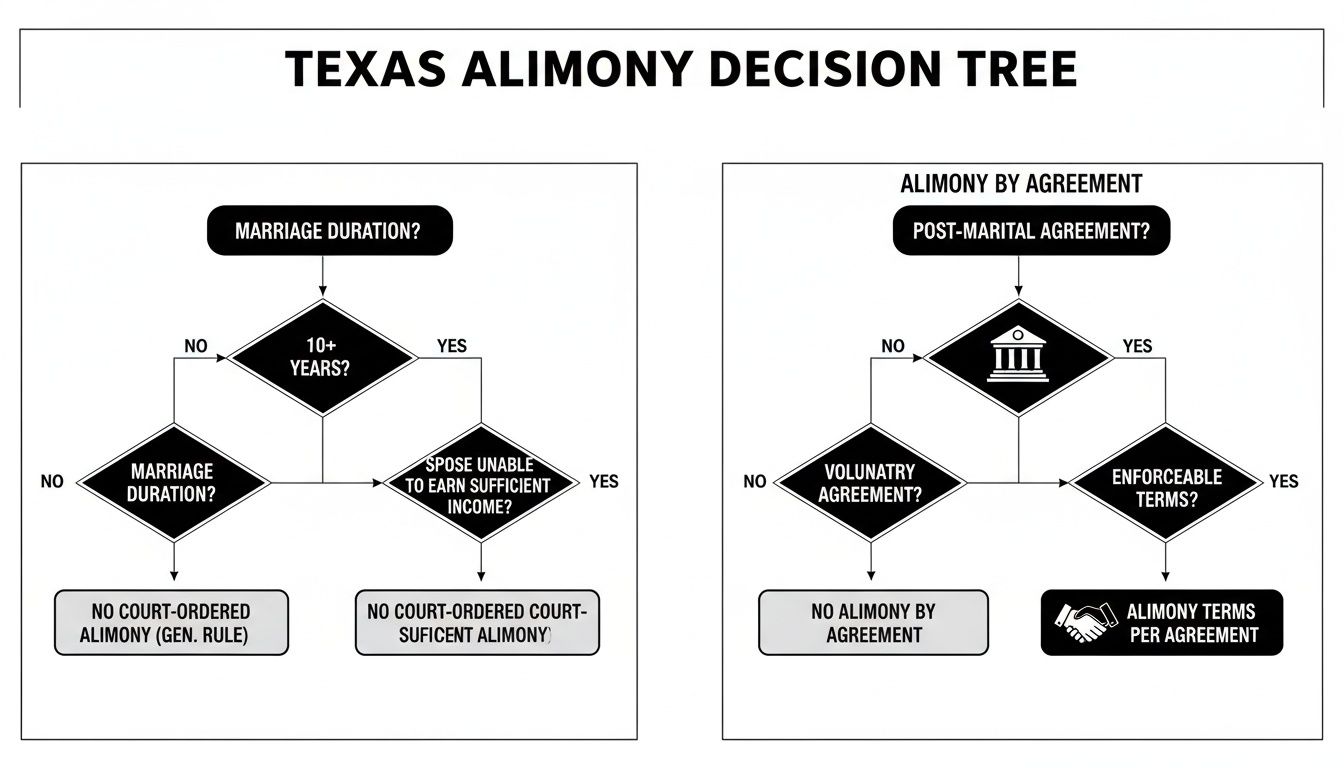
As the chart shows, the process for court-ordered maintenance is strict and involves multiple steps. It's a high bar to clear, and it’s one of the biggest reasons why having an experienced local attorney in your corner can make all the difference.
How Alimony Payments and Duration Are Calculated
So, you’ve cleared the tough eligibility hurdles for spousal maintenance in Texas. The big questions now are probably, "How much money are we talking about?" and "How long will it last?"
Unlike in some states where judges have a lot of leeway, Texas law is very specific on these points. The system isn't designed to provide a lifelong income stream; it's meant to be a temporary bridge, giving the lower-earning spouse a realistic chance to get back on their feet financially.

This philosophy translates into hard-and-fast caps on both the dollar amount and the duration of payments. For anyone navigating a divorce in Humble or anywhere in Northeast Houston, knowing these limits is crucial for planning your financial future.
The Strict Caps on Alimony Payments
When a Harris County judge orders spousal maintenance, they don't just pick a number out of thin air. The monthly payment is capped by law and can't be more than the lesser of these two figures:
- $5,000 per month, or
- 20% of the paying spouse's average monthly gross income.
That's it. Even if the paying spouse is a high-powered executive, a judge cannot legally order them to pay a penny over $5,000 a month in maintenance. For most families, though, it’s the 20% rule that really matters.
Let’s say the paying spouse in Atascocita brings in a gross monthly income of $10,000. The absolute most a judge could order is $2,000 per month (that’s 20% of $10,000), because it's less than the $5,000 ceiling. This formula makes the potential support amount fairly predictable, but it also creates a firm limit.
A lot of people mistakenly believe alimony is supposed to let both people maintain the same lifestyle they had when married. In Texas, that's not the case. The law is very clear: maintenance is strictly for meeting "minimum reasonable needs" while the receiving spouse works toward becoming self-supporting.
How Long Can Alimony Last in Texas?
Just like the payment amount, the duration is also tightly controlled. The law links the maximum time you can receive court-ordered support directly to how long you were married. The idea is to provide a set timeline for the receiving spouse to acquire new skills, find a job, or otherwise secure their own income.
The Texas Family Code sets out the following maximum time limits:
- 5 years of support for marriages lasting 10 to 20 years.
- 7 years of support for marriages lasting 20 to 30 years.
- 10 years of support for marriages of 30 years or more.
There are a couple of exceptions. If the marriage was under 10 years but involved family violence, a judge can order support for up to 5 years. The only time maintenance can be ordered indefinitely is in rare situations where a spouse has an incapacitating disability that prevents them from working.
These strict deadlines reinforce the state's philosophy: court-ordered support is a temporary fix. Once the clock runs out, the financial obligation is over. If you're trying to figure out what this all means for you, you may want to review our guide on how much alimony you could expect in Texas. Getting a handle on these numbers is the first step in mapping out your post-divorce life.
Finding Flexibility with Contractual Alimony
While the state's rules for court-ordered maintenance can feel rigid and unforgiving, there’s a much more flexible and powerful path available for divorcing couples in Texas. It's called contractual alimony, and frankly, for many families in Humble and Atascocita, it’s the key to crafting a stable financial future without letting a judge make the final call.
At its core, this is a private agreement. You and your spouse sit down—ideally with your attorneys or a mediator—and design a custom support plan. Instead of being handcuffed by the court's strict limits on how much can be paid and for how long, you're in the driver's seat. You get to create a plan that genuinely reflects your family’s unique history, financial reality, and future goals.

Bypassing the Court's Strict Limits
The biggest draw of contractual alimony is the freedom it offers. You get to step outside the legal caps imposed by the state. Texas law actually encourages these kinds of private agreements, which gives couples in Northeast Houston a game-changing opportunity.
Think about this: court-ordered spousal maintenance is capped at $5,000 per month or 20% of the paying spouse's gross monthly income, whichever is less. But with a private contract, you can agree to whatever amount makes sense for your situation. Payments of $10,000 a month or more are absolutely possible if both parties agree it’s fair. You can learn more about how this works by exploring the nuances of Texas spousal support laws.
Contractual alimony shifts the power from the judge back to you. It transforms the conversation from "What will a court force us to do?" to "What can we build together that works for our family's future?"
This approach isn't just more empowering; it’s often far more practical. It lets you craft a solution that works for everyone involved, which can drastically reduce conflict and set a much healthier tone for the next chapter of your lives.
A Kingwood Couple’s Story of Success
Let’s imagine a couple from Kingwood. The wife put her career on hold for over 20 years to be a stay-at-home parent, which allowed her husband to climb the corporate ladder. If they left it up to a judge, she might only get a few years of limited support—a terrifying prospect that would leave her financially vulnerable.
But they chose a different route: negotiation. Working with skilled family law attorneys, they hammered out a contractual alimony agreement. It gave her substantial support for a longer, more realistic period, allowing her to go back to school and re-enter the workforce without panic. The payments were even designed to taper off as her own income grew, creating a plan that was both fair to her and manageable for him.
Their story really highlights the power of working together. By sidestepping a courtroom battle, they reached a solution that was far more supportive and sensible than anything a court could have ordered, securing a stable future for them both.
How Property Division Impacts Your Alimony Case
In a Texas divorce, you can't talk about spousal maintenance without first talking about property division. They aren't two separate issues; they're deeply intertwined, and the court looks at them in a very specific order. For anyone going through this in Humble or greater Harris County, getting this sequence right is critical.
A judge is required by law to divide your community property first. Only after that's done will they even entertain a request for spousal maintenance.
This "property first" approach is a cornerstone of Texas family law. The court's initial job is to determine if the assets you walk away with are enough to meet your basic needs. If the property you receive—whether it's cash from the sale of a home in Kingwood, a share of a retirement account, or other savings—is sufficient to support you, the conversation about court-ordered maintenance usually stops right there.
The Role of Community Property
Think of your share of the marital estate as the first pot of money available for your support. If you receive a large cash payout or assets that can produce income, a judge will almost certainly conclude that you can provide for yourself without needing ongoing payments from your ex. For a deeper dive on this, our guide explains in detail what community property is in Texas.
This is where having a sharp legal strategy becomes so important. The back-and-forth over who gets which asset isn't just about what seems fair; it has a direct and immediate impact on whether you can even qualify for spousal maintenance.
A classic example we see all the time in Northeast Houston is what to do with the family home. If one spouse gets the house with significant equity, the court sees that value as a resource. The judge might decide that selling or borrowing against that home provides more than enough capital to meet that spouse's needs, making an award of maintenance unnecessary.
Strategic Negotiations for Your Future
Because of this undeniable link, we never look at property division and spousal support in isolation. They are two pieces of a single financial puzzle. A good attorney can help you model different scenarios to see how a particular property settlement might play out for your maintenance eligibility.
For example, sometimes it makes more sense to accept a smaller share of the property in exchange for contractual alimony, which is more flexible and isn't bound by the court's strict rules. In other cases, fighting for a specific asset could give you far more long-term security than a few years of temporary maintenance payments ever could. We help families in Atascocita and Humble weigh these trade-offs to find the best path forward for their financial future.
Taking the Next Step on Spousal Support in Texas
Going through a divorce can feel like you're trying to find your way in the dark, but you don’t have to do it alone. For families here in Humble and all over Northeast Houston, the first light at the end of the tunnel is understanding that while Texas is an alimony state, its rules are incredibly specific and strict. Getting a handle on this is the first real step toward taking back control of your finances.
While getting a judge to order spousal maintenance is a high bar to clear, it’s far from your only path forward. Often, the best solutions are found outside the courtroom through what’s called contractual alimony. This negotiated approach can lead to outcomes that are more creative, more flexible, and ultimately, more fair for everyone involved. The point is, you have options.
Practical Steps to Prepare for What's Ahead
A little prep work now can make a world of difference down the road. It helps you walk into any legal conversation feeling organized and in control. Here's where to start:
- Start Your Financial Paper Trail: Begin gathering all the important documents—recent pay stubs, bank statements for all your accounts, a few years of tax returns, and any paperwork on major assets (like your house or car) and debts. This paperwork is the bedrock of any financial discussion in a divorce.
- Draft a Realistic Post-Divorce Budget: Sit down and map out what your monthly expenses will actually look like after the divorce. This exercise is crucial for proving your "minimum reasonable needs" and showing what you’ll need to stand on your own two feet.
- Figure Out What You Really Need: What does financial stability look like for you? Are you looking for short-term support to finish a degree and re-enter the workforce, or is your situation one that requires a longer-term plan? Having clear goals is what allows us to build a smart legal strategy around them.
Your financial future isn't something you should leave to chance or a judge's rigid interpretation of the law. It's something you can actively build with a well-prepared strategy and a strong advocate in your corner.
We get it—this is a tough journey. But you absolutely do not have to walk it by yourself. Here at The Law Office of Bryan Fagan, our Humble family law attorneys have spent years helping our neighbors in communities like Atascocita and Kingwood find their footing and move forward with confidence.
We invite you to schedule a free, confidential consultation at our Humble office to talk through your unique situation. Let's work together to understand your rights, explore all your options, and craft a solid plan for the next chapter of your life.
Common Questions We Hear About Texas Alimony
To wrap things up, let's tackle a few of the most frequent questions we get from clients right here in Humble, Atascocita, and our neighboring communities. These are the things people often wonder about, and getting straight answers can clear up a lot of confusion.
"We Were Married for Less Than 10 Years. Can I Still Get Alimony?"
This is a big one. As a general rule, Texas courts require a marriage to have lasted 10 years or more before they'll order spousal maintenance. But—and this is a critical "but"—there are a couple of major exceptions.
The first, and most significant, is family violence. If the spouse who would be paying was convicted of an act of family violence against you or your child, the 10-year rule can be waived. Another key exception applies if you or a child from the marriage has a serious disability that prevents you from earning enough to support yourself.
"How Does Cheating Affect Alimony in Harris County?"
It absolutely can. While adultery doesn't automatically guarantee or disqualify someone from receiving alimony, Harris County judges are permitted to take it into account.
Think of it this way: the judge looks at the whole picture. Fault in the breakup of the marriage, including infidelity, is one of the many factors they weigh when deciding if maintenance is appropriate, how much to award, and for how long. It can definitely tip the scales one way or the other.
"My Ex Got Remarried. Do I Still Have to Pay?"
That all depends on what kind of alimony you’re paying.
If it's court-ordered spousal maintenance, the legal obligation to pay ends automatically when the receiving spouse remarries. The payments also stop if they move in and start living with a new romantic partner.
But if you're paying contractual alimony—the kind negotiated as part of your settlement—you have to look at the contract itself. The terms you both agreed to in your divorce decree will spell out exactly what happens. This is why it’s so important to have that agreement drafted carefully to cover these kinds of future possibilities.
Navigating the world of spousal support requires clear, practical guidance from a team that knows the law and, just as importantly, knows the local courts. At The Law Office of Bryan Fagan, we're committed to helping our neighbors in Humble secure their financial footing for the future.
Schedule a free, confidential consultation with us today to talk about your specific situation. We are here to help.