Skip to content

A parent in Humble opens a court order after a separation and sees unfamiliar phrases like “medical support,” “cash medical support,” and “uninsured expenses.” The panic is not due to a lack of concern. It arises because the order sounds important, expensive, and hard to decode.
That reaction is normal.
Parents in Humble, Atascocita, Kingwood, and across Northeast Houston often understand regular child support in a general way, but medical child support in Texas causes more confusion. Many assume it only means “keep the child on insurance.” Texas law is broader than that, and the details matter because courts treat these obligations seriously.
If you're trying to figure out what a Harris County judge can order, who has to provide coverage, what “cash medical support” really means, or what happens if life changes and the current order no longer fits, you're in the right place. The law can feel cold on paper. In real life, this is about making sure your child can see a doctor, fill a prescription, and get care without parents fighting over every bill.
Navigating Your Child's Healthcare After a Separation
A common Humble situation looks like this. One parent has coverage through work but the payroll deduction feels high. The other parent has the child on Medicaid or has found a marketplace plan. Then the order arrives and says one parent must provide insurance, both parents must handle certain medical costs, and there may also be a cash payment tied to healthcare.
That's where people get stuck.
They ask practical questions. Does the paying parent have to buy insurance no matter what? What if the child already has coverage? Is dental separate? If one parent pays monthly child support on time, can they still get in trouble over copays or prescriptions?
The short answer is yes, those issues can still become legal problems. Texas treats healthcare support for children as its own part of the case, not as an afterthought. That's why parents around Atascocita and Kingwood sometimes feel blindsided. They thought the main fight was over possession schedules or monthly support. Then medical support becomes the part that keeps causing conflict.
Medical support problems usually don't begin with bad intentions. They begin with a vague order, poor records, or different assumptions about who was supposed to pay.
In Harris County family cases, clarity matters. The more clearly you understand the order, the easier it is to protect your child and avoid future enforcement trouble. That's true whether you're working through divorce, a suit affecting the parent-child relationship, or a modification tied to custody and support.
For many Northeast Houston families, peace of mind starts with separating three ideas that get mixed together all the time: insurance coverage, cash medical support, and uninsured medical expenses.
What Exactly Is Medical Child Support in Texas
Medical child support in Texas is not just one thing. It usually involves separate duties that work together to protect a child's healthcare access.
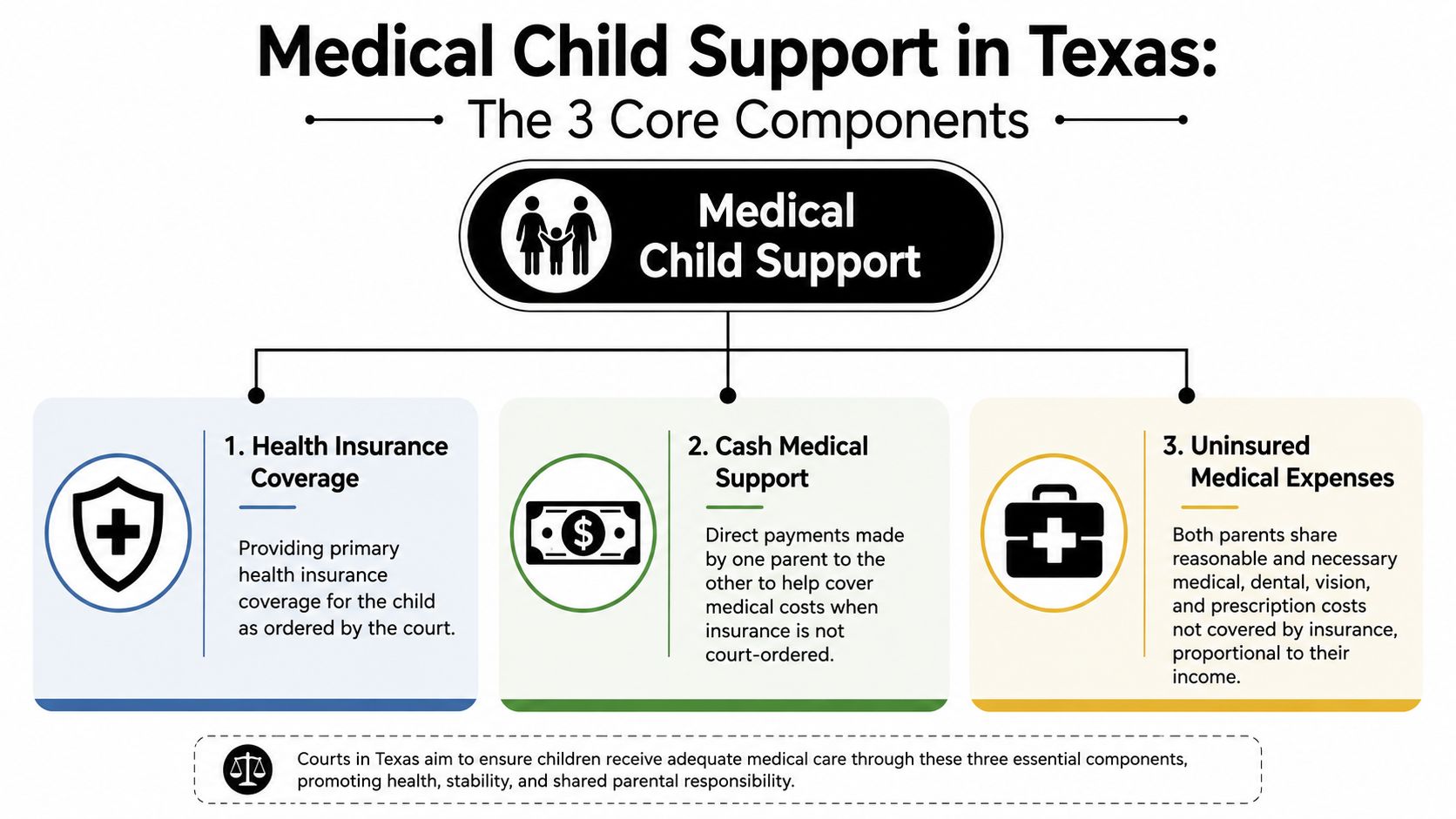
Under Texas Family Code Chapter 154, courts must order both medical and dental support as separate obligations alongside standard child support, requiring the child to have health insurance coverage and covering uninsured expenses like deductibles, copays, prescriptions, and mental health services. That same law also makes medical support legally distinct from cash child support, so a parent can face enforcement for failing to maintain insurance or pay medical expenses even if regular monthly child support is current.
The three parts parents need to separate
The easiest way to understand this is to think of medical support as a package with three different moving parts:
- Health insurance coverage means someone is ordered to keep the child enrolled in a health plan if qualifying coverage is available.
- Cash medical support means money is paid when insurance isn't being provided through the order in the usual way.
- Uninsured medical expenses are the bills left after insurance does its part, such as copays, deductibles, prescriptions, and similar costs.
Parents often combine all three into one mental bucket and call it “insurance.” That shortcut causes trouble.
Why the distinction matters
A Kingwood parent might say, “I pay support every month, so I'm covered.” Legally, that may not be true. If the order requires maintaining the child on a health plan, reimbursing part of a prescription, or paying a separate medical support amount, each duty stands on its own.
That matters in court and in everyday parenting. If your child needs counseling, fills a prescription after an urgent care visit, or has a deductible bill after a specialist appointment, the order may assign responsibility even if those costs weren't part of the monthly child support amount.
A Child Support Attorney in Humble handles establishing, modifying, and enforcing child support in Harris County. That often includes sorting out these medical support terms when an order is unclear or parents disagree about what it requires.
Practical rule: If your order mentions insurance, dental coverage, reimbursements, or cash medical support, treat each one as a separate line item you need to understand and follow.
How Humble Courts Decide Who Provides Insurance
Harris County courts don't assign insurance randomly. Judges follow a legal framework that asks a practical question first: is health coverage available at a reasonable cost?

Under Texas Family Code Section 154.182, courts must order the obligor to provide health insurance for a child if coverage is available through a parent's employment, union, or other organization at a reasonable cost. Texas law defines that cost as not exceeding 9% of the obligor's annual net resources for health insurance and 1.5% for dental insurance. If no such coverage is available, the court must order cash medical support capped at 9% of the obligor's annual resources, in addition to standard child support.
What reasonable cost means in real life
That phrase sounds abstract until you run the numbers.
For a parent earning $60,000 annually, the maximum reasonable cost for medical coverage is $5,400 per year or $450 monthly under the Texas standard described in this Texas child support health insurance guide. The same source explains that, effective September 1, 2025, Texas increased the child support income cap by 27%, raising it from $9,200 to $11,700 per month under Texas Family Code § 154.125. It also notes that the 9% medical support cap on the new $11,700 monthly limit equals $1,053 per month or $12,636 annually in maximum medical support obligations.
That doesn't mean every parent will pay anywhere close to those amounts. It means the court has a ceiling to work with when deciding whether available coverage is legally “reasonable.”
The order courts usually follow
In plain language, courts tend to work through the issue like this:
| Court question | What it means for parents |
|---|---|
| Is employer or organization-based coverage available? | The court looks first at whether a parent can get the child on an existing plan. |
| Does the cost fit the legal standard? | If the premium falls within the statutory limit, the court can order that coverage. |
| If not, what fills the gap? | The court turns to cash medical support so the child still has healthcare support built into the order. |
This is why two Humble families with similar custody schedules may get different medical provisions. One parent may have affordable work coverage. Another may not.
Why judges focus on predictability
Parents sometimes expect the court to choose whichever option feels fairest in the moment. Judges are usually looking for something more stable. They want a support structure that can be enforced, tracked, and explained in the order.
That's especially important in Northeast Houston cases where employment can change, benefits can disappear, and one parent may assume that if the child already has some coverage, no separate order is needed. Texas law doesn't work that way. The court still has to address medical and dental support directly.
The Truth About Cash Medical Support and Uninsured Costs
Often, parents become confused. Cash medical support is not the same thing as paying an insurance premium, and it isn't just a side note in the child support order.
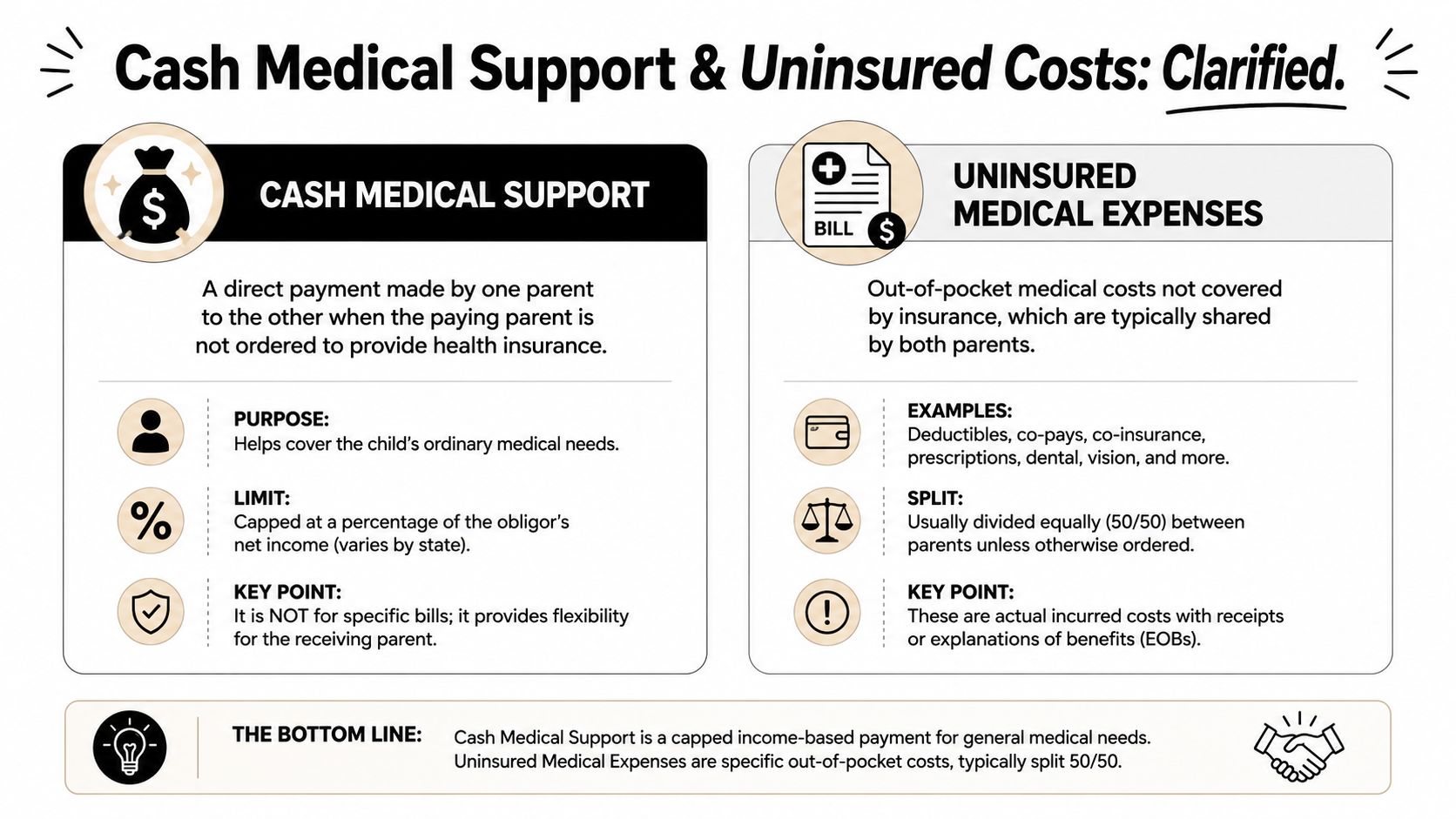
Texas law requires cash medical support in specific situations. According to Texas Law Help's explanation of medical and dental support, Texas law mandates cash medical support of up to 9% of net resources if the child receives Medicaid or if private insurance is unavailable at reasonable cost. That same guidance notes a point many parents miss: the Attorney General's office can enforce cash medical support independently, which can lead to unexpected enforcement action.
What cash medical support actually is
Think of cash medical support as a healthcare-specific payment obligation built into the case when traditional insurance coverage through the order isn't the answer. It exists so the child's medical support doesn't vanish just because employer-based insurance isn't available or doesn't meet the legal cost standard.
That's a critical distinction for families in Humble and Atascocita. A parent may say, “My child is on Medicaid, so I don't owe anything extra for medical support.” That assumption can be wrong.
Cash medical support can exist even when a child already has healthcare coverage through Medicaid. The legal question is whether the court has ordered a separate medical support payment, not whether the child has a card in hand.
Uninsured expenses are a different category
Then there's the third bucket: uninsured medical expenses.
These are the costs insurance doesn't fully cover. In everyday life, that might include:
- Copays and deductibles after a pediatrician, urgent care, or specialist visit
- Prescription costs when the pharmacy total isn't fully covered
- Mental health bills for counseling or therapy
- Dental gaps that remain after dental coverage pays its portion
Parents often discover these disputes months after the fact, when one parent sends screenshots of bills and wants reimbursement. The order may spell out who pays what share, but even a fair order can become messy when records are incomplete.
How to handle reimbursement disputes
If you're dealing with uninsured costs in Kingwood or Northeast Houston, a practical system matters more than verbal promises.
Use a simple routine:
- Save the bill as soon as you receive it.
- Keep proof of payment if you paid the provider.
- Send the documentation promptly to the other parent.
- Track what was requested and when in one folder or spreadsheet.
- Check the court order language before assuming the split.
Some parents need help when the other side refuses to reimburse or denies that the bill qualifies. In those cases, Enforcement of Court Orders in Humble involves enforcing divorce decree and custody order provisions in Harris County, which can include disputes tied to family court obligations.
The point is simple. Medical support doesn't stop at “Who carries insurance?” The main conflict often comes later, in the unpaid prescription, the therapy invoice, or the overlooked cash medical support line in the order.
Enforcing Medical Support Orders in Harris County
A common Harris County problem looks like this. One parent pays regular child support on time every month, then gets pulled into court anyway because the child was dropped from insurance, cash medical support was never paid, or reimbursement for medical bills never happened.

That catches many parents off guard in Humble and greater Harris County. Medical support is not a side promise. It is a court-ordered duty, and Texas can enforce it on its own track.
That separate track matters. A parent can be current on base child support and still be behind on medical support. Courts treat those as different parts of the same order, much like rent and utilities under one lease. Paying one does not erase the other.
What enforcement often looks like in real life
Enforcement cases usually start with a specific failure, not a general complaint. One parent says, "The order required insurance, and there was no coverage for three months." Or, "The order required $___ in cash medical support, and none of it was paid."
In Humble-area cases, the dispute often centers on one of these problems:
- Insurance was supposed to stay in place but lapsed or was canceled
- Cash medical support was ordered but treated like an optional add-on
- Uninsured medical expenses were shared in the order but one parent never paid their portion
- Dental or medical support terms were ignored even though monthly child support was paid
Cash medical support causes a lot of confusion. Parents sometimes assume it is folded into regular child support. Often, it is not. If the order lists a separate cash medical support amount, that amount must usually be paid as ordered unless the court changes it.
How Harris County can enforce a medical support order
Texas has several enforcement tools available, and they are practical, not theoretical.
- Income withholding: An employer can be ordered to withhold support-related amounts from a parent's paycheck.
- Money judgment: The court can total unpaid amounts and enter a judgment for what is owed.
- License suspension: Driver's and professional licenses can be affected if the noncompliance continues.
- Contempt proceedings: In some cases, a judge can impose penalties for violating a clear court order.
The exact tool depends on the wording of the order, the payment history, and the proof each side can show.
Records often decide these cases
Judges usually need documents, dates, and amounts. Good records help the court see whether the problem was a missed premium, an unpaid cash medical support obligation, or a dispute over whether a bill qualified under the order.
If you are asking the court to enforce the order, gather:
- the signed order
- insurance enrollment or cancellation records
- bills, receipts, and explanation of benefits forms
- payment histories
- texts, emails, or portal messages showing notice and requests for payment
If you are defending against enforcement, gather the same type of proof. Maybe coverage existed and the other parent did not have the updated card. Maybe a bill was never sent to you. Maybe the amount claimed does not match the order. Specific records carry much more weight than a general explanation.
A short warning here helps. Waiting rarely improves a medical support problem. Unpaid amounts can accumulate unnoticed, especially with cash medical support, because parents often focus only on the regular child support line.
The Law Office of Bryan Fagan handles family law matters for local residents, including issues involving support, custody, and court enforcement.
When and How to Modify a Medical Support Order
A medical support order isn't supposed to stay frozen if your life changes in a serious way. Texas allows modification, but the court won't change the order just because the arrangement has become inconvenient.
The legal standard is a material and substantial change in circumstances. According to this discussion of Texas child support modification standards, examples can include sudden job loss, a major income shift, or a permanent custody change that affects the child's healthcare needs. That same source notes that the 2025 net resources cap of $11,700 per month also affects how high-income modifications are calculated.
Situations that may justify a change
For a parent in Atascocita or Kingwood, this often comes up in ordinary life events:
- Job loss or benefit loss when employer-sponsored insurance disappears
- A new job with different coverage that is more workable or more affordable
- A major change in income that affects whether existing premiums still fit the legal framework
- A custody change that shifts who is handling appointments, prescriptions, and insurance administration
A child's healthcare needs can also evolve. What worked when the order was signed may not fit the child's current treatment routine.
The basic modification path in Harris County
You usually don't fix this with a text message agreement or a verbal understanding. The safer path is to ask the court to change the order.
A practical roadmap looks like this:
- Read the current order carefully so you know exactly what it requires now.
- Collect proof of the changed circumstances such as benefit notices, pay information, or custody-related documents.
- File the proper modification request in the appropriate court.
- Present clear evidence showing why the current order no longer fits.
- Wait for a signed new order before acting like the terms changed.
Parents often make the same mistake here. They agree informally to switch insurance or stop a payment, but they never update the court order. Later, one of them gets treated as if the original order never changed. Legally, that's often exactly what happened.
When medical support changes are tied to conservatorship or parenting time, Child Custody Lawyer in Humble, TX addresses custody and conservatorship representation for Humble families. That can matter when health decisions and possession schedules are connected.
Your Next Steps for Securing Your Child's Health
If you remember only a few points, remember these. Medical child support in Texas is separate from regular child support. It can involve insurance, cash medical support, and uninsured expenses. And it can be enforced even when a parent believes they've otherwise stayed current.
That's why clarity matters so much for families in Humble, Atascocita, Kingwood, and Northeast Houston. A vague assumption can become a court problem. A careful review of the order, a clean recordkeeping system, and early action when circumstances change can prevent a lot of stress.
If you're confused about who should carry insurance, whether cash medical support applies in your case, how unreimbursed expenses should be handled, or whether a modification is possible, don't wait until missed payments or unpaid bills pile up. Parents usually feel more in control once they understand exactly what the order says and what the court expects them to do next.
Help is available, and getting answers early is often the most practical move for both you and your child.
If you need guidance on medical support, child support, custody, or another family law issue affecting your household, schedule a free consultation with Law Office of Bryan Fagan. Our Humble office works with families across Humble, Atascocita, Kingwood, and Northeast Houston to help them understand their options and take the next step with confidence.