Skip to content

You may be living together in Humble, sharing bills, raising children, introducing each other as family, and still not know whether Texas sees you as married. That question usually gets urgent when something changes. A breakup. A death in the family. A home purchase. An insurance form. A probate dispute.
I talk with people from Humble, Atascocita, Kingwood, and across Northeast Houston who are in exactly that spot. They aren't asking abstract legal questions. They're trying to figure out what happens to the house, the bank account, the children, or the estate.
Texas does recognize informal marriage, which many people still call common law marriage. But the rules are narrower than widely believed, and the myths are everywhere. If you're sorting out your status, the key is understanding what Texas requires, how proof works in Harris County, and what steps protect you if the relationship is ending.
Are We Married in the Eyes of Texas
A couple in Humble might live together for years, split groceries, attend school events together, and call each other partners. Then one day one person says, “We were never legally married.” The other person is stunned because they assumed time together settled it.
Texas law doesn't work that way.
Texas is one of only seven U.S. jurisdictions that currently recognize informal marriage, and under Texas law an informal marriage has the same legal status as a ceremonial marriage for property rights, inheritance, divorce requirements, and spousal benefits under community property rules, as noted in this overview of common-law marriage recognition in the United States. That means this isn't a casual label. If an informal marriage exists, the legal consequences are real.
Plain-English takeaway: In Texas, the question isn't whether you had a wedding. The question is whether your conduct created a legal marriage.
That catches many local families off guard. A couple in Atascocita may never have filed for a marriage license, but they may still have legal obligations. A surviving partner in Kingwood may assume they can inherit, only to learn they first have to prove the marriage existed. A separated couple in Northeast Houston may think moving out ended everything, when the law may say otherwise.
The good news is that Texas gives a clear legal test. Once you understand that test, the confusion starts to fall away. You can look at your relationship through the same lens a court would use and make better decisions about divorce, probate, estate planning, or parenting issues.
The Three Legal Pillars of an Informal Marriage
Texas treats informal marriage like a three-legged stool. If one leg is missing, the stool falls. The same is true here. Under TexasLawHelp's explanation of Texas Family Code § 2.401(a)(2), an informal marriage exists only when three elements are present at the same time: a present agreement to be married, living together in Texas as spouses, and representing to others that you're married. The same source also makes clear there is no minimum cohabitation period, which means the old seven-year belief is wrong.

Agreement to be married
This is the part many people misunderstand. Texas looks for a present agreement to be married, not a future plan to marry. Being engaged isn't enough. Saying “we'll do a ceremony later” isn't the same as agreeing that you're already husband and wife.
Courts often look for conduct that supports that agreement. Did you act like spouses in official settings? Did you make decisions together as a married couple? Those details matter.
Living together in Texas
The second pillar is cohabitation in Texas as spouses. Living under the same roof as dating partners or roommates doesn't automatically satisfy this requirement. The issue is whether you lived together in a way that reflects a married relationship.
A Humble couple may share a household, combine routines, and run a family unit. That's different from merely spending a lot of nights together.
Holding out to others
This is often the most disputed part. “Holding out” means you represented yourselves to others as married. In real life around Kingwood or Atascocita, that may look like:
- Introductions in public: You call someone “my husband” or “my wife” to neighbors, coworkers, or family.
- Paperwork: You sign forms or records in a way that reflects a married relationship.
- Community conduct: You consistently present yourselves as spouses at school events, church, medical appointments, or family gatherings.
A private understanding is usually not enough if the public picture looks different.
All three pillars must exist together. That's why some couples who lived together a long time still aren't legally married, while others may have created a valid marriage much faster than they expected.
For some couples, that legal status affects later planning. In those situations, Prenuptial & Postnuptial Agreements in Humble involves drafting and review of marital property agreements for Humble clients.
How to Prove Your Informal Marriage in Harris County
Once a dispute starts, proving an informal marriage becomes a practical document problem. Courts don't just want a story. They want evidence that points to agreement, cohabitation, and public representation.
Texas courts generally require the person claiming the marriage to prove it by a preponderance of the evidence, and evidence can include records such as joint tax returns, joint loan applications, insurance beneficiary designations, and testimony from people who observed how the couple described their relationship, as discussed in this Texas informal marriage overview from O'Neil Attorneys.
Two ways people usually prove it
The first route is building a file of circumstantial evidence. The second is filing a declaration.
If you never filed anything with the county, don't assume you're out of options. Many Harris County cases rely on records, witness testimony, and consistent public behavior.
If you do want the clearest formal proof, filing matters. As explained in DivorceNet's discussion of Texas informal marriage, a Declaration and Registration of Informal Marriage isn't required to create a valid marriage, but it creates prima facie proof of the marriage. For many families in Harris County, that's the most direct way to validate status.
Evidence courts may consider
| Evidence Type | What It Helps Prove |
|---|---|
| Joint tax returns filed as spouses | Public representation and intent |
| Insurance forms naming a partner as beneficiary | Intent and treatment of the relationship as a marriage |
| Leases, deeds, or loan applications signed as spouses | Public representation and shared household status |
| Testimony from friends, relatives, or coworkers | How the couple held themselves out to others |
| Use of the same last name | Conduct consistent with a marital relationship |
| Records involving children and household decisions | Family structure and shared life as spouses |
A practical checklist for Humble families
- Gather official records: Pull tax documents, insurance records, deeds, leases, and employment paperwork.
- List witnesses: Think about who in Humble, Atascocita, or Kingwood heard you describe each other as spouses.
- Review consistency: If some records say “single” and others say “married,” that conflict can become a major issue.
- Organize child-related documents: Parenting records can matter in family law disputes. For related guidance, review evidence needed for a custody case in Harris County.
If children are involved, support questions often follow quickly. A Child Support Attorney in Humble handles establishing, modifying, and enforcing child support in Harris County.
Your Rights and Responsibilities in an Informal Marriage
Once an informal marriage is legally established, Texas doesn't treat it like a lesser version of marriage. The legal effect is the same.

That means daily life can change in ways people don't expect. A couple may think, “We never had a wedding, so this should be simple.” But once the marriage is recognized, property, debts, inheritance, and divorce procedure all follow the same legal framework used for ceremonial marriages.
Property and debt
Texas community property rules can apply to property and debts acquired during the marriage. If you're trying to sort out who owns what, it helps to understand what community property means in Texas.
In practical terms, that may affect:
- A house or lease: Even if one name appears first, the analysis may not stop there.
- Bank accounts and retirement savings: The timing of acquisition can matter.
- Debt: Credit cards, loans, and other obligations may not belong only to the person who opened the account.
Practical rule: If an informal marriage exists, separation doesn't automatically separate the financial picture.
Children, decision-making, and family obligations
Parents in an informal marriage face the same kinds of legal questions as parents in a ceremonial marriage. Issues involving conservatorship, possession schedules, and support are handled through the same family law system in Harris County.
Later in a case, it can help to hear a broader explanation of how these issues play out in court:
Inheritance and legal standing
Informal marriage can also matter outside divorce. If one partner dies, the surviving partner may need to prove the marriage in probate before asserting inheritance rights. That's one reason these cases often overlap with estate planning and probate concerns, not just divorce.
For local families in Northeast Houston, the focus of legal advice shifts from labels to consequences. A status question can turn into a property dispute, a custody case, or an estate fight very quickly.
Ending a Common Law Marriage in Texas
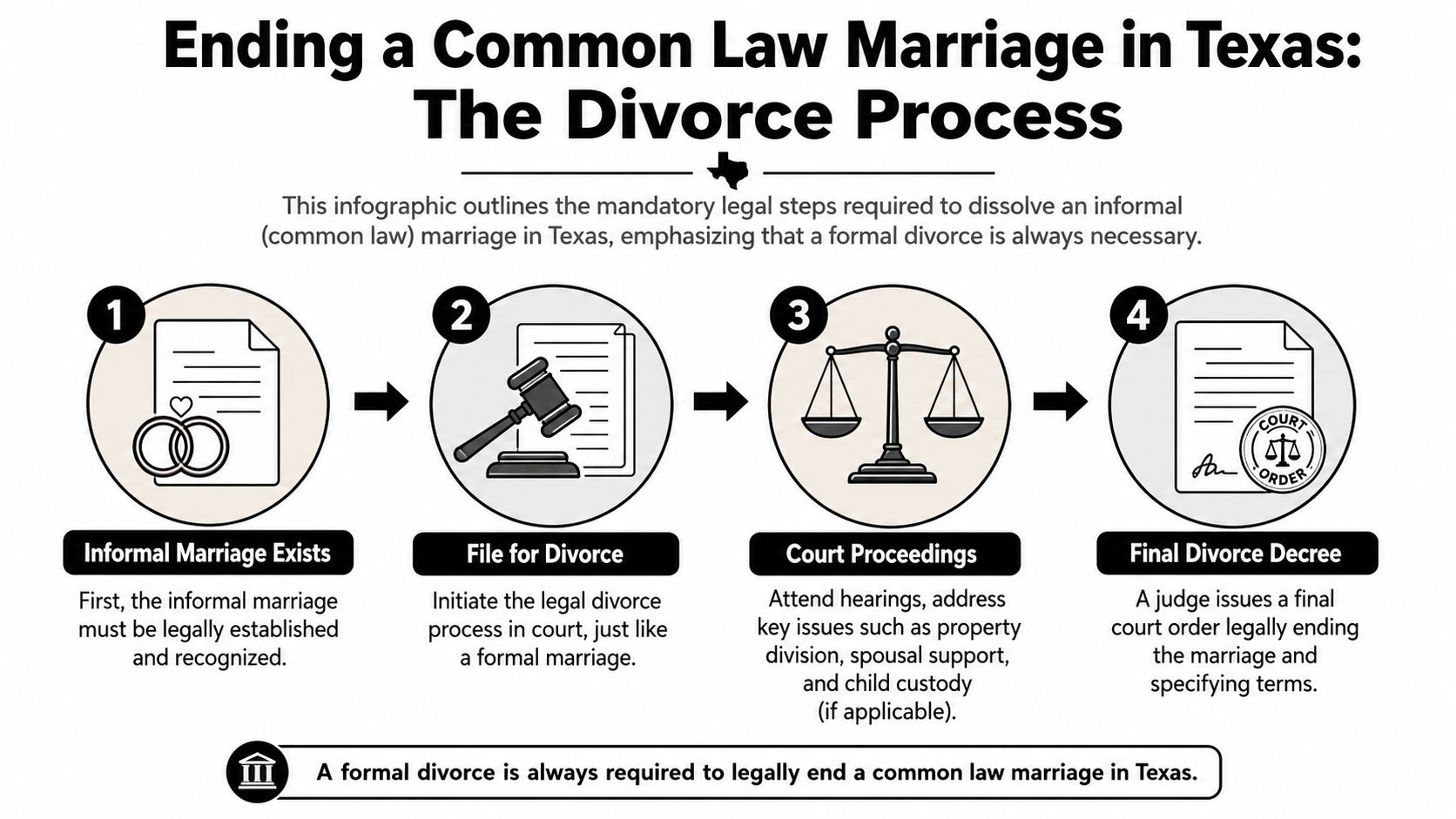
A lot of people assume there must be a simpler way to end an informal marriage. There isn't. If the marriage exists, you don't get a “common law divorce.” You get a regular divorce.
Under LegalZoom's summary of Texas Family Code § 2.401(b), Texas imposes a two-year deadline to file a legal proceeding to prove an informal marriage after separation. If that doesn't happen within that period, the law creates a rebuttable presumption that the marriage never existed. The same source also states that couples must file a standard divorce petition in the proper county to dissolve the union.
The normal divorce path
If you're in Humble or elsewhere in Harris County and the marriage is recognized, the process generally looks like this:
- File a divorce case: The case is filed in the appropriate court.
- Address contested issues: Property, debt, custody, and support are sorted out.
- Present proof if needed: If the other party denies the marriage existed, that issue may need to be litigated first.
- Receive a final decree: The judge signs an order ending the marriage and setting the terms.
For a local overview of procedure, see filing for divorce in Harris County from Humble.
The misunderstood two-year separation rule
This is the part many people in Kingwood and Atascocita have never heard. If a couple separates and too much time passes, proving the marriage can become much harder. People often repeat the line that common law marriage only ends by death or divorce. In litigation, that oversimplifies the problem.
The two-year rule doesn't erase every possibility, but it creates a presumption against the marriage claim. That can change the whole case.
If you've been separated for a long time and your former partner denies the marriage, waiting longer usually doesn't help.
Practical steps if you're separated
- Preserve records now: Don't wait until texts, forms, and account records disappear.
- Check filing dates: Timing can shape the entire legal strategy.
- Prepare for remote participation if needed: In contested family law matters, tools such as AONMeetings for legal firms can help people understand how online depositions and remote proceedings may fit into a modern case workflow.
- Consider whether agreement is possible: If both spouses agree on major terms, an Uncontested Divorce Lawyer in Humble handles efficient uncontested divorce matters for agreeing Humble couples.
Next Steps for Humble and Northeast Houston Residents
A couple in Humble separates, and six months later one person says, "We were married," while the other says, "No, we were just living together." That is usually the moment the guesswork needs to stop and the paper trail needs to start.
Begin with a simple file, digital or paper. Gather leases, bank statements, insurance forms, tax records, school or medical paperwork, and screenshots of messages that show how you and your partner described the relationship. Then write out a timeline with key dates, addresses, and the names of relatives, neighbors, church members, or coworkers who saw you as a married couple. In Harris County, those details often matter more than people expect.

If you need sworn statements, property paperwork, or identity documents prepared correctly, it can also help to get documents notarized in Sugar Land before records become harder to track down.
When it's time to call a lawyer
Legal advice makes sense quickly if your situation involves any of these:
- Your partner now denies the marriage
- You bought a house together, share debts, or mixed major property
- Children are involved and you need clear court orders
- A death, probate issue, or inheritance dispute has surfaced
- You separated and are unsure how that timing affects your claim
- You are trying to decide between filing a declaration, a divorce, or taking no action yet
For families in Humble, Atascocita, Kingwood, and the rest of Northeast Houston, informal marriage disputes often overlap. One case can touch divorce, child custody, probate, and title to property all at once. That is why local context matters. A couple living in an apartment near FM 1960 may need a different proof strategy than a couple who owned a home in Kingwood and listed each other as spouses on multiple accounts.
The Law Office of Bryan Fagan handles divorce, child custody, estate planning, wills, trusts, and probate for local clients who need coordinated legal guidance.
A consultation can help you sort the problem into manageable parts. First, are you likely to be treated as married under Texas law? Second, what evidence do you have? Third, what filing in Harris County protects you now?
Clear answers early can prevent expensive fights later.
Frequently Asked Questions About Informal Marriage
Does living together for seven years automatically make us married
No. Texas law does not use a seven-year rule, or any other set number of years, to create an informal marriage. A couple in Humble can live together for a long time and still not be married. Another couple can meet the legal requirements much sooner if they agreed to be married, lived together in Texas as spouses, and represented to others that they were married.
A simple way to view it is this. Time may give you more evidence, but time by itself does not create the marriage.
What if one partner dies without a will
The surviving partner may have to prove the informal marriage before claiming inheritance rights as a spouse. In Harris County probate cases, that often means gathering the kinds of everyday records families do not always realize matter until after a death. Joint accounts, insurance forms, tax records, lease paperwork, and statements from people who knew the couple can all become important.
These disputes can get tense fast, especially if relatives disagree about whether a marriage existed.
Is filing a declaration required
No. An informal marriage can be valid even if the couple never filed a declaration. Still, a filed declaration works a lot like putting a label on a file before it gets misplaced. It does not create every marriage issue by itself, but it can make proof much easier later if a dispute comes up over divorce, probate, benefits, or property.
Can an informal marriage affect child custody and child support
Yes. The marriage question and the children's issues can end up connected in the same court system, but they are not the same legal question. Parents still need clear court orders covering conservatorship, possession, and support.
That distinction matters. Even if adults disagree about whether they had an informal marriage, the court can still address the children's needs.
What if we moved or have records in different places
That is common in Northeast Houston. A couple may have lived in Humble, worked in Kingwood, kept bank accounts in Atascocita, and signed papers somewhere else in the Houston area. In that situation, the goal is to build a clean timeline and collect records that show how the relationship was presented over time.
If you need affidavits or related paperwork completed while organizing records, some families also use services to get documents notarized in Sugar Land.
Will another state recognize a Texas informal marriage
Sometimes yes, sometimes no. The answer depends on the other state's law and the issue involved, such as divorce, inheritance, or benefits. If your relationship started in Texas and now touches another state, get advice before assuming the other state will treat the relationship the same way Texas would.
For local families, that question often comes up after a move, a death in the family, or a job transfer.
If you are trying to figure out whether you were informally married, whether the two-year separation rule may affect your case, or what to file in Harris County now, the Law Office of Bryan Fagan can help you assess the facts in a practical way. A conversation with a Humble attorney can bring the issue down to earth and help you decide on the next step for your family in Humble, Atascocita, Kingwood, or nearby Northeast Houston.