Skip to content

Some people read about divorce late at night after the house gets quiet. The kids are asleep, the dishes are still in the sink, and your mind keeps circling the same questions. Do I qualify to file here? Do I have to go downtown? What happens if my spouse won't cooperate? How badly can I mess this up if I try to do it myself?
If that sounds familiar, you are not unusual. You are a neighbor in Humble, Atascocita, Kingwood, or Northeast Houston trying to make sense of a legal process at the same time your personal life feels unsteady.
Filing for divorce in harris county humble is not impossible. It is manageable when you handle it in the right order. It gets harder when people rush to forms before they understand residency, service, standing orders, and what Harris County requires. That is where local guidance matters.
Navigating Divorce in Our Humble Community
A lot of people around Humble think their situation is somehow rare. It usually is not. A teacher in Atascocita, an airport employee near IAH, a parent in Kingwood, a small business owner in Northeast Houston. Different lives, same knot in the stomach when the marriage is no longer working.

What makes this local conversation important is simple. Harris County has the largest divorce filing volume in Texas, with 28,500 annual filings and a divorce rate of 3.4 per 1,000 residents, which is higher than the Texas average of 2.6 per 1,000 according to Texas divorce statistics covering Harris County. That means our local courts deal with divorce constantly. It also means the system is busy, procedural, and unforgiving when paperwork is wrong.
This feels personal because it is
You are not just ending a legal relationship. You are sorting out where the children sleep, who keeps the house, how bills get paid, and whether retirement accounts or debts need to be divided. In Humble, that often means people are dealing with school routines, commutes into Houston, and the practical reality of trying to protect normal life while everything changes.
Some couples are still deciding whether divorce is the right move. If you are in that stage, a counseling-focused resource like Should We Get A Divorce can help you organize your thinking before you make legal decisions. It is not a substitute for legal advice, but it can help you get clearer about where you stand.
Practical advice: Do not file just to create an advantage in an argument. File when you are ready to follow through and make organized decisions.
Why local court knowledge matters
Generic divorce articles treat Harris County like a dot on a map. That is a mistake. People in Humble often need answers that are more specific than "go file in Harris County." They need to know how local court procedure affects people who live outside downtown, how service problems derail a case, and why one missing document can waste weeks.
If you want a better sense of the local court system serving this area, review the Harris County family court information for Humble residents. It helps to understand where your case lives once it is filed.
Many individuals feel better once they realize divorce is not one giant event. It is a sequence. Eligibility first. Documents next. Filing after that. Then service, waiting period, negotiation, and final orders. Once you stop treating it like a mystery, it becomes a process you can work through.
First Steps Eligibility and Preparing to File
Before you touch a form, answer the first question. Are you allowed to file in Harris County? If the answer is no, everything else is wasted effort.
Residency rules are not complicated
For a Harris County divorce, one spouse must have lived in Texas for at least 6 months and in Harris County for at least 90 days before filing. In plain English, the court wants a real connection to the state and the county before it accepts the case.
People trip over this more than they should. They moved recently. They split households. They are staying with family in Kingwood for the moment. They assume mailing address equals legal residency. Sometimes it does. Sometimes it does not.
Use common-sense proof:
- Utility records: Electric, water, gas, or internet bills can help show where you lived.
- Lease or mortgage papers: These are often the cleanest residency documents.
- Driver’s license or state ID: Helpful, but not always enough by itself.
- School or medical records for children: These can help support where the family has been living.
If there is any doubt about county residency, slow down and sort that out first.
Gather documents before emotions drive the process
The fastest way to create an expensive divorce is to start angry and stay disorganized. I recommend building a single folder, digital or paper, before filing anything.
You want the financial picture in one place. Not because it is fun. Because divorce law runs on documents.
Here is the practical checklist I give people:
Income records
Gather recent pay stubs, bonus information, and anything that shows regular compensation.Tax returns
Pull the most recent returns you can access. If your spouse handled taxes, get copies now.Bank and credit card statements
These show cash flow, spending patterns, and account balances.Retirement and investment records
If there is a 401(k), IRA, pension, brokerage account, or stock plan, collect statements.Real property documents
Get deeds, mortgage statements, refinance papers, and any home equity paperwork.Vehicle titles and loan information
Cars, trucks, motorcycles, boats. If it has value or debt attached, include it.Children’s records
School information, medical records, and childcare receipts matter if custody or support will be disputed.
Preparation changes the tone of the case
A prepared person makes better decisions. A prepared person also sees major issues sooner. Sometimes that leads to settlement. Sometimes it reveals a fight is coming. Either way, clarity beats panic.
Texas divorce rates have fallen over time, dropping from 3.8 per 1,000 residents in 2003 to about 2.7 per 1,000 residents by 2023, a 29% decrease, while second and third marriages still face significantly higher divorce rates according to Texas divorce trend data. My takeaway is blunt. Fewer people may be divorcing overall, but the people who do divorce still need to get the details right, especially when there has been a prior marriage, blended family, or more complicated property picture.
Key takeaway: The cleaner your records are on day one, the less room there is for confusion, delay, and bad deals later.
Decide what kind of case you have
Not every divorce should be approached the same way. Ask yourself:
| Question | Why it matters |
|---|---|
| Do both spouses want the divorce? | That affects whether the case starts cooperatively or with immediate conflict. |
| Do you agree on children? | Parenting disputes drive a lot of stress and delay. |
| Do you agree on property and debts? | Agreement here often determines whether the case stays efficient. |
| Is anyone hiding money or controlling access? | That changes how aggressively documents need to be obtained. |
If you need help deciding what to look for in counsel before you file, this guide on how to find a good divorce attorney is worth reading. Pick someone who can explain process plainly, not someone who tries to impress you with jargon.
The Official Filing Process From Petition to Court
Once eligibility and documents are in order, filing becomes mechanical. That is good news. Mechanical steps are easier to control than emotional ones.
Start with the Original Petition
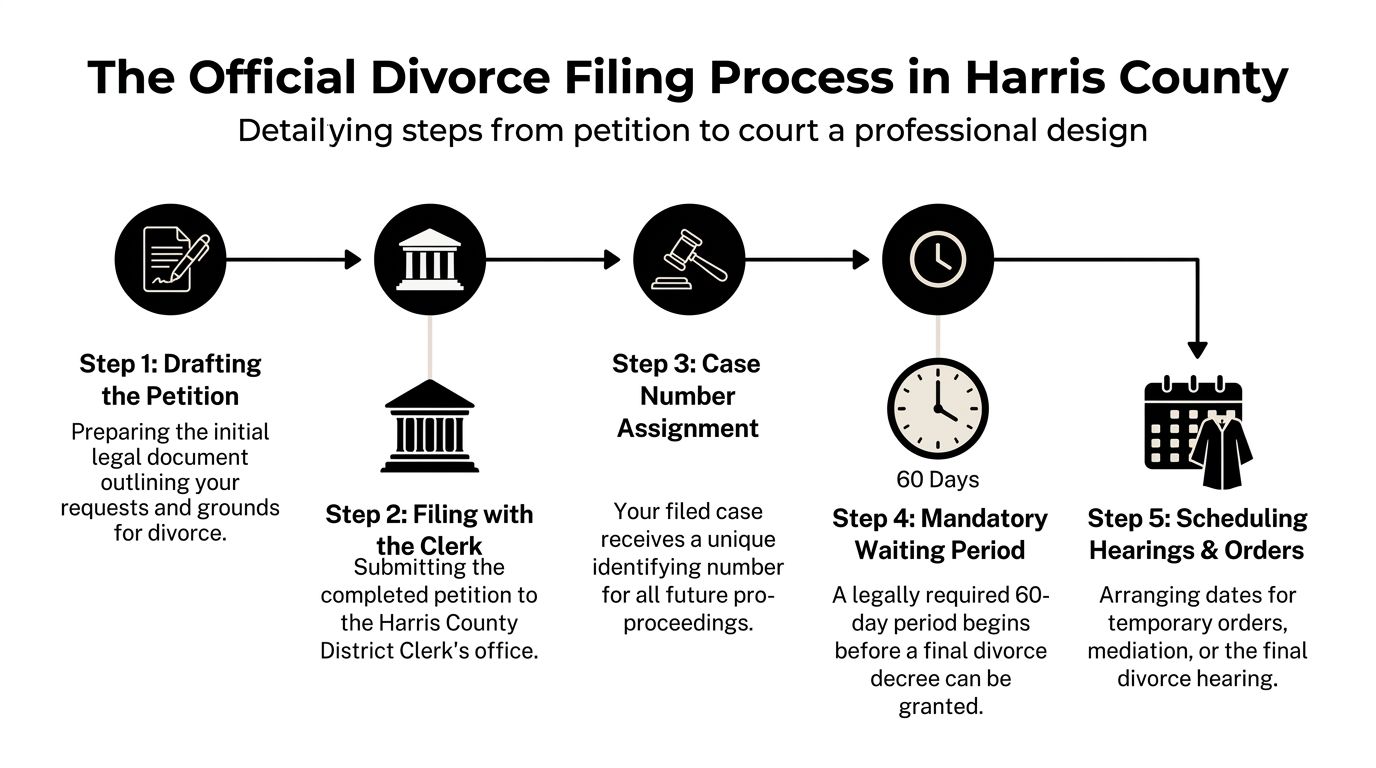
The case begins with the Original Petition for Divorce. This is the document that tells the court you are asking for a divorce and outlines the basic requests. It is not where you tell your whole life story. It is where you start the case correctly.
In Harris County, you also need the Civil Case Information Sheet when filing. Accuracy matters more than drama here. Wrong names, incomplete information, and missing required attachments create delays fast.
Use eFileTexas.gov carefully
The filing itself is commonly done through eFileTexas.gov. Attorneys use it. Many self-represented people use it too. The portal is useful, but it does not save you from bad documents.
The usual sequence looks like this:
- Create an account: Use full legal names and current contact information.
- Choose the correct court and case type: At this stage, people make avoidable mistakes.
- Upload the petition and required forms: Read every file before submitting it.
- Pay the filing fee or submit fee-waiver paperwork: Do not leave this step unfinished.
- Wait for clerk acceptance: Filing is not complete just because you clicked submit.
Filing fees and fee-waiver option
For Harris County divorce cases, the filing fee is $300 to $350, and the filing package includes the residency requirement, Original Petition for Divorce, and Civil Case Information Sheet, according to this Harris County divorce filing guide. The same source notes that incomplete or inaccurate petitions are a leading reason for clerk rejections, which can exceed 20% to 30% for self-represented filers.
If paying the filing fee is a genuine hardship, you may be able to file a Statement of Inability to Afford Payment of Court Costs. That is not a loophole. It is a formal request, and it needs to be completed accurately and fully.
Tip: Never treat filing like online shopping. The portal is digital, but the consequences are legal. Review every document line by line before you submit it.
What happens right after filing
Once the clerk accepts the filing, the court assigns a cause number. That number matters. Put it on everything that follows. If your spouse must be served, the service process starts from there. If temporary issues need attention, such as use of the home or temporary parenting arrangements, that usually gets addressed after filing, not before.
A lot of Humble-area residents assume they can just "file locally" because they live outside central Houston. The process is still tied to Harris County procedure. Geography does not change the court system.
Keep the paperwork clean from the start
Here is what I tell people in plain language. If your case is simple, do not make it messy with careless paperwork. If your case is already messy, do not make it worse by filing documents that create more confusion.
A strong filing package should do three things:
State the basics clearly
Names, dates, children, and general requests must be accurate.Match the facts of the case
If there are children, property, or safety concerns, your filing approach must reflect that.Avoid preventable rejection
Missing pages, unsigned forms, and bad uploads are not harmless mistakes.
If you want a more local overview of how divorce cases move through the court system in this area, read the page on divorce court in Humble Texas. It gives useful context for what happens after the clerk accepts your petition.
One practical recommendation
If your case involves children, a house, retirement accounts, or a spouse who has already become difficult, do not assume filing is a DIY admin project. It is legal positioning. One option some people in this area consider is the Law Office of Bryan Fagan for help preparing and filing family-law documents from the Humble area. The important point is not the name. The important point is choosing counsel before bad paperwork sets the tone for the whole case.
Serving Papers and Immediate Next Steps
Filing starts the case. Service makes it real for the other side.

People often get this step wrong because they think "my spouse knows I filed" is enough. It is not. Courts care about proper notice, not casual notice.
Your main service options
In most Harris County divorces, service happens one of these ways:
Personal service
A sheriff, constable, or private process server delivers the filed paperwork. This is the standard route when the divorce is contested or the other spouse is unlikely to cooperate.
It is formal. Sometimes awkward. Often necessary.
Waiver of service
If the divorce is relatively amicable, your spouse may sign a Waiver of Service before a notary. This can reduce conflict and keep things moving.
This route is common in agreed cases, but it still has to be done correctly. A sloppy waiver creates its own problems.
Alternative service
If a spouse cannot be found, the court may allow different methods in some situations. That usually requires extra procedural steps. It is not the first option, and it is not something to improvise.
Why service matters so much
Properly serving divorce papers is critical. Waived service cases in Harris County have an 85% finalization rate within 90 days, while improper service can increase the risk of case dismissal by 25%, and there is also a mandatory 60-day waiting period before a final hearing can occur according to this Harris County service and hearing guide.
That should get your attention. Service is not a side issue. It is one of the fault lines where cases stall.
Local advice: If your spouse is cooperative, a properly prepared waiver is often the cleaner path. If your spouse is evasive, stop hoping that will fix itself and move quickly on formal service.
The 60-day waiting period
Texas requires a waiting period after filing before the divorce can be finalized. That does not mean nothing happens during that time. It means the court cannot grant the final divorce immediately.
During that period, people usually work on:
- Drafting temporary agreements
- Exchanging needed financial information
- Negotiating parenting schedules
- Preparing final decree language
- Setting hearings if there is conflict
To understand service and next-step timing in a more visual format, this short video gives a useful overview:
What to do after your spouse is served
Once service is complete, do not drift. Start organizing for the next stage immediately.
If you filed first, focus on these questions:
| Issue | What to do |
|---|---|
| Children | Write down the schedule that is working right now. |
| Bills | Track who is paying what after separation. |
| Property | Make a list of what exists before items start “disappearing.” |
| Communication | Keep messages brief, civil, and useful for the case. |
If your spouse reacts badly, resist the urge to answer chaos with chaos. Judges notice behavior. So do opposing lawyers.
Common Pitfalls for Humble and Northeast Houston Filers
People think the hard part is deciding to divorce. Legally, the hard part is avoiding dumb mistakes that cost time and advantage. That is where Humble, Atascocita, and Kingwood residents often get burned.

Mistake one, assuming a county-wide guide is enough
It usually is not. A generic article may tell you to file in Harris County and move on. It will not tell you what outer-area residents commonly miss. It will not warn you about practical service delays, confusion about local forms, or how easy it is to misread where your case should be handled.
For residents in outer Harris County areas like Humble, pro se filings have shown dismissal rates up to 15% higher due to procedural errors and service delays, according to this guide focused on filing in Harris County from peripheral areas. That tracks with what local lawyers see. Distance from downtown does not change the rules, but it often changes how fast people fix problems.
Mistake two, acting like e-filing solved everything
It did not. E-filing is convenient. It is not forgiving.
A lot of self-represented filers assume digital submission means the process is simple. Then they upload the wrong version, miss a required county-specific document, or do not understand what the clerk rejected. By the time they realize there is a problem, days have passed and service has not even started.
Mistake three, underestimating Harris County standing orders
Many people file without realizing that county rules affect conduct right away. Those orders can limit what parties should do with property, finances, and children while the case is pending. If you move money, lock someone out, or change routines without understanding the rules, you can create avoidable trouble.
Take this seriously: A bad first month in a divorce case can shape settlement talks and court credibility for the rest of the case.
Mistake four, believing local residence means local courthouse convenience
People in Humble ask this all the time. “Can I just file nearby instead of dealing with downtown?” The practical answer is that filing for divorce in harris county humble still means dealing with Harris County procedure. Living in Kingwood or Atascocita does not create a separate divorce system.
That matters because logistics affect behavior. People delay filing. They delay fixing rejected paperwork. They put off service because they are juggling work, traffic, and family demands. Delay sounds harmless. In divorce, delay usually turns into disorder.
Mistake five, trying to save money in the wrong place
I understand why people try to do as much as possible themselves. Sometimes that is reasonable. But if your case involves a house, kids, retirement, support, or a spouse who is already difficult, saving money on front-end legal review can create much larger costs later.
A local lawyer does not just "do paperwork." A local lawyer spots county-specific problems before they become hearings, resets, or dismissal issues. That is its true value.
Moving Forward to Finalize Your Divorce
The finish line usually comes into view after the waiting period, document exchange, and initial conflict settle into something more organized. For many people, the final phase is less dramatic than they feared. It is still important.
Most cases move toward agreement or mediation
If you and your spouse can reach workable terms, the case often ends through an agreed final decree. If not, mediation is commonly used to try to resolve disputes before the court spends time on a trial setting.
Mediation is often where people stop arguing in broad emotional terms and start making decisions. Who keeps the house. What the possession schedule looks like. How debts get assigned. What language goes into the final decree so the order can be enforced later if needed.
The prove-up hearing is the last formal step in many cases
In an agreed divorce, the final hearing is often called a prove-up. One spouse appears and gives the court the basic testimony needed for the judge to approve the divorce. The judge reviews the paperwork, confirms the legal requirements have been met, and signs the decree if everything is in order.
That sounds simple because it can be simple. But only if the documents were drafted correctly.
Finalizing is more than getting a signature
After the decree is signed, you still need to carry out the terms. That may include updating titles, closing joint accounts, refinancing debt, following custody orders, and changing beneficiary information where appropriate. A signed decree ends the marriage. It does not automatically complete every practical task tied to the marriage.
What matters most at the end: Your decree should be clear enough that you can live by it without constant future conflict.
Think beyond the court date
The right way to judge a divorce outcome is not whether the hearing was fast. It is whether the orders make your life workable afterward. Good divorce planning protects your next year, not just your next court appearance.
If you are near Humble, Atascocita, Kingwood, or Northeast Houston and you are unsure where your case stands, talk with a local attorney before the final decree is drafted. Fixing vague or incomplete final orders after the fact is harder than doing it correctly the first time.
Frequently Asked Questions About Divorce in Humble
Do I have to go to court for a divorce in Humble
Sometimes yes. Sometimes very little. It depends on whether the case is agreed, whether children are involved, and what the assigned court requires. The key point is that even when the process feels mostly administrative, the paperwork still has to satisfy Harris County requirements.
What is the difference between uncontested and contested
An uncontested divorce means both spouses agree on the major terms, including property, debts, and if applicable, child-related issues. A contested divorce means there is a dispute on one or more important issues. That difference affects stress, timing, cost, and how much court involvement the case needs.
Can I file for divorce locally in Humble instead of going downtown
People ask this constantly. The short answer is that living in Humble does not create a separate divorce court system. Your case still runs through Harris County procedure. Some parts can be handled electronically, but you should not assume every issue can be handled from your phone without local procedural knowledge.
How much does divorce really cost
There is the filing fee, and then there is everything else. The full cost depends on whether the case is agreed, how many issues are disputed, whether service becomes difficult, and whether children or significant property are involved. Cheap paperwork that creates a bad decree is not cheap.
Should I file first
Sometimes yes. Filing first can help you control timing and frame the initial requests. But filing first is only smart if you are prepared to follow through with service, temporary issues, and organized document handling. Filing first without a plan is not strategy. It is just starting a fire.
If you are thinking about divorce in Humble, Atascocita, Kingwood, or Northeast Houston and you are unsure where your case stands, talk with a local team before a paperwork mistake turns into a bigger problem. The Law Office of Bryan Fagan offers free consultations for people who need clear answers about filing, service, custody, property division, and what Harris County expects.