Skip to content

When you’re facing a divorce, the mountain of questions can feel overwhelming. One of the first, and most common, questions we hear from our neighbors in Humble, Atascocita, and Kingwood is, "Where do I even file for divorce?" It’s a logical question, but the answer often surprises people.
There is no dedicated "divorce court in Humble, Texas." Instead, your case will be handled in the Harris County District Courts, located in downtown Houston. As a law firm deeply rooted in this community, we want to help you understand what that means for you and your family.
Where Your Humble Divorce Case Will Be Heard

If you live in the Humble area and are starting the divorce process, it's essential to know that there isn't a local courthouse for family law matters. Every divorce for every resident of Harris County—from Atascocita to Northeast Houston—gets filed and heard at the Harris County Civil Courthouse in downtown Houston.
While a trip downtown might feel like an extra hassle, this system is set up to keep all family law cases in front of judges who specialize in Texas divorce law. Knowing this from the start helps you focus your energy where it matters—on the specific courts that will actually handle your case.
This brief table outlines the initial process for any Humble, Kingwood, or Atascocita resident.
Quick Guide to Filing for Divorce in Humble, TX
| Step | Where to Go | Key Detail |
|---|---|---|
| 1. File Your Petition | Harris County District Clerk's Office (Civil Courthouse) | You'll file the "Original Petition for Divorce" to officially start your case. |
| 2. Case Assignment | Electronically, by the Clerk | Your case will be randomly assigned to a specific Family District Court. |
| 3. Attend Hearings | The assigned District Court in Houston | All hearings, from temporary orders to final trial, happen here. |
This gives you a clear road map of where the journey begins. The next question is usually about the specific courtroom your case will land in.
The Dedicated Family Law Courts
Once you file your petition, your case isn't just thrown into a general pile. Harris County has a group of District Courts that only handle family law. This is a good thing—it means the judge overseeing your divorce has deep experience with the issues your family is facing, like child custody and property division.
Your divorce will be randomly assigned to one of these specialized courts, which include:
- The 245th District Court
- The 309th District Court
- The 311th District Court
These judges and their staff live and breathe Texas family law every single day. They have their own specific procedures and rhythms. This is where having an attorney who regularly practices in these specific courtrooms becomes a huge advantage for our clients from Humble and Northeast Houston. We know the people, the processes, and what to expect, which is invaluable when navigating hearings and paperwork. You can get a better feel for the courtroom experience by reading our guide on what happens at a divorce hearing.
Why Court Volume Matters for Your Humble Divorce Case
Let's be direct: the Harris County court system is one of the busiest in the United States. That fact has a direct impact on your case's timeline. In a recent year, these courts handled over 20,000 family law cases. Divorces made up about 60% of that caseload—that's roughly 12,000 new divorce cases every year.
For a family in Humble, this high volume means the court dockets are packed. Without an experienced guide, it's easy for a case to get bogged down, facing delays of 6 to 12 months or more.
Facing the court system alone can feel like trying to navigate a bustling airport without a map. Our role at The Law Office of Bryan Fagan is to be your local guide, ensuring you don’t miss your connection and arrive at your destination with your future secure.
We know this process seems complicated, but you don't have to face it with anxiety and uncertainty. With the right local legal team that understands the Harris County courts, you can move forward with confidence. Schedule a free, no-obligation consultation with our Humble office today to get the clear, straightforward answers you and your family deserve.
Taking the First Steps in Your Divorce: A Practical Guide for Humble Residents
Filing for divorce can feel like a massive, intimidating task, but it really boils down to a series of clear, manageable steps. Think of it like a roadmap—once you understand the route, the journey becomes a lot less stressful. For folks living here in Humble, Kingwood, or Atascocita, the good news is that these first steps all follow a well-worn path through the Harris County court system.
The whole process kicks off with one key document: the Original Petition for Divorce. This is the official paper that you file to get your case started. It lays out the basic facts for the court—who you and your spouse are, whether you have children, and the legal reasons you’re seeking a divorce.
Meeting the Texas Residency Requirements
Before a Texas court can hear your case, you have to prove you belong here. The law is very clear on this, and it's all about where you've been living. To file for divorce in Harris County, you must meet two simple criteria:
- You must have lived in Texas for at least the last six months.
- You must have lived specifically in Harris County for the last 90 days.
These rules simply ensure your case is handled locally. For our neighbors in the Humble, Atascocita, and Kingwood areas, this means if you’ve been a Texan for half a year and a Harris County resident for the past three months, you’re eligible to file at the Harris County Civil Courthouse downtown.
Filing the Petition and Paying Fees
Once you’ve confirmed you meet the residency rules, it's time to officially file your Original Petition for Divorce with the Harris County District Clerk's office. This is what formally opens your case and gets it on the court's radar.
When you file, you'll also have to pay a filing fee, which usually runs a few hundred dollars. If that cost is a genuine financial burden for your family, don't worry. You can ask the judge to waive it by filing a form called a "Statement of Inability to Afford Payment of Court Costs."
The initial filing is a critical moment. One small mistake on that first petition can create frustrating delays and add a lot of unnecessary stress to an already difficult situation. As your local attorneys, we ensure everything is done right from the start, so you can focus on your family.
What It Means to "Serve" Your Spouse
After your petition is filed and accepted by the clerk, Texas law requires that your spouse is given formal, official notice that a divorce has been filed. This is what lawyers call "service of process," but most people just refer to it as "serving" the papers. It might sound confrontational, but it's a standard, neutral step that ensures everyone is aware of what's happening.
Here are the practical, step-by-step ways to get this done:
- Waiver of Service: This is the easiest and most common method, especially in amicable cases. Your spouse simply signs a "Waiver of Service," a legal document stating they received a copy of the petition and agree to skip the formal delivery process. It saves time, money, and hassle for everyone.
- Personal Service: If a waiver isn't an option, a sheriff's deputy or a private process server will be hired to physically hand-deliver the divorce papers to your spouse. They will then file a document with the court called a "Return of Service" to prove the delivery was completed.
Getting these initial steps right is what sets the stage for the rest of your case to proceed as smoothly as possible. For a more detailed breakdown of the exact forms and local procedures, you can learn more by reading our guide on how to properly file for divorce in Texas. Our team handles these details every day for Humble-area families, freeing you up to focus on what matters most—your family and your future.
Understanding the Harris County Divorce Timeline
Navigating a divorce can feel like trying to find your way through a thick fog. When you're from Humble, Atascocita, or Kingwood, you just want to know what the road ahead looks like here in Harris County. Knowing the typical timeline doesn't just reduce anxiety; it gives you a map, helping you set realistic expectations so you can start planning your next chapter.
First things first: every divorce in Texas has a mandatory 60-day waiting period. This starts the day the Original Petition for Divorce is filed. It’s essentially a "cooling-off" period required by state law. So, even if you and your spouse agree on every single detail from day one, your divorce can't be finalized for at least two months. For most families, especially when kids or property are involved, the process will take longer.
Setting the Ground Rules with Temporary Orders
One of the first, and most important, steps after filing is the Temporary Orders hearing. We often tell our clients to think of these as the official "rules of engagement" that will govern your lives until the divorce is final. These orders are designed to create stability and predictability for your family during what is often a chaotic time.
A judge will listen to both sides and then issue orders covering the immediate essentials. This can include:
- Temporary Custody: Deciding which parent the kids will live with for now.
- Visitation Schedules: Creating a clear, enforceable schedule for when the other parent will see the children.
- Financial Support: Ordering temporary child support and sometimes spousal support to keep the household finances afloat.
- Who Stays in the House: Granting one spouse exclusive use of the family home.
- Paying the Bills: Spelling out who is responsible for the mortgage, car notes, and other joint debts.
These court orders aren't just suggestions; they are legally binding and provide much-needed structure while everything else is in motion.
This timeline gives you a bird's-eye view of how a typical divorce case flows through the Harris County court system.
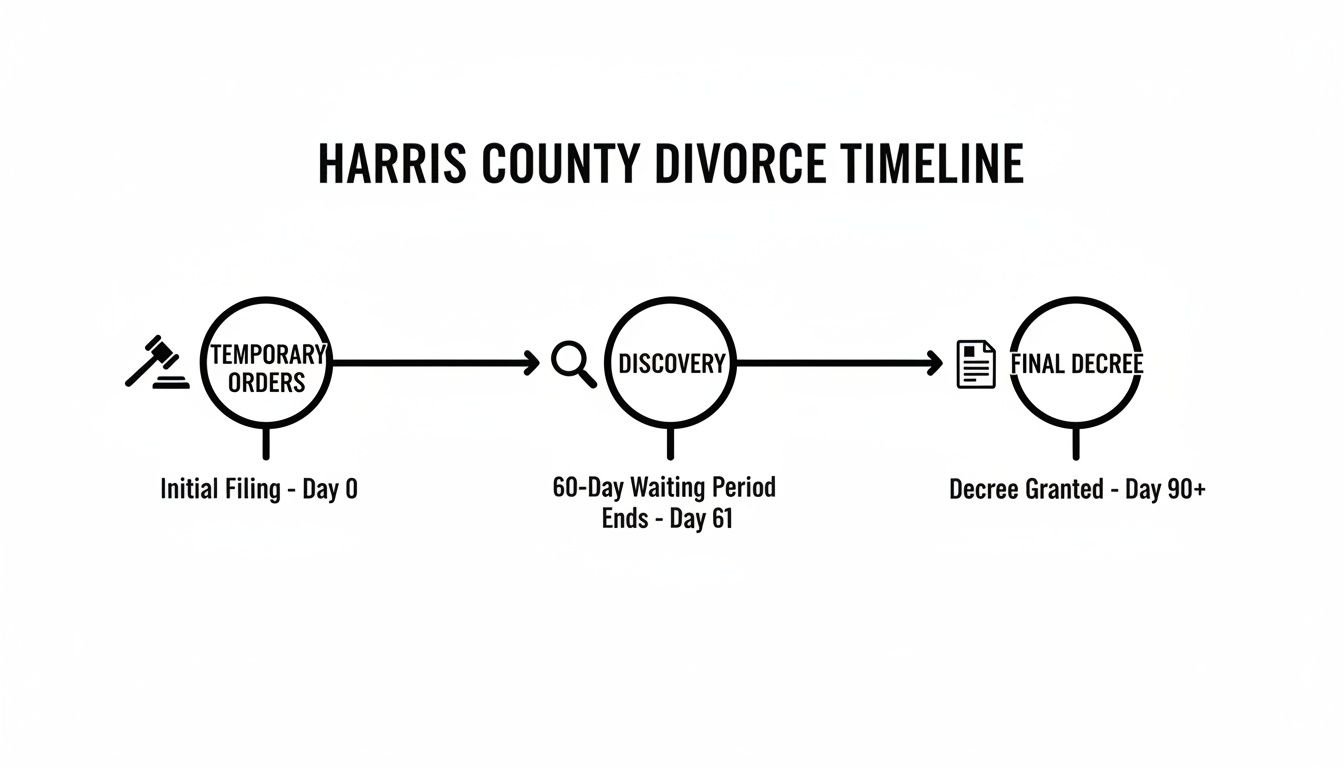
As you can see, the major phases—Temporary Orders, Discovery, and the Final Decree—are milestones that every case will pass through on its way to resolution.
The Information-Gathering and Negotiation Stages
Once Temporary Orders are set, your case moves into a phase called discovery. This is a practical, step-by-step process where both sides formally trade information. It’s about laying all the cards on the table—bank statements, property deeds, retirement accounts, and debts—to ensure everyone has a complete and honest financial picture before making any final decisions.
What comes next is a crucial step for almost every family in Harris County: mediation. In fact, our local courts require that you attempt mediation before they will even consider giving you a trial date for a contested divorce.
Mediation is a confidential process where you, your spouse, and your lawyers sit down with a neutral third-party—the mediator. The mediator’s entire job is to help you and your spouse find common ground and negotiate a settlement on any issues you haven't been able to agree on.
From years of helping Humble-area families, we can tell you that mediation is where most cases get resolved. It gives you control over the outcome, rather than handing that power over to a judge who doesn't know you or your family. It also has a huge impact on your wallet. While about 32% of Texas marriages end in divorce, the path you take matters. An uncontested divorce might run $1,500-$5,000, but a contested case that goes to trial can easily cost $15,600-$30,000 or more. Why the huge jump? Litigated cases have roughly 70% higher costs than those settled amicably. You can see a full breakdown of Texas divorce statistics to understand how choosing a cooperative path can change the entire experience for your family.
Uncontested vs. Contested: Choosing Your Path
Ultimately, every divorce travels down one of two main roads.
- Uncontested Divorce: This is the ideal route. It’s faster, less stressful, and far more affordable. An uncontested divorce happens when you and your spouse agree on everything—custody, child support, who gets what property, and who pays what debt. Once the 60-day waiting period is over, you can present your signed Final Decree of Divorce to the judge and be done.
- Contested Divorce: This is what happens when you and your spouse are at a stalemate on one or more issues. Your case will then have to go through the full process of Temporary Orders, discovery, and mediation. If you still can't reach an agreement in mediation, the last resort is a final trial, where a judge will make the decisions for you.
The path your divorce takes is the single biggest factor in determining how long it will take and how much it will cost. At The Law Office of Bryan Fagan, we focus on helping Humble families find the most direct and sensible path forward. Contact our Humble office for a free consultation where we can talk about your specific situation and start building a clear plan together.
Protecting Your Children and Your Property in a Humble Divorce

When you're going through a divorce, it's easy to feel like everything is up in the air. But if you’re like most of the Humble and Kingwood parents we help, two things matter more than anything else: your children’s well-being and your financial security. These aren't just line items in a legal document; they're the foundation of your family’s future.
For families here in Humble, Atascocita, and across Northeast Houston, the court process can feel intimidating. Our goal is to pull back the curtain and show you how Texas law is designed to protect what matters most to you.
The "Best Interest of the Child" Standard in Texas
In any Texas divorce involving children, every single decision a judge makes revolves around one guiding principle: the "best interest of the child." This isn't just a feel-good phrase; it's a specific legal standard laid out in Texas Family Code §153.002.
A judge won't just flip a coin. They will carefully examine a whole host of factors to figure out what arrangement will truly help your child thrive. This is a crucial point—it's not about one parent winning and the other losing. It's about building a stable, safe, and loving new reality for your kids. For a clear explanation of how this works in a courtroom, you can read our guide on how to prove the best interest of the child.
So, what does a judge actually look at? Here are just a few key considerations:
- The child’s present and future emotional and physical needs.
- Any potential danger to the child, emotionally or physically.
- The stability of each parent's home.
- Each parent's abilities as a caregiver.
- The plans each parent has for the child's future.
Understanding Custody and Visitation in Texas: A Clear Explanation
You’re going to hear a lot of legal jargon, but let's break down the two terms you'll encounter most: conservatorship and possession and access.
Here is a practical, easy-to-understand explanation:
- Conservatorship is what most people mean when they say "custody." It’s about the legal rights and responsibilities you have as a parent—things like making decisions about your child’s school, healthcare, and religious upbringing. In most cases, Texas courts prefer to name parents "Joint Managing Conservators," which means you’re expected to share in making those big decisions for your children.
- Possession and Access is the visitation schedule. It's the calendar that lays out exactly when the child will be with each parent, covering everything from regular weekends to holidays, birthdays, and summer break.
The ultimate goal is to create a predictable and consistent schedule that ensures both parents get to have meaningful, quality time with their children.
In our experience helping families from Kingwood to Humble, we’ve learned that hammering out a custody and visitation agreement on your own terms is almost always better for the children. It reduces conflict and lets you, the parents who know your kids best, craft a plan that actually works for your unique family.
Dividing Your Property the Texas Way
Just as crucial as your kids' future is your own financial stability. Texas is a community property state, which is a simple way of saying that most of the property, assets, and debts you and your spouse acquired during the marriage belong to both of you as a "community."
But here’s a common myth we need to bust: community property does not automatically mean a 50/50 split. The law actually calls for a "just and right" division. This gives a judge the flexibility to award more than half to one spouse if the circumstances warrant it, considering factors like fault in the breakup or a significant difference in earning potential between spouses.
This is especially important for Humble-area families who might have a diverse mix of assets—a family home in Atascocita, a 401(k) with a local employer, or even a small business that serves the Northeast Houston community. Properly identifying, valuing, and dividing these assets takes real skill and an eye for detail.
It's a fact that handling these issues well can save your family a tremendous amount of stress and money. Current Texas data shows that about 60% of divorces involve children, with these cases averaging $23,500 in costs—much higher than the $15,600 for child-free cases. A bitter custody fight can increase legal fees by 50%, but reaching early agreements on both children and property can save families up to 70% of those costs.
At The Law Office of Bryan Fagan, our Humble attorneys are adept at navigating these complex financial waters. We are dedicated to ensuring you get a fair division that sets you up for a secure future in our community.
Why a Local Humble Divorce Attorney Matters
Trying to get through a divorce in Harris County on your own can be overwhelming. On top of the emotional stress of ending your marriage, the court system itself is a complicated world of deadlines, specific forms, and unwritten rules. This is where a local Humble divorce attorney doesn’t just help—they become your essential guide and advocate.
Being part of this community means we're more than just legal advisors; we're your neighbors. We understand the lives and unique pressures facing families right here in Humble, Atascocita, and Kingwood. Our office in downtown Humble isn't just for convenience; it’s a sign of our deep commitment to being here for the people we serve, in person. We're not some faceless firm downtown; we are your local family law attorneys.
The Strategic Advantage of Local Knowledge
There’s a huge difference between an attorney who can practice in Harris County and one who is there every single week. When you practice in the same Family District Courts day in and day out, you learn things you’ll never find in a law book.
You get a real feel for the judges and their staff—how they prefer arguments to be presented, what details they focus on, and the specific procedures they expect. This familiarity is a real strategic advantage for our clients. It means knowing how to file paperwork to avoid getting stuck in an administrative backlog or how to schedule hearings to get in front of a judge faster. This inside track can save you an incredible amount of time, money, and frustration.
DIY Divorce vs. Hiring a Humble Divorce Attorney
It's tempting to consider representing yourself in a divorce to save on legal fees. This is known as appearing "pro se." For a very simple case where you and your spouse agree on absolutely everything and have no children or significant property, it might be possible. But for most families, it's a massive gamble with your future.
The court system has incredibly strict rules, and a judge is legally prohibited from giving you legal advice or cutting you any slack. A single missed deadline or an incorrectly filled-out form can have devastating consequences for your finances or your time with your children.
To help you see the difference, here’s a straightforward comparison.
A Clear Comparison: Risks and Benefits
| Aspect | Representing Yourself (Pro Se) | Hiring The Law Office of Bryan Fagan |
|---|---|---|
| Legal Strategy | You're forced to learn complex laws and local court rules on your own, all while under intense stress. | We build a professional strategy from day one, tailored to your goals and our deep knowledge of the local courts. |
| Mistakes & Deadlines | There is a high risk of making critical errors in paperwork or missing deadlines, which can seriously damage your case. | Our experienced team manages every document and deadline meticulously, preventing costly mistakes and ensuring compliance. |
| Negotiation | You must negotiate directly with your spouse or their attorney, which is often emotionally draining and puts you at a disadvantage. | As your local attorneys, we handle all communications and negotiations, protecting your rights and shielding you from direct conflict. |
| Courtroom Presence | You have to argue your own case, often against a seasoned lawyer, without understanding the nuances of the courtroom. | We bring a confident, respected presence to the courtroom, backed by years of experience in front of these specific judges. |
Ultimately, the choice comes down to the level of risk you're willing to take with your family's future.
Choosing to represent yourself in a contested divorce is like performing your own dental surgery—it’s possible, but the risk of causing long-term damage is incredibly high. An experienced attorney acts as your skilled surgeon, ensuring the process is handled with precision and care to protect your future.
At The Law Office of Bryan Fagan, we believe that families in Humble, Kingwood, and Atascocita deserve dedicated, skilled, and local representation. We are here to be your guide and your strongest advocate, making sure your rights are protected from start to finish.
What's the Next Step for Your Family?
We've covered a lot of ground—from understanding that the "divorce court in Humble" is really the Harris County court system, to mapping out the entire process with practical steps. You now have a clearer picture of what to expect. But knowing the path is one thing; taking the first step is another entirely.
The research phase can only take you so far. At some point, you have to transition from gathering general information to getting specific advice for your life and your family. This is where having a trusted local guide can make all the difference.
Get Answers for Your Specific Situation
Coming in for a free consultation at our Humble office isn't about us trying to sell you something. Think of it as your first real planning session. It’s a completely confidential, no-pressure conversation where you can lay out the details of your situation and finally get answers that apply directly to you.
We'll listen to what's happening, explain your rights in plain English (no confusing legal jargon), and help you see the options ahead. Whether your biggest worry is about your kids, keeping your home, or just understanding what your financial future looks like, our job is to give you clarity and a solid plan. We live and work here, and we're deeply committed to helping our neighbors in Humble, Atascocita, and Kingwood navigate these challenges with confidence.
This is so much more than a court case; it's your life. We are committed to providing the clear-headed advice and strong advocacy you need to move into your next chapter with confidence and peace of mind.
Don't let uncertainty keep you stuck. The best way to take back control is to get the right information from a team that cares. You can reach The Law Office of Bryan Fagan by calling our Humble office or stopping by our convenient downtown location. Or, you can schedule your free consultation online right now and connect with a team that is dedicated to serving the Humble community.
Frequently Asked Questions About Divorce in Humble
If you're considering a divorce, your mind is probably racing with questions. It's a confusing and stressful time for any family, and getting straight answers can feel impossible. We get it. We talk to people from Humble, Atascocita, and the surrounding Northeast Houston areas every day, and we hear the same concerns over and over. Let's walk through some of the most common questions we get asked.
How Long Does a Divorce Take in Harris County?
This is often the first thing people want to know. The short answer is: it depends. Texas law has a mandatory 60-day waiting period that begins the moment the Original Petition for Divorce is filed. So, even if you and your spouse agree on every single detail, your divorce can't be finalized for at least two months.
Now, if you don't agree on everything—which is far more common—you're looking at a contested divorce. These cases involve disputes over property, finances, or child custody. The timeline can stretch out considerably, often taking anywhere from six months to over a year, depending on how complex the disagreements are and how backed up the court dockets are in Houston.
Do I Really Have to Go to Court in Downtown Houston?
Yes, and this is a critical piece of information for anyone living in the Humble area. All family law cases for Harris County residents, including every divorce, are handled at the Harris County Civil Courthouse in downtown Houston. There are no local family courts in Humble, Kingwood, or Atascocita that can grant a divorce.
This logistical hurdle is exactly why having a local Humble attorney who is constantly in those specific Houston courtrooms is a real advantage. We know the routes, the clerks, the judges, and the unwritten rules of how things get done. This allows us to navigate the system for you without hitting frustrating and costly snags.
Can My Spouse and I Just Use the Same Lawyer to Save Money?
Simply put, no. In Texas, it's a direct conflict of interest for one lawyer to represent both people in a divorce. An attorney's job is to be a fierce advocate for their client's interests, and one person can't advocate for two opposing sides at the same time.
That said, there is a more streamlined path for an uncontested divorce. One spouse can hire an attorney to prepare all the legal documents. The other spouse can then review them—and we always recommend they do so with their own independent consulting lawyer—before signing. This keeps things efficient for your family and is certainly more affordable than a drawn-out court fight.
The first step to getting through a divorce is replacing anxiety with information. Once you understand the road ahead, you can start making a plan and take back control of your future.
What Is a Geographic Restriction and How Does It Affect My Kids?
A geographic restriction is a standard and very important part of nearly every Texas custody order. It’s a court-ordered boundary that dictates where the primary parent—the one who decides where the kids live—can establish a home. Most often, this restriction is set to Harris County and its adjacent counties (like Montgomery County).
The whole point is to keep both parents close enough to stay actively involved in their children's daily lives here in our community. It prevents one parent from moving hours away and making it nearly impossible for the other to have meaningful visitation. If you ever need to move outside that restricted area after the divorce is final, you'll have to get written permission from the other parent or go back to court to ask a judge for approval.
At The Law Office of Bryan Fagan, we know these questions are just scratching the surface. Our team is here to give you the personal, straightforward guidance you deserve. To get clear answers about your specific situation, schedule a free, confidential consultation at our Humble office by visiting us at https://humbletxlawyers.com.