Skip to content

Your child is asleep down the hall. You are not.
You are staring at the ceiling in Humble, Atascocita, or Kingwood, trying to answer questions no parent wants to face. Where will the kids live? Who makes school and medical decisions? What happens if the other parent is already being difficult? What will a Harris County judge care about?
That fear is real. So is the confusion. Texas custody law uses terms most families do not use in everyday life, and the court process can feel cold when your concern is simple. You want your child safe, stable, and okay.
A search for harris county custody lawyer humble usually brings up a flood of generic answers. Families here need something more practical. You need guidance that fits how custody cases move through Harris County and what that means for daily life in Northeast Houston.
A Guide for Humble Families Facing Child Custody Decisions
A parent in Kingwood recently described the first week after separation like this. Every conversation turned into an argument, every text felt loaded, and every plan for the children seemed to raise five new questions. The legal words were unfamiliar, but the fear was familiar. Losing time with a child. Making a mistake in court. Agreeing to something that causes trouble for years.
That is where many families start.

In Harris County, families are not dealing with a small or isolated legal system. Harris County’s active attorney population grew by 14% from 21,688 in 2011 to 24,688 in 2021, which reflects a large legal network available to help families with custody matters, according to the State Bar of Texas archive on attorney population growth. That does not make your case easy, but it does mean local families have access to lawyers and court infrastructure built to handle complex family disputes.
What matters most at the beginning is getting grounded.
What families in Humble often need first
Most parents do not need a lecture on legal theory. They need answers to a few immediate questions:
- What do I do today: Save texts, emails, calendars, school notices, and medical information.
- What should I avoid: Do not use your child to carry messages. Do not argue in front of them.
- Where will this case go: Custody matters for local families usually move through the Harris County family court system. A practical overview of that system can help at the start through this guide to Harris County family court in Humble.
A custody case feels personal because it is personal. The court file may be paperwork, but the outcome affects school mornings, holidays, doctor visits, and bedtime routines.
Why local context matters
A Humble custody issue is not handled in a vacuum. Parents here often balance long commutes, blended families, school zoning questions, and support networks spread across Humble, Atascocita, Kingwood, and Northeast Houston. A workable custody plan has to fit real life, not just legal language.
If you are overwhelmed, that does not mean you are unprepared. It means you are a parent trying to protect your child in a stressful moment. That is a very human place to begin.
Understanding Texas Custody Terms Conservatorship Possession and Access
Texas uses words that can make parents feel like they need a translator. The good news is that the ideas are easier than the labels.
Think of custody as having two parts. One part is decision-making. The other part is time.
Conservatorship means decision-making
Conservatorship is the legal term for who has the right to make major choices for a child. That can include decisions about school, medical care, counseling, and other important issues.
A simple way to think about it is this. Conservatorship is like being on the board of directors for your child’s life. The question is who gets a voice, and on which decisions.
You will usually hear these terms:
| Term | Plain-English meaning |
|---|---|
| Joint Managing Conservator | Both parents share important rights and duties, though not always equally on every issue |
| Sole Managing Conservator | One parent has the primary authority to make major decisions |
| Possessory Conservator | A parent has rights of access or visitation, but not the main decision-making authority |
Many parents get stuck here because they think “joint” means everything is split down the middle. It does not always work that way. A court can name both parents joint managing conservators but still give one parent the exclusive right to decide where the child lives within a defined area or the exclusive right to make certain choices.
Possession and access mean parenting time
Possession and access describe when the child is with each parent and how that parenting time works.
If conservatorship is the boardroom, possession is the calendar.
Possession answers questions like:
- School week arrangements
- Holiday schedules
- Summer periods
- Exchange times and locations
- Phone or video contact
Many parents casually say “physical custody.” Texas courts are more likely to talk about possession and access. If you want a clear breakdown of that difference, this article on legal and physical custody helps translate the terms into everyday language.
Why the wording matters
A vague order causes conflict. A clear order prevents it.
For example, “Dad gets reasonable visitation” sounds polite, but it often creates arguments because each parent defines “reasonable” differently. A more detailed order can reduce stress by setting out exact times, holiday rotations, pickup locations, and notice requirements.
The more detail you put into a parenting plan, the fewer surprises you leave for the next disagreement.
A simple example
Suppose parents in Atascocita share two children.
One parent may have the right to choose the primary residence within a certain area so the children can stay in the same school. Both parents may still share access to school records and medical records. One parent may handle routine weekday care more often, while the other has a defined weekend and holiday schedule.
That arrangement could still be called joint managing conservatorship.
Where parents often get confused
Three misunderstandings come up all the time:
“If we both love the kids, we automatically get equal time.”
Love matters. So do logistics, stability, history of caregiving, and the child’s needs.“If I pay support, I should get more control.”
Child support and conservatorship are related family law issues, but one does not automatically buy the other.“If the other parent is difficult, they should lose all rights.”
Courts usually focus on the child’s welfare, not on punishing a difficult co-parent unless that conduct affects the child’s best interest or safety.
When you understand the vocabulary, the process becomes less intimidating. You can ask better questions. You can read proposed orders more carefully. You can spot whether a schedule is realistic before you sign it.
The Best Interest of the Child Standard in Harris County Courts
In any custody case, one rule sits above everything else. Texas courts decide custody based on the best interest of the child.
That phrase sounds broad because it is. But it is not random.
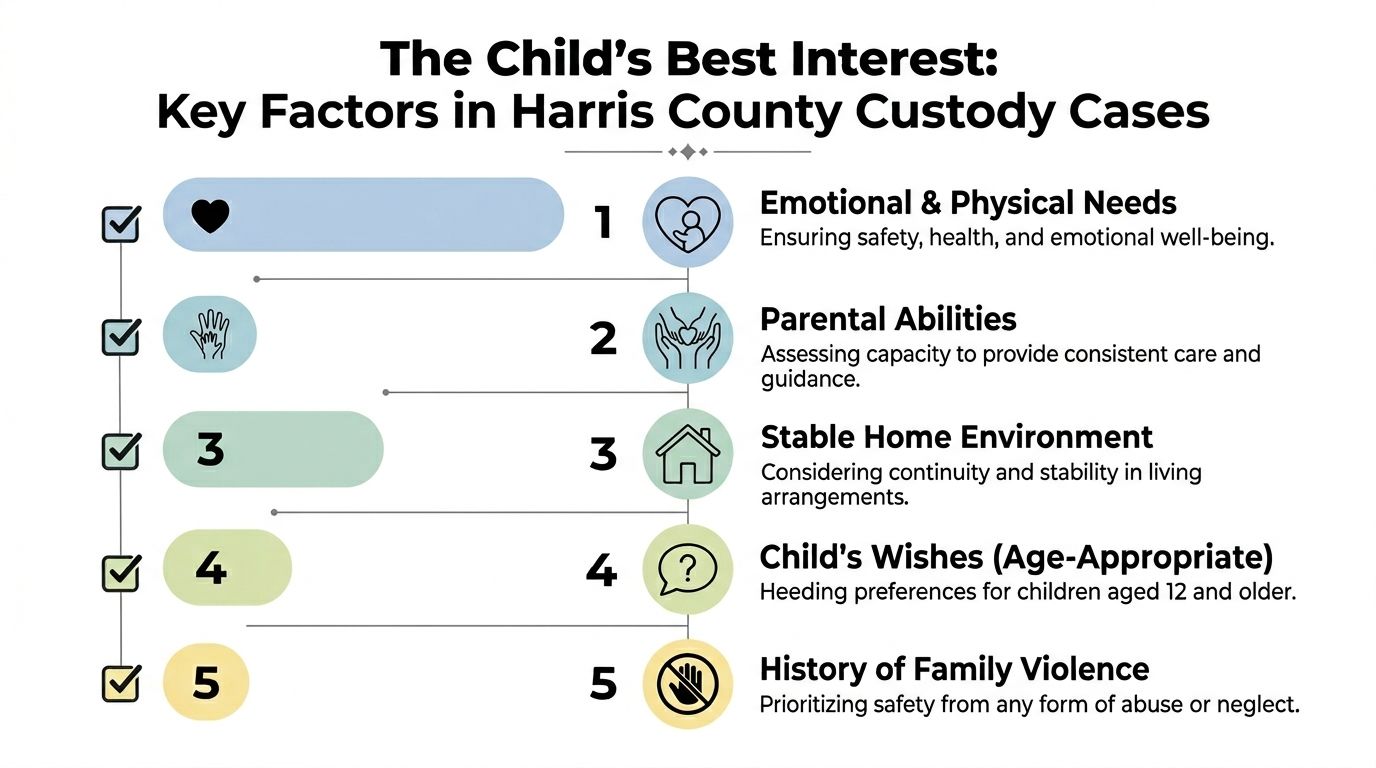
Under Texas Family Code §153.002, Harris County judges focus on the child’s best interest, and joint managing conservatorship is a common outcome in contested cases. Texas law also allows a child’s preference to be heard when the child is over 12, as noted in this Avvo summary for Humble child custody matters.
What judges look at
A judge at the Harris County courthouse is not grading which parent is more charming or more upset. The court is looking for evidence tied to a child’s daily life.
Common factors include:
Emotional and physical needs
Who meets them consistently? Think meals, medication, school support, bedtime routines, and emotional steadiness.Parental abilities
Can each parent provide guidance, structure, and follow-through?Home stability
A stable environment often matters more than dramatic promises about what a parent plans to do later.Past caregiving roles
Judges often look closely at who handled the child’s ordinary life before the separation.Safety concerns
Family violence, abuse, neglect, or serious instability can reshape the entire case.
A helpful practical resource on building evidence around these issues is this page on how to prove best interest of child.
What this looks like in real life
Take two parents in Northeast Houston.
One parent has historically managed school drop-off, teacher communication, pediatric appointments, and homework routines. The other parent loves the child but has traveled often and has not handled daily care as consistently. A judge may consider that history important, not to reward one parent, but to preserve continuity for the child.
Now change one fact. The parent with the stronger day-to-day history is also creating chaos by refusing communication, missing exchanges, or exposing the child to unsafe situations. That changes the analysis. The court’s job is not to preserve a parent’s preferred narrative. It is to protect the child’s real-world wellbeing.
Child preference is not the same as child control
Parents often ask whether a teenager gets to choose.
Not exactly.
A child who is over 12 may be heard by the court, but that does not mean the child gets final authority. Judges weigh the child’s wishes alongside maturity, reasons for the preference, family dynamics, and the child’s overall welfare.
A child’s voice matters. It is one factor, not the whole case.
Useful evidence and weak evidence
A judge usually finds some forms of proof more helpful than others.
| More helpful | Less helpful |
|---|---|
| School records | Angry social media posts |
| Medical records | General accusations with no detail |
| Calendar history of caregiving | “Everyone knows” statements |
| Neutral witness observations | Long emotional texts with insults |
| Photos or logs tied to dates | Vague claims with no timeline |
The strongest custody presentations are specific. They connect facts to the child’s needs.
If your position is “I should be primary because I’m the better parent,” that is too abstract. If your position is “I have handled school attendance, therapy appointments, and daily routines, and here are the records,” that gives the court something concrete to evaluate.
Navigating the Harris County Custody Process A Step-By-Step Guide
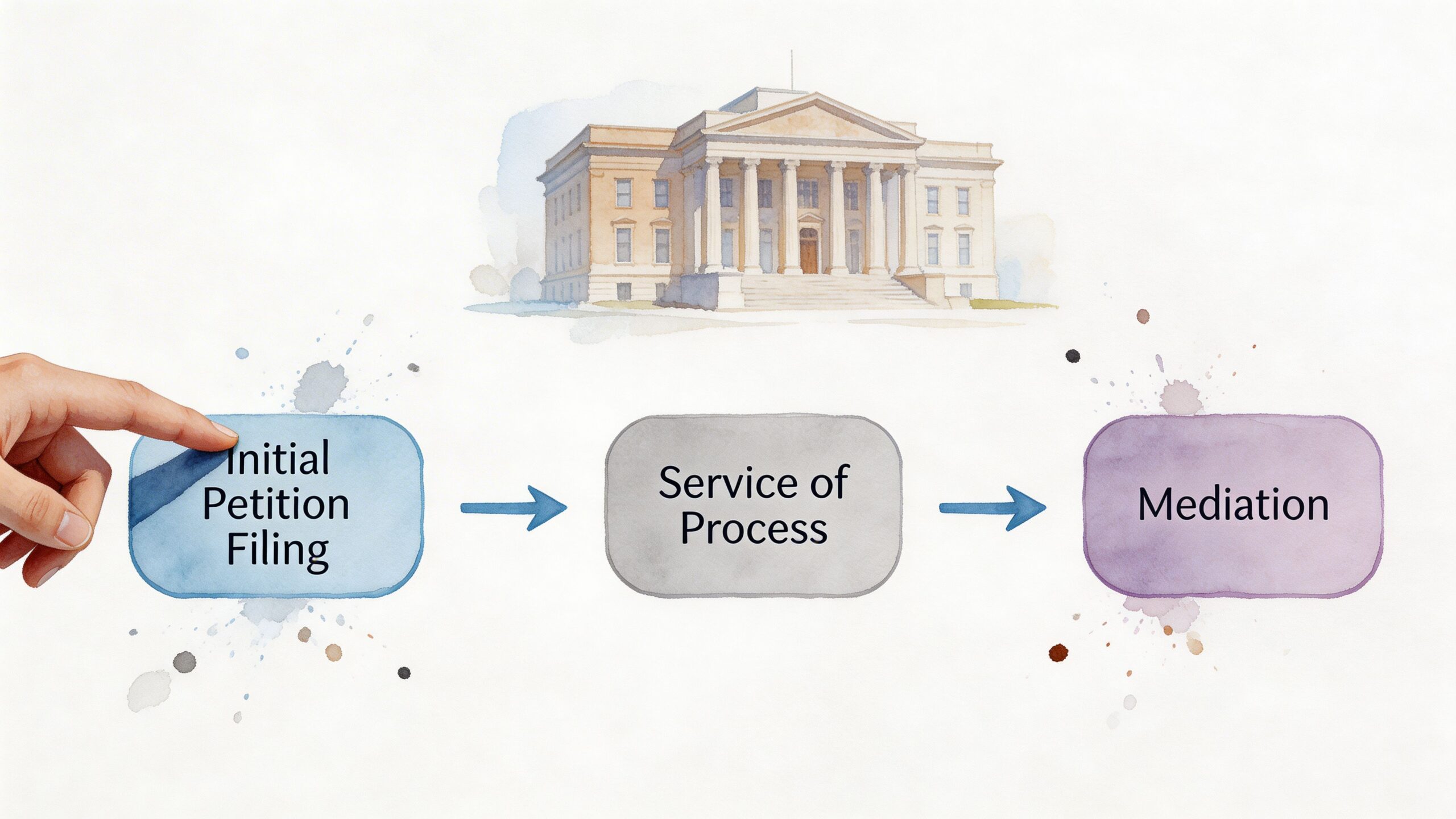
The Harris County custody process feels less overwhelming when you break it into stages. Most families do not walk into court and immediately get a final answer. The case usually unfolds through a series of steps, each with its own purpose.
Step one starts the case
A parent files the initial petition. In some situations, the custody issue is part of a divorce. In others, it is a separate case involving unmarried parents or a request to change an existing order.
The filing tells the court what you are asking for. That may include conservatorship, possession, child support, or temporary relief.
At this stage, details matter. If the request is too vague, the other side may fill in the blanks in a way that does not help you.
Step two is service and the first response
After filing, the other parent must receive formal notice unless service is waived properly. This is often called service of process.
People sometimes take this personally, but it is the legal way the court confirms everyone knows a case has been filed. The responding parent then has the chance to file an answer and, if needed, make requests of their own.
Temporary orders often shape the tone of the case
Temporary orders can cover where the child stays, who pays what, how exchanges happen, and who makes certain decisions while the case is pending.
For many families in Humble or Kingwood, this is the first major turning point. Temporary orders can create patterns that last for months while the case moves forward.
Three practical habits help here:
- Bring a clean timeline: List major dates, school concerns, medical issues, and caregiving history.
- Keep communications organized: Screenshots with dates are more useful than summaries from memory.
- Stay child-focused: Courts respond better to facts tied to the child than to personal attacks about the other parent.
If a temporary hearing is approaching, prepare as if it matters long-term. In many cases, it does.
Discovery is where facts replace assumptions
Discovery is the evidence-gathering phase. Parents exchange information, documents, and written responses. In some cases, that may also include records from schools, medical providers, or other relevant sources.
At this stage, many people realize the court process is not driven by who is louder. It is driven by what can be shown.
A parent may feel certain the other side is hiding income, understating debt, or asking for an unrealistic support arrangement. Harris County courts pay close attention to financial transparency. A 2025 Harris County judicial priority is full financial disclosure, with judges scrutinizing realistic support requests based on income and self-sufficiency, in a country where 40 to 50% of marriages end in divorce, according to this State Bar of Texas archive discussing Harris County judicial priorities.
That matters even in custody-heavy cases because financial issues often sit right beside parenting disputes.
Mediation resolves many disputes
Before trial, many families go to mediation. This is a structured negotiation process where a neutral mediator works with both sides to see whether an agreement can be reached.
Mediation is not group therapy. It is not a place where the mediator decides who is right. It is a negotiation setting, usually with each side in separate rooms while the mediator carries proposals back and forth.
Parents often do better in mediation when they come prepared with:
- their ideal parenting schedule
- a backup position they can live with
- a list of critical safety concerns
- documents that support practical requests
Here is a short video that walks through custody issues many Texas parents face during this stage.
If no agreement happens, the case can go to trial
Trial is where each side presents testimony, records, and legal arguments to the judge. Witness preparation becomes important. So does document organization.
Most parents are surprised by how much trial depends on simple consistency. A parent who says one thing in texts, another thing in pleadings, and a third thing on the stand can lose credibility fast.
A practical roadmap for local parents
| Stage | What you should do |
|---|---|
| Filing | Define what you want and why |
| Response | Read everything carefully and do not ignore deadlines |
| Temporary orders | Gather school, medical, and parenting records |
| Discovery | Be thorough, accurate, and organized |
| Mediation | Know your goals and your fallback position |
| Trial | Focus on facts, not frustration |
For parents in Atascocita, Humble, Kingwood, and Northeast Houston, the process gets easier when you stop viewing it as one giant crisis and start treating it as a series of decisions. Each stage gives you a chance to strengthen your position and protect your child’s stability.
Handling High-Conflict and Special Custody Cases
Some custody cases do not fit the standard pattern. The legal issues are deeper, the emotions are sharper, and the child’s safety may depend on a more careful approach.
That often happens when a case involves substance abuse, untreated mental health concerns, family violence, or serious manipulation between households.
When standard advice is not enough
In these cases, broad statements like “co-parent better” may be unrealistic or even unsafe.
The challenge is not just proving that conflict exists. The challenge is showing the court how that conflict affects the child. Missed medication. Unsafe supervision. Exposure to threatening behavior. School disruption. A parent whose condition changes from week to week.
A reviewed local resource notes that high-conflict custody cases involving substance abuse or mental health disorders require a specialized, multidisciplinary approach, and that many general custody lawyers do not address trauma-informed practice or coordination with healthcare professionals, as described in this Super Lawyers Humble custody and visitation resource.
Building a safer case
A strong high-conflict case usually involves more than legal paperwork. It may require coordinated input from therapists, counselors, doctors, school staff, or other professionals with firsthand knowledge.
That does not mean every case needs a parade of experts. It means the legal strategy should match the risk.
Helpful forms of support can include:
- Therapeutic records: When legally available and relevant, they can help explain how a child is responding to instability.
- Professional observations: Teachers, counselors, and medical providers sometimes document patterns parents overlook.
- Detailed parenting logs: Dates, times, missed exchanges, and safety concerns matter more than general complaints.
In a high-conflict case, judges need clear evidence tied to the child’s welfare. They do not need a running scorecard of who was more insulting over text.
Trauma and the child’s behavior
Children under stress do not always say, “I feel unsafe.” Sometimes they act it out through shutdowns, anger, sleep trouble, clinginess, or school problems.
Parents trying to understand those patterns may find it useful to read about developmental trauma, especially when a child has lived with chronic instability, fear, or inconsistent care. It is not a legal source, but it can help families describe what they are seeing in plain language before they speak with a lawyer or therapist.
Special family structures deserve real attention
Many online custody guides ignore non-traditional arrangements. Real families in Humble do not.
Grandparents may be raising grandchildren. A relative may have stepped in during a parent’s incarceration or health crisis. A blended family may need a practical order that reflects who has provided care.
These cases often raise questions about standing, guardianship, and how courts balance a biological parent’s rights against a child’s need for stability. They require careful analysis because the emotional history is usually layered, and the legal path is not always obvious.
If your case feels “outside the usual,” that does not mean the court cannot address it. It means the facts need to be organized thoughtfully, with the child’s safety and continuity at the center.
How a Dedicated Humble Custody Lawyer Protects Your Family
A parent in Humble gets a late-night text. The other parent wants to change the weekend schedule again, threatens to keep the child longer, and says, “My lawyer says I can.” In that moment, custody law stops feeling like paperwork and starts feeling personal.
That is when legal help matters most. A custody lawyer helps you slow the situation down, sort out what matters, and respond in a way that protects your child instead of feeding the conflict.

What a lawyer does in a custody case
A good custody lawyer fills several jobs at once.
First, your lawyer is a guide for decision-making. Custody disputes often feel like a flood of accusations, screenshots, and urgent choices. A lawyer helps separate what feels upsetting from what a Harris County judge is likely to care about.
Your lawyer also drafts orders with clear language. That may sound technical, but it affects daily life. A sloppy holiday schedule or a vague exchange term can create the same argument over and over, like a door that never quite latches.
A lawyer can also serve as a buffer. Instead of every disagreement turning into another heated text exchange, communication can become more focused, documented, and tied to the actual legal issues.
Local representation matters in practical ways
Parents often search for a harris county custody lawyer humble because local experience can make the process less confusing. The path through Harris County is not just about knowing Texas law. It is about understanding how to move a case forward while balancing school pickup in Atascocita, work commutes from Kingwood, and the practical realities of family life in this part of the county.
That local perspective helps in concrete ways:
- Organizing useful evidence: School records, attendance issues, medical notes, calendars, and communication logs are more helpful when they are arranged in a way the court can quickly follow.
- Testing proposed parenting plans: Some schedules sound fair on paper but fall apart in real life, especially if they disrupt school routines or create stressful exchanges across different parts of Harris County.
- Preparing for mediation and hearings: Clear requests usually lead to better discussions. If you know what you are asking for and why it helps the child, you are in a stronger position.
- Catching local process issues early: Small procedural mistakes can cause delay, extra expense, or unnecessary stress.
If you are comparing legal options, families often review a firm’s pages on child custody matters and related divorce services before scheduling a meeting. The Law Office of Bryan Fagan handles custody and family law matters for clients in the Humble area.
What to bring to a consultation
The first meeting does not require a perfect binder or a polished story. Bring enough to help your lawyer see the shape of the problem.
Start with these basics:
- Existing court orders, if any
- A short timeline of the relationship, separation, and major parenting events
- School or medical records tied to the dispute
- Screenshots or printed messages showing specific problems
- A list of questions, so stress does not cause you to forget them
If your case involves a child with special needs, a parent living with a new partner, substance use concerns, or a grandparent who has taken on daily care, say so early. Those details can change strategy from the start.
You do not need a perfect case file before speaking with a lawyer. You need enough information for an honest conversation about what is happening, what the court may do, and how to protect stability for your child.
Custody cases affect bedtimes, school mornings, holidays, and peace in your home. Good legal guidance helps you choose your next steps with more clarity and less fear.
Frequently Asked Questions From Our Humble Neighbors
Can my teenager decide who to live with
Not fully. In Texas, a child over 12 may be heard by the court about preference, but the judge still decides based on the child’s overall best interest. A teenager’s view matters, especially when it is thoughtful and grounded in real concerns, but it is not the only factor.
What happens if the other parent violates the court order
Start by documenting the violation carefully. Save dates, messages, missed exchanges, and related costs or disruptions. Enforcement may be available, but the strength of that request often depends on how clear the order is and how well the violation is documented.
Can grandparents get custody in Texas
Sometimes, yes. These cases are more complicated than many families expect. There is a real gap in public guidance on grandparent custody rights and kinship guardianship in Harris County, even though these are growing concerns and Texas Family Code includes provisions related to grandparent standing, as noted in this discussion of child custody and grandparent rights issues. If a grandparent, aunt, uncle, or other relative has been acting as the child’s day-to-day caregiver, the legal path may depend on the family’s history and current safety concerns.
What if my case involves addiction or mental health issues
Those cases often need more than a standard parenting schedule. The court may need focused evidence about treatment, stability, supervision, and the child’s wellbeing. Early legal advice is important because the wording of temporary orders can make a major difference.
I live in Humble but my case connects to Kingwood or Atascocita. Does that matter
It can matter for logistics, school planning, exchanges, and the evidence you present about the child’s routine. The more your proposed order fits the child’s real daily life, the more useful it becomes.
If you are facing a custody dispute in Humble, Atascocita, Kingwood, or Northeast Houston, a conversation with a local attorney can bring order to a very stressful moment. Law Office of Bryan Fagan offers free consultations for families who need clear guidance on custody, conservatorship, visitation, and related family law issues in Harris County.