Skip to content

You may be dealing with a problem that did not exist last week.
A spouse mentions divorce. A child’s other parent changes the pickup routine without warning. A police officer makes an arrest after a traffic stop. A parent asks you who will handle things if something happens to them and they still do not have a will.
So you open Google. You type in a few words. Then the confusion starts.
One law firm looks polished but feels far away. Another says it serves all of Houston, but gives you no sense that it understands Humble, Atascocita, Kingwood, or the day-to-day reality of families in Northeast Houston. A third site tells you almost nothing about local court procedure, local concerns, or what you should do next.
That gap matters. Legal problems are personal. People do not just need a licensed attorney. They need someone they can trust, someone who understands local courts, and someone whose online presence reflects ties to the community. This builds authority and local relevance. It also makes it easier for a neighbor in need to find dependable legal help instead of getting lost in a sea of generic websites.
Why Finding Trusted Local Legal Help in Humble Feels Harder Than Ever
Maria lives near Atascocita. She is not looking for a lawyer because she wants to. She is looking because she has to.
Her child’s school week has become a tug-of-war between households. She needs answers about custody, and she needs them fast. She searches online and gets pages of results. Some firms seem enormous. Some have addresses she does not recognize. Some sites feel so vague that she cannot tell whether they handle Harris County family court matters at all.
That experience is common. When people search for help during stress, they often cannot tell the difference between a firm that serves local residents and a firm that bought online visibility. The result is hesitation. People delay calls. They keep reading. They second-guess themselves.
The trust problem online
In person, trust forms naturally. You hear a name from a neighbor. You see that attorney involved in the community. You learn they have helped someone in Kingwood with probate, or defended a DWI case for a Humble resident, or guided a family through divorce in Harris County.
Online, those signals are harder to read.
A website can look professional without being helpful. A long list of services can still feel empty if it does not answer local questions like what happens in Harris County family court, what a first court setting may involve, or how a Humble family should prepare records for a custody dispute. That is why plain, local education matters, including resources about Harris County family court in Humble.
Why access is part of the issue
The challenge is not only digital confusion. It is also access.
While many areas lack adequate access to essential services, this is especially true for legal services in economically distressed neighborhoods. Community engagement efforts show that residents participate when they are given accessible entry points, and that same principle applies to legal access, as discussed in this overview of underserved communities from CU Collaborate.
That matters in Humble and across Northeast Houston. Some families worry they cannot afford to ask a question. Others are unsure whether their issue is serious enough. Some may face language barriers or may not know where to begin.
Good legal information should lower barriers, not raise them.
When a law firm creates clear local content, keeps its public information accurate, and speaks to concerns in Humble neighborhoods, it does more than market itself. It becomes easier to find, easier to evaluate, and easier to trust. This exemplifies the practical meaning behind building authority and local relevance.
What Authority and Relevance Means for Your Family's Legal Needs
If the phrase authority and local relevance sounds technical, consider how you would choose a roofer after a storm.
You would not hire someone just because they have a website. You would want to know two things. First, do they work on homes like yours in your area. Second, do other people trust them.
That same logic applies when choosing legal help.
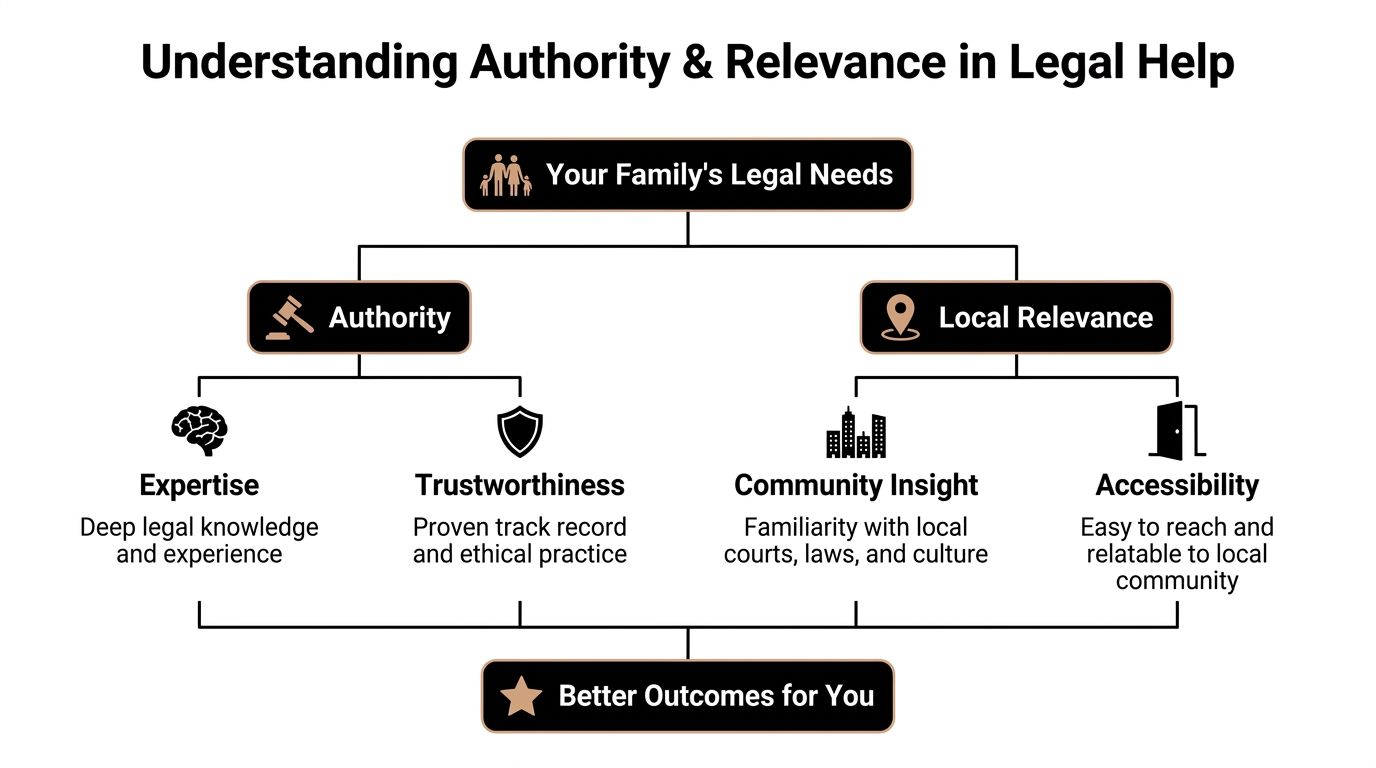
Relevance means the fit is clear
Relevance answers a simple question. Does this attorney appear to handle the issue you have, in the place where you live?
For a family law matter, that could mean content that addresses divorce, child custody, child support, and property division under Texas law, with attention to how cases move through Harris County. For criminal defense, it could mean practical guidance after an arrest in Humble, including what to do before speaking further with law enforcement. For estate planning, it could mean explaining wills, trusts, probate, and how local families can prepare documents before a crisis happens.
A relevant law firm does not make you guess.
It should be obvious from the website that the attorney serves Humble, Atascacita, Kingwood, and Northeast Houston. It should also be obvious that the firm handles your type of matter. If you are not sure how to evaluate that fit, a guide on how to choose a family law attorney can help you compare local options more thoughtfully.
Authority means trust has been earned
Authority is reputation made visible.
Offline, authority looks like community respect. It sounds like a neighbor saying, “They explained things clearly.” It grows when people have experiences with a lawyer and share those experiences.
Online, authority shows up through signs that support credibility:
- Clear educational content that answers questions instead of hiding behind vague slogans.
- Public reviews that help people understand how others felt during difficult legal matters.
- Consistent local presence across maps, directories, and community mentions.
- Community recognition through local organizations, events, or partnerships.
Why both matter together
A lawyer can be authoritative but not relevant to your problem.
A lawyer can also be relevant on paper but not inspire trust.
You need both. If your family is facing a custody dispute, criminal charge, or probate issue, you want someone whose experience fits the problem and whose reputation gives you confidence. That combination helps you move from fear to action.
Here is a simple way to consider this:
| What you need | What it looks like |
|---|---|
| A clear fit | The attorney handles your type of case in your local area |
| A trustworthy reputation | People and organizations in the community know the firm |
| Useful guidance | The website answers practical questions in plain language |
| Easy access | You can quickly find contact details, office information, and next steps |
When an attorney’s online presence reflects those traits, the digital experience starts to feel more like asking around in a connected town. You see evidence. You recognize local knowledge. You feel less like you are taking a blind risk.
That is why this builds authority and local relevance.
How Google Connects Humble Families with the Right Attorney
Many people never think about how local search works until they need it.
They type “family law attorney Humble,” “DWI lawyer near me,” or “probate attorney Kingwood,” and expect Google to sort things out. Google does try to do that, but it does not make decisions randomly.
It looks for signals that suggest a business is both nearby and reliable.
The three ideas behind local search
Google’s local search system is built around relevance, proximity, and prominence, according to this explanation of local search ranking factors.
Each part plays a different role.
Relevance asks whether the business matches the search. If someone in Humble searches for a family law attorney, Google looks for a strong match between that search and the information on the firm’s website and business profile.
Proximity asks how close the business is to the person searching. Someone in Atascocita may see different map results than someone in downtown Houston, even when both type similar words.
Prominence asks whether the business appears established and trusted. In local search, that trust often comes from reviews, links, mentions, and consistent public information.
Why this matters during stressful moments
Legal searches are often urgent.
A parent may need custody guidance the same day. A family may need probate help soon after a loss. Someone arrested over the weekend may search for defense counsel before the next business day. Local search matters because it helps people narrow options quickly when they do not have time for a deep investigation.
The same local search source notes that 76% of “near me” searchers visit a business within 24 hours, and that reaching 10 verified reviews gives a meaningful ranking boost for prominence in local results. Those details matter because they show how online trust signals can affect whether a local resident even sees a law firm at the moment they need help most.
What Google aims to measure
Google cannot sit in a courtroom and watch how an attorney advises a client.
So it relies on clues.
Consider these three questions:
- Is this law firm about the right topic
- Is it close enough to help the person searching
- Does the community appear to trust it
That third question is where many people get confused. Reviews, local mentions, and links are not cosmetic. They help search platforms decide whether a business looks credible.
When legal information is accurate, local, and easy to verify, families spend less time sorting through noise and more time getting answers.
This is especially important for local legal matters. A criminal defense issue in Humble is not just a general legal issue. A custody case in Harris County is not just a broad family law topic. The details of venue, procedure, and local practice matter.
What families should look for in search results
When you scan local results, look beyond ads and slogans.
Check whether the listing and website show signs of local service:
- Location clarity so you know the firm serves Humble and nearby communities
- Practice fit so the legal issue matches your need
- Local educational content that reflects Texas law and Harris County procedure
- Visible public feedback that helps you judge trust
When those signals line up, Google has an easier job. So do you.
Our Digital Front Door How We Optimize for Humble Residents
A physical law office has a front door, office hours, a sign, and a receptionist who helps people understand where to go.
Online, the same job falls to a set of tools and listings. If those details are incomplete, outdated, or inconsistent, people get frustrated before they ever call. If they are clear and current, families can verify what they need and take the next step with more confidence.
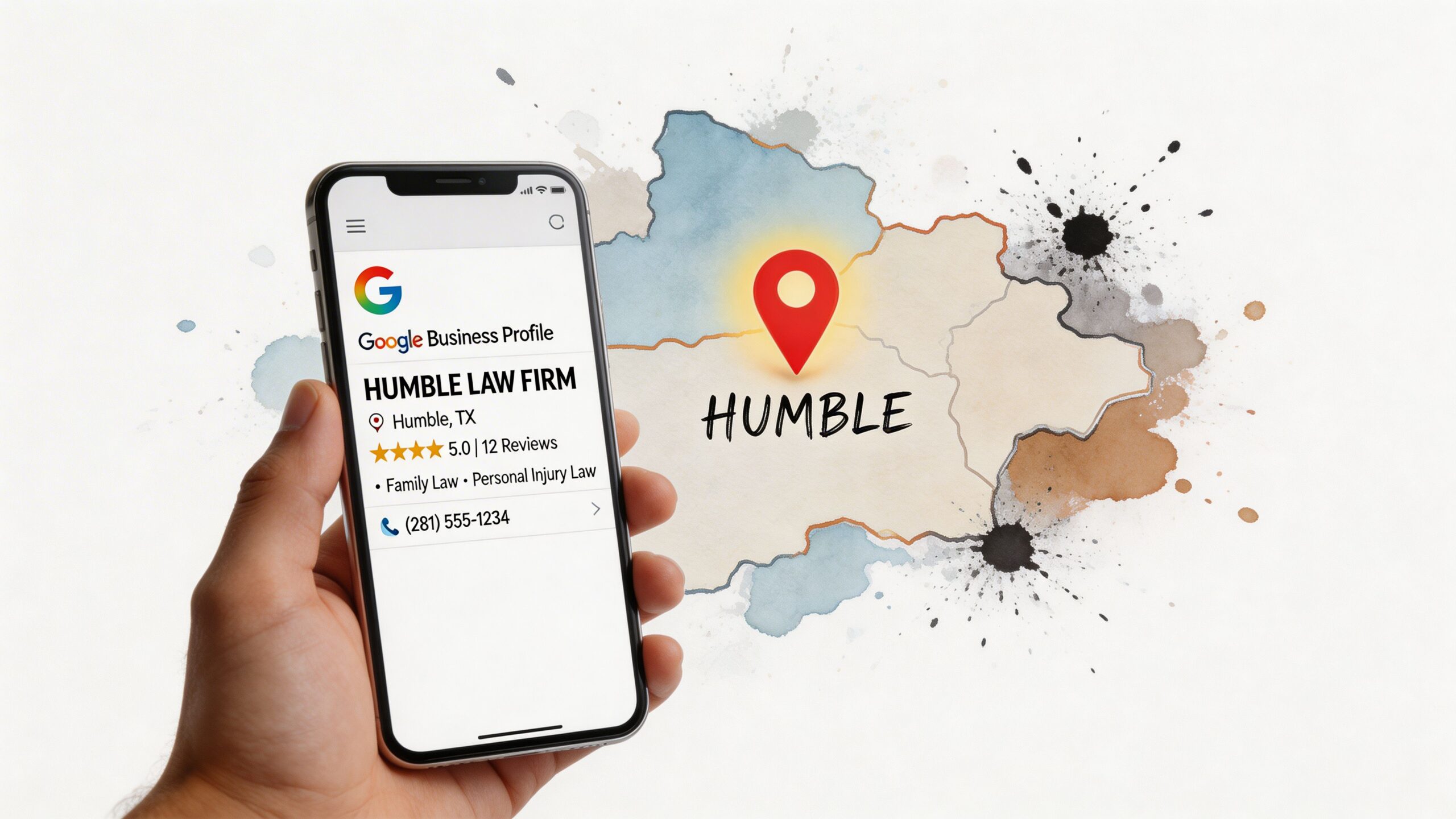
Google Business Profile as the public storefront
A Google Business Profile is often the first thing people see when they search for a lawyer in Humble, Atascocita, or Kingwood. It appears on Google Maps and in local search results.
That listing needs to do basic but important work well.
It should show the correct office location, contact information, hours, practice areas, and photos that help people recognize the business. A parent looking for custody help should not have to wonder whether the office is still open, whether the phone number is current, or whether the firm even handles family law.
A strong profile also helps set expectations. If someone needs help with estate planning or a criminal matter, the listing should make those services easy to identify.
Reviews as public conversation
Reviews are often the first human signal people trust.
Not because every review tells the full story, but because patterns matter. When several people describe clear communication, responsiveness, and professionalism, readers learn something useful. When a firm invites honest feedback, it also shows a willingness to be accountable in public.
People sometimes assume review strategy means chasing praise. It should mean something healthier than that. It should mean making it easy for clients to share their experience, then learning from what they say.
A review profile can help answer questions a website alone cannot:
- Did the attorney explain things clearly
- Did the office treat people with respect
- Did the client feel informed during a difficult process
Citations as the digital version of a correct phone book listing
A citation is a mention of the firm’s name, address, and phone number on another website, directory, or business platform.
That may sound minor, but accuracy matters. If one listing has an old suite number, another has a wrong phone number, and a third uses a different business name format, trust drops. Search engines may also struggle to connect those records confidently.
This is similar to checking that a local business appears correctly in every directory a resident might use.
Here is how each part helps a person:
| Digital asset | What it does for residents |
|---|---|
| Google Business Profile | Helps people confirm location, hours, and services |
| Reviews | Adds real-world feedback and transparency |
| Citations | Confirms that key business details are consistent |
Why careful setup matters
Families dealing with divorce, criminal charges, or probate already have enough uncertainty. They should not have to spend extra energy verifying whether a business is legitimate.
That is why attention to these details matters. They reduce friction. They help people feel safer making contact. They also support the larger goal of local trust online.
For readers who want a broader, non-legal overview of practical listing and profile habits, this guide to Top 10 Local SEO Best Practices offers a helpful outside perspective.
A reliable digital front door does not impress people with jargon. It helps them confirm they are in the right place.
Engaging Our Community in Humble On and Offline
Local relevance is not something a law firm can declare about itself. The community decides whether it is true.
That is why technical setup alone is not enough. A complete local presence grows from participation, listening, and useful education that reflects how people in Humble live.

Local content should answer local questions
Generic legal articles are easy to spot. They use broad language, skip practical detail, and could have been written for any city in Texas.
Helpful local content sounds different.
It answers the questions people in Humble, Atascocita, Kingwood, and Northeast Houston ask. For family law, that might include how property division works in a Harris County divorce, how temporary orders can affect daily parenting routines, or what documents help in a custody dispute. For criminal defense, it may involve what to do after an arrest, how to protect your rights, and why early legal advice matters. For estate planning, it can include how wills, trusts, probate, and powers of attorney fit together for local families.
The point is not to flood a website with pages.
The point is to create guidance that feels grounded, practical, and local.
Diverse communities need culturally informed guidance
In Northeast Houston, one-size-fits-all legal content often misses important realities.
Meaningful engagement requires understanding residents’ lived experiences, and culturally informed educational content can address questions such as how cultural considerations may factor into Harris County custody decisions or what immigrant families in Humble should know about estate planning, as discussed in this guide on engaging underserved families.
That kind of guidance builds authority in a more human way. It shows that legal education is not written for an abstract audience. It is written for families with different histories, languages, concerns, and support systems.
Examples of that approach include content around:
- Affordability concerns for residents who fear even asking a legal question
- Language access for families who are more comfortable gathering information in simpler or more inclusive formats
- Cross-border family issues when probate or inheritance questions involve relatives or assets in more than one country
- Faith and cultural context when custody concerns intersect with family traditions or community expectations
Community presence creates credibility that websites cannot fake
A local law office also earns relevance by showing up offline.
That can mean speaking at community events, supporting local organizations, attending neighborhood gatherings, or participating in business and civic groups that matter in Humble and Kingwood. People notice who is present before a crisis happens. They also remember who took time to teach instead of only trying to sell.
A firm that invests in the area becomes easier to trust online because the digital profile matches what people experience in their community.
The strongest online reputation usually begins offline, in repeated acts of service, visibility, and accountability.
Local backlinks are digital word-of-mouth
One part of local authority often sounds technical but is easy to understand.
When a trusted local organization mentions a law firm on its website and links to that firm, it acts like a public recommendation. Search engines treat those links as signs that the business is connected to the community it says it serves.
Local SEO analyses place quality or authority of inbound links at 148 points and links from locally relevant domains at 137 points, which shows how strongly search systems value trustworthy local connections, as summarized in these local SEO statistics from Backlinko.
In plain language, a mention from a Humble community organization, local news outlet, or neighborhood association can say more about local trust than a generic mention from a broad directory.
What authentic engagement looks like
A resident should be able to see a pattern.
Not a polished claim, but a pattern.
- Useful content that addresses local legal concerns
- Visible community involvement that shows the office is invested in Humble and Northeast Houston
- Recognition from local organizations that confirms ties
- Educational language that includes people who often feel overlooked
That is how local relevance becomes believable. Not because a website says it is local, but because the evidence keeps pointing back to the same conclusion.
Measuring Our Commitment to the Humble Community
A local digital strategy should do more than attract attention. It should help the right people find the right information at the right time.
That requires measurement, but not the shallow kind. Raw traffic alone does not tell you whether a parent understood the next step in a custody matter or whether a family in Kingwood found probate guidance that reduced confusion.
Schema markup helps search engines understand the facts
One useful tool behind the scenes is schema markup.
Schema is a structured way of labeling information on a website so search engines can understand it more clearly. For a local law office, that may help identify the business as a law firm in Humble, connect practice areas to the site, and clarify important public details.
A simple analogy helps. If a website is a conversation, schema is the typed name tag that prevents misunderstandings.
Without it, a search engine has to infer more. With it, the platform gets stronger hints about what the business is, where it is located, and what kind of services it offers. That supports accuracy, especially in local search where small details matter.
Good measurement focuses on signs of help
Some metrics matter more than others.
A spike in visits means little if the wrong audience is arriving. What matters more is whether local residents are finding useful answers and taking sensible next steps.
That might include questions like these:
- Are people calling the Humble office after viewing local service pages
- Are readers spending time on pages that explain Harris County divorce, custody, criminal defense, or probate concerns
- Are visitors finding directions, office hours, and contact details without friction
- Are consultation requests coming from the communities the firm intends to serve, including Humble, Atascocita, and Kingwood
Those signals say more about community service than vanity metrics do.
Legal education should reduce uncertainty
This is especially important in law because people often arrive online at vulnerable moments.
A family under strain may need plain-language guidance on divorce or custody. Someone accused of a crime may need immediate direction about protecting their rights. An adult child handling a parent’s estate may need help understanding what probate involves in Texas. In each case, success begins before representation. It begins when the person can quickly tell, “This information applies to me, and this office appears prepared to help.”
That is why the earlier ideas all connect. Accurate listings make the office easier to verify. Community engagement makes trust more believable. Local content helps people recognize their issue. Schema helps search engines understand what the site already knows about itself.
The best local legal marketing is not just visible. It is understandable, accurate, and useful.
When those elements work together, the online experience starts to reflect what people want from a neighborhood attorney. Clear answers. Local understanding. A reasonable path forward.
Your Next Step Toward Peace of Mind
If you are dealing with divorce, a child custody dispute, criminal charges, or estate planning decisions, you already have enough on your mind. Finding a lawyer should not feel like another obstacle course.
A trustworthy local legal presence helps solve that problem. It gives you a way to verify who serves Humble, who understands Harris County practice, and who has taken the time to become visible and accessible in the community. That is why this builds authority and local relevance. It is not just a marketing phrase. It is a way of making legal help easier to find and easier to trust.
What to do before you hire anyone
You do not need to rush blindly. You do need a short, calm plan.
Try this:
- Match the issue to the lawyer. If your problem involves custody, divorce, probate, wills, or criminal defense, confirm that the attorney clearly handles that area.
- Look for local signs. Check whether the office speaks directly to Humble, Atascocita, Kingwood, and Northeast Houston rather than only using broad regional language.
- Read for clarity. Useful legal content should help you understand Texas law and local procedure in plain English.
- Make contact. A consultation is often the fastest way to tell whether the attorney listens well and communicates clearly.
A consultation should feel like a first step, not a sales pitch
Many people wait too long because they worry they need every document, every answer, and every detail before they call.
Usually, they do not.
They need a starting point. They need someone who can listen, identify the legal issue, and explain the next steps in a way that makes sense. If your matter involves family law, this overview of Harris County family law attorneys may help you begin framing the questions you want to ask.
For readers interested in the business side of accountability, this outside guide on how to measure marketing effectiveness is a useful reminder that good outreach should be judged by whether it creates meaningful results, not just visibility.
If you are in Humble, Atascocita, Kingwood, or elsewhere in Northeast Houston, the right next step is often the simplest one. Ask your questions. Get grounded advice. Find out whether the fit feels right for your family and your situation.
You do not need to solve everything today.
You only need to begin in the right place.
If you need guidance from a local team that serves Humble families with care and clarity, schedule a free consultation with the Law Office of Bryan Fagan. Whether you are facing divorce, custody issues, criminal charges, or estate planning concerns, the conversation can help you understand your options and take the next step with more confidence.