Skip to content

Some people reach this point.
You may be sitting at your kitchen table in Humble after the kids are asleep, scrolling through your phone and wondering whether filing for divorce will make everything worse before it gets better. You may live in Atascocita and be worried about the mortgage, or in Kingwood and unsure how parenting schedules will work if you and your spouse stop living under the same roof. For many people, the hardest part is not the paperwork. It’s deciding that the marriage is over and asking what comes next.
That question deserves a straight answer.
Starting a divorce in Humble, Texas, isn’t about filing a form. It’s about making careful first moves that protect your finances, your time with your children, and your peace of mind. In Harris County, small mistakes at the beginning can create avoidable delays later. That’s especially true when people try to handle filing, service, and early court requests without understanding the local process.
Families in Northeast Houston often need two things at once. They need compassion, and they need a plan. Both matter. A good plan keeps the case moving. Compassion helps you make sound decisions while your emotions are running high.
Navigating a New Beginning with Support and Dignity
A divorce usually starts long before anyone files anything.
It starts when conversations stop going anywhere. When one spouse sleeps in the guest room. When bills are still being paid, but trust is gone. In Humble, Kingwood, and Atascocita, I’ve seen people come in carrying the same mix of emotions: grief, relief, fear, anger, and sometimes guilt for feeling relieved at all.
All of that is normal.
Many people also feel embarrassed that they don’t know how the process works. They’ll say they’ve searched online, read a few generic articles, and still don’t know what to do first. That’s common because most divorce guides stay at a surface level. They tell you to file and wait, but they don’t explain what happens if you need access to money right away, what to do if your spouse controls the accounts, or how Harris County’s digital filing system affects the first days of the case.
A strong start in a divorce case usually looks calm from the outside. That’s because the person filing already knows the next two or three steps.
If you’re overwhelmed by the idea of calling a law office, even the first contact can feel like a lot. Some firms use trained support staff or an intake specialist to gather the basic facts before an attorney meeting, which can make that first conversation easier when you’re stressed and not sure how to tell your story.
What people in Humble usually need first
The first need is clarity.
You need to know whether you can file in Harris County now, what documents the court expects, and whether your situation calls for immediate court orders. If children, a house, or shared accounts are involved, waiting too long to get organized can create pressure that affects your negotiating position.
The second need is stability.
That can mean making sure there’s a plan for who stays in the home, who covers routine bills, and how the children will move between households. People often assume they must endure the uncertainty until the divorce is final. That’s not how these cases have to work.
A practical mindset helps
Start by thinking in days, not months.
You don’t need to solve the whole divorce this week. You do need to make smart decisions about filing, service, finances, and immediate family routines. That’s the difference between reacting to the case and guiding it.
If you’re searching for how to start a divorce in humble texas, the right answer isn’t just “fill out forms.” It’s “make sure your first filing matches your real priorities.”
The First Step Meeting Texas Residency Requirements
Before you prepare papers, confirm that Harris County is the right place to file.
Texas has residency rules for divorce, and they’re not optional. In Harris County, Texas, including Humble, one spouse must have lived in Texas for 6 months and in Harris County for 90 days before filing the Original Petition for Divorce. Filing also involves a court cost of approximately $300 to $400, according to this Harris County divorce filing overview.

What those residency rules mean in real life
The rule sounds simple, but it creates confusion.
If you recently moved to Humble from another county, or moved from another state into Kingwood or Atascocita, timing matters. The court looks at where you lived before the case was filed, not where you plan to live soon. If the residency requirement isn’t met, the court can’t properly move forward with your divorce in Harris County.
That’s why I tell people to check dates first.
Don’t spend energy drafting forms, paying filing fees, or serving your spouse until you know the filing county is correct. If there’s any move history in the last several months, it’s worth slowing down and confirming the timeline before you act.
The petition that starts the case
The first formal document is the Original Petition for Divorce.
That document opens the case and tells the court basic information about the marriage and the relief being requested. Depending on your circumstances, it may address the grounds for divorce, identify whether children are involved, and begin framing issues involving property, debts, or immediate concerns that may need court attention.
A petition isn’t supposed to tell your whole life story.
It should be accurate, strategic, and consistent with what you may later ask the court to do. When people rush this step, they often create cleanup work later.
Practical rule: If your situation involves children, a house, retirement benefits, separate property claims, or urgent safety concerns, treat the petition as a legal roadmap, not just a form.
If the filing fee is a problem
Some people delay filing because money is tight.
That’s understandable. Divorce often begins during financial strain. If paying the court cost isn’t realistic, Texas procedure allows some filers to request relief through a Statement of Inability to Afford Court Costs. That option can be important for people trying to leave a difficult situation without immediate access to cash.
A short delay to organize finances may make sense. An open-ended delay usually doesn’t.
A simple pre-filing checklist
Use this as your starting point:
- Confirm residency dates: Make sure at least one spouse meets the Texas and Harris County residency periods before filing.
- Identify the right court location: Humble residents typically file in Harris County district court.
- Budget for filing costs: Plan for the basic filing expense unless you’ll pursue a fee waiver.
- Gather core information: Marriage date, separation facts, children’s information, property lists, and debt details all help.
- Review a local guide: This page on how to file for divorce in Humble, Texas is a useful next read if you’re checking whether your case is ready for filing.
If you meet the residency rules, you’ve cleared the first gate. That matters because everything else in the divorce depends on starting in the right court, at the right time, with the right paperwork.
How to File Your Divorce Petition in Harris County
Once residency is confirmed, the next challenge is filing correctly.
For many people in Humble, the process starts to feel less personal and more bureaucratic at this point. That’s usually when frustration kicks in. You know your marriage is ending, but the court system wants file formats, service details, and procedural accuracy.

Harris County requires e-filing through eFileTexas.gov, and this is one of the most common stumbling blocks for self-represented filers. According to this discussion of Harris County e-filing issues, pro se divorce default rates rose 12% in Harris County last year due to e-filing errors, and 70% of e-filers hire counsel after a rejection. That doesn’t mean every filing problem is catastrophic. It does mean the court’s digital process is less forgiving than many people expect.
Step one begins before you upload anything
Draft the petition carefully.
People often get themselves into trouble by using a generic form that doesn’t match the situation of the case. A straightforward divorce with no children is one thing. A divorce involving parenting issues, disputed property, business records, or immediate support needs is something else.
Before filing, make sure you know:
- What type of case you’re filing: Children and property issues change what should appear in your paperwork.
- What immediate relief you may need: Some situations call for additional requests early in the case.
- How you want your spouse served: Service choices affect cost, speed, and cooperation.
The e-filing process in plain English
You’ll generally create an account, upload the petition, select the right filing category, and pay the court costs through the platform.
That sounds easy until the system rejects a filing for a technical reason. The issue may be a wrong category, an incomplete party name, a formatting problem, or a mismatch between the document and the selected case type. People often assume “submitted” means “accepted.” Those aren’t the same thing.
If the filing is rejected, don’t panic. Fix the problem quickly and refile correctly.
The clerk’s system processes documents. It doesn’t coach you through strategy. That’s why a filing can be technically uploaded and still create legal problems later.
For local procedural help, this guide on filing for divorce in Harris County from Humble can help you understand how these county-specific steps fit together.
Service of process is not a minor detail
After filing, your spouse must be formally notified.
That’s called service of process, and its importance is often underestimated. If service is mishandled, the case can stall. In some situations, improper service can affect later orders.
Common paths include:
- Personal service by constable or sheriff: This works well when your spouse won’t cooperate or you need a clear record of service.
- Waiver of Service: This can be efficient if your spouse is willing to sign after filing. It often reduces conflict and saves time.
- Digital service in some circumstances: Texas procedure can allow digital service under TRCP 21a(f), but it isn’t a shortcut you should assume applies in every situation.
A waiver can be useful in amicable divorces. It is not a document to sign casually without understanding what has been filed.
Filing strategy matters more than people expect
If your spouse controls the finances, if you expect a custody dispute, or if there’s a risk someone will empty accounts or lock the other out of the home, filing should be coordinated with the next move. Sometimes that next move is service. Sometimes it’s a request for temporary relief.
A rushed filing with no plan creates an advantage for the other side.
An organized filing often creates the opposite.
A brief walkthrough may help if you want to see the process visually before taking action:
What works and what usually doesn’t
Here’s the trade-off in practical terms.
| Approach | What usually works | What often fails |
|---|---|---|
| DIY with a simple case | Careful review, accurate forms, realistic expectations | Assuming the platform will catch legal mistakes |
| Cooperative spouse | Proper waiver after filing, clear communication | Informal notice by text or email alone |
| High-conflict filing | Planned service and immediate follow-up motions | Filing first and hoping the conflict settles itself |
The court process in Harris County is manageable. It’s just not forgiving when the first steps are done casually.
Securing Your Family’s Stability with Temporary Orders
Filing for divorce doesn’t freeze real life.
The mortgage still comes due. Children still need routines. One spouse may keep using joint funds as if nothing changed. Many online guides skip this point, but it matters most for families who need immediate structure.
In Harris County, over 40% of the 15,000+ annual family law cases involve motions for temporary relief, and those requests are made under Texas Family Code §6.501, according to this discussion of temporary relief in Harris County family cases. That tells you something important. Temporary orders aren’t rare. They’re a regular part of divorce practice because families often need rules in place long before a final decree is signed.

What temporary orders can do
Temporary orders create a framework while the case is pending.
Depending on the facts, they can address who stays in the home, who pays which bills, how parenting time will work, and whether one spouse should provide temporary support. They can also reduce the chaos that often follows separation by turning arguments into enforceable court rules.
That matters in Humble families because uncertainty can become its own problem.
If no temporary orders exist, one spouse may believe they can control access to the house, the children, or the bank accounts because they moved faster. Courts don’t like chaos. Temporary orders help replace chaos with structure.
Why waiting can backfire
People sometimes avoid temporary orders because they want to keep things “peaceful.”
Sometimes that works. Often it doesn’t.
If your spouse is cooperative, transparent about money, and reliable with the children, you may not need an early hearing. But if the other side is changing routines without your agreement, withholding money, or making possession of the children unpredictable, waiting usually increases pressure on you and decreases your negotiating position.
Temporary orders don’t mean you’re escalating the divorce. In many cases, you’re stabilizing it.
When to seriously consider asking for them
A request for temporary orders deserves close attention if any of these are happening:
- Money is being restricted: One spouse controls income, cards, or account access.
- The children’s schedule is unstable: Drop-offs, overnights, or school decisions are changing without agreement.
- The home is becoming a battleground: One spouse wants the other out, or exclusive use of the residence is becoming an issue.
- Basic bills are uncertain: Mortgage, rent, utilities, insurance, or car payments are being used as pressure points.
For parents, this topic often overlaps with concerns about child possession and routine. If that’s your focus, this page on temporary custody orders in Texas may help you think through the practical questions before filing a motion.
What the process feels like
A temporary orders hearing is not the final divorce trial.
It’s an early court appearance focused on immediate needs. The court is not trying to divide every asset permanently at that stage. The judge is trying to create workable rules that protect the family while the divorce continues.
That means your preparation should also be focused.
Bring organized financial information. Be specific about the parenting problem. Know what relief you’re asking for. General frustration doesn’t help much in court. Clear requests do.
For many people searching how to start a divorce in humble texas, this is the missing piece. The filing begins the case. Temporary orders often make the case livable.
Uncontested vs Contested Divorce The Two Paths Forward
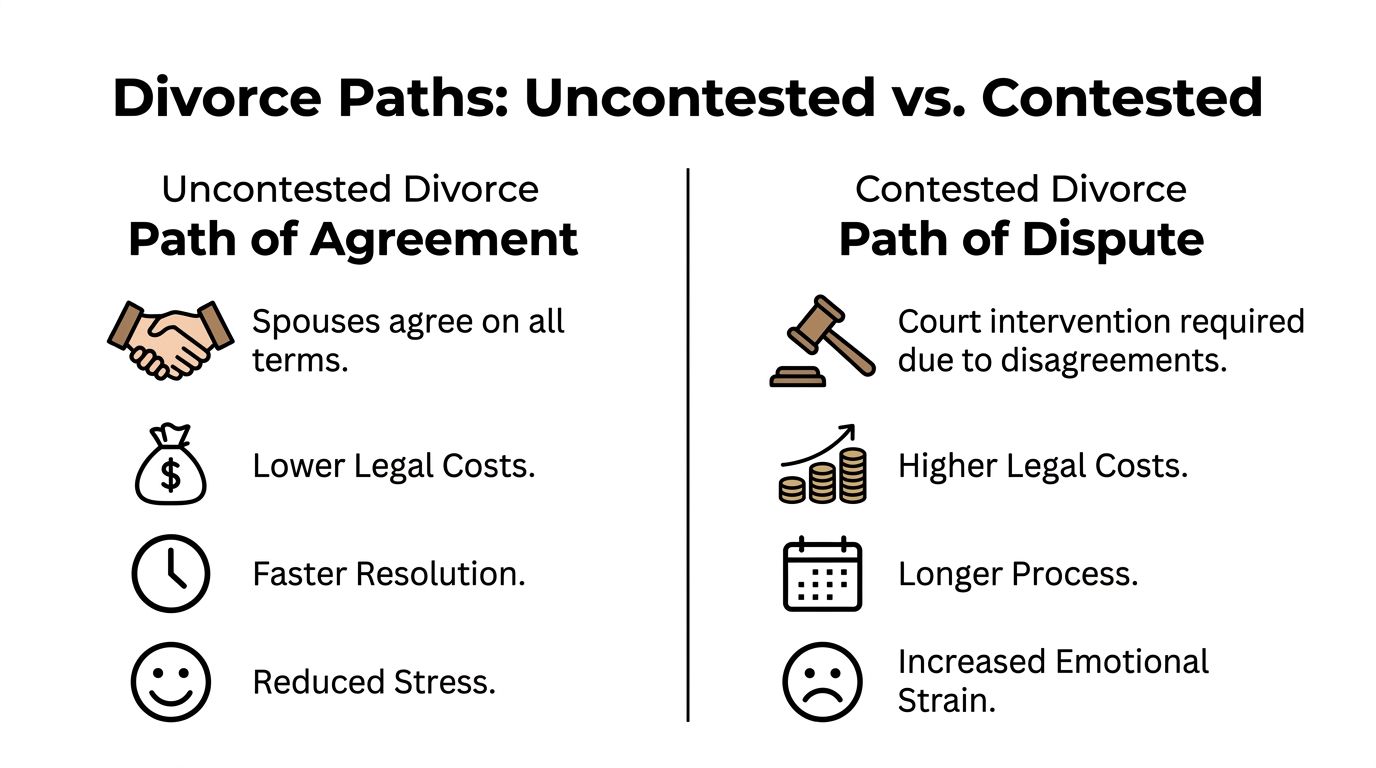
Once the petition is on file and the immediate pressure is under control, the case usually follows one of two paths. It either settles by agreement, or it needs the court’s help to resolve disputes.
That distinction matters in Harris County because the path you are on affects cost, timing, paperwork, and how much court involvement your case will require.
The path of agreement
An uncontested divorce works when both spouses can reach a full agreement on every material issue. That includes property, debts, parenting terms if children are involved, support, and the language in the final decree.
A lot of Humble clients prefer this route, and for good reason. It usually gives families more privacy, fewer hearings, and more control over the final terms. It can also reduce the risk of a rejected filing or a decree that does not match what the parties intended, especially in Harris County where paperwork errors and e-filing mistakes can slow down even simple cases.
Still, an uncontested divorce only stays uncontested if the agreement is real and complete.
If one spouse is still unsure about retirement accounts, credit card balances, reimbursement claims, or the house, the case is not ready for final papers. In my experience, rushed agreements often create trouble later because the decree leaves out details that matter once people start dividing accounts, refinancing property, or following a parenting schedule.
The path of dispute
A contested divorce begins when there is a genuine disagreement that the parties cannot resolve on their own. That disagreement may involve custody, possession schedules, support, separate property claims, business interests, or how debt should be divided.
Contested does not mean the case is headed straight to trial. In Harris County, many contested cases still resolve through negotiation, document exchange, and mediation. But the process is heavier. More filings are common. Deadlines matter more. If valuable property is involved, informal guesses and incomplete records can put you in a bad position quickly.
That is one reason early organization pays off. If you have not already started gathering records, a practical guide on taking an inventory of your home and assets can help you document what exists before property goes missing from memory, photos, or account statements.
A side-by-side look at the trade-offs
| Issue | Uncontested divorce | Contested divorce |
|---|---|---|
| Decision-making | Spouses decide the terms together | The court may need to decide unresolved issues |
| Pace | Often faster if paperwork is complete and both sides cooperate | Usually slower because disputes must be addressed step by step |
| Cost | Usually lower | Usually higher because of added legal work, hearings, and preparation |
| Stress on the family | Often easier to manage | Commonly higher, especially when children or significant assets are involved |
| Paperwork | Final documents still need to be accurate and complete | Financial records, motions, discovery, and mediation materials are often required |
What helps in either path
Good preparation helps both types of cases.
For an uncontested divorce, it keeps the agreement clear enough to turn into enforceable final orders. For a contested divorce, it gives your position credibility and helps your lawyer present the facts efficiently. That includes account statements, property records, tax returns, pay information, and a practical list of the issues that still need to be resolved.
In Harris County, one more point matters more than many online guides admit. Even when the legal issues are straightforward, digital filing and court-required formatting can still create delays. A simple case can lose momentum if the wrong document is uploaded, the filing category is incorrect, or the proposed decree does not match the petition.
Choosing the right approach without forcing it
Some spouses push for an uncontested divorce because they want peace as fast as possible. That can work well if both sides are informed and honest.
It goes badly when one spouse gives up too much just to get the case over with.
On the other hand, a contested filing is sometimes the right move even when settlement is still the goal. Filing contested papers can create the structure needed to exchange information, pin down disputed facts, and get the case into mediation with a clearer record. Options can also include getting targeted legal help. Some people use self-help forms, some hire a lawyer for limited-scope work, and some need full representation from start to finish.
The better question is not whether the divorce feels civil today. The better question is whether your chosen process protects your finances, your parenting rights, and your ability to finish the case with orders that will work in real life.
Your Humble Divorce Questions Answered
The first consultation usually ends with practical questions.
Not abstract legal questions. Real ones. How much is this going to cost me? Do I need a lawyer if we mostly agree? How long am I going to live in limbo? What do I do if I own something valuable or run a business?
Here are the answers people in Humble, Atascocita, Kingwood, and Northeast Houston usually need most.
What is the total cost of a divorce in Humble
There isn’t one total price that fits every case.
The one number you can usually plan for at the start is the filing cost. In Harris County, filing the Original Petition for Divorce is approximately $300 to $400, based on the source cited earlier in this article. Beyond that, cost depends on the level of conflict, whether children are involved, whether experts are needed, and how much legal work the case requires.
A simple agreed divorce costs less than a case involving repeated hearings and property disputes.
If money is tight, ask early whether you may qualify to file a Statement of Inability to Afford Court Costs. Also think carefully about the hidden cost of mistakes. A cheap start that leads to rejected filings, bad temporary arrangements, or a defective final decree often becomes more expensive later.
Do I really need a lawyer for an uncontested divorce
Not every uncontested divorce requires full representation.
Some people can handle a simple case with good forms and careful review. But “simple” is a narrower category than many people perceive. Once retirement accounts, a house, reimbursement claims, separate property questions, custody issues, or support issues appear, an uncontested case can still carry real legal risk.
You don’t hire a lawyer because the divorce is hostile. You hire one because the consequences are important.
If you and your spouse agree on everything, legal guidance may still help you make sure the final paperwork states what you think it states. That’s especially true in Harris County, where procedure and drafting matter.
A peaceful divorce can still produce lasting problems if the decree leaves property or parenting terms vague.
How long will my divorce take
Every Texas divorce has a waiting period before it can be finalized.
What happens after that depends on whether the case is agreed or contested, whether service goes smoothly, and whether temporary disputes need court attention. In practical terms, an agreed case can move much faster than a contested one. A contested case involving mediation, hearings, and unresolved property issues can take much longer.
The key point is this: delay usually comes from unresolved issues, not from the filing itself.
If you want the process to move efficiently, gather documents early, stay organized, respond quickly, and avoid informal side deals that never make it into signed orders.
How do I protect my business or important assets
Start with documentation and restraint.
Don’t try to “hide” anything. That creates bigger problems. Instead, identify what exists, what was owned before marriage if that applies, what documents prove ownership, and what records show current value or ongoing obligations.
Business owners should think early about records, access, payroll practices, and what information may need to be produced if the case becomes contested. Anyone with investments, real estate, collections, tools, or family heirlooms should create a clean list with photos and records where possible.
If the asset is significant, don’t rely on memory.
Preserving records early is often more valuable than arguing later about what used to exist.
What if my spouse has already started moving money or changing the kids’ routine
That usually means you shouldn’t sit back and hope things stabilize on their own.
Those are the kinds of facts that often justify fast legal action at the beginning of a divorce. When one spouse starts controlling the practical realities of daily life, the other spouse can lose their negotiating advantage greatly. That’s why early strategy matters greatly.
If your situation feels urgent, treat it as urgent.
Waiting for things to “settle down” can be the wrong move when finances or parenting time are already shifting without agreement.
If you’re ready to talk through your next step, schedule a free consultation with the Law Office of Bryan Fagan. Our Humble office works with families across Humble, Atascocita, Kingwood, and Northeast Houston to sort out filing, temporary orders, child-related concerns, and the practical decisions that come at the start of a divorce. You don’t have to figure this out alone.