Skip to content

If you're facing a divorce in Humble, Atascocita, or Kingwood, the first question is always the same: where do I even begin? It’s an overwhelming thought, but the first step is actually pretty straightforward. Before you can file a single piece of paper, you and your spouse have to meet the state's basic residency requirements.
This isn't just a technicality; it’s the legal foundation for your entire case. To file for divorce here, you absolutely must have lived in Texas for the last six months and, more specifically, in Harris County for the last 90 days.
Understanding The First Steps For a Humble Divorce
The journey through a divorce starts long before you step into a courtroom. For families in our corner of Northeast Houston, it begins by making sure you're legally allowed to file here in the first place. The Harris County court will check this right away, so it’s the first hurdle you need to clear.
Meeting The Texas Residency Requirement
So, what do those timeframes really mean? Let's break it down in a way that's easy to understand. To file your divorce in Harris County, either you or your spouse must have called Texas home for at least the past six months. On top of that, one of you needs to have been a resident of Harris County for the 90 days immediately before you file.
Here’s a practical example we see often with local families: Say you’ve lived in your Kingwood home for years, but you recently moved to an apartment in Montgomery County two months ago. You can still file for divorce in Harris County because your spouse still lives there. However, if you and your spouse just moved to a new place in Atascocita from Louisiana four months ago, you’ll have to wait another two months to meet the six-month state requirement before you can file anywhere in Texas. It’s a simple rule, but it's an ironclad one.
An Overview Of The Divorce Process
Once you've confirmed you meet the residency rules, the process officially kicks off. This flowchart gives you a bird's-eye view of how things get started for Humble, Texas residents.
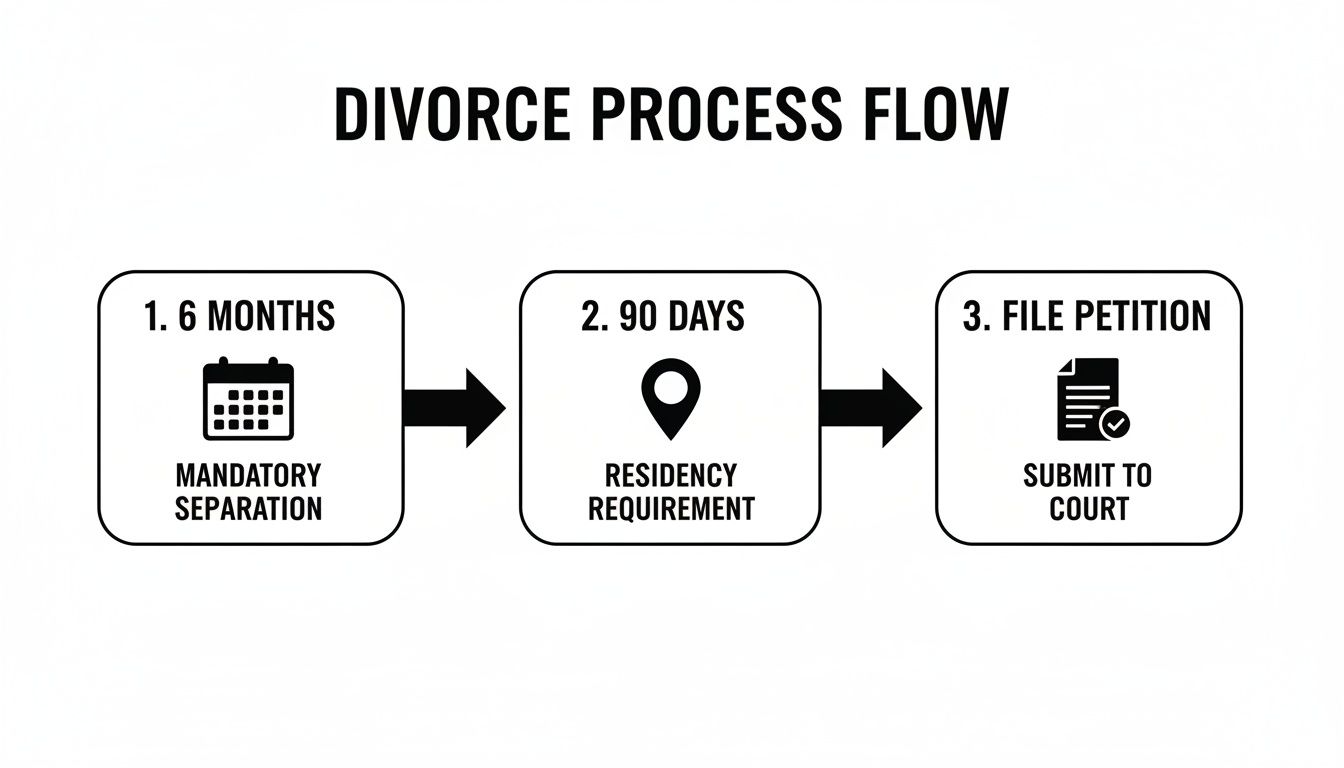
The first official move is filing a document called the Original Petition for Divorce. This is what legally starts your case with the court.
Here in Harris County, getting this right from the beginning is critical. Our local courts are incredibly busy. For you, as a resident of Humble, Atascocita, or the surrounding communities, that means a clean, correct filing is your best bet to avoid getting bogged down in procedural delays.
Your initial filing doesn’t just start the clock; it sets the tone for your entire case. A well-prepared petition can help create a smoother path forward, while errors or omissions can lead to frustrating delays and unnecessary conflict.
Before you take that first step of filing, a quick checklist can help ensure you have all your ducks in a row. It's a simple way to organize your thoughts and initial documents.
Initial Divorce Checklist for Humble Residents
| Requirement | What It Means for You | Local Tip for Humble/Atascocita/Kingwood |
|---|---|---|
| Residency Verified | Confirm you've lived in Texas 6+ months and Harris County 90+ days. | Use utility bills or your Texas driver's license to pinpoint your residency dates. This is the first thing the Harris County clerk's office will look for. |
| Grounds for Divorce | Texas is a "no-fault" state. Most people file on "insupportability," meaning the marriage just isn't working anymore. | You don't need to prove someone did something wrong. Simply stating the marriage has become insupportable is sufficient for the court. |
| Gather Key Documents | Start collecting financial statements, property deeds, tax returns, and birth certificates for any children. | Create a secure digital folder and a physical one. It's much easier to gather these things now before emotions run higher. |
| Consider Your Goals | Think about what you want regarding property, custody, and support. This helps focus your legal strategy. | What's most important to you? Keeping the house? Maintaining the kids' school routine in Humble ISD? Knowing your priorities helps your attorney advocate for you. |
This checklist isn't exhaustive, but it covers the core things you need to address before the legal process truly begins.
Of course, you might be the one receiving the divorce papers. If that's your situation, knowing your rights and deadlines is just as critical. You can get a head start by reviewing our guide on how to respond to a divorce petition in Texas. It's also interesting to see how lawyers harness AI to save money on back-office tasks, which can make the process more efficient for everyone involved.
Navigating these initial steps with a clear understanding of the rules is the best way to protect yourself and your family. At The Law Office of Bryan Fagan, our Humble attorneys are part of this community, and we are here to provide that clarity. We invite you to schedule a free, confidential consultation to discuss your situation and learn how we can help you move forward with confidence.
Preparing and Filing the Divorce Petition
Once you've confirmed you meet the residency rules, it's time to get the ball rolling by preparing and filing the Original Petition for Divorce. This is the document that officially kicks off your case in the Harris County court system. Think of it as the foundation for everything that follows—getting the details right from the start is absolutely critical.
This petition tells the court who you are, who your spouse is, and lays out the basic facts of your marriage. You’ll need to provide clear information about your property, debts, and, most importantly, your children. Accuracy isn’t just a nice-to-have; it’s essential for preventing frustrating delays and complications later on.
No-Fault vs. Fault-Based Divorce in Texas
Here in Texas, you have a fundamental choice to make right at the beginning. Most divorces you see in Humble, Atascocita, and Kingwood are filed on "no-fault" grounds, which is by far the most common and straightforward path.
- No-Fault Divorce: This is the simple route. You just need to tell the court that the marriage has become "insupportable" because of conflicts that have destroyed the relationship. There's no need to point fingers or prove that one person did something wrong.
- Fault-Based Divorce: In some cases, it might make sense to file based on "fault"—things like adultery, cruelty, or abandonment. This can potentially impact how property is divided, but be warned: you have to prove these claims in court. That can make the whole process much longer, more expensive, and far more emotionally draining for everyone involved.
Deciding which route to take is a serious strategic decision. It’s worth knowing that the vast majority of Texas divorces are filed on a no-fault basis. It generally keeps things calmer and more focused on finding a resolution for your family.
Filing Your Documents With the Harris County Court
With your petition drafted and signed, the next move is to file it with the Harris County District Clerk. As a Humble resident, you’ll be dealing directly with the Harris County court system for this.
Today, there's really only one way to file:
- E-Filing (Electronic Filing): This is mandatory in Harris County and is the standard for a reason—it’s fast and efficient. Your attorney will use the state's official e-filing portal to submit everything. It creates an instant digital record and ensures there are no delays in getting your case started.
- In-Person Filing: While you technically can file papers in person at the Harris County Civil Courthouse downtown, it's very uncommon now. E-filing is the required method and is almost always handled by your legal team.
When you file, you'll also have to pay the court's filing fee, which in Harris County typically runs between $300 and $350. This fee just covers the administrative work of opening your case file.
For many local families, coming up with several hundred dollars unexpectedly can be a real hardship. If you are facing financial strain, Texas law provides a way to ask the court to waive these fees.
If you can't afford the filing fee, you can submit a Statement of Inability to Afford Payment of Court Costs. This form explains your financial situation to the judge. If the judge approves it, you can move forward with your case without paying the upfront costs. It’s an important protection ensuring everyone in our community has access to the courts, no matter their income.
Preparing the initial petition is so much more than just filling out a form. It’s your first official statement to the court, and it sets the tone for your entire divorce.
At The Law Office of Bryan Fagan, we’ve guided countless Humble, Atascocita, and Kingwood residents through every line of this critical document. We make sure your petition is not only accurate and complete but also strategically crafted to support your goals from day one. If you're ready to take this step, we encourage you to schedule a free, no-obligation consultation with our local attorneys today.
Serving Papers and Using the Waiting Period Wisely

Once your divorce petition has been officially filed with the Harris County District Clerk, you have to make sure your spouse receives a copy. This isn't just a courtesy—it's a fundamental legal requirement known as "service of process." It’s the court's way of guaranteeing that everyone is on a level playing field and has a fair chance to respond.
For many Humble families, this part can feel pretty awkward and intimidating. But you've got a couple of ways to handle it, and the right choice usually comes down to how well you and your spouse are communicating.
How to Officially Notify Your Spouse
In Texas, you generally have two paths for serving divorce papers. What works for a couple in Atascocita might be different from what’s best for a family in Kingwood, so it’s important to understand the difference.
- Formal Service: This is the go-to method when you and your spouse aren't on speaking terms or if you’re unsure how they’ll react. You can hire a private process server or use a Harris County constable to hand-deliver the papers. They provide your spouse with the documents and then file a "Return of Service" with the court, which acts as official proof of delivery. It's a formal, by-the-book process that leaves no room for doubt.
- Waiver of Service: If your divorce is on more amicable footing, this is a much simpler route. Your spouse can voluntarily sign a Waiver of Service form in front of a notary. By signing, they are legally acknowledging they've received the divorce petition and are giving up their right to be formally served. It’s faster, cheaper, and far less confrontational, making it perfect for most uncontested divorces.
Choosing between formal service and a waiver does more than just check a legal box; it really sets the tone for the entire divorce. A waiver often signals a willingness to cooperate, while formal service draws a clear line in the sand when communication has broken down.
Putting the 60-Day Waiting Period to Good Use
The moment your spouse is served (or signs a waiver), a new clock starts. Texas law imposes a mandatory 60-day waiting period before a judge can finalize any divorce. This "cooling-off" period is designed to prevent rash decisions and can only be bypassed in rare situations involving family violence.
Don't mistake this for downtime. This window is your single best opportunity to sort things out. For the families who file for divorce in Harris County, these two months are where the real work of untangling a marriage happens. It's when you lay all the cards on the table and start building the agreements that will become your Final Decree of Divorce. To get a better sense of this timeline, you can explore our guide on the Texas divorce waiting period.
With the median cost of a Texas divorce being a significant expense for any family, making smart use of this time is also a great way to manage your legal fees. For more on the numbers, you can find helpful divorce and custody statistics in Texas.
Here’s a practical, step-by-step plan for making that 60-day period count:
- Gather Your Financials: Now is the time to track down every financial document you can find—bank and retirement statements, tax returns, pay stubs, property deeds, and car titles. This discovery process gives both you and your spouse a full, transparent view of your community estate.
- Establish Temporary Orders: Life doesn't stop just because a divorce is filed. Temporary Orders are crucial for creating stability. These are short-term rules a judge approves that outline who stays in the house, who has the kids on which days, and how bills get paid while the divorce is ongoing.
- Consider Mediation: Instead of gearing up for a courtroom battle, most couples find resolution through mediation. A neutral, trained mediator helps you and your spouse negotiate tough issues like property division and custody in a private setting. The goal is to reach a settlement you both can live with, saving immense stress and expense.
This 60-day window is your chance to take control of the process. At The Law Office of Bryan Fagan, we help families in Humble and Northeast Houston use this time strategically to work toward a fair and sustainable outcome. If you want to build a solid plan for this critical period, schedule a free consultation at our Humble office today.
Tackling the Big Three: Property, Kids, and Support

Once the divorce is filed, the real work begins. That 60-day waiting period isn't just about waiting around; it's the time for the most critical conversations you'll have. For families here in Humble, Kingwood, and Atascocita, this is when you and your attorney will sort out the three pillars of any Texas divorce: how you'll divide your property, how you'll co-parent your children, and how financial support will work.
These negotiations are the absolute heart of the process. Getting them right lays the foundation for a stable, predictable future for you and your kids.
How Your Property Gets Divided in Texas
Texas is a community property state. This is a legal concept that can be confusing. It basically means that almost everything you and your spouse acquired while you were married is considered to belong to you both. It doesn't matter whose paycheck bought it or whose name is on the deed.
This "community estate" isn't just the obvious stuff like your house or the cars. We're also talking about:
- Financial Accounts: Checking, savings, 401(k)s, IRAs, and investment portfolios.
- Real Estate: Your family home in Humble, any rental properties, or that vacation spot you bought together.
- Debts: It's not just assets. The mortgage, car loans, and credit card balances you took on during the marriage are also community debt that has to be divided.
Of course, there's also separate property. This is anything you owned before the wedding day, or assets you received during the marriage as a personal gift or inheritance. Just know that you have to prove it's separate with clear and convincing evidence, which can be tricky.
The court’s job is to make a "just and right" division of your community estate. While that sounds like a 50/50 split, it doesn't always end up that way. The 50/50 line is just the starting point. For a really detailed breakdown, you can learn more about how property division works in Texas.
Creating a Stable Parenting Plan for Your Children
When kids are involved, the entire focus of the case shifts. Every decision made by a Harris County judge will be guided by one single standard: the "best interest of the child."
In Texas, we don't really use the term "custody." Instead, we talk about conservatorship. The vast majority of the time, judges name parents as Joint Managing Conservators. This means you both share the rights and duties of raising your children, like making decisions about school and medical care.
Even when you're joint conservators, one parent is usually named the "primary" parent. This just means they have the exclusive right to decide where the children live (often within a certain geographic area, like Humble ISD). The other parent then has a visitation schedule, which the law calls possession and access. The Texas Standard Possession Order is the default, but you are absolutely encouraged to work out a custom schedule that truly fits your family’s life here in Northeast Houston.
Sorting Out Child and Spousal Support
The final piece of this puzzle is making sure everyone has the financial resources they need to move forward.
- Child Support: This is very straightforward and is calculated with a formula set by Texas law. It's based on a percentage of the non-primary parent’s net monthly income. For one child, the guideline is 20% of net resources, which goes up to 25% for two children, and so on.
- Spousal Support (Alimony): This is much less common in Texas and is never awarded automatically. A judge will only consider ordering spousal maintenance if the marriage lasted 10 years or more and one spouse truly can't earn enough to meet their basic needs.
Trying to figure all this out on your own is incredibly complex, and the stakes couldn't be higher. By focusing on these key areas with professional guidance, families in Humble, Atascocita, and Kingwood can work toward fair and lasting solutions.
Finalizing Your Divorce in Harris County
You've made it through the negotiations and the mandatory 60-day waiting period. Now, you’re at the finish line, ready to make everything official. This final stage is all about turning the agreements you've worked so hard on into a binding court order, giving you the legal clarity to start moving forward.
For anyone living in Humble, Kingwood, or Atascocita, this last step centers on one critical document: the Final Decree of Divorce.
Crafting Your Final Decree of Divorce
Think of the Final Decree as the single most important document in your entire case. It's the comprehensive, legally-binding order that officially ends your marriage and spells out every detail of your settlement. A vague or poorly written decree is an invitation for future conflict, so getting this right is non-negotiable.
This document must leave zero room for interpretation and will contain the judge's final rulings on:
- Property and Debt Division: It will specifically list who gets what, from the house and retirement accounts right down to the living room sofa. It also clearly assigns who is responsible for paying each debt.
- The Parenting Plan: If you have kids, the decree incorporates the full custody plan—officially known as conservatorship, possession and access, and the specific rights and duties of each parent.
- Child Support and Medical Support: The exact dollar amount for monthly child support will be stated, along with the plan for how the children's medical and dental insurance will be provided and paid for.
- Spousal Maintenance: If alimony is part of your agreement, the decree will lock in the amount, how long payments will last, and any other terms.
This isn't just a summary of your agreement; it's a powerful legal order signed by a judge. It governs your rights and obligations the moment it’s finalized.
The Prove-Up Hearing in a Harris County Court
Even in a completely amicable, uncontested divorce, Texas law requires one last, brief appearance in court. We call this the "prove-up" hearing. For Humble residents, this almost always takes place at the Harris County Civil Courthouse downtown.
Don't let the word "hearing" worry you. This isn't a dramatic trial scene from a movie. It’s a very quick, straightforward formality, usually lasting just 5 to 10 minutes.
During the prove-up, you and your attorney will stand before the judge. You'll be asked a handful of simple questions under oath to confirm basic facts, like your identity and residency, and to state that you believe the agreement is fair. Your attorney then hands the signed Final Decree of Divorce to the judge. Once the judge signs it, your divorce is legally final.
The prove-up hearing is the procedural conclusion to your divorce journey. It's the moment when all your hard work and negotiation become an official, legally binding reality, providing the closure needed to start your next chapter.
Your Post-Divorce Checklist
The judge’s signature marks the end of your marriage, but a few practical loose ends still need tying up. This practical, step-by-step checklist can help Humble residents transition smoothly.
- Update Your Financial Accounts: Take a certified copy of your decree to your bank to remove your ex-spouse from joint accounts and retitle any assets awarded to you.
- Change Your Beneficiaries: This is a big one. Update your life insurance, 401(k)s, IRAs, and other investment accounts.
- Retitle Your Vehicle: If a car was awarded to you, you'll need to visit the county tax assessor-collector's office to get the title transferred solely into your name.
- Revise Your Estate Plan: Your old will is likely invalid now. It's absolutely crucial to create a new will and update any trusts or powers of attorney.
- Notify Important Agencies: Inform the Social Security Administration, your employer’s HR department, and the post office of your name and marital status change.
Finalizing your divorce is a major life event. At The Law Office of Bryan Fagan, we guide our Humble clients through every single step, ensuring your final decree is drafted meticulously and your prove-up hearing is as seamless as possible. Schedule a free consultation with our local Humble attorneys to see how we can help you close this chapter with confidence.
Common Questions About Divorce in Humble, TX
If you’re considering divorce, your mind is probably racing with questions. It’s a period filled with uncertainty, and finding clear, honest answers can make a world of difference. We work with families across Humble, Atascocita, and Kingwood every day, and we tend to hear the same concerns time and again.
Here are some straightforward, easy-to-understand answers to the questions likely on your mind right now.
Do I Have to Go to Court for My Humble Divorce?
This is probably the number one fear we see, but the reality is rarely as dramatic as what you see on TV. For the vast majority of our clients here in Harris County, a drawn-out courtroom battle just doesn't happen. Most divorces are settled through agreements reached outside of a formal trial, often with the guidance of a mediator.
That said, you will almost certainly make one brief court appearance for what's called a "prove-up" hearing. Don't let the name intimidate you. It’s a short, simple meeting with a judge, usually lasting only 5-10 minutes, where you and your lawyer present the signed Final Decree of Divorce for approval. A full-blown trial only happens if you and your spouse truly cannot agree on the big issues. A good attorney's primary goal is always to keep you out of that situation by finding common ground first.
What Is the Average Cost of a Divorce in the Humble Area?
The cost of a divorce really comes down to the level of conflict involved. While the initial court filing fee in Harris County is a set cost, typically around $300 to $350, the legal fees are what vary the most.
- Uncontested Divorce: If you and your spouse agree on everything from the start, a simple, uncontested divorce might only cost a few thousand dollars in attorney fees.
- Contested Divorce: On the other hand, if your case involves complex assets, a family-owned business in Northeast Houston, or serious custody disagreements, the cost will naturally be higher. These cases can potentially reach $15,000 or more.
The only way to get a realistic picture of the potential costs is to discuss your specific situation with a local attorney. We offer a free, private consultation at our Humble office to give you a transparent financial overview of what you can expect.
The most powerful way to manage the cost of your divorce is to focus on resolution over conflict. Every issue you and your spouse can agree on—whether through direct negotiation or mediation—is money you save.
What Is the Difference Between Contested and Uncontested Divorce?
The difference is simple but profound. An "uncontested divorce" is the ideal path. It means you and your spouse are in total agreement on every major issue: how to divide your property, the parenting plan for your kids, and any child or spousal support.
A "contested divorce" just means there’s a disagreement on at least one of those key points. It's crucial to understand that "contested" doesn't automatically mean you're headed for a nasty court fight. Many cases start with disagreements but become uncontested once skilled negotiation or mediation helps bridge the gap. That's a huge part of what experienced divorce lawyers do—help families find common ground even when they start far apart.
Can I File for Divorce in Humble if My Spouse Lives Out of State?
Yes, absolutely. As long as you meet the Texas residency rules—living in the state for the last six months and in Harris County for the last 90 days—you can file for divorce right here in our local court. It doesn’t matter where your spouse lives.
The main challenge is formally notifying, or "serving," your spouse in another state. This involves a specific set of legal procedures that have to be followed perfectly. Getting this right is critical for the Harris County court to have proper jurisdiction over your case and make orders that stick. This is not a step you want to handle without professional guidance, as a mistake can cause major delays or even get your case dismissed.
The road ahead can feel overwhelming, but you don't have to figure it all out on your own. The experienced attorneys at The Law Office of Bryan Fagan are here in Humble to offer the clear guidance and steady support you need. We are committed to protecting your family, your rights, and your future. We encourage you to schedule your free, no-obligation consultation with our local team today by visiting https://humbletxlawyers.com.