Skip to content

Your phone rings after dinner. It's your co-parent, your lawyer, or maybe your mother asking the same question you've been dreading: “What happens if the judge orders supervised visits?”
If you live in Humble, Atascocita, Kingwood, or anywhere in Northeast Houston, that question hits hard. You're not just thinking about court. You're thinking about where visits will happen, who will supervise, what your child will feel, and whether this is temporary or the start of a much longer fight.
I've seen parents on both sides of this issue. Some are terrified because they believe their child needs protection right now. Others feel crushed because they know they've made mistakes and want a real path back to normal parenting time. Both situations are emotional. Both need a clear legal strategy.
A strong supervised visitation attorney in Humble, TX doesn't just react to the order. The right lawyer helps you make smart choices from day one so the evidence you create during supervised visits can help you later in Harris County court.
Understanding the Emotional Weight of Supervised Visitation
A lot of parents walk into this problem already exhausted. They're in the middle of a divorce, a custody fight, or a modification case. Then supervised visitation comes up, and suddenly the case feels personal in a different way. It can feel like the court is questioning your safety, your judgment, or your role as a parent.
That reaction is normal.
For the parent asking for supervision, the fear usually sounds like this: “I can't risk my child being alone with the other parent right now.” For the parent facing supervision, it usually sounds like this: “I know I need time with my child, but I don't know how to prove I'm safe.” In Harris County family court, both concerns show up often, especially when a case involves allegations of violence, substance use, or instability at home.
What families around Humble are really dealing with
In Humble and nearby communities like Atascocita and Kingwood, these cases rarely stay neatly inside the courthouse. They affect school pickup, holidays, church, grandparents, and routines the child depends on. A supervised visitation order changes all of that at once.
Supervised visitation is stressful because it touches the most sensitive part of family law: a child's safety and a parent's access.
Parents need plain answers, not courtroom jargon. They need to know what the judge cares about, what evidence matters, and how to avoid mistakes that make the case harder. That's especially true when someone is tempted to use a friend or relative as a supervisor without thinking ahead to what a Harris County judge will trust later.
Steady advice matters early
If you're dealing with this now, don't treat it like a side issue. Supervised visitation can shape the entire direction of your custody case. The steps you take in the first few weeks often affect whether the order stays in place, how long it lasts, and whether you can modify it later.
What Supervised Visitation Means in Texas
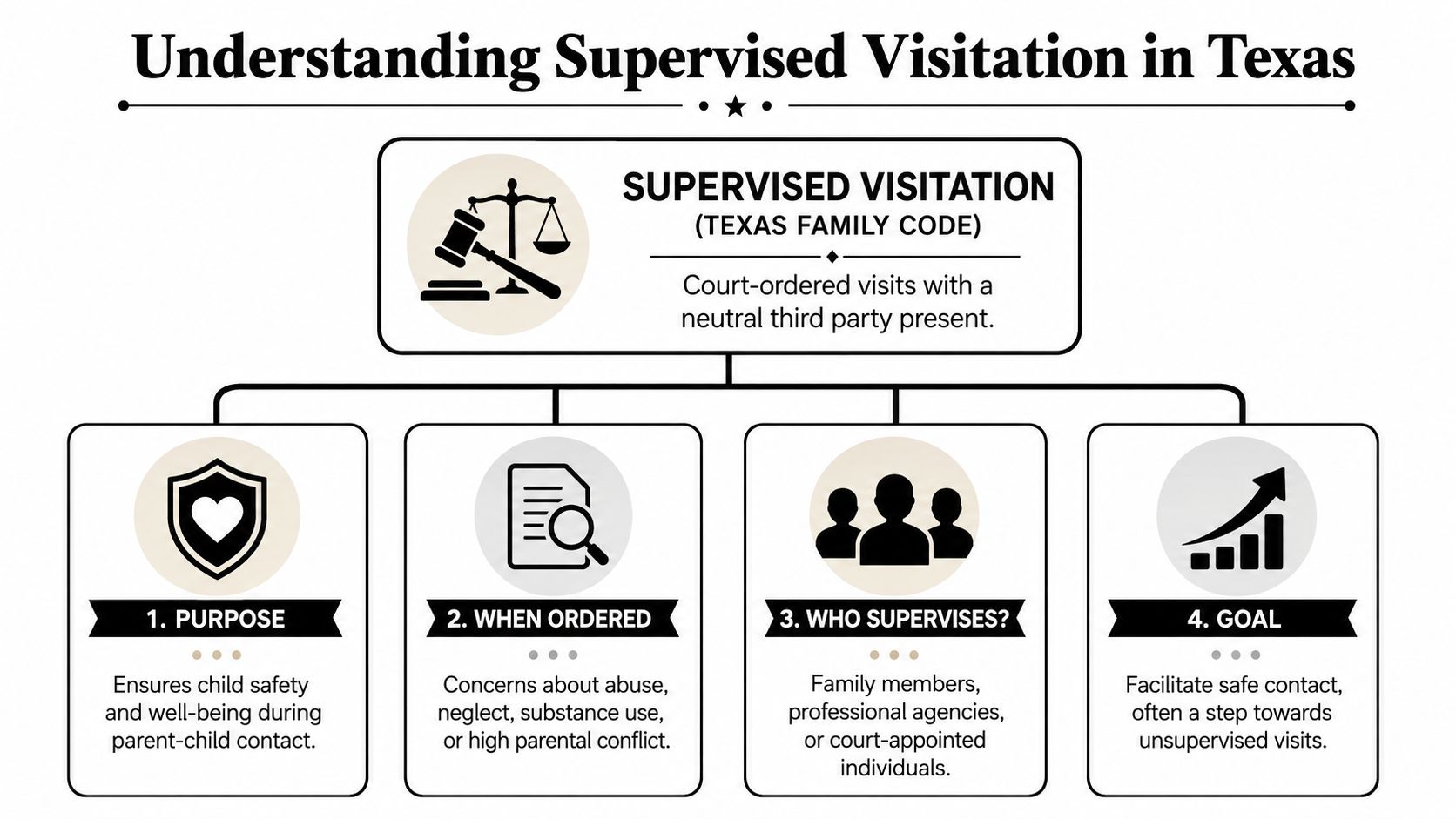
In Texas, supervised visitation means a court orders parenting time to happen with another approved adult present. That adult watches the interaction and helps make sure the child stays safe. The point is protection, not punishment.
Texas courts use this tool when the facts show ordinary possession terms aren't enough. Under Texas Family Code guidance on supervised visitation, supervised visitation is a court-ordered measure under Texas Family Code §153.004 when credible evidence exists of physical or sexual abuse, and the requesting party must show that unsupervised access would endanger the child physically or emotionally.
When judges usually consider it
This is not the answer for every disagreement between parents. Judges generally reserve supervised visitation for high-risk situations.
Common examples include:
- Documented abuse concerns that affect the child's physical or emotional safety
- Neglect allegations supported by records, testimony, or other credible proof
- Substance abuse patterns that create safety concerns during parenting time
- Severe conflict when the child's well-being can't be protected through a standard order alone
If you're trying to understand whether safety concerns can justify restrictions, this article on when visitation can be denied for safety concerns in Texas is a useful companion.
Who can supervise
The supervisor might be a professional agency, a neutral provider, or sometimes a family member or friend if the court approves that person. That sounds simple, but it isn't. The choice of supervisor can directly affect the future of your case.
That issue also comes up in related family disputes. For example, Grandparents' Rights in Humble involves custody and visitation rights for grandparents in Harris County, and those cases can overlap with questions about safe access and court-imposed limits.
Practical rule: Don't assume a judge will accept “someone I trust” as the same thing as “someone the court trusts.”
What this order is supposed to accomplish
The goal is usually to preserve contact while reducing risk. In many cases, the court expects the arrangement to be controlled, structured, and capable of review later. That's why details matter. Who supervises, where visits happen, how behavior gets documented, and whether concerns are improving all become part of the larger custody picture.
The Legal Process for Supervised Visitation in Harris County
Families in Humble often feel overwhelmed because Harris County procedure sounds bigger and colder than it really is. The process has moving parts, but it follows a pattern. If you know that pattern, you can prepare instead of panic.
How the case usually starts
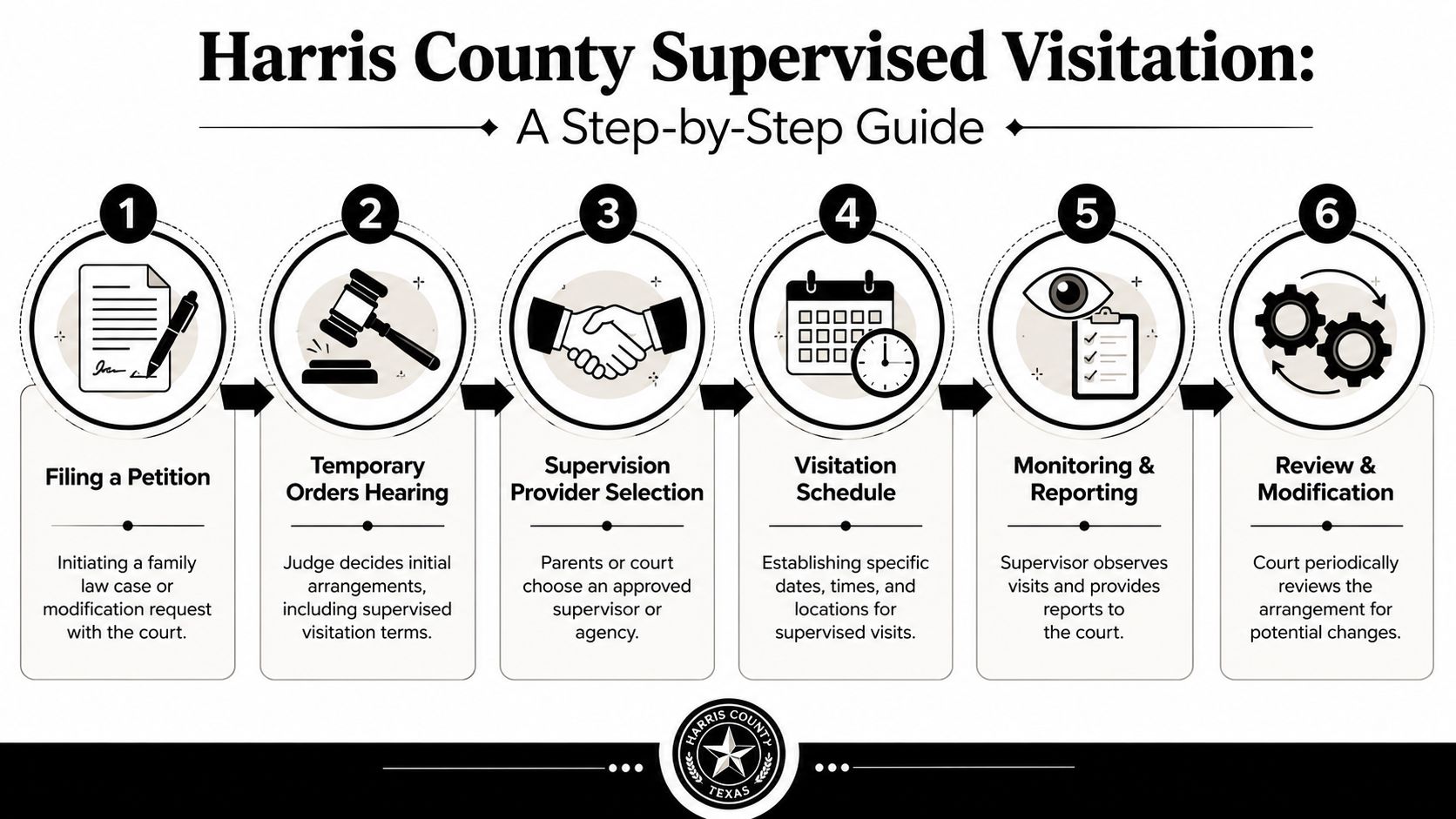
A parent usually asks for supervised visitation in an original custody case, a divorce, or a modification. The request is made through pleadings asking the court to limit possession and access because of safety concerns. The other parent then has a chance to respond, deny the allegations, and present their own evidence.
The court won't impose supervision just because someone is angry or suspicious. The parent requesting it needs proof that carries legal weight. That can include police reports, protective orders, medical records, witness testimony, or similar evidence showing why unsupervised access would be dangerous.
Temporary orders often matter most
Many supervised visitation decisions first show up at a temporary orders hearing. That hearing matters because it can shape the status quo for months. If the judge orders supervision early, that arrangement may stay in place until final orders unless someone brings the court strong evidence to change it.
Here's the basic flow most parents should expect:
- A petition or motion is filed. One side asks for restricted access or challenges that request.
- Both sides gather evidence. Records, messages, witnesses, and service history start to matter.
- A temporary hearing happens. The judge decides what should happen while the case is pending.
- A supervisor is selected. The court may approve a provider, agency, or individual.
- Visits begin under detailed rules. Time, place, conduct, and reporting expectations should be specific.
- The court reviews the bigger case later. Final orders or a later modification decide what comes next.
What judges want to see
Judges in Harris County want facts they can rely on. They don't want vague accusations. They also don't want sloppy documentation from the supervised period. If your case involves long text threads, incident records, or prior orders, organizing them clearly matters. Many parents use digital tools to sort records before hearings, and resources on how AI PDF readers transform workflows can be helpful when you're trying to review bulky court documents, treatment records, or visitation logs efficiently.
The parent who presents organized, credible evidence usually has the stronger position. Family court is emotional, but judges still decide based on proof.
Local court reality
Humble families often file and litigate in a county system serving a huge population. That means your presentation needs to be clean and direct. In Northeast Houston cases, the judge may only have a short window to absorb your facts. Don't hand the court a pile of confusion. Hand the court a clear story supported by reliable documents and witnesses.
How a Humble Visitation Attorney Protects Your Rights
A good lawyer does more than argue at a hearing. In supervised visitation cases, your attorney should build the record that decides what happens later. That's the difference between temporary damage control and an actual path forward.

The private supervisor problem most parents miss
Here's the trap I see too often in Humble and greater Harris County. A parent wants to save money, so they ask a cousin, friend, or family friend to supervise visits. That choice may seem practical in the moment. Later, it can wreck a modification case.
The reason is simple. According to this discussion of supervised visitation evidence problems in Harris County, professional supervisors can cost $35–$250/hour, but Texas Family Code §153.004 still requires clear evidence of safety to modify a visitation order. Courts in Harris County often reject reports from unvetted private supervisors, especially when those people look biased, poorly trained, or unable to testify objectively.
That means a parent can do everything right during visits and still fail to convince the court because the person watching those visits isn't credible enough.
What an attorney actually does
A supervised visitation attorney in Humble, TX should focus on the evidence chain from the first order forward. That includes:
- Testing the allegations early by reviewing whether the other side has real evidence or just accusations
- Preparing hearing evidence such as records, witness statements, and a timeline the judge can follow
- Negotiating terms that are workable so the order names specific supervisors, locations, and reporting expectations
- Screening private supervisors carefully if a family member is being considered
- Planning for modification from day one so every visit creates usable proof instead of wasted paper
If you need legal help in a pending divorce tied to custody issues, Divorce Lawyer in Humble, TX covers divorce representation for clients in Humble and Harris County. In cases focused on visitation strategy, the Law Office of Bryan Fagan handles family law matters involving custody, access, and modification work in this area.
Vetting matters more than convenience
A lawyer should ask hard questions before any private supervisor is used. Is this person neutral? Will they follow written rules? Can they take clear notes? Can they appear in court if necessary? Do they understand that they are not there to help one side win, but to observe safely and accurately?
If the supervisor can't stand up to cross-examination, their notes may not help you when it's time to ask for more parenting time.
That's why some families choose professional agencies even when the cost hurts. In some situations, the price of a professional record is lower than the cost of staying stuck in supervised visitation because your proof doesn't hold up.
Practical logistics matter too. When families need to assemble, copy, and deliver records for hearings, service packets, or provider communications, dependable local resources for reliable legal document delivery can save time and prevent avoidable filing problems.
A short overview may help if you're weighing your next move:
Rights still matter even when visits are supervised
If you're the parent requesting supervision, your lawyer protects your child by pushing for a clear order with enforceable conditions. If you're the parent under supervision, your lawyer protects you by making sure the order is specific, fair, and capable of being lifted with the right proof.
Vague orders create more conflict. Strong orders create a roadmap.
Finding Providers and Understanding Costs in Northeast Houston
Once the court orders supervision, the next problem is practical. Where do visits happen? Who supervises? Who pays? Families in Humble, Atascocita, Kingwood, and Northeast Houston need answers fast because delays can create missed time and more conflict.
The State of Texas provides a starting point. The Texas Office of the Attorney General provider search maintains a certified list of supervised visitation providers, including Houston-area facilities such as A Child's Time LLC and A Family Affair Supervised Visitations of Texas. The state's Access and Visitation program also offers resources and a directory for parents seeking services.
State and local options
You generally have two broad choices. You can use a professional provider, or you can ask the court to approve a private individual.
The Texas Attorney General also offers support through the Access and Visitation program. If you need a practical starting point, this page on the Texas Access and Visitation Hotline explains how parents can find information and support services connected to parenting time issues.
Comparing Visitation Supervisors Professional vs. Private
| Factor | Professional Supervisor/Agency | Private Supervisor (Friend/Family) |
|---|---|---|
| Training and structure | Usually operates with formal procedures, scheduling rules, and written observation practices | Often informal unless the court order is very specific |
| Location | May offer a dedicated visitation site in the Houston area | Often takes place in a home or informal setting if approved |
| Cost | Professional supervision can cost $35–$250/hour as noted earlier in the article's discussion of Harris County supervisor evidence issues | May cost less or nothing directly, depending on the arrangement |
| Neutrality | Usually stronger because the provider is not part of the family dispute | Often questioned if the person has loyalty to one parent |
| Court usefulness of reports | More likely to create records a judge views as objective | Risky if the person is unvetted or unable to testify credibly |
| Flexibility | Less flexible because agencies follow schedules and policies | More flexible, but that flexibility can weaken consistency and documentation |
My recommendation for most families
If your long-term goal is to end supervision, use the most credible supervisor you can reasonably afford. That doesn't mean a private supervisor never works. It means you should never pick one casually.
Before using any private person, make sure your order answers basic questions:
- Who exactly is approved
- Where the visits occur
- Whether the supervisor must keep written notes
- Whether the supervisor may testify if needed
- What conduct must be reported immediately
A loose arrangement may save money today and cost you months of progress later.
The Path Back to Unsupervised Visitation
Most parents want the same answer once supervision begins. “How do I get out of this?”
The honest answer is that supervised visitation usually ends only when the court sees reliable proof that the child can be safe without it. Hope is important, but proof wins motions.
What progress usually looks like
Courts often look for a pattern, not one good week. A parent trying to move from supervised to unsupervised time should focus on consistent, documentable improvement.
That often includes:
- Following every rule in the current order
- Showing up on time and behaving appropriately at each visit
- Completing any required services such as parenting classes, anger management, or domestic violence programming if ordered
- Providing clean testing records when substance abuse is part of the case
- Maintaining stable housing and stable employment
- Avoiding new incidents that raise fresh safety concerns
The records supporting those points need to be organized. This guide on evidence needed for a custody case in Harris County is a good starting point for understanding what courts want to see.
Modification is a legal process, not a verbal request
A lot of parents think the judge will relax the order once everyone informally agrees that visits are going well. That's a mistake. Court orders stay in place until the court changes them.
To move forward, your attorney usually files a motion to modify and supports it with evidence from the supervised period. That evidence may include provider notes, completion records from services, testing history, testimony, and proof that your life is more stable than it was when supervision began.
The question isn't whether you feel ready. The question is whether you can prove to the court that unsupervised time is now in the child's best interest.
Small decisions during supervision affect the outcome later
This is why the supervisor issue matters so much. If the person observing visits keeps weak notes, skips details, or looks biased, you may lose the chance to show the judge how much has changed. Strong modification cases are built during the supervised period, not the night before the hearing.
Your Next Steps with The Law Office of Bryan Fagan
If supervised visitation is already on the table in your case, don't wait for the court process to sort itself out. It won't. You need a plan for the hearing, the supervisor, the evidence, and the eventual modification. Families in Humble, Atascocita, Kingwood, and Northeast Houston do better when they approach this issue early and realistically.
The biggest mistake I see is treating supervised visitation like a short-term inconvenience instead of a legal record that will shape the future. The second biggest mistake is trusting an unvetted private supervisor without thinking about whether that person's testimony and notes will matter in Harris County court.
You don't have to face that alone. A focused lawyer can help you challenge weak allegations, request protection when safety is the primary issue, and build evidence that supports the outcome you want later. Whether your case is part of a divorce, a custody modification, or a larger family conflict, the strategy has to be local, organized, and child-centered.
If you're curious how people usually choose counsel, this guide on attorney client acquisition offers a useful outside look at how families often search for lawyers when legal stress is high. Once you're ready, the next step should be simple. Sit down with someone who knows the local process and can give you straight answers.
If you're dealing with supervised visitation, custody concerns, divorce, criminal charges, or estate planning issues in Humble, don't guess your way through it. Schedule a free consultation with Law Office of Bryan Fagan to talk through your situation, protect your rights, and build a practical plan for your family's next step.