Skip to content

In Texas, a judge must interview a child who is 12 or older about their preference, but the child still can't legally make the decision. A child's preference is only one factor the court considers, and the child can only choose where to live at 18.
If you're reading this in Humble, Atascocita, Kingwood, or Northeast Houston, you're probably dealing with a painful moment at home. Your son may have said he wants to stay with Dad. Your daughter may be asking to live with Mom full-time. Or maybe the other parent is telling you, “She's 12 now, so she gets to decide.”
That last part is wrong.
Texas law gives older children a voice. It does not give them the final vote. In Harris County courts, judges look at the bigger picture. They want to know why the child feels the way they do, whether either parent is creating pressure, and which arrangement protects the child's day-to-day well-being.
This issue is emotional before it's legal. Parents hear a child's preference and immediately feel rejected, scared, or angry. That reaction is normal. What matters next is how you handle it. If your child is caught in the middle, your choices in the next few weeks can help your case or hurt it.
Families often benefit from legal guidance and emotional support at the same time. If your household is struggling with conflict, transitions, or loyalty issues, outside counseling can help keep your child out of the crossfire. For families looking for a counseling resource, Find family counselling in Kelowna offers an example of the kind of structured family support many parents look for during custody stress.
A Conversation Every Texas Parent Navigates
A lot of parents ask the same question in almost the same words: what age can a child choose which parent in Texas? They usually ask it after a hard conversation in the car, after a school night meltdown, or after the other parent starts treating the child's opinion like a signed contract.
It isn't a signed contract.
What parents in Humble usually need to hear first
There is no magic birthday that lets a child take over the custody order. Texas law draws an important line, but it's not a line of independence. It's a line of formal consideration.
That distinction matters in real life. A child may prefer one home because it feels calmer, closer to school, or less tense. Another child may prefer the parent with fewer rules. A Harris County judge isn't going to treat those reasons the same way.
Practical rule: Listen carefully to your child's preference, but don't assume the court will treat that preference as the answer.
For local families, this usually comes up during divorce, post-divorce modifications, or long-running co-parenting conflict. It can also overlap with other legal stress. Some parents are managing custody while also handling criminal allegations, support disputes, or estate planning for blended families. That's why clear legal advice matters. You need a response that fits your actual family, not something you heard from a friend at a ballfield in Kingwood.
What your child's preference really means
Your child's words matter. They just don't control the case.
The court cares about stability, safety, routine, emotional health, and whether each parent supports the child's relationship with the other parent. In plain terms, Harris County judges want to know which home is more likely to help the child grow up healthy and steady.
That means your child saying, “I want to live with Mom,” or “Dad understands me better,” may open the door to a legal conversation. It does not close the case.
The Age 12 Rule What Texas Law Actually Says
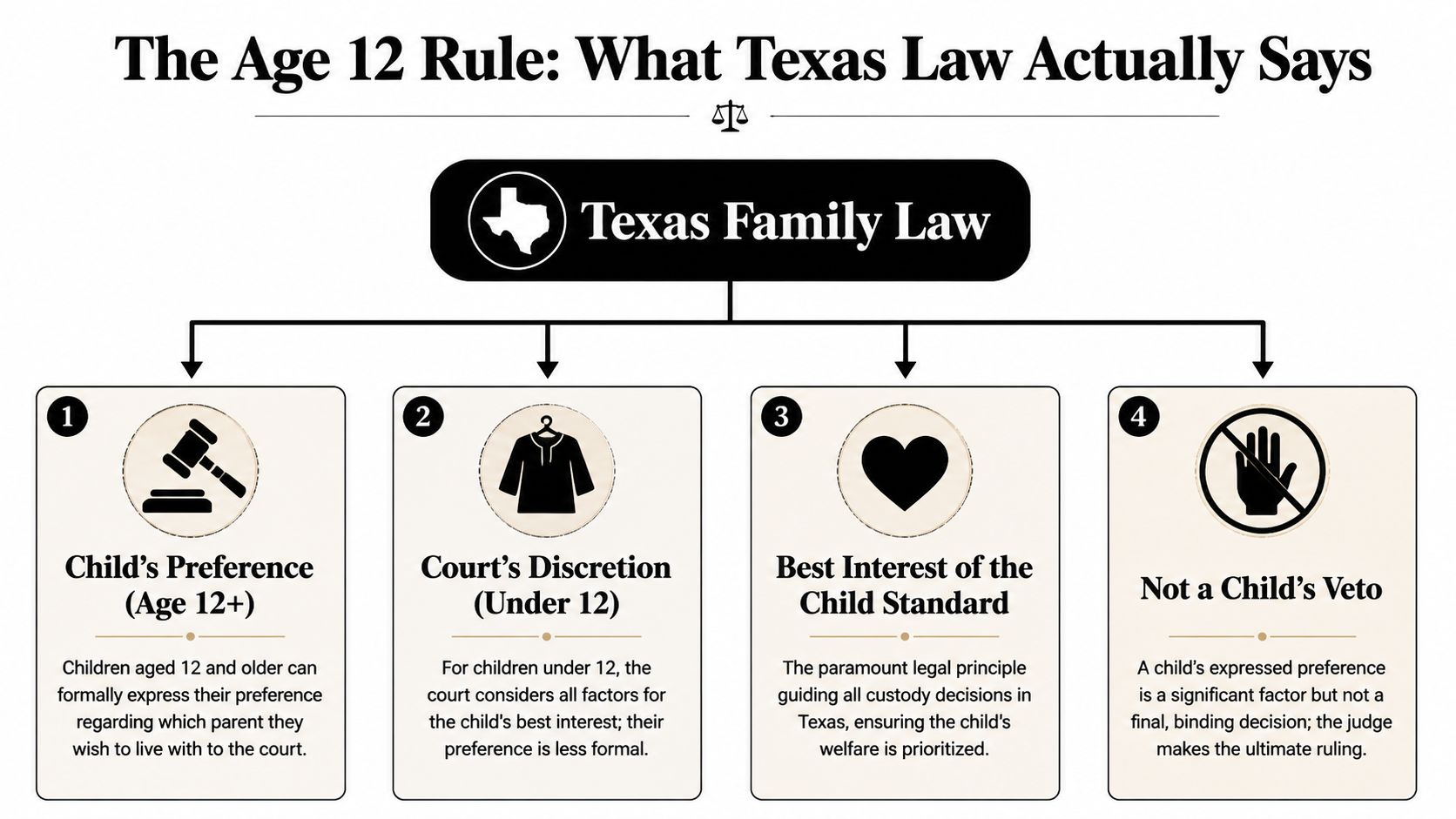
Texas parents hear "age 12" and often assume that is the age a child gets to pick a home. That is wrong, and believing it can lead to bad strategy in court.
Under Texas Family Code Section 153.009, a judge must interview a child who is 12 or older in chambers if the legal requirements are met. For a child under 12, the judge may choose to conduct that interview, but does not have to. The point of the interview is narrow. It lets the judge hear the child's wishes about conservatorship or who determines the child's primary residence. It does not hand decision-making power to the child.
What the interview really means for your case
In Harris County, the in-chambers interview is a tool for the judge, not a prize for the parent who says, "My child wants to live with me."
Judges use that conversation to test what is driving the preference. Is the child asking for more structure and peace? Is the child reacting to a recent argument, a new boyfriend or girlfriend, or looser rules at the other house? Is someone pressuring the child to take sides? Those questions matter because the court still has to rule based on the child's best interest, not the child's vote.
If your family is also fighting about possession schedules, read this guide on whether a child can refuse visitation in Texas. Parents often confuse a child's stated preference with a legal right to ignore the current order, and those are two different problems.
What "best interest" looks like in a Harris County courtroom
For families in Humble and Atascocita, "best interest" usually comes down to ordinary life. Who gets the child to school on time at Humble ISD or Atascocita-area campuses? Who keeps homework, counseling, sports, medication, and bedtime steady? Who protects the child from adult conflict instead of recruiting the child into it?
A judge is looking for patterns, not polished lines.
Here is what usually helps a parent's position:
- A stable routine: regular school attendance, sleep, meals, and follow-through
- Calm parenting: shielding the child from arguments, texts, and guilt
- Sound judgment: making adult decisions without asking the child to carry adult stress
- Support for the other parent-child relationship: unless there is a real safety issue
- Credible reasons for the child's preference: school, emotional health, consistency, and practical daily needs
What hurts? Coaching. Bribing. Letting a child skip visits because "that's what she wants." Telling a teenager the judge will let them decide everything at 12. Harris County judges have seen those mistakes many times, and they tend to backfire fast.
A child's preference matters more when it lines up with stability, maturity, and evidence that the requested change will help the child day to day.
How a Child's Age Changes the Court's Perspective
Age changes how a judge listens, but it doesn't hand over authority before adulthood. Texas is clear that no child can legally choose which parent to live with until age 18, which is the age of majority, as explained in this overview of when a child can legally choose in Texas.
That means parents in Kingwood and Northeast Houston need realistic expectations. A child's voice may grow more influential over time, but a court order remains a court order until it is changed or the child becomes an adult.
How judges usually view different age ranges
The easiest way to understand this is to stop asking, “Can my child decide?” and start asking, “How much weight will the court give this preference right now?”
| Child's Age | Right to an Interview | Weight Given to Preference |
|---|---|---|
| Under 12 | No automatic right. The judge may choose to interview the child. | Usually limited and highly dependent on maturity and the full family situation |
| 12 to 15 | Yes. The judge must interview the child in chambers when required by law. | Meaningful, but still only one factor among many |
| 16 to 17 | No legal right to make the final choice | Often taken seriously because of maturity, but still not binding on the court |
What this means in practice
A younger child may say what sounds good in the moment. A judge knows that. Courts are cautious with younger children because they are easier to influence and often don't grasp long-term consequences.
For children in the middle range, the court listens more carefully. At that stage, judges often look past the headline preference and focus on the reason behind it. Is the child asking for more peace, better school consistency, or relief from conflict? Or is the child reacting to less supervision and looser household rules?
Older teens present a harder practical problem. A nearly adult child has a more developed viewpoint, stronger social ties, and more day-to-day independence. Even then, the court does not surrender its role. Judges still examine whether the requested change supports the child's welfare.
If you're trying to understand the bigger custody analysis, this article on how judges decide custody in Harris County gives useful local context.
The older the child gets, the more carefully the court will listen. But listening isn't the same thing as handing over control.
The biggest mistake parents make with teenagers
Parents often assume a teenager can move out of one parent's home and that the law will shrug. That assumption causes avoidable damage.
A teen may resist visitation, refuse exchanges, or pressure a parent to “just let me stay.” If you respond by ignoring the existing order, you can create legal problems for yourself. The court may view that as noncompliance rather than good parenting, especially if you made no effort to seek a formal modification.
What Parents Should and Should Not Do
Your child says, "I want to live with Mom," or "I'm staying with Dad." In that moment, many Harris County parents panic and start arguing their case to the child. That is the wrong move. Your job is to lower the temperature, protect your child from the conflict, and respond in a way that will still look responsible if a judge later reviews your conduct.
A child's preference matters. It does not give the child authority to rewrite the order at the kitchen table. In Humble and Atascocita cases, judges pay close attention to which parent kept the child out of the middle, which parent kept life stable, and which parent acted like the adult when emotions ran high.

Do this
- Ask calm questions: Say, “Help me understand what's been hard lately.” You need facts, not a debate.
- Listen for the underlying problem: In my experience, “I want to live with the other parent” often means “I'm stressed,” “I'm tired of the fighting,” or “I want more predictability.”
- Keep daily life steady: School attendance, counseling, medication, homework, sports, and sleep routines matter. Harris County courts notice which parent protects structure.
- Document facts cleanly: Write down missed exchanges, school concerns, medical issues, and major behavior changes. Keep opinions and insults out of it.
- Follow the current order while you address the problem: If the arrangement no longer works, use the court process instead of making informal deals that collapse under pressure.
Do not do this
- Do not coach your child: Rehearsed language is easy for judges, custody evaluators, and amicus attorneys to spot.
- Do not use your child as a messenger: No child should be carrying adult complaints between homes.
- Do not badmouth the other parent: That hurts your child first. It also hurts your credibility.
- Do not offer freedom, gifts, or fewer rules in exchange for loyalty: That looks manipulative because it is manipulative.
- Do not stop complying with the order because your child is upset: If there is a legal problem, fix it legally.
If your child is under pressure, be the parent who brings calm, structure, and common sense.
What good judgment looks like in a Harris County case
Judges are not impressed by the parent who talks the loudest about fairness. They are persuaded by conduct. Did you get the child to school? Did you keep counseling in place? Did you encourage the relationship with the other parent even while disagreeing with them? Did you avoid turning every exchange in Atascocita or Humble into a scene in the driveway?
Those details matter because "best interest" is not an abstract slogan. It shows up in ordinary parenting choices. A parent who protects the child's routine usually stands on stronger ground than a parent who treats the child's preference like a vote to be collected.
What to do if the order really needs to change
If your child's wishes point to a real problem, address the problem with proof and a plan. That may include school records, counseling records, attendance problems, medical concerns, or a documented pattern of conflict. Then get advice about whether a formal change makes sense through a custody modification case in Humble, TX.
The goal is simple. Take the burden off your child and put the issue where it belongs, in the proper legal process.
Seeking a Custody Modification Based on Your Child's Wishes
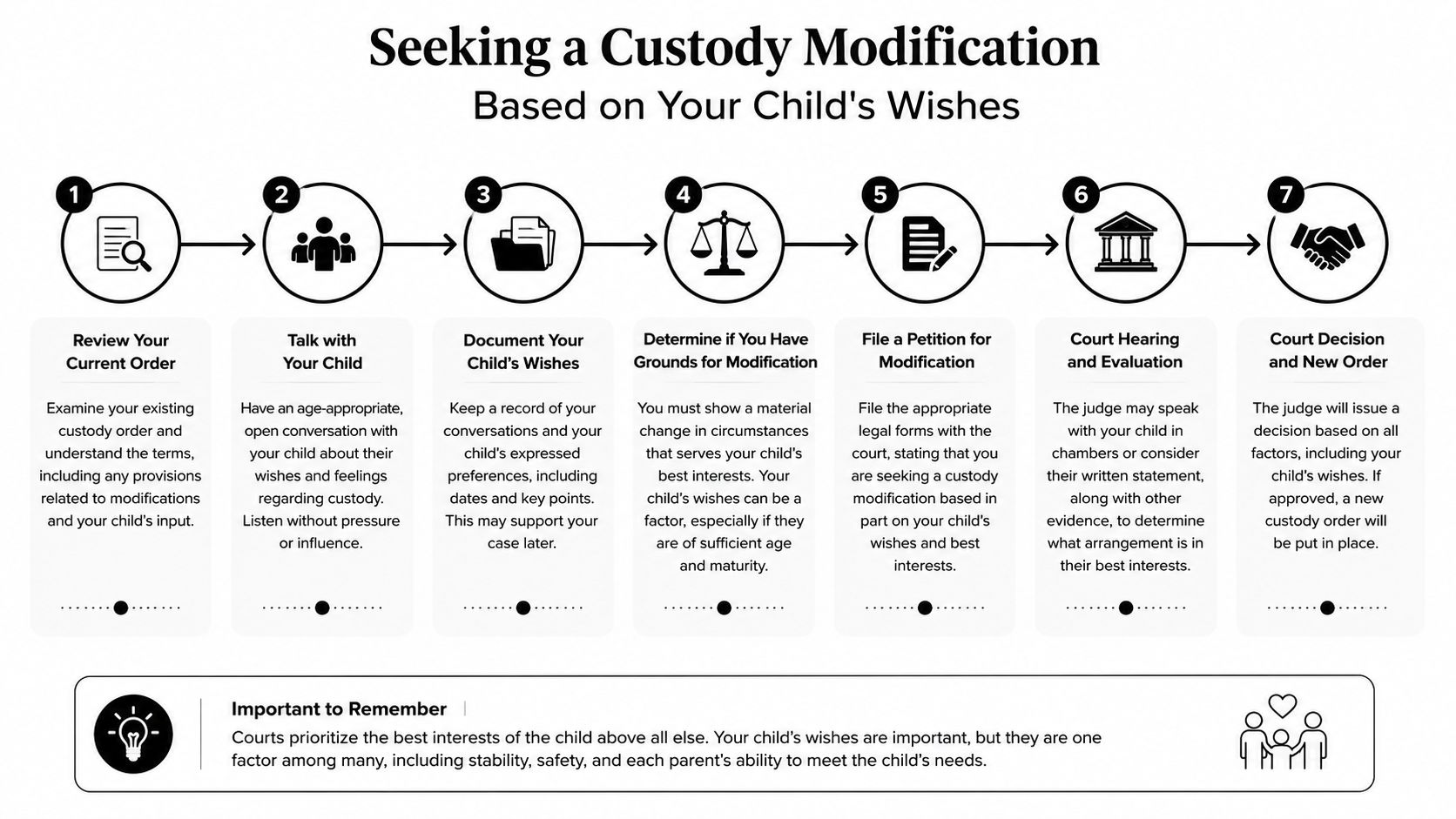
A child's preference can matter in a modification case, but it only helps if you use it correctly. In Texas, a child's preference for primary custody at 12 or older can be one of the statutory grounds for modifying an existing custody order, but the court must still find a material and substantial change in circumstances, as outlined in this explanation of custody modification grounds in Texas.
The basic path in Harris County
If you live in Humble, Atascocita, or Northeast Houston, the practical path usually looks like this:
Get legal advice early
Don't wait until exchanges have already broken down. A lawyer can tell you whether the facts support filing now or whether you need more evidence first.Identify the actual change
The child's wishes matter, but the court wants the broader story. Has the child's routine changed? Is there a school issue, mental health concern, conflict in one home, or a new need for structure?File the modification case
The formal request has to be filed through the court. If you're considering that step, this page on custody modification in Humble, TX outlines the local service involved.Gather proof that fits the best-interest standard
Good evidence usually includes records, communication history, and details that show how the requested change helps the child, not just how it helps you.
Here is a short overview that may help you visualize the process:
What evidence usually matters more than the child's statement alone
Parents often overfocus on the interview and underprepare the case. The judge wants a full picture.
Helpful proof may include:
- School-related information: Attendance issues, grade changes, or school stability concerns
- Parenting patterns: Who is getting the child to activities, appointments, and school consistently
- Communication history: Messages that show cooperation, conflict, or refusal to support the child's needs
- Living conditions: Facts about schedule reliability, supervision, and household calm
- Support needs: Whether a change in conservatorship may also require review of Child Support Attorney in Humble services, since support issues often shift when custody arrangements change
What usually hurts these cases
Some modification requests fail because a parent files based on frustration instead of proof. Others fail because the child's preference sounds temporary, reactive, or parent-driven.
Your child's wishes can open the door to modification. They won't carry the whole case by themselves.
Another common mistake is informal switching. Parents sometimes allow a new living arrangement for weeks or months without getting a court order. That can create confusion about school, support, transportation, and enforcement. If a change is serious enough to live by, it's serious enough to put in writing through the court.
Your Next Steps With a Humble Family Law Attorney
By this point, the answer should be clear. In Texas, a child's voice matters. It does not replace the judge's decision. Even when a 12-year-old says they want to live with one parent, Texas courts still hold that the child cannot legally refuse court-ordered visitation or possession until 18, as explained in this discussion of a child's custody preference under Texas law.
What local families should do now
If you're in Humble, Kingwood, Atascocita, or Northeast Houston, take a breath and focus on the next right step.
- Follow the current order: Don't assume your child's preference changes your legal obligations.
- Pay attention to patterns: One emotional statement is different from a sustained and well-grounded concern.
- Keep your child out of the fight: Don't ask them to choose you. Ask how to help them feel safe and heard.
- Get informed before acting: Harris County family court procedure matters, and mistakes are hard to unwind once they're in the record.
When it's time to get legal help
If your child is asking for a change, if the other parent is misrepresenting the law, or if your home life has become unstable because of the current order, you shouldn't try to improvise your way through it.
This area of law affects where your child sleeps, goes to school, and spends holidays. It deserves a careful, local strategy. A lawyer who works with Harris County families can help you separate emotion from evidence, keep you compliant with the current order, and decide whether modification is the right move.
If you need clear answers about custody, visitation, child support, divorce, criminal defense, or estate planning, schedule a free consultation with the Law Office of Bryan Fagan. Our Humble office works with families across Humble, Atascocita, Kingwood, and Northeast Houston, and we'll help you understand your options in plain English so you can make the next decision with confidence.