 Skip to content
A lot of parents start this process the same way. They're sitting at a kitchen table in Humble, Atascocita, Kingwood, or somewhere in Northeast Houston, staring at a phone full of texts, trying to figure out what just happened. Maybe the other parent moved out. Maybe pick-ups have become unpredictable. Maybe you've been doing the day-to-day parenting and suddenly you're being told you have no say.
That's when people start searching for how to file for custody in Texas. And most of what they find is too generic to be useful. It talks in broad terms, skips the local court realities, and leaves out the procedural traps that cost parents time, money, and advantage.
Custody cases in Texas have rules. Harris County has habits and expectations on top of those rules. If you miss the basics, your case can stumble before a judge ever hears your side. If you handle the basics correctly, the process becomes much more manageable.
Navigating Your First Steps Towards Custody
A parent came into an office like ours after a rough weekend exchange. The child's backpack never made it back. School medication was missing. Nobody had a written schedule. The parent wasn't asking for a courtroom battle. They wanted stability.
That's often the core issue in most custody cases. Parents don't wake up wanting litigation. They want a plan they can rely on, rules both sides must follow, and protection for their child when informal arrangements stop working.
In Humble and nearby communities, that pressure feels especially personal because your life is local. Your child may go to school in Atascocita, have a doctor in Kingwood, and spend weekends with grandparents in Northeast Houston. A custody order needs to fit that real life. It can't be built from vague promises and crossed fingers.
Practical rule: If the current arrangement depends on the other parent “doing the right thing,” you probably need a court order.
People often assume custody is one form and one hearing. It isn't. You need the right legal footing before you file, the right petition when you file, and the right evidence when the court starts making temporary decisions. That sequence matters.
The good news is that this process is navigable. You don't need to know every statute by heart. You do need to know what comes first, what can wait, and what mistakes will hurt you in Harris County.
Before You File Foundational Legal Groundwork
Before you file anything in Harris County, make sure you have the right to bring the case and the right court to hear it. Those two issues sink a lot of custody filings before a judge ever gets to the child.
Start with the child's home county. In Texas, custody cases are usually filed as a Suit Affecting the Parent-Child Relationship, or SAPCR, in the county where the child has lived for the last six months. For many families in Humble, Atascocita, Kingwood, and the surrounding Harris County area, that means Harris County. If the child recently moved, or has been bouncing between homes, do not guess. Check the timeline carefully. Filing in the wrong county wastes filing fees, delays temporary orders, and gives the other side an easy procedural argument.
Get your paperwork together before you touch the petition. I tell parents to build one clean folder with documents that show where the child has been living and receiving care. That usually includes school enrollment records, attendance records, medical records, lease paperwork, utility bills, and any prior court orders involving custody or support.
Good records matter early. They can help you prove residence, show who has been handling the child's daily needs, and keep the other parent from rewriting history. If you want to see what tends to matter in local cases, review this guide on evidence judges look for in a Harris County custody case.
Unmarried parents need to pay especially close attention here, because Harris County cases often go off track at this point.
For an unmarried mother, standing is usually straightforward. For an unmarried father, it may not be. If paternity has not been legally established, you should not assume you can file for custody just because you have been involved, paid support informally, or your name is on the birth certificate. Those facts may matter emotionally. They do not replace legal paternity.
That is the trap a lot of parents in Humble run into. They come in asking for custody when the first step is establishing the legal parent-child relationship.
If you are an unmarried father and paternity has not been established, handle paternity first.
Sometimes that happens through an Acknowledgment of Paternity. Sometimes it requires a court case. The right path depends on the facts, including whether the mother agrees, whether another man is presumed to be the father, and whether there are already orders on file. A Paternity Lawyer in Humble can help you get that issue fixed before you spend time and money on a custody filing that is not ready.
One more practical point. Check for existing orders before you start fresh. If there is already a divorce decree, prior SAPCR, or Attorney General child support order, you may need to modify an existing case instead of opening a new one. In Harris County, that distinction matters. Filing the wrong type of case creates delay you do not need.
Do the groundwork first. It is the fastest way to get in front of the court with a case that can proceed.
Filing the Petition in Harris County
You can do all the prep work right and still lose time here if you file the wrong case, in the wrong county, or with missing paperwork. That happens a lot in Harris County, especially with unmarried parents who assume the clerk will sort out a problem that should have been fixed before filing. The clerk will not fix it for you.
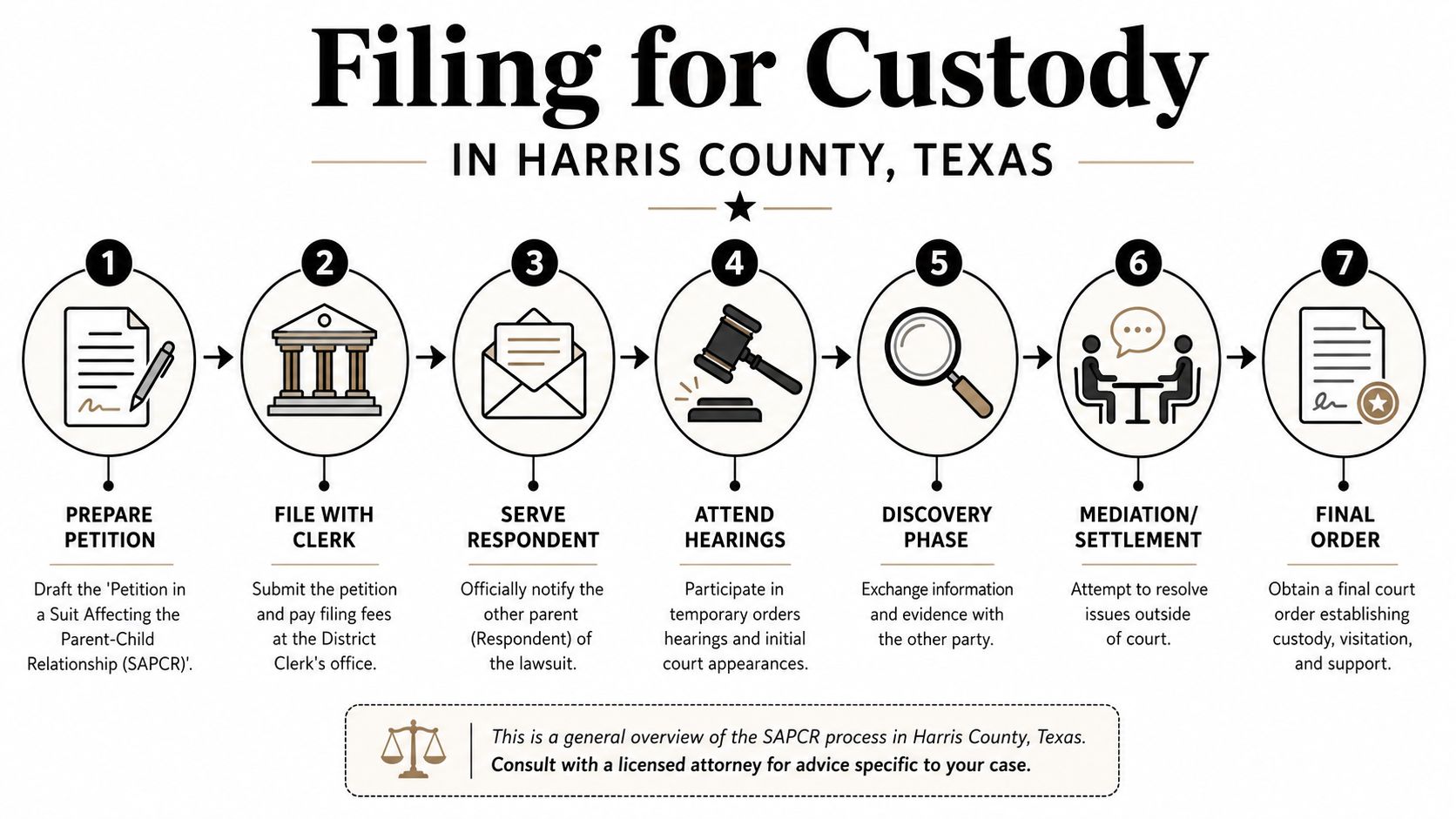
The document that starts the case
The case usually starts with a Petition for SAPCR, short for Suit Affecting the Parent-Child Relationship. For many families in Humble, that means filing in Harris County because that is where the child has been living. If the child has not lived in Harris County long enough, stop and verify venue before you file. Filing in the wrong county buys you delay, not progress.
For unmarried parents, accuracy matters even more. If paternity is already established and there are no prior custody orders, a SAPCR may be the right vehicle. If there is already an order somewhere, you may need a modification instead. Those are different filings, and Harris County courts expect you to get that choice right.
Texas courts may also require a certified copy of each child's birth certificate for SAPCR filings starting September 1, 2025. Check the current filing requirements before you submit anything. A missing document can turn a simple filing into a rejected one.
What to bring when you file
Walk in prepared or log in prepared. Same rule either way.
At minimum, have these ready:
- Your Petition for SAPCR
- A certified birth certificate for each child, if required for your filing date
- Any Harris County local forms
- Your filing fee, or a Statement of Inability to Afford Payment of Court Costs
- Enough copies for your records and for service
If money is tight, do not let the filing fee stop you. Ask for the fee waiver paperwork and complete it carefully. Sloppy fee-waiver forms get kicked back all the time.
Once the clerk accepts your case, you will get a Cause Number and Court Number. Put those numbers on every document from that point on. Keep file-stamped copies in one folder, paper or digital, because you will need them quickly when it is time for service, temporary orders, and your first hearing. If you want a practical roadmap for that stage, read this guide on how to prepare for a custody hearing in Humble, TX.
My recommendation for Humble and Harris County parents
Treat filing like the start of litigation, not a paperwork errand.
Use a checklist before you submit anything:
| Item | Why it matters |
|---|---|
| Petition completed correctly | It tells the court what you are asking for |
| Correct county and case type | Filing in the wrong place or under the wrong case can stall everything |
| Birth certificates and local forms | Missing paperwork can delay acceptance |
| Fee or inability statement | The clerk needs one or the other |
| Copies of everything filed | You need clean records for service and court |
E-filing works. In-person filing works. Accuracy matters more than method. If you are in Humble and dealing with a custody case involving an unmarried father, prior orders, or disagreement about where the child has been living, slow down and get the filing right the first time. That is how you keep your case moving in Harris County.
What Happens After You File Service and Temporary Orders
You file on Monday. By Friday, the other parent has picked up the child from school early, your phone is full of hostile texts, and you still do not have a court order telling either of you what happens next. That is the gap this stage is meant to cover.
In Harris County, filing starts the case. Service and temporary orders are what give the case teeth.
Service has to be done right
The other parent must be served the right way. Personal service by a constable, sheriff, or private process server is the standard route. A text, email, social media message, or heads-up through a relative does not count.
Once service is completed, the other parent has a deadline to file an answer. Put that date on your calendar the same day you get the return of service. If you miss the timing or serve the wrong papers, you can stall your own case and waste weeks fixing it.
This problem shows up often with unmarried parents in Humble and across Harris County. One parent assumes signing the birth certificate settled legal parentage and skips over the service issue. It did not. If paternity, acknowledgment, or prior orders are part of the story, handle service carefully and make sure the court has the authority to enter the orders you want.
Temporary orders set the rules while the case is pending
Temporary orders decide the practical questions that matter right now. Where does the child sleep? Who handles school pickup? Who pays support? Who can make medical decisions? What happens if one parent tries to cut off contact?
Judges often get their first clear look at the family during this hearing. If you show up organized, child-focused, and realistic, that matters. If you show up angry and vague, that matters too.
A common Harris County mistake is assuming uploaded documents are enough. Bring paper copies of anything you want the judge to read, especially school records, medical records, messages, calendars, and a proposed parenting schedule. Make it easy for the court to follow your timeline.
What to bring to the temporary orders hearing
Go in with evidence, not speeches.
- School records: Attendance, report cards, teacher emails, tardy history, and anything showing who is involved day to day.
- Medical records: Appointments, prescriptions, counseling records if appropriate, and proof of who took the child for care.
- Communication history: Texts, emails, and app messages that show cooperation, missed exchanges, threats, or refusal to share information.
- A workable schedule: Judges prefer a clear plan over a complaint list.
- A short timeline: Dates of separation, where the child has been living, and any urgent problems since filing.
Keep your presentation tight. The court does not need every bad thing the other parent has done over the last five years. The court needs facts tied to the child's safety, stability, schooling, health, and routine.
If your case involves an unmarried father, disputed paternity, or a parent who has never consistently exercised visitation, do not wing the temporary orders hearing. Those cases can go sideways fast if the paperwork and proof do not line up. Use this Humble custody hearing preparation guide to get your documents and testimony in order before you walk into court.
Crafting a Strong Parenting Plan and Calculating Support
A lot of parents in Humble hit this point and assume the hard part is over. It is not. The order you walk out with will control school pickups, holidays, medical decisions, and support payments for years. If the language is vague, the conflict keeps going.
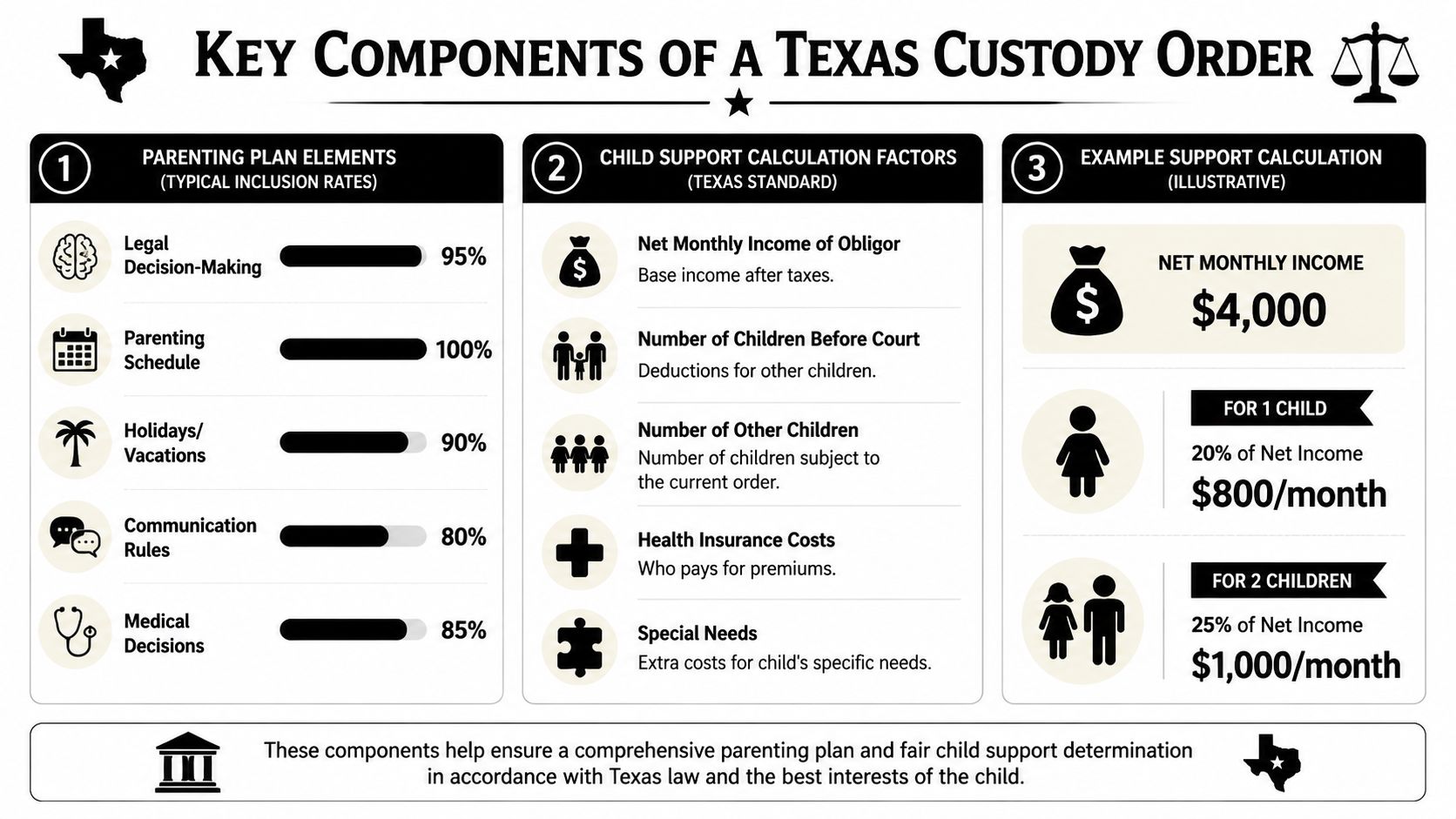
What judges want in a parenting plan
Texas judges decide custody based on the child's best interest. Broad legal standards matter less than clear facts a court can use. Parents who bring a specific, workable plan usually do better than parents who show up with general complaints.
In Harris County, the strongest parenting plans answer the questions that usually start the next argument. Put it in writing.
A solid plan should cover:
- Decision-making rights: Who can make education, medical, dental, and counseling decisions, and whether those rights are joint or independent.
- Possession schedule: Regular weekdays, weekends, holidays, summer, birthdays, and school breaks.
- Exchange details: Pick-up times, drop-off locations, transportation duties, and what happens if someone is late.
- Communication rules: How parents share school updates, doctor information, and activity schedules, and how the child contacts the other parent.
- Notice requirements: How much advance notice is required for travel, schedule changes, or extracurricular events.
For unmarried parents, this part deserves extra attention. I see too many cases where one parent has been handling most of the daily care, but there was never a clear written routine. That gap causes trouble fast. If paternity was established late, or the parents never lived together, do not assume the court will fill in the blanks the way you want. Spell out the routine, the decision-making structure, and the exchange logistics.
One more point. “Reasonable visitation” sounds friendly, but it often creates constant fighting. Specific terms are better.
Child support is math first, argument second
Texas child support usually starts with guideline percentages tied to the paying parent's net resources, as noted in this summary of Texas family law custody and support statistics. The fight is usually not about the formula. The fight is about income, health insurance, daycare, overtime, self-employment records, and whether someone is hiding money.
Get the numbers right the first time.
That means gathering pay stubs, tax returns, benefits information, proof of insurance cost for the child, and any records that show irregular income. If a parent is paid in cash, works for themselves, or suddenly claims they are unemployed, expect scrutiny. Harris County judges have seen every version of creative bookkeeping.
Build an order people can actually follow
The best custody orders are practical. They match the child's real life.
If your child goes to school in Humble ISD, plays sports on certain nights, or sees a counselor during the week, your proposed schedule should reflect that. A judge is more likely to approve a plan that fits the child's routine than one copied from a form and dumped into your case. Parents who want less conflict should also consider reading this local guide on what mediation looks like in family court before locking themselves into a courtroom fight over every detail.
Here is the kind of proof that strengthens a final parenting proposal:
| Type of evidence | Why it helps |
|---|---|
| School records | Shows attendance patterns, school involvement, and who handles day-to-day education issues |
| Medical records | Shows who schedules appointments and follows through with treatment |
| Parent communications | Shows whether each parent shares information and cooperates |
| Calendar logs | Shows the actual parenting time, not the version argued about later |
| Witness testimony | Confirms routines, caregiving history, and the child's stability |
Courts reward clarity. So do children.
If an order is entered and the other parent ignores it, enforcement may become part of the case later. The Law Office of Bryan Fagan handles family law matters for local families, including custody disputes and related enforcement concerns in the Humble area.
Common Pitfalls and Alternative Paths like Mediation
Some custody fights need a judge. A lot of them need structure, discipline, and less ego from both sides.

The biggest mistakes I see are predictable. Parents post online, talk too much around the kids, and treat every disagreement like proof the other parent should lose all rights. Courts don't reward that. They reward preparation and judgment.
Here's a quick comparison:
- Court fight: Necessary when safety, manipulation, or total deadlock is the problem.
- Mediation: Often the better route when both parents can negotiate with guardrails.
- Collaborative discussions: Useful when details matter more than drama.
- Agreed orders: Smart when the parents already have basic alignment and need the agreement made enforceable.
A practical explanation of the process helps. This guide on what mediation is in family court gives local context for parents weighing their options.
This short video also gives families another way to think through resolution paths before they harden into a full-scale court fight.
Mediation isn't weakness. It's often a disciplined way to get to a detailed order faster and with less damage to the co-parenting relationship. But it only works if both sides come prepared, stay child-focused, and stop trying to re-litigate the breakup through the parenting plan.
You Don't Have to Face This Alone Your Humble Legal Partner
Custody law feels personal because it is personal. You're not sorting out a business dispute. You're trying to protect your child, your role as a parent, and the shape of daily life for years to come.

Parents in Humble, Atascocita, Kingwood, and across Northeast Houston don't need another generic article. They need local guidance that respects how Harris County courts work. They need someone who understands when paternity has to come first, when temporary orders will make or break stability, and when a clean agreed order is better than a loud court fight.
You can file some custody cases on your own. That's true. But “can” and “should” are different questions. If your facts are contested, if the other parent is uncooperative, or if you're an unmarried parent dealing with standing issues, local legal advice can save months of mistakes.
If you need help with the next step, start with a direct conversation and get clear on your options. A dedicated Child Custody Lawyer in Humble, TX can help you evaluate the facts, the procedure, and the smartest path forward in Harris County.
If you're dealing with a custody problem in Humble, Atascocita, Kingwood, or Northeast Houston, schedule a free consultation with the Law Office of Bryan Fagan. We'll talk through where your case stands, what needs to happen first, and how to move toward a workable court order that protects your child and your future.


