 Skip to content
Some custody problems in Humble don't start with a courtroom filing. They start in a driveway after school pickup, with a text that says one thing and a child hearing something else. Maybe you and the other parent tried to keep it informal. Maybe that worked for a while. Then schedules slipped, school decisions turned into arguments, or one parent stopped following through.
That's usually the moment parents in Humble, Atascocita, Kingwood, and across Northeast Houston realize they need more than goodwill. They need structure. They need a plan that protects their child and gives them something reliable to stand on.
A good custody case isn't about “winning” in the dramatic sense. It's about building stable routines, clear rights, and workable expectations. It's also about lowering the temperature where possible, because children feel the strain long before adults say it out loud.
If you're searching for a custody lawyer in Humble, TX, you probably want straight answers before you make another move. That's what this guide is for. It focuses on the local Harris County realities that generic Texas articles often skip, and it starts with the practical steps that matter before you ever walk into court.
Taking the First Step in Your Humble Custody Case
A parent in Humble might begin with the same thought many people have: “We can handle this ourselves.” At first, that can seem reasonable. One parent keeps the child during the week, the other takes weekends, and everyone tries to stay flexible.
Then real life gets in the way. A new partner enters the picture. School attendance becomes inconsistent. Exchanges move from calm to tense. One parent starts making unilateral decisions about doctors, daycare, or activities. What used to feel manageable now feels unstable.
That shift matters. Informal arrangements can help in the short term, but they often break down when there's conflict, changing work schedules, or disagreement about what's best for the child. Once that happens, parents need something more dependable than text messages and verbal promises.
Most parents don't call a lawyer because they want conflict. They call because the child needs consistency and the adults can't create it alone anymore.
The first useful step is usually not filing paperwork that same day. It's getting clear on three things:
- What is happening now. Write down the current schedule, where the child sleeps, who handles school and medical issues, and where communication keeps failing.
- What worries you most. Is it missed pickups, instability, a relocation concern, or lack of communication about the child's needs?
- What outcome would work. Judges and mediators respond better to reasonable, child-focused requests than broad frustration.
That kind of preparation helps you speak clearly when you meet counsel. It also helps you avoid reactive decisions that create more trouble later.
If you're still deciding whether it's time to involve counsel, this overview on when to hire a custody lawyer in Humble can help you gauge whether your situation has moved beyond an informal parenting dispute and into a legal one.
Finding the Right Family Law Advocate in Northeast Houston
A Humble parent often starts this search after a small routine breaks down. One missed exchange turns into three. School pickup becomes uncertain. The other parent stops giving straight answers. At that point, the question is usually not “Do I need a lawyer at all?” It is “Who can help me get a workable plan in Harris County without making this harder than it already is?”

A good fit starts with local judgment. Texas custody law sets the rules, but Humble families deal with Harris County procedures, courthouse expectations, mediation practices, and the practical reality of school zones, commutes, and exchange logistics around Northeast Houston. A lawyer who regularly handles cases from Humble, Atascocita, Kingwood, and nearby communities will usually see those details sooner and build them into the strategy.
What to look for first
Look for a lawyer whose work centers on family law. Custody cases turn on facts that can seem ordinary until they are presented in court. Who gets the child ready for school. Who attends doctor visits. How often the schedule changes. Whether communication stays civil enough to co-parent. A lawyer who handles these issues every week usually knows which facts matter and which ones only create noise.
Ask about Harris County experience in practical terms, not just years in practice. Does the lawyer regularly handle temporary orders hearings, mediation, enforcement issues, and modifications? Can they explain how local judges tend to expect parents to present concerns about school attendance, medical care, or missed possession without turning the case into a personal vendetta? That is the kind of local knowledge generic Texas guides often miss.
Temperament matters too. Some lawyers are built for high-conflict litigation. Others are better at negotiated parenting plans. Many cases need both skills. The right advocate should be able to protect you in a hearing and still recognize when settlement is the better result for the child.
Questions worth asking in a consultation
Use the consultation to test judgment, clarity, and fit.
- How much of your practice is family law? A direct answer is better than a broad list of unrelated services.
- What would you focus on first in my case? This shows whether the lawyer can quickly spot the immediate risk.
- How do you handle temporary orders and mediation in Harris County? Early decisions often shape the months that follow.
- What kind of client communication should I expect? You should know who returns calls, how often you get updates, and how emergencies are handled.
- What facts would weaken my position? Good counsel does not just validate your side. Good counsel gives you a realistic assessment.
One useful sign is whether the lawyer can explain conservatorship, possession, and decision-making rights in plain English. Parents make better choices when they understand the difference between wanting “full custody” and asking for orders a Harris County judge is likely to sign.
The best consultation usually feels calm, direct, and specific. You should leave with a clearer picture of the case, not just a stronger emotional reaction.
Research on represented custody disputes from Custody X Change's custody representation research suggests that cases with lawyers often resolve through settlement rather than final trial. That lines up with what many parents see in Harris County. Preparation, realistic advice, and structured negotiation often matter more than courtroom drama.
What to avoid
Early warning signs are usually easy to spot once you know what to watch for.
| What helps | What creates problems |
|---|---|
| A lawyer explains likely outcomes and trade-offs clearly | A lawyer promises a quick win before reviewing the facts |
| They ask about your child's routine, school, health, and schedule | They focus almost entirely on attacking the other parent |
| They understand Harris County procedure and local practice | They speak only in broad Texas law generalities |
| Billing, retainer terms, and next steps are explained up front | Fees and staffing stay vague until after you sign |
One trade-off deserves special attention. A very aggressive lawyer can feel reassuring in the first meeting, especially if you are angry or scared. That same approach can increase cost, harden the other parent's position, and make co-parenting harder after the case ends. On the other hand, a lawyer who avoids conflict at all costs may leave urgent problems unaddressed. The better choice is usually counsel who knows when to press and when to de-escalate.
A firm's website can also tell you something about how it treats clients. Clear explanations, realistic language, and useful educational content are good signs. If you want to see how law firms build trust online, these expert insights for legal marketing offer a helpful outside view of what client-focused communication looks like.
If you are comparing local options, this guide to the best family lawyer in Humble, Texas gives another practical benchmark for judging experience, communication style, and overall fit.
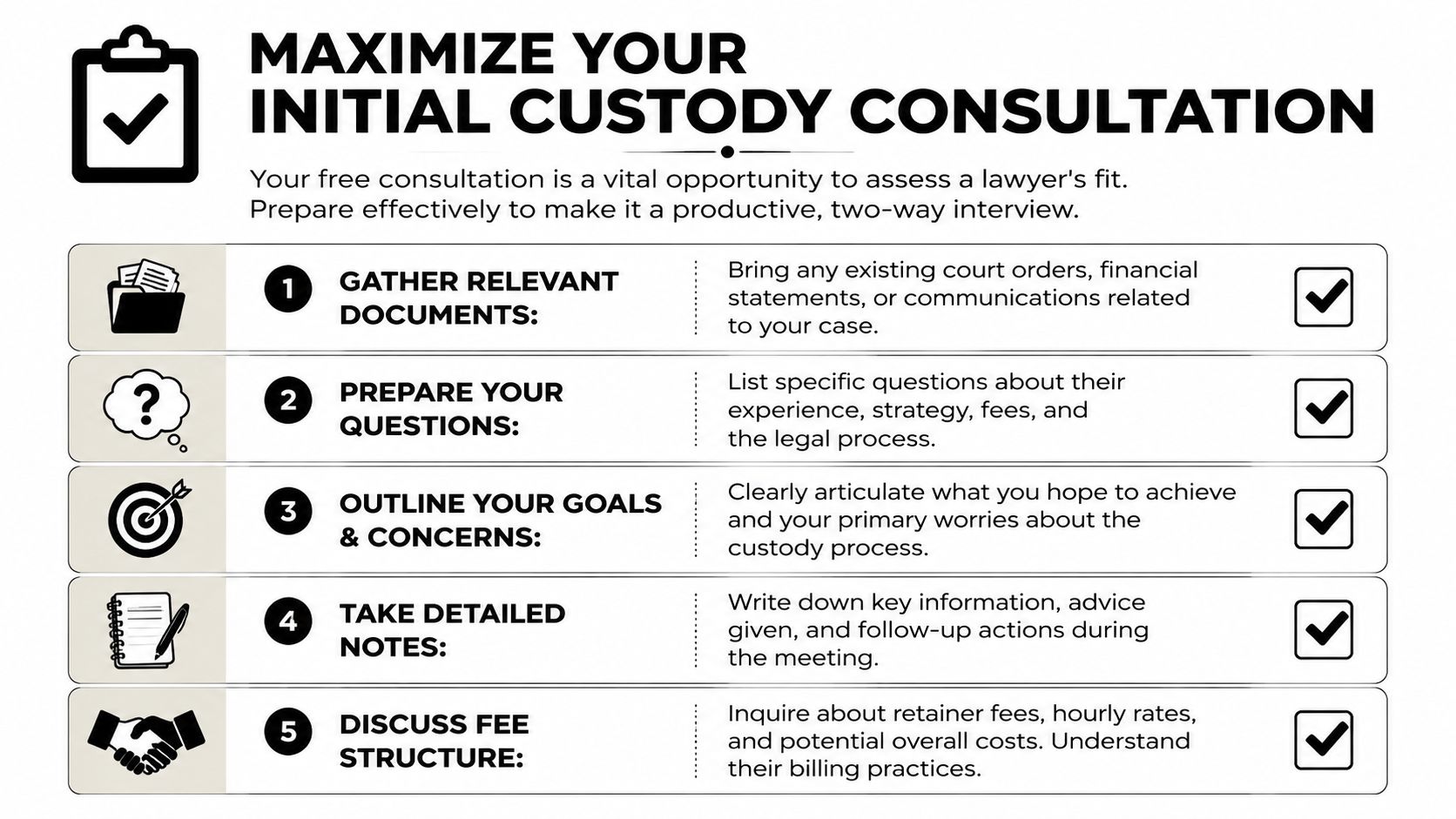
How to Prepare for Your Initial Consultation
The first consultation goes better when you treat it like a working meeting, not a passive intake. You don't need a perfect binder. You do need enough information to help the lawyer see the shape of your case quickly.
Bring a simple timeline
A one-page timeline is often more useful than a stack of unsorted screenshots. Include the child's age, current living arrangement, school situation, major disputes, any prior court orders, and any recent event that pushed you to seek help now.
If there's been a pattern of missed exchanges, school disruptions, or communication problems, write dates where you can. If you don't know every date, list the sequence as accurately as possible. Clear chronology helps a lawyer identify where immediate action may be needed.
Gather the documents that matter
Harris County requires serious document preparation in family cases. Each party must submit a final Inventory, Financial Information Statement, tax returns from the last two years, and two recent pay stubs no later than 10 days before trial, and parents must complete a co-parenting course, according to this summary of Harris County custody and divorce requirements.
You won't need every trial document on day one, but starting early saves time and stress. Helpful items include:
- Existing court papers. Prior orders, petitions, or notices.
- Financial basics. Recent pay stubs, tax returns, and any support records.
- Parenting evidence. School notices, medical records, calendars, and key written communications.
- Your own notes. A list of concerns, goals, and questions.
If you're looking for factual background on custody and conservatorship representation for local families, Child Custody Lawyer in Humble, TX describes that service area in straightforward terms.
Here's a short video that can help you think through consultation prep before you meet with counsel:
Ask better questions
A good consultation isn't just about whether a lawyer will take your case. It's about whether the fit is right.
Consider asking:
- What should I stop doing right now if I don't want to hurt my case?
- What will the court care about most in my specific situation?
- What kind of temporary arrangement makes sense while the case is pending?
- How do you prepare clients for mediation and hearings?
- Who will communicate with me, and how often?
Practical rule: Don't bring every angry text you've ever received and expect that alone to decide custody. Bring the communications that show patterns affecting the child's stability, safety, schooling, health, or routine.
If you want a more detailed checklist before your meeting, review this guide on how to prepare for a consultation with a family lawyer.
Navigating the Humble Custody Process in Harris County Courts
A parent in Humble often calls after the first real shock of a custody case. Papers have been filed, emotions are high, and the biggest question is usually simple: what happens now?
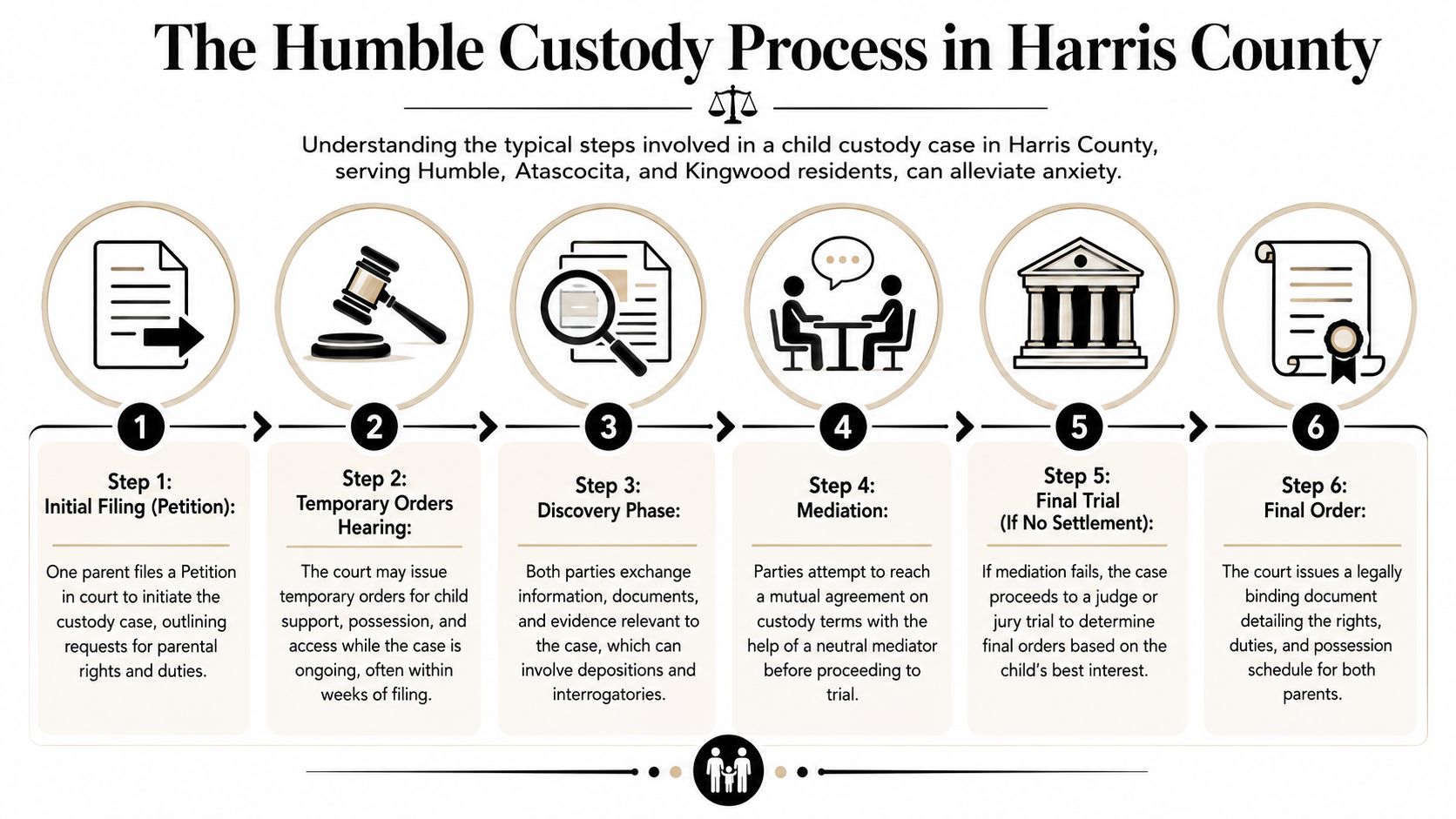
Most Harris County cases follow a fairly predictable path, but the local details matter. A case filed downtown can still turn on practical facts from everyday life in Humble, Atascocita, or Kingwood. School pickup times, commute distance, medical routines, and who has been handling weeknight care often matter more than dramatic accusations.
The case starts with filing and service
A custody case usually begins with a petition. That filing tells the court what orders a parent wants on conservatorship, possession, support, and decision-making. After that, the other parent must be formally served unless a valid waiver is signed.
This part is more technical than people expect. Texting the other parent that a case was filed is not service. If service is mishandled, the case can stall, hearings can be delayed, and money gets spent fixing a problem that should have been handled correctly at the start.
Temporary orders often shape the case early
In many Harris County family cases, the first meaningful court structure comes through temporary orders. Those orders can set a possession schedule, child support, exchange terms, use of the home, and rules for decision-making while the case is pending.
That early stage carries real weight. Judges and mediators often look closely at what has already been working, what has not, and whether either parent followed temporary arrangements in good faith. A parent who shows up with a child-centered plan, accurate school and medical information, and a calm explanation of the daily routine usually stands on better ground than a parent who arrives with broad complaints and no workable proposal.
I often tell parents to focus on the next 90 days, not just the final hearing. Temporary orders are where the court sees whether a proposed plan fits the child's actual life.
A useful temporary-order request usually includes:
- A schedule the family can follow
- Details about school, daycare, therapy, or medical care
- Specific examples of cooperation or missed responsibilities
- Requests tied to the child's stability, not the parents' anger
Mediation is often where the real parenting plan gets built
Very few parents get a full trial on every disagreement. In Harris County, mediation is often the point where the case either settles or narrows enough to make the remaining dispute manageable.
That is not a sign the case is weak. It is usually a practical decision. A judge has limited time and will not know your child's routines the way you do. Mediation gives parents more room to shape exchange times, holiday language, phone contact, extracurricular rules, and pickup logistics in a way that fits life in Northeast Houston.
Good mediation preparation is usually plain and concrete. Bring a schedule you can defend. Know which issues matter. Be ready to trade on lower-priority points so you can protect the terms that affect your child every week.
If your custody case overlaps with divorce
Some custody cases are filed on their own. Others are wrapped into a divorce, which adds pressure fast. Parenting decisions then sit alongside property division, support, debt, and questions about who stays in the house.
That overlap changes strategy. A possession schedule that looks fair on paper may fail if it does not account for work hours, transportation, or who can get a child to school in the Humble area on time. Divorce Lawyer in Humble, TX provides factual information about divorce representation for clients in Humble and Harris County.
Final orders need plain, specific language
Whether the case settles or goes to trial, the written final order matters as much as the courtroom result. Vague language creates future fights. Clear language prevents them.
A solid final order should spell out possession dates, holiday rotations, exchange locations, notice rules, decision-making rights, support terms, and who covers which child-related expenses. If parents have a history of conflict, details matter even more. “We will work it out later” is usually how families end up back in court.
Understanding Texas Custody Rules Timelines and Costs
A parent in Humble can file a custody case on Monday and still need to get a child to school, cover after-school pickup, and answer tense texts that same night. That is why these three questions come up so often. What standard will the court apply, how long will this take, and what is this likely to cost?

What judges are looking for
Texas courts decide conservatorship and possession based on the best interest of the child. In Harris County, judges usually want to see which parent can offer stability, support the child's routine, make sound decisions, and keep conflict from spilling onto the child.
Under Texas Family Code §153.134, many cases involve Joint Managing Conservatorship, as discussed in this overview of Texas custody rules affecting Harris County cases. That usually means both parents keep important rights and duties, even if the possession schedule is not equal.
Parents often hear “joint” and assume that means a perfect 50/50 split. Harris County courts do not treat those as the same thing. A judge may keep both parents in major decision-making roles while still giving one parent the right to determine the child's primary residence or setting a schedule that fits school, work hours, transportation, and the child's age.
Local court practice matters here. A schedule that sounds fair in the abstract can fall apart fast if exchanges require a long drive across Houston traffic, one parent works rotating shifts, or the child attends school near Humble and one household is much farther away. Those practical details often shape outcomes more than parents expect.
Timelines depend on conflict, court settings, and preparation
Custody cases rarely move at the pace family life demands. The court has its calendar. Lawyers have deadlines. Parents still have birthdays, report cards, doctor visits, and missed pickups.
In practice, cases move faster when temporary issues are addressed early, records are organized, and both sides respond on time. Cases slow down when there are emergency filings, disputed facts, missing documents, or constant fights over side issues.
A useful way to view the timeline is by stage:
| Stage | What parents usually need to do |
|---|---|
| Early case | Gather records, follow temporary rules, avoid reactive communication |
| Negotiation period | Clarify priorities, respond to document requests, prepare for mediation |
| Final stretch | Review proposed terms carefully, confirm logistics, make sure the order matches the agreement |
Some Harris County family courts move more quickly than parents expect on temporary matters and more slowly than they hope on final resolution. That gap is hard on families. It also means parents should prepare for a process, not a single hearing that fixes everything.
Costs depend on facts, but also on how the case is handled
No careful family lawyer should promise a flat answer on cost at the first conversation without knowing the dispute, the amount of evidence involved, and whether trial is likely. A narrow disagreement over schedule details costs less to handle than a case with emergency requests, extensive discovery, business income questions, or repeated court appearances.
Client behavior affects fees too. Last-minute document searches create billable work. Disorganized communication makes it harder to separate a legally important issue from an upsetting one. Constant escalation over minor grievances usually drains time and money without improving the final result.
Several habits tend to keep a case more manageable:
- Organized records. Store calendars, school records, medical information, and messages in one place.
- Clear priorities. Know which terms matter for your child's routine and safety.
- Careful communication. Write as if a judge may read it later.
- Practical settlement efforts. A workable agreement often saves substantial time, stress, and expense.
If you need a system for storing and sharing records, these secure options for family document management can help keep sensitive files in order.
Child support planning in higher-income cases
Support and custody often overlap, especially when one parent has variable income, self-employment earnings, bonuses, commissions, or employer-paid benefits. Those details can take time to sort out, and parents in Northeast Houston are often dealing with exactly that kind of pay structure.
Texas guideline support applies to net resources up to a cap. For families above that level, support questions may require a closer look at the child's proven needs and the financial picture in both households. That does not automatically mean a fight. It does mean good records matter.
Waiting until the end of the case to gather pay stubs, tax returns, business records, or benefit information usually creates avoidable problems. Early organization gives your lawyer better facts to work with and puts you in a stronger position during negotiation.
For readers comparing options, the Law Office of Bryan Fagan handles family law matters for Humble-area clients, including custody and related divorce issues. The better question is whether the lawyer you hire can explain Harris County practice clearly, set realistic expectations about timing, and help you make disciplined decisions about cost from the start.
You Have Hired Your Lawyer What Happens Next
Once you hire counsel, the case becomes more structured. That's often the first real relief parents feel. Instead of reacting to each new text or threat, you begin working from a plan.
Your lawyer will usually move into a deeper fact-gathering stage. That can include reviewing your timeline, organizing documents, identifying immediate risks, and deciding whether temporary relief is needed. You may also discuss what communication with the other parent should look like from this point forward, especially if things have been volatile.
Expect homework. Good custody representation depends on complete information, not guesses. You may need to gather school records, medical information, calendars, financial documents, and key communications. If keeping those materials organized feels overwhelming, these secure options for family document management can be a practical starting point for storing and sharing sensitive files safely.
Your role matters after hiring a lawyer. The parents who help their own cases most are usually the ones who stay organized, follow advice, meet deadlines, and keep their focus on the child instead of the argument.
A custody case can still be emotionally hard. But it becomes much less confusing when you know what the court expects, what your lawyer needs, and what steps come next. For many Humble families, that shift from uncertainty to structure is what finally makes progress possible.
If you're dealing with a custody dispute in Humble, Atascocita, Kingwood, or Northeast Houston, the next step doesn't have to be complicated. Schedule a free consultation with Law Office of Bryan Fagan to talk through your situation, understand your options under Texas law, and build a practical plan that protects your child, your rights, and your future.


