 Skip to content
A lot of people in Humble, Atascocita, Kingwood, and Northeast Houston hit the same uneasy moment during divorce. You're sorting through the house, the bank accounts, and the bills, then you realize the biggest asset may be the retirement account that took years to build.
That's when the questions start. Is a 401(k) in one spouse's name still shared? What if part of it was saved before the marriage? What happens to a teacher's pension? If you've searched for answers about property division retirement benefits Texas families can easily understand, you're not alone.
At the Law Office of Bryan Fagan, we talk with local families every day who want straight answers without legal jargon. Divorce is stressful enough. You shouldn't also have to guess how Texas handles your future retirement security.
Facing Divorce and Worried About Your Retirement
A neighbor in Kingwood might have spent years working for a private company and building a 401(k). A spouse in Humble ISD may be counting on a future pension through TRS. Another family in Atascocita may have one spouse who handled the paycheck and another who handled the home and children. In all of those situations, retirement benefits can become one of the most emotional parts of the divorce.
That fear makes sense. Retirement accounts don't feel like a checking account you can split today. They represent future stability, years of work, and plans you made as a couple.
Divorce can end a marriage, but it doesn't automatically answer who gets what from a retirement plan.
Many people assume the account belongs to whoever earned it at work. In Texas, that's often not how it works. Other people assume everything gets split right down the middle. That can be wrong too.
The better approach is to slow down and separate the issues. First, identify what part of the retirement benefit was earned during the marriage. Then figure out what type of plan it is. After that, make sure the legal paperwork matches the deal or court order.
Why local families get tripped up
In Harris County divorces, retirement division gets confusing because several rules can apply at once. You may have community property rules, tracing issues for pre-marriage contributions, plan-specific paperwork, and standing orders that limit withdrawals after filing.
For families in Northeast Houston, that usually means the retirement question isn't solved by a quick conversation at mediation. It takes documents, careful drafting, and a practical strategy.
If you're in Humble and trying to protect what you built, or make sure you receive the share Texas law gives you, clear information matters. So does timing.
Texas Community Property and Your Retirement Funds
Texas treats marriage a bit like a shared financial partnership. A simple way to think about it is a shared savings jar. If money goes into the jar during the marriage, Texas starts with the presumption that it belongs to both spouses, even if only one spouse earned the paycheck.
That same idea applies to many retirement benefits. In Texas, under Texas Family Code Chapter 3, any retirement savings earned during the marriage are automatically presumed to be community property belonging equally to both spouses, regardless of whose name is on the account or which spouse contributed through employment (Flatiron Legal on retirement accounts as community property in Texas divorces).
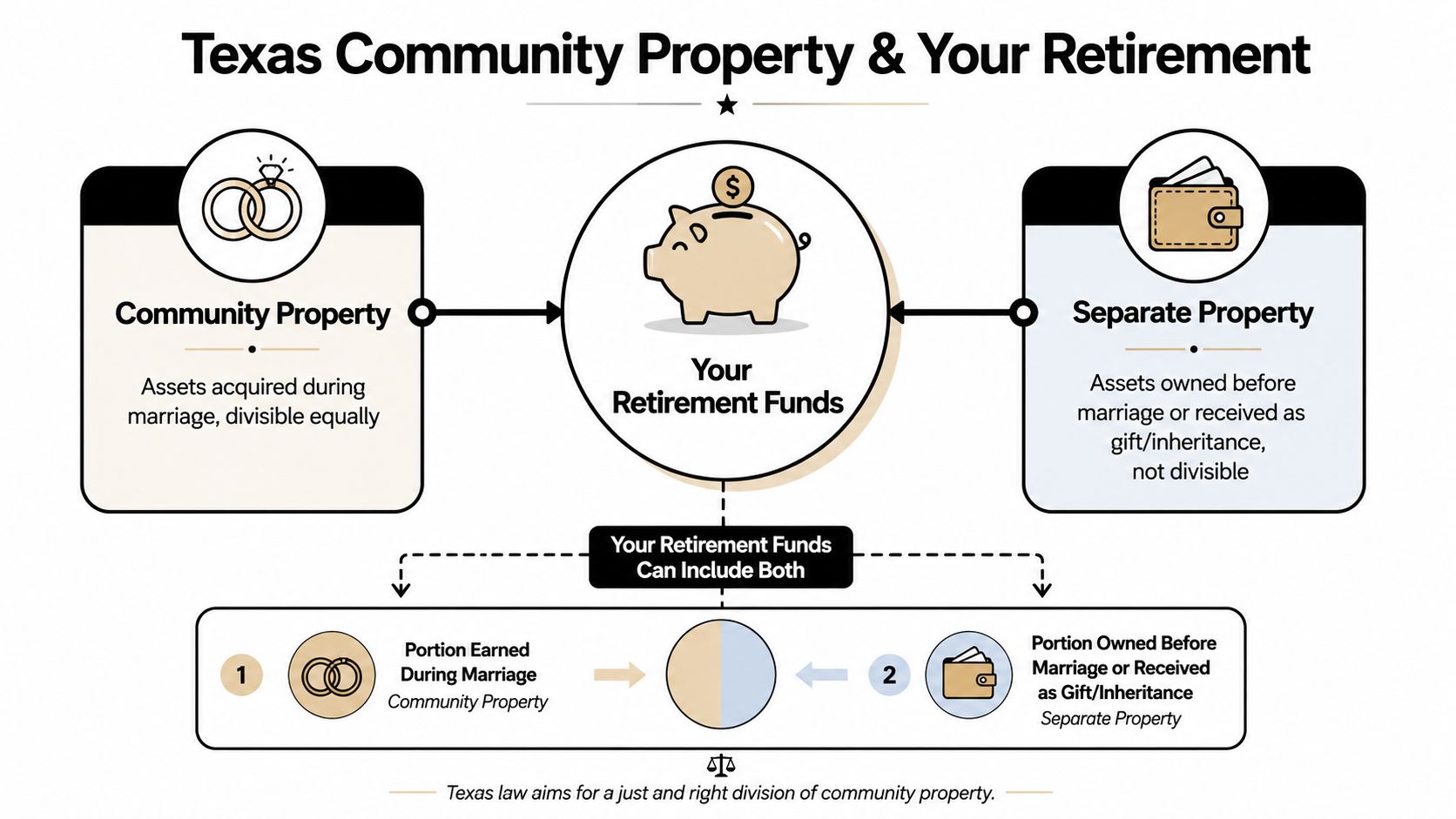
Community property versus separate property
The line usually comes down to timing.
- Before marriage: Contributions made before the wedding are generally separate property.
- During marriage: Contributions and earnings during the marriage are generally part of the community estate.
- After divorce: New contributions and growth after the divorce belong to the employee spouse.
That sounds simple until one account contains all three. A long-running 401(k) often includes pre-marriage money, marital contributions, and later growth. When that happens, the court has to sort out which portion is community and which portion is separate.
Why proof matters so much
Texas law starts with a presumption. If an asset was acquired during marriage, the court generally treats it as community property unless someone proves otherwise. To protect a separate portion, the spouse claiming it has to produce strong documentation.
That usually means old account statements, plan records, and anything else showing what the balance was before marriage and how the funds changed over time. Without that paper trail, a separate-property claim can fall apart.
Practical rule: If you believe part of your retirement account is yours alone, don't rely on memory. Rely on records.
For a broader explanation of how these rules work in local divorce cases, this guide on community property in Texas is a useful starting point. In more asset-heavy divorces, a Property Division Lawyer in Humble may also be involved in reviewing community property and complex assets for Humble divorces.
How to Value and Trace Retirement Assets
Once you know an account may be divisible, the next question is value. That answer depends on what kind of retirement plan you're dealing with. A 401(k) is usually more direct. A pension usually isn't.

Valuing a 401(k) versus valuing a pension
A defined contribution account, such as a 401(k), usually has a statement showing the account balance. The hard part is often deciding what date controls and separating any pre-marriage amount from the marital portion.
A defined benefit plan, such as a pension, is different. The benefit may be paid in the future and tied to service time or a formula within the plan. That means the issue may not be a visible account balance at all. It may be a future stream of benefits that has to be analyzed carefully.
Tracing the separate portion
Texas doesn't make the court guess. Texas law presumes that all income and benefits earned during marriage are community property under Texas Family Code § 3.007, but the division must be "just and right," not necessarily a 50/50 split. The account holder bears the burden of proving the separate portion to protect it from division (Business and Family Lawyers on dividing retirement benefits and QDROs).
That burden matters in real life. If you had a retirement account before marriage and want to keep that portion separate, gather documents early.
- Old statements: The statement closest to the wedding date can be especially important.
- Plan summaries: These help identify how the plan works and what records exist.
- Transaction history: Contributions, rollovers, and loans can complicate tracing.
- Employment records: These may help show when benefits were earned.
If one spouse controlled most of the financial records, formal information gathering may be needed. In that situation, the Texas divorce discovery process often becomes important for obtaining plan documents and account histories.
The court is aiming for fair, not automatic equality
People often walk into a divorce expecting the retirement portion to be split evenly. Sometimes it is. Sometimes it isn't. Texas uses a just and right standard, which means the court looks at fairness under the circumstances rather than requiring an exact half-and-half result.
That's one reason valuation disputes matter. If the numbers are off, the settlement may be off. If the order later isn't followed, issues can spill into proceedings involving Enforcement of Court Orders in Humble, which deals with enforcing divorce decree and custody order provisions in Harris County.
Good property division starts long before the final hearing. It starts when someone saves the records.
The QDRO Your Most Important Divorce Document
A divorce decree may say a spouse gets a share of a retirement account. But for many employer-sponsored plans, that decree is not enough to make the transfer happen. The document that usually makes the transfer effective is the Qualified Domestic Relations Order, or QDRO.
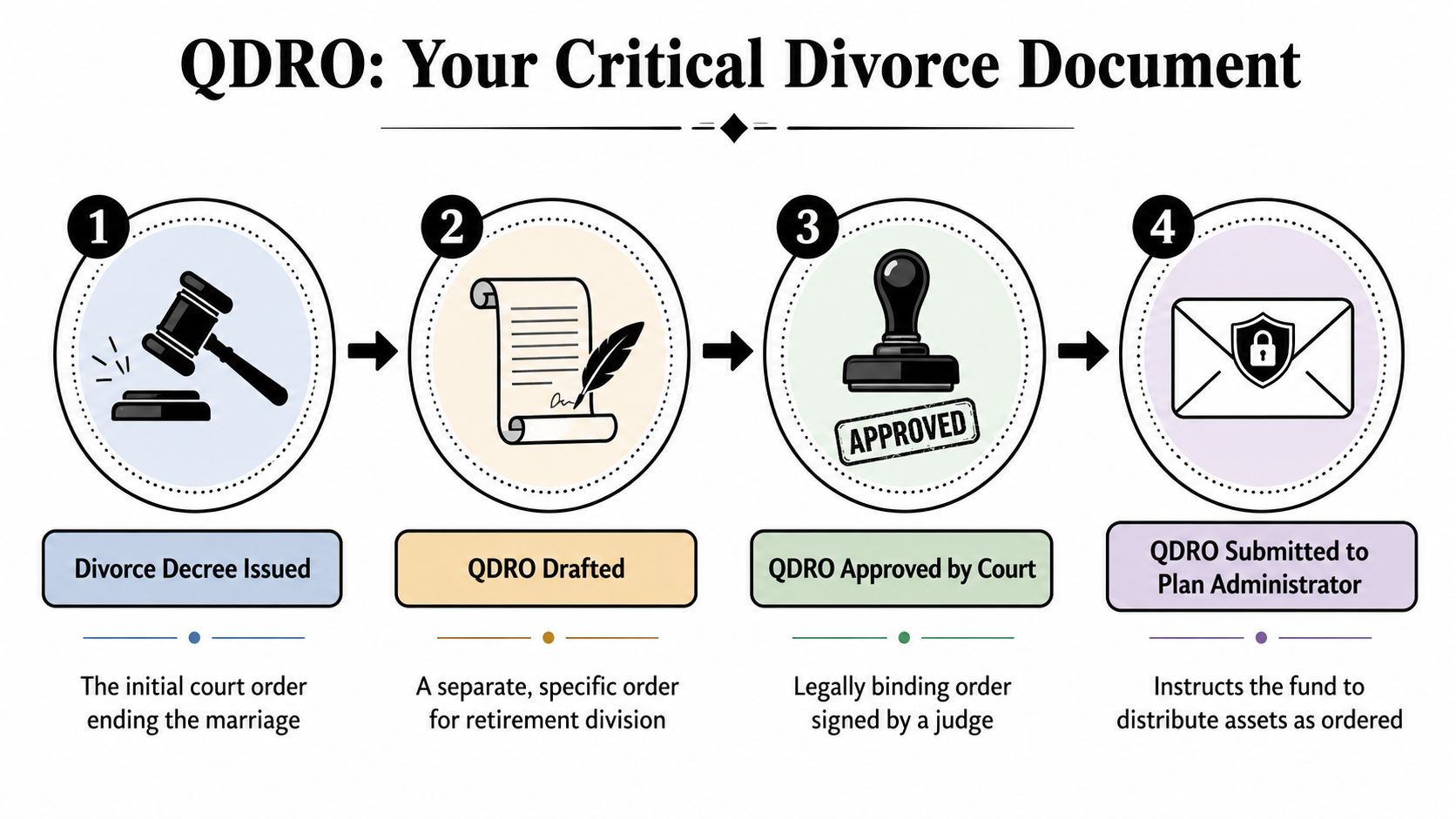
A QDRO is a separate court order that tells the plan administrator what to divide and who should receive the assigned share. For plans like many 401(k)s and 403(b)s, it is legally required to divide the account without triggering immediate tax problems or early withdrawal penalties. The divorce decree alone can't legally direct the plan administrator to pay the non-employee spouse.
Why delay creates real risk
The most dangerous mistake is what many lawyers informally call the Sleep-QDRO problem. That happens when the divorce is finished, everyone assumes the retirement issue is handled, but the QDRO is never drafted, signed, or submitted to the plan.
Here's why that matters. The decree may award a share on paper, but the non-employee spouse's rights may remain exposed until the plan administrator receives the proper order.
A decree values the asset. The QDRO severs it.
If you want a plain-language overview of this process, this page on a QDRO attorney in Humble, TX explains how the order fits into divorce practice locally.
A short video can also help make the process easier to follow:
The hidden trap after the decree is signed
Texas law does allow people to go back later if the QDRO was missed. But later can be expensive and risky in ways many families don't expect. If a QDRO was missed during the divorce, a client can return to court to get it signed. However, this "Sleep-QDRO" scenario is risky; the divided share is not legally protected until the QDRO is filed with the plan administrator, and administrators often reject retroactive division if the account holder has already moved funds or passed away (Texas Attorney on dividing a 401(k) or retirement account in Texas divorce).
That single point causes a lot of heartbreak. A person may think, “The decree says I get my part, so I'm fine.” Then years pass. The employee spouse retires, borrows against the plan, rolls funds elsewhere, or dies before the order is in place. By then, recovering the intended share can become far harder.
What filing quickly protects
A timely QDRO helps protect several things at once:
- Your access to the plan: The administrator has formal instructions it can follow.
- The transfer process: The order can allow division without the wrong kind of distribution.
- The timing of ownership: Your share is treated as something that should be carved out, not left floating after divorce.
- Fewer future disputes: Clear paperwork reduces the chance of arguments years later.
This is not optional paperwork. In many cases, it is the only document that turns a divorce award into something the retirement plan will recognize.
Dividing Different Types of Retirement Plans
Not all retirement plans are divided the same way. That's where many families in Humble and Kingwood get frustrated. A 401(k), a TRS pension, a military retirement benefit, and an IRA can all appear under the broad label of “retirement,” but the legal steps are different.
A side-by-side view
| Account Type | Legal Document Required | Key Division Factor |
|---|---|---|
| 401(k) or 403(b) | QDRO | Community portion earned during marriage |
| Private pension | QDRO or plan-specific qualifying order | Benefit earned during marriage |
| TRS public pension | Court-issued DRO using official TRS model order for qualifying orders after January 1, 2015 | Portion of pension earned during marriage |
| Military retirement | QDRO-like order | Community property share, subject to Texas rules |
| IRA | Divorce transfer language and proper transfer process, not a standard QDRO | Terms of decree and transfer mechanics |
401(k)s and similar plans
For many private employer plans, the central question is how much of the account was built during the marriage. If the spouses agree on that share, the next step is using the proper order so the administrator can divide it correctly.
These accounts often feel easier because there's a visible balance. Still, visible doesn't mean simple. Loans, rollovers, and mixed separate and community funds can all complicate the final division.
Public pensions and the time-share confusion
Public pensions create a different kind of confusion. Teachers, school employees, and other public workers around Humble often assume the issue is “half the pension.” That shortcut can lead to bad expectations.
For Texas Teacher Retirement System benefits, the court orders the community property division. For court-issued orders entered on or after January 1, 2015, spouses must use the official TRS model DRO. An ex-spouse is typically entitled only to a portion of the pension earned specifically during the marriage (TRS divorce and DRO guidance).
That's where the time-share idea matters. With many public pensions, the focus is not merely the account's cash contributions. The focus is often the benefit earned through service during the marriage compared with total service time. If a teacher worked before marriage and continued working after divorce, the ex-spouse usually doesn't receive a share of the entire lifetime pension.
This is why someone may hear “you're getting a share” and still receive less than they expected. The share may apply only to the marital slice of the pension benefit.
Military retirement and federal plans
Military retirement follows its own rules, and Texas courts treat military pensions as community property up to a maximum share for the non-military spouse under the governing Texas rule described earlier in this article. Federal civilian retirement systems also have separate procedures and language requirements. If your case involves federal employment, this overview of benefits planning for federal employees can help you understand the broader structure before you talk strategy with counsel.
IRAs are different too
IRAs usually don't require a standard QDRO, but they still must be transferred the right way under the divorce settlement. That means the wording in the decree and the transfer steps matter. A casual withdrawal can create problems that a proper divorce transfer is meant to avoid.
Practical Steps and Smart Settlement Strategies
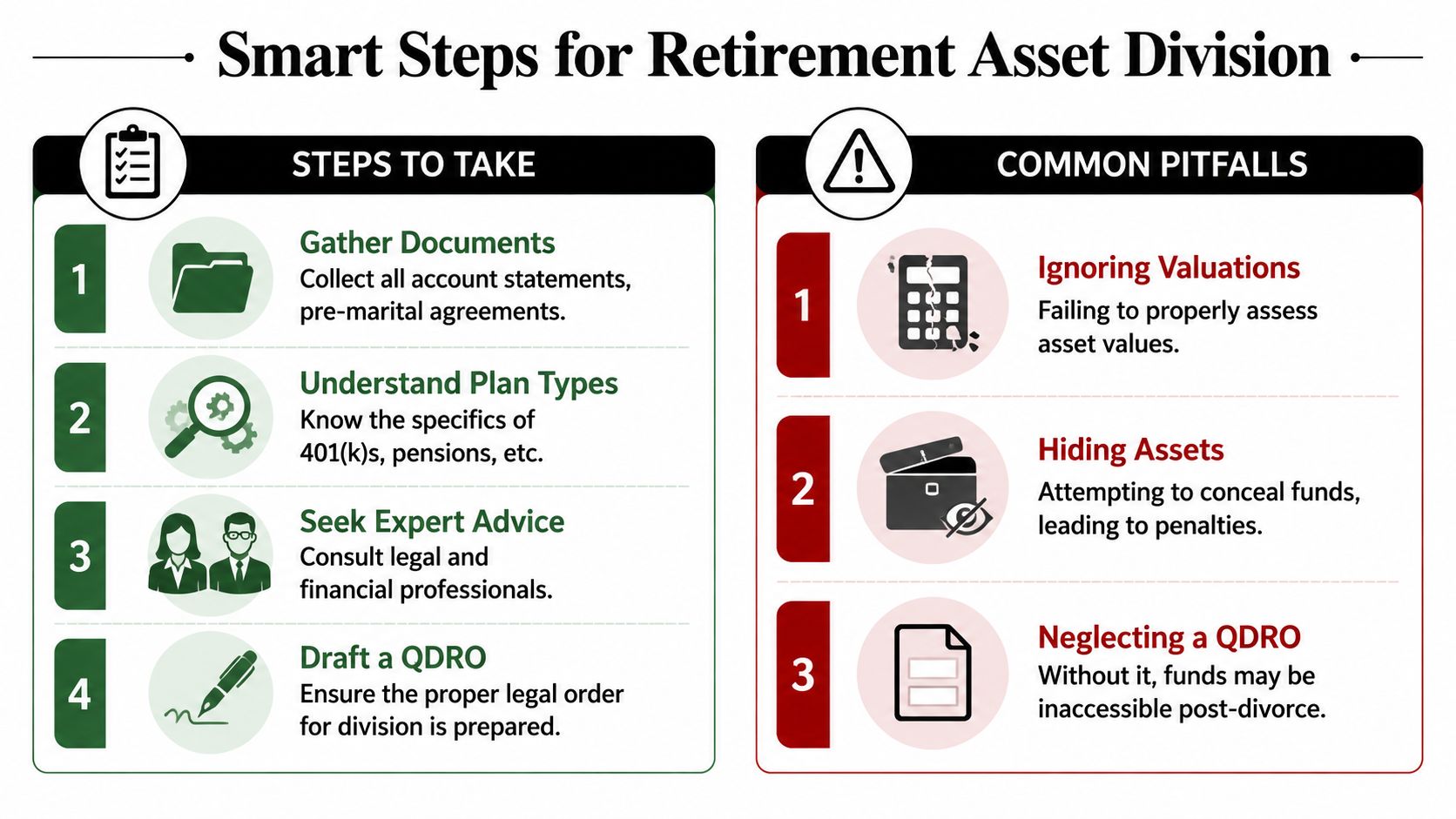
Once retirement benefits are on the table, people usually want to know what to do first. A clear checklist helps.
What to gather before negotiations start
- Current statements: Get the latest statement for each retirement account or plan.
- Pre-marriage records: If you're claiming a separate portion, find the earliest statement you can from before the wedding.
- Plan documents: Ask for the summary plan description or any division procedures the administrator provides.
- Employment benefit information: This matters for pensions, public plans, and military-related benefits.
- Existing court paperwork: Temporary orders, standing orders, and draft decree language all affect the process.
Two common ways to resolve the retirement issue
One option is to divide the retirement account itself through the proper legal order. The other is to use an offset or buyout. In a buyout, one spouse keeps the retirement asset while the other receives something else of similar value, such as equity in the home or another community asset.
That second route can be attractive when both spouses want a cleaner break. It can also be risky if the assets being traded aren't really comparable in liquidity, future value, or tax treatment. A retirement dollar and a house dollar don't always feel the same in real life.
How to think about settlement choices
A useful question is not just “What am I getting?” It's “When can I use it, what rules govern it, and what paperwork secures it?” That mindset often leads to better settlement decisions.
If divorce is colliding with other money decisions, such as whether to keep investing or focus on loan repayment, neutral financial education can help. This article on help with student debt choices is one example of the kind of outside budgeting resource some clients read while planning post-divorce finances.
For legal guidance on the property side, the Law Office of Bryan Fagan is one local option families use when they need help evaluating whether a direct division or a negotiated offset makes more sense for their circumstances.
Protect Your Future with a Humble Divorce Attorney
Retirement benefits often carry more emotion than almost any other asset in divorce. They represent safety, independence, and the years you spent building a life. That's why getting the details right matters so much for families in Humble, Atascocita, Kingwood, and across Northeast Houston.
The big ideas are straightforward, even if the paperwork isn't. Texas generally treats retirement benefits earned during marriage as part of the community estate. If part of the account predates the marriage, tracing and documentation matter. If the plan requires a special order, timing matters just as much as the final decree.
The two mistakes that hurt people most are assuming the account belongs only to the worker and assuming the decree alone finishes the job. In many cases, neither assumption is safe. Public pensions can involve a time-share approach, and private plans often require a QDRO before the non-employee spouse's rights are protected.
When your future income is at stake, “close enough” paperwork isn't close enough.
Divorce can leave you tired, distracted, and ready to be done. That's exactly when overlooked retirement details can create lasting problems. Careful legal review can help you avoid signing off on a settlement that looks fair today but doesn't hold up when the plan administrator gets involved later.
If you're dealing with retirement accounts, pensions, or other property issues in a divorce, schedule a free consultation with Law Office of Bryan Fagan. Our Humble office works with local families in Humble, Kingwood, Atascocita, and Northeast Houston to explain Texas law clearly, review your options, and help you protect your financial future with practical next steps.


