Skip to content

You're the one who opens the drawer, finds a signed will, and immediately feels the pressure rise. Maybe your loved one lived in Humble, maybe the house is in Kingwood, and maybe the family just wants to keep things simple without getting trapped in a long court process. In Texas, muniment of title can be that simpler path when the estate is straightforward and the goal is mainly to move title to property without full administration.
For families comparing options, it helps to see how other states handle smaller transfers too. If you've ever wondered how a different state treats a lighter-touch transfer process, the small estate transfer process in Arizona offers a useful comparison point, even though Texas uses its own rules. In Harris County, the main question is whether your situation fits a probate shortcut that can move property efficiently while still protecting the record.

A Simpler Path for Your Loved One's Will
A lot of Humble and Atascocita families reach the same point. They have a valid will, they know the house has to be transferred, and they don't want to spend months dealing with a full probate administration if they don't have to. That's usually when the term muniment of title starts to matter.
Think of it this way. Some probate paths put a person in charge of the entire estate, while muniment of title is more like getting a court order that opens the door for title transfer without naming a full-time property manager. Texas treats it as an efficient probate path when the estate qualifies under Estates Code § 257.001, and that makes it a practical option for simple estates where the main issue is getting the property record cleaned up.
The process still matters, though. This isn't a casual paperwork shortcut, and it's not something to guess your way through. Families in Northeast Houston often need clarity fast because they're trying to handle a home, a vehicle, or other property while also dealing with grief and family logistics.
Practical rule: if the will is clear and the estate is simple, muniment of title may save your family from unnecessary administration. If the estate has moving parts, the shortcut can create more work later.
What Muniment of Title Means for Your Family
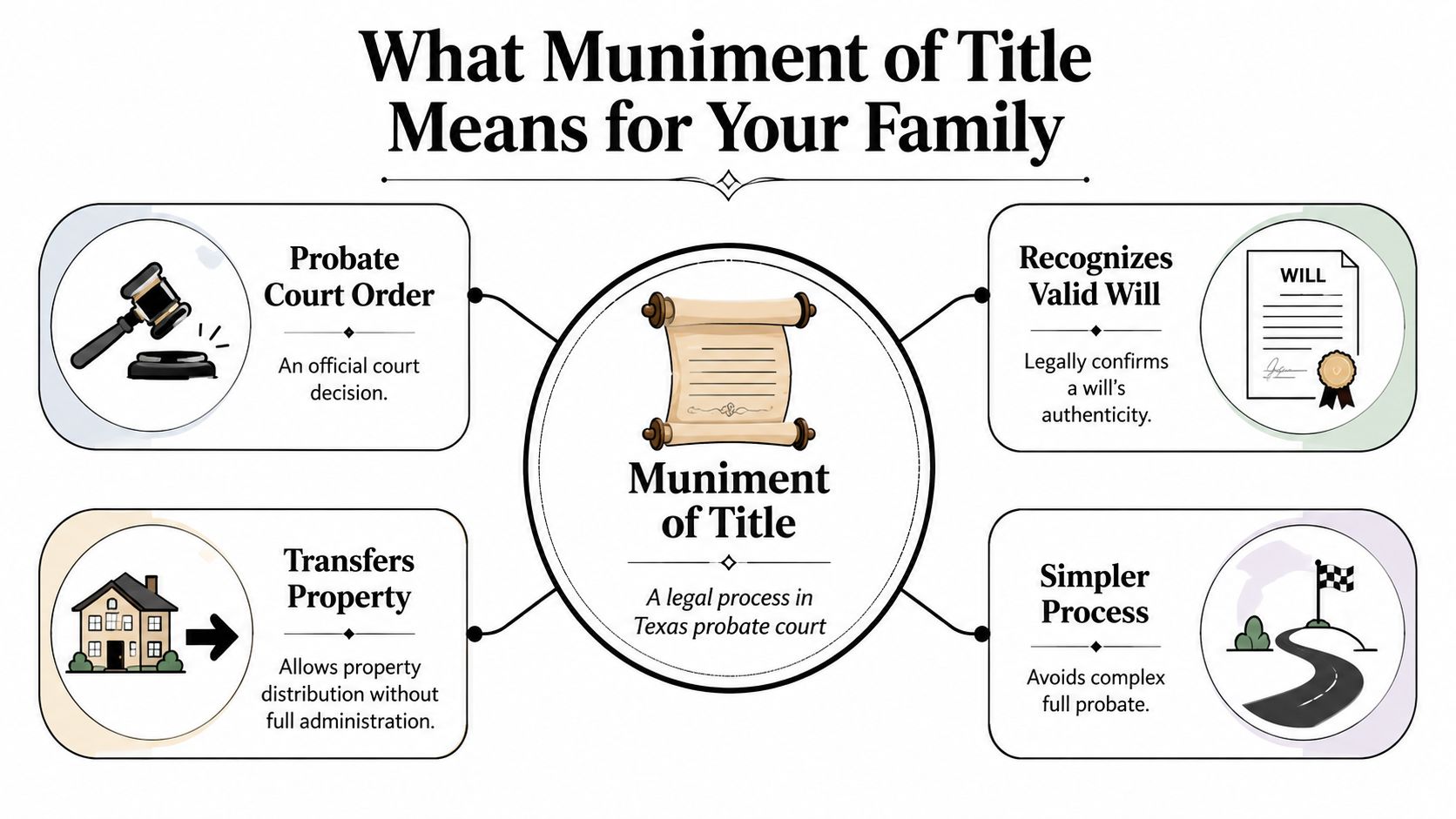
A muniment of title is a probate court order that recognizes a valid will and allows property to pass without a formal estate administration. Texas law says that if the court admits the will as a muniment of title, an executor is not formally designated, Letters Testamentary are not provided, and continuous court oversight is not necessary under the statute described in the verified material from MCM Firm's Texas overview. That is why this process feels lighter than traditional probate.
The cleanest way to think about it
A regular probate administration works more like hiring a property manager for the estate. Someone takes responsibility for collecting assets, handling claims, and managing the process. Muniment of title is narrower. It is more like the court handing your family a title key, one that proves the will and enables transfer of ownership without the extra layers.
Its purpose is simple, even if the legal term sounds formal. The court order creates a record that title companies, clerks, and future buyers can rely on once the order is properly recorded. That is why the recorded order matters so much in Harris County and every county where real property sits.
What the court is really doing
The judge is not managing the estate. The judge is confirming that the will can function as the legal foundation for title transfer. Under the verified Texas guidance, the procedure is limited to estates with no unpaid unsecured debts, and county guidance adds a post-probate filing step tied to an affidavit of fulfillment of terms within 180 days unless the court waives that requirement. That follow-up keeps the shortcut from becoming sloppy.
The order is useful only if the family completes the recording and follow-up steps on time.
That's why muniment of title works best when the goal is straightforward. It clears the way for property to move on paper, which is often exactly what surviving spouses, adult children, and heirs in Harris County need.
Qualifying for Muniment of Title in Harris County
Harris County families usually want the answer to one question first. Does the estate qualify? The safest way to answer that is with a simple checklist, because muniment of title is narrower than many people expect.
The three core checks
- There must be a valid will. The court needs a written will it can admit. If the document is missing, disputed, or not executed properly, this path can fall apart quickly.
- There must be no unpaid unsecured debts. A mortgage is not the same thing as an unsecured credit card bill. For a home in Kingwood or Atascocita, a secured mortgage debt may sit differently from consumer debt, but the estate still has to fit the legal test.
- There must be no Medicaid Estate Recovery issue that blocks the process. If that claim is in play, the shortcut may not be available.
These rules sound technical, but they're practical. A family may think, “The house is paid for enough, so we're fine,” when the actual issue is an old personal loan, a medical bill that wasn't secured, or another claim that changes the court's view.
If you're comparing this to a smaller-estate approach, it can help to look at small estate affidavit guidance for Texas, because families often confuse the different shortcuts. They're not interchangeable, and the wrong one can delay title transfer.
A local example
A Humble heir comes in with a will, a homestead, and a couple of bank accounts. If the only remaining debt is a mortgage, the family may assume the estate is ready for muniment. That assumption is too quick. The estate still needs to satisfy the no-unsecured-debt rule, and the judge will want the paperwork lined up before signing an order.
The practical takeaway is simple. Muniment of title is designed for estates that are legally clean enough to move directly toward title transfer. It's not a “close enough” process.
Muniment of Title vs Traditional Probate
Families in Atascocita often ask whether the shortcut is always the better choice. It isn't. The right path depends on how much action the estate needs after death.
| Feature | Muniment of Title | Traditional Probate |
|---|---|---|
| Executor appointed | No | Yes |
| Letters Testamentary issued | No | Yes |
| Court supervision | Limited after the order is signed | More ongoing oversight |
| Main purpose | Transfer title under a valid will | Administer, manage, and distribute the estate |
| Best fit | Simple estates with a clear title transfer goal | Estates needing active management, creditor handling, or dispute resolution |
The biggest difference is flexibility. Traditional probate gives the estate representative tools to deal with more moving parts. That matters when there are online accounts, beneficiary-managed assets, or a house that may need to be sold quickly in a tight housing market. Texas probate guidance still frames muniment as best for an estate that is simple and focused on transferring title, which means a technically eligible estate may still be a poor practical fit if the family needs active administration. The broader question is whether the shortcut solves the whole problem or only part of it.
For families who want a deeper look at how probate options are handled locally, the How to Handle Probate Without an Attorney resource can help set expectations before anyone files.
When the shortcut can be too narrow
If the estate has to keep paying bills, negotiate claims, or move assets that depend on an executor's authority, traditional administration may be safer. Muniment of title is efficient because it avoids those steps. That same efficiency is also its limit.
The practical question for a Northeast Houston family is not “Which process sounds easier?” It's “Which process lets us finish the job without leaving title problems behind?”
The Step-by-Step Filing Process in Humble
When a family is ready, the process is less mysterious than it sounds. The trick is following the sequence correctly, because the court order only helps if the paperwork chain stays intact from the hearing through recording.
The filing order that usually makes sense
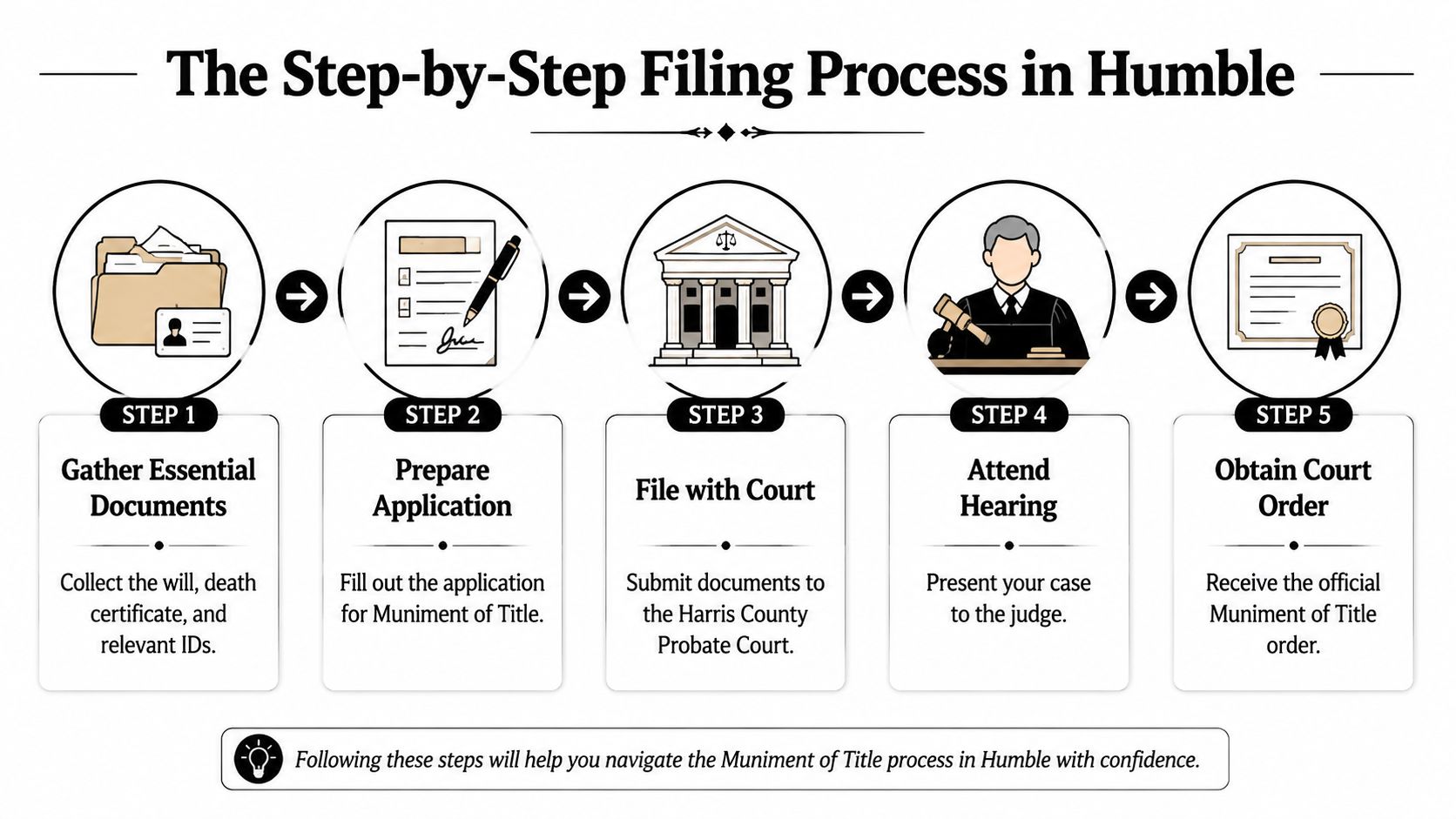
- Gather the essential documents. Start with the original will and the death certificate. If the will was stored in a safe deposit box or kept with other family papers, the search commences in those locations.
- Prepare and file the application. In Harris County, the application asks the court to admit the will as a muniment of title. If you want to see how local probate filings are handled in the county system, the Harris County Probate Court in Humble page is a useful local reference.
- Attend the hearing. The hearing is usually brief, but it still matters. The judge is checking the legal basics before signing the order.
- Obtain the signed order. Once signed, the order becomes the document that supports title transfer.
- Record the order and will in the county property records. The certified order and will must be filed in the county property records where the property is located. That recording step is what gives the order its practical value for marketable title purposes.
For families handling multilingual paperwork or translated exhibits, legal documents have to be accurate, not just understandable. That's one reason some teams rely on Translators USA's legal document services when documents cross language lines.
The deadline that people miss
After the court signs the order, county guidance commonly requires a compliance affidavit within about 180 days to confirm the order was recorded and the distributions were completed. The verified source from MCM Firm says this affidavit of fulfillment of terms is due within 180 days unless waived by the court. That deadline matters because a signed order sitting in a drawer doesn't clear title.
If you're comparing service options for probate administration and estate settlement in Harris County, the Probate Lawyer in Humble, TX listing is one place to review the local practice area. The primary point, though, is timing. Recording completes the legal chain, and missed recording can complicate refinancing, sale, or future title review.
Common Pitfalls and When This Is Not the Right Choice
Muniment of title can look like a shortcut, so people assume it fits almost any estate with a will. That assumption causes trouble. The process is narrow, and the wrong facts can turn a quick filing into a title headache later.
Red flags that should slow you down
- Unexpected debts surface. If an unsecured creditor claim appears after the filing, the estate may no longer be a clean fit for muniment.
- The will is contested. A disputed will belongs in a more formal process, because the court has to sort out the conflict first.
- The estate needs an active decision-maker. Brokerage accounts, lawsuits, and other assets that require someone to act on the estate's behalf may need traditional administration.
- The family hasn't planned for recording. If the certified order never makes it into the property records, title problems can follow the heirs for years.
A lot of confusion comes from treating muniment like a one-size-fits-all answer. It isn't. It works best when the estate is simple and the legal goal is title transfer, not estate management.
If the estate needs someone to collect, negotiate, or defend, muniment of title may be the wrong tool.
There's also a practical family issue. Heirs sometimes want to move fast because the house needs to be sold, but speed without the right filing sequence can slow the sale later. A buyer's title company cares about the recorded paper trail, not just the family's understanding of who should inherit.
For Humble and Kingwood families, the safest approach is to check the facts before filing. That's often the difference between a clean transfer and a round of corrective paperwork.
Consult a Humble Attorney for Peace of Mind
Muniment of title is simpler than full administration, but simple doesn't mean automatic. Harris County families still have to qualify, file correctly, record the order, and protect the title record afterward. A small mistake at the front end can create a much bigger issue when someone tries to refinance or sell the property.
That's why local guidance matters. The Law Office of Bryan Fagan works with Humble-area families on probate and estate planning matters, and local court experience can help keep the process on track from the first filing to the final county record. If your family is in Humble, Atascocita, Kingwood, or Northeast Houston, getting the paperwork right can save a lot of stress later.

If you're not sure whether your loved one's estate qualifies, schedule a free consultation with our Humble office and talk through the will, the debts, and the property records before you file.