 Skip to content
In Harris County, you generally cannot probate a will without an attorney, and Texas also requires that a will be filed within 4 years of the date of death or it won't remain legally effective for estate administration. That catches many families in Humble off guard, especially when they're trying to do the responsible thing and handle everything themselves.
If you've just lost a parent, spouse, or other loved one, you're probably dealing with grief first and paperwork second. Then the questions start coming fast. Where is the will? Who has access to the bank account? What happens to the house? Do I need to go to court? Can I just file something myself?
For families in Humble, Atascocita, Kingwood, and Northeast Houston, the answer is more local than most online articles admit. Generic probate advice often says you can represent yourself. In Harris County, that's usually not how it works when a will needs to be probated. The courts here take the unauthorized practice of law seriously, and that changes the entire conversation.
That doesn't mean you're stuck. It means you need the right path. Sometimes that path is formal probate with counsel. Sometimes it's a simpler alternative that avoids full probate altogether. The key is figuring out which situation you're truly in before you lose time, money, or your advantage.
First Steps After a Loved One's Passing
Losing someone close to you can make even simple tasks feel heavy. Most families I talk to in Humble aren't looking for legal theory. They want to know what to do today, what can wait until next week, and what mistake they absolutely need to avoid.

Start with the basics. Get control of the documents before you try to control the estate.
What to gather first
Focus on these items right away:
- The original will if one exists. Don't mark on it, staple extra notes to it, or alter it.
- Certified death certificates. You'll need them for banks, insurance companies, and court filings.
- A rough asset list. Think bank accounts, vehicles, retirement accounts, life insurance, the home, and debts.
- Property records and titles. Real estate and vehicles create different issues than a checking account.
- Mail and billing information. Ongoing bills often reveal assets and debts the family didn't know about.
Practical rule: Don't start distributing personal property just because family members agree verbally. Early “informal” handoffs often create later probate problems.
What families often miss
A lot of people assume probate starts when they're emotionally ready. It doesn't. Legal deadlines and title problems start moving whether your family feels prepared or not.
You also need to know whether the estate even calls for formal probate. Some assets pass outside probate. Some estates may qualify for a simpler route. Others require court involvement because of a will, real estate, debt issues, or unclear heirs.
If you're trying to figure out how to handle probate without an attorney, the first smart move is not filing forms. It's identifying whether Harris County will even allow a do-it-yourself filing in your situation. For many families here, that answer is no.
The Harris County Rule Why You Usually Need an Attorney
Here's the hard truth. In Harris County, including the courts serving Humble, Atascocita, Kingwood, and Northeast Houston, non-licensed individuals are explicitly prohibited from probating a will without an attorney because local probate courts treat that as a risk for unauthorized practice of law, as described in this Harris County probate answer discussing local court policy.
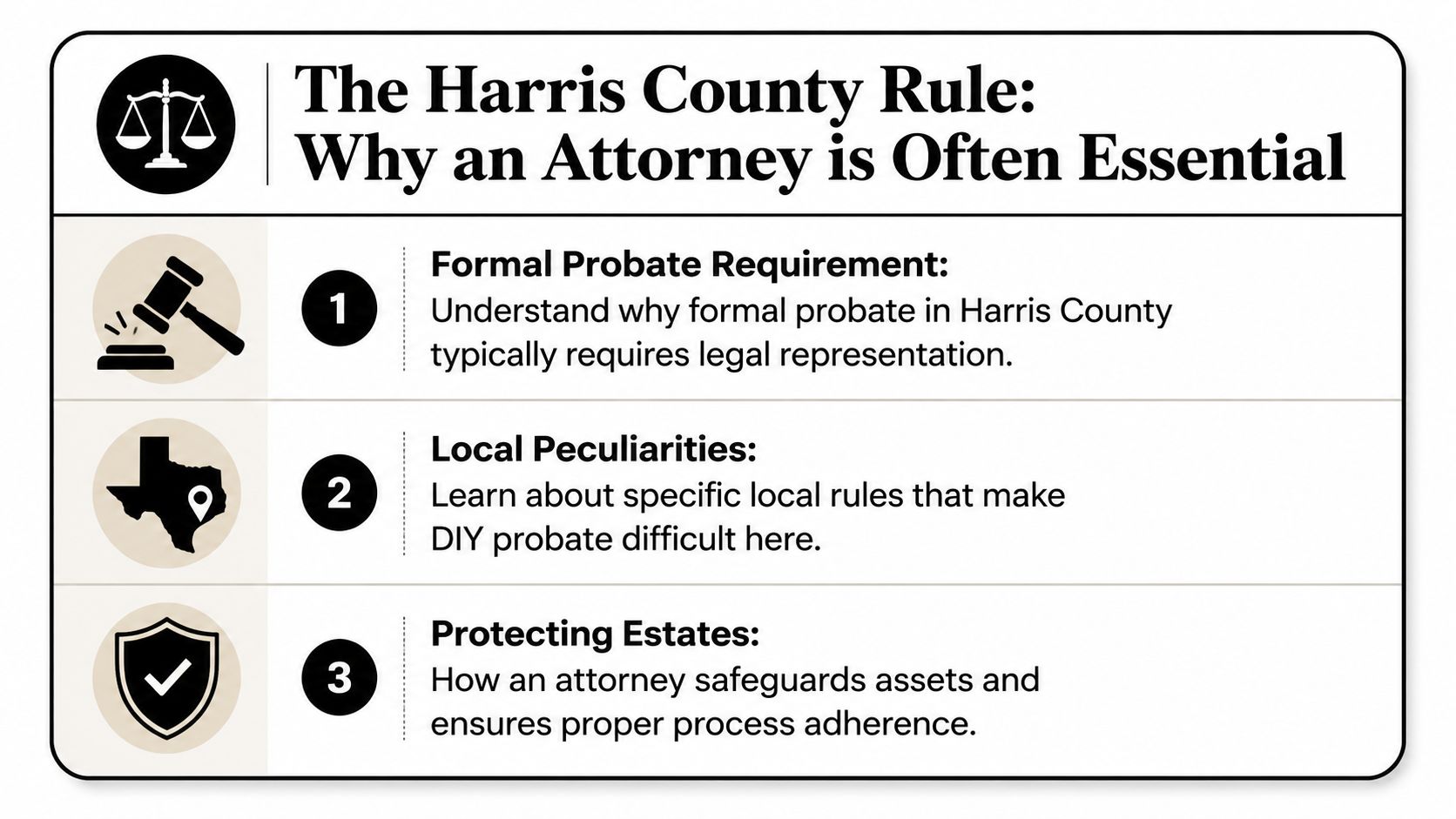
That means the usual internet advice is often wrong for local families. You may be the named executor. You may be honest, organized, and fully willing to do the work. Harris County still generally won't let you probate the will on your own.
Why the courts take that position
The rule exists to stop a non-lawyer from effectively acting as a lawyer for other people.
That sounds technical, but it's simple. When an executor files and handles a probate case, that person's actions affect every heir, beneficiary, and interested party in the estate. If you're not just protecting your own rights, but also advancing the legal interests of siblings, children, or other relatives, the court sees a real unauthorized-practice problem.
Texas self-representation rules create a trap here. You can represent yourself. You usually can't represent other people's legal interests just because you're family. The issue is discussed clearly in this Texas Law Help explanation of probate court and representing yourself.
Probate isn't just paperwork. It's a court process that affects other people's rights, and Harris County treats it that way.
What this means for Humble area families
If you live in Humble or nearby and you're holding a will, don't assume you can walk into court and open probate yourself. That assumption wastes time and often creates more frustration right when your family can least afford it.
The better approach is to divide probate situations into two buckets:
- Cases that need formal probate. In Harris County, that usually means hiring counsel.
- Cases that may qualify for an alternative. Those are the situations where you may avoid full probate and, in some instances, avoid the same level of court involvement.
This isn't unique to probate. Local court procedure matters across practice areas. If you want a plain-language example of how county-level process affects real people, Harris County Family Courts: A Humble Resident's Guide outlines how family law cases proceed in the Harris County courts serving Humble.
A lot of bad probate advice comes from treating Texas as one uniform experience. It isn't. County practice matters. Court expectations matter. In Harris County, that reality hits fast.
Here's a short explanation that may help:
Understanding the Texas Probate Process Timeline
Even if you'll need a lawyer for formal probate, you should still understand the sequence. Families make better decisions when they know what's coming and why each step exists.

The deadline you cannot ignore
Texas gives you exactly 4 years from the date of death to file the will with the proper county probate court, and missing that deadline means the will is no longer legally effective for estate administration, according to this Texas probate deadline explanation.
That's the first deadline I want neighbors in Humble, Kingwood, and Atascocita to remember. If you know there's a will, don't leave it in a drawer while the family “waits for the right time.”
The usual sequence
Formal probate usually follows a predictable order, even though every estate has its own complications.
Locate the will and key records
The court needs the governing document, not guesses about what the decedent “wanted.”File the probate application
This opens the case in the proper county court and asks the court to recognize the will and appoint the personal representative.Attend the hearing
The judge reviews the filing and decides whether to admit the will to probate and authorize estate administration.Receive authority to act
Once properly appointed, the executor can begin dealing with estate assets in an official capacity.Identify assets and debts
This includes bank accounts, vehicles, business interests, real estate, and outstanding obligations.Handle creditor and beneficiary issues
Some estates move smoothly. Others slow down because documents are missing, debts are disputed, or family members don't agree.Distribute what remains and close the estate
The executor wraps up administration only after the legal groundwork is in place.
If you want a local overview of pacing and practical expectations, this guide on how long probate takes in Texas is a useful companion.
One cost that surprises families
When there's no existing administrator and the court needs an heirship determination, the court appoints an attorney ad litem to represent unknown heirs, and the applicant must pay a $750 fee for that lawyer's services, as explained in this Harris County passing without a will resource.
That fee catches many families off guard because they assume the only costs will be filing fees or document costs. In reality, probate often includes court-driven safeguards designed to protect people who aren't even present yet, including unknown heirs.
If the estate requires heirship work, build that attorney ad litem fee into your expectations early. It's not optional.
Why the timeline stretches
Probate slows down for ordinary reasons, not just dramatic disputes. Missing paperwork, unclear title history, uncertainty about heirs, debt questions, and problems with asset inventory all create delays.
That matters most when the estate includes a house or other titled property. Real estate almost always demands cleaner paperwork than families expect. A bank may tolerate some back-and-forth. A title company usually won't.
Here's the practical takeaway for Northeast Houston families: don't judge probate by what your cousin did in another state. Texas probate has its own deadlines, and Harris County has its own working realities.
Texas Alternatives to Formal Probate
If formal probate in Harris County usually requires an attorney, the right question becomes this: Can the estate avoid formal probate altogether? Sometimes the answer is yes.
Families in Humble often find some relief in the fact that not every estate needs the full formal process. Texas offers several alternatives, but each fits a different fact pattern. Picking the wrong one creates delay. Picking the right one can save a lot of stress.
The three alternatives most people should know
Some estates are simple enough that a narrower procedure works better than full probate.
| Texas Probate Alternatives at a Glance | Best For | Key Requirement | Involves Court? | Can Transfer Real Estate? |
|---|---|---|---|---|
| Small Estate Affidavit | Smaller estates with limited assets | Estate must qualify under Texas rules and not require full administration | Yes, but typically in a simplified form | Sometimes, depending on the facts and court approval |
| Muniment of Title | A valid will with little or no need for ongoing administration | Usually works best when there are no unpaid debts other than secured debt | Yes | Yes, often used to clear title under the will |
| Affidavit of Heirship | No will, usually with real property and family agreement | Heir information must be complete and credible | Often used outside formal probate, but title review still matters | Often used for real estate, subject to acceptance by title companies and others |
Small Estate Affidavit
A Small Estate Affidavit can be a strong option when the estate is modest and the facts line up cleanly. The trouble is that people hear “small estate” and assume that means “easy.” It doesn't. The paperwork still has to be right.
For a practical local discussion of that route, see this page on the Texas small estate affidavit process.
A few cautions matter:
- It's not a shortcut for every problem. If the estate is too large, too messy, or tied up with disputes, this option can fail fast.
- Real estate changes the analysis. Families often think the house can be handled the same way as a bank account. It usually can't.
- Debt matters. If there are unresolved creditor issues, a simplified affidavit may not be the right fit.
Muniment of Title
This is one of the most useful Texas-specific tools, and it's often underused. If there's a valid will and the estate doesn't need full administration, probating the will as a muniment of title can transfer title without the usual ongoing executor process.
That can be especially helpful when the main goal is clearing title to a house or other property, not managing a long list of debts and claims. Families in Kingwood and Atascocita often find this option appealing when everyone agrees and the estate is otherwise quiet.
Sometimes the best probate strategy isn't “fight through full administration.” It's “use the narrowest legal tool that actually fits the estate.”
Affidavit of Heirship
When there is no will, an Affidavit of Heirship may help establish who inherited property, especially real estate. But do-it-yourself mistakes often accumulate.
A flawed heirship affidavit can create title problems that don't show up until someone tries to sell or refinance the property later. I've seen families think they solved everything, only to learn that a title company won't accept the document because key family-history details were incomplete or inconsistent.
Which option should you lean toward
Use this practical filter:
- There's a will, no major debt, and title needs clearing. Muniment of Title may deserve a close look.
- There's no will and the family mainly needs to address inherited property. Affidavit of Heirship may be part of the answer.
- The estate is modest and appears to fit simplified rules. Small Estate Affidavit may work.
What you should not do is force the estate into the cheapest-looking option. Probate alternatives work well when they match the facts. They create headaches when they're used as wishful thinking.
Common Mistakes to Avoid When Going It Alone
Most probate errors don't come from bad intentions. They come from families trying to move quickly while grieving.

Four mistakes I see over and over
A family in Kingwood finds a will in a desk drawer and assumes they can deal with it later. That's dangerous. If you sit on the will and miss the filing window, you may lose the ability to use it for estate administration.
Someone in Atascocita adds up the checking account and vehicle, then decides the estate is “small enough” for a simplified process. They forget about another asset or misunderstand how the home affects the analysis. The filing gets rejected or becomes useless.
A Humble family records an Affidavit of Heirship they found online, but the family history is incomplete. Years later, they try to sell the house and discover the title issue wasn't fixed at all.
A Northeast Houston executor starts paying family members first because everyone agrees on who should get what. Then a debt issue surfaces, or title to property turns out to be unclear. Now the estate is harder to unwind.
What to do instead
Use a slower, cleaner approach:
- Verify the asset picture first. Don't guess at what the estate owns.
- Check whether real estate is involved. A house almost always changes the strategy.
- Treat deadlines as real deadlines. Probate law doesn't pause because the family is still deciding.
- Don't rely on generic forms. A document can look official and still fail where it matters.
- Get clarity before you distribute anything. Early distribution is one of the fastest ways to create personal liability and family conflict.
The cheapest probate decision is usually the one that avoids a second round of cleanup later.
Why local guidance matters
Online probate content tends to flatten everything into one national script. That's not how this works in Harris County. A step that looks harmless on a general website may be completely wrong for a family in Humble dealing with local court practice, Texas title issues, and multiple heirs.
That's also true in other areas of law. Whether someone is facing a custody dispute, a criminal charge, or an estate issue, local procedure changes the answer. The families who do best are the ones who get the rules right before they act.
When You Need a Compassionate Guide
If you're reading this while sorting through your loved one's papers, I want to leave you with a simple point. Trying to honor someone's wishes by handling their estate responsibly is a good instinct. But in Harris County, formal probate usually isn't something you can just take on by yourself.
That doesn't mean every family is headed for a long court fight. Some estates can use a Small Estate Affidavit, Muniment of Title, or an Affidavit of Heirship. Others need formal representation because there's a will to probate, heirs to identify, real estate to transfer, or debt issues to resolve.
If you need formal probate help in Harris County, one local option is the Probate Lawyer in Humble, TX page, which covers probate administration and estate settlement in Harris County.
The right time to ask for help isn't after a rejected filing, a title problem, or a family disagreement that's already escalated. It's at the beginning, when one clear conversation can save months of uncertainty.
If your family is in Humble, Atascocita, Kingwood, or Northeast Houston, you don't need to carry the legal side of this alone. A good probate plan should lower stress, protect the estate, and help you move forward with confidence.
If you're unsure whether your loved one's estate needs formal probate or qualifies for a simpler alternative, schedule a free consultation with Law Office of Bryan Fagan. Our Humble office works with families across Humble, Atascocita, Kingwood, and Northeast Houston to sort out probate, estate planning, family law, and other legal issues with clear, practical guidance.


