 Skip to content
A parent in Humble passes away, and by the next week the family is dealing with more than grief. Someone needs access to a bank account to cover final bills. Someone else is asking what happens to the house. A daughter in Atascocita has one set of papers, a son in Kingwood has another, and everyone is wondering whether they have to open a full probate case in Harris County.
That's usually when the phrase Small Estate Affidavit comes up.
For many families, a Small Estate Affidavit Texas case can be a simpler path than full probate. But it only works when the facts fit the law exactly. In Harris County, small mistakes on the form, the wrong witnesses, or a minor heir in the mix can stop the process fast.
At the Law Office of Bryan Fagan, we regularly talk with families in Humble, Northeast Houston, and nearby communities who are trying to sort through probate questions while also handling work, school, child custody schedules, and everyday responsibilities. If you're trying to figure out whether a Small Estate Affidavit might help your family, a good starting point is learning how probate works in Harris County near Humble and then matching your situation to the county's requirements.
Navigating a Loved One's Estate in Humble
Individuals generally don't wake up already knowing the difference between a will, heirship, and a Small Estate Affidavit. They learn because they have to. A family in Northeast Houston may be trying to transfer a car, close a small bank account, or keep utilities running at the homestead while they're still arranging a funeral.
In that setting, the legal process can feel colder than it needs to be. The terms sound formal. The paperwork feels unforgiving. And when different relatives give different answers, it's hard to know who's right.
Why families look for a simpler option
A Small Estate Affidavit is often the first thing people ask about because they've heard it can avoid a larger probate case. Sometimes that's true. Sometimes it isn't. The hard part is that statewide guides often stay general, while Harris County families need practical answers tied to local filing habits and common rejection issues.
If your family is trying to handle a modest estate, clarity matters more than speed. One wrong assumption can cost more time than slowing down and doing it correctly.
For families in Humble, Atascocita, and Kingwood, the biggest relief often comes from understanding that there is a path forward, even if it's not the path they first expected. Some estates fit the affidavit process well. Others need a different probate tool. Either way, the confusion usually starts to ease once you separate three questions: what property exists, who the legal heirs are, and whether Harris County will accept this specific shortcut.
What this process feels like in real life
A surviving spouse may think, “It's just one house, one vehicle, and a checking account.” An adult child may respond, “Then this should be easy.” But probate law doesn't run on impressions. It runs on categories, signatures, and proof.
That's why Small Estate Affidavit cases are less about filling in blanks and more about matching your family's facts to Texas law in a careful way. If you're in Humble and trying to make sense of it, you're not behind. You're doing what most neighbors do. You're asking questions before filing papers that could be rejected.
Is a Small Estate Affidavit Right for Your Family?
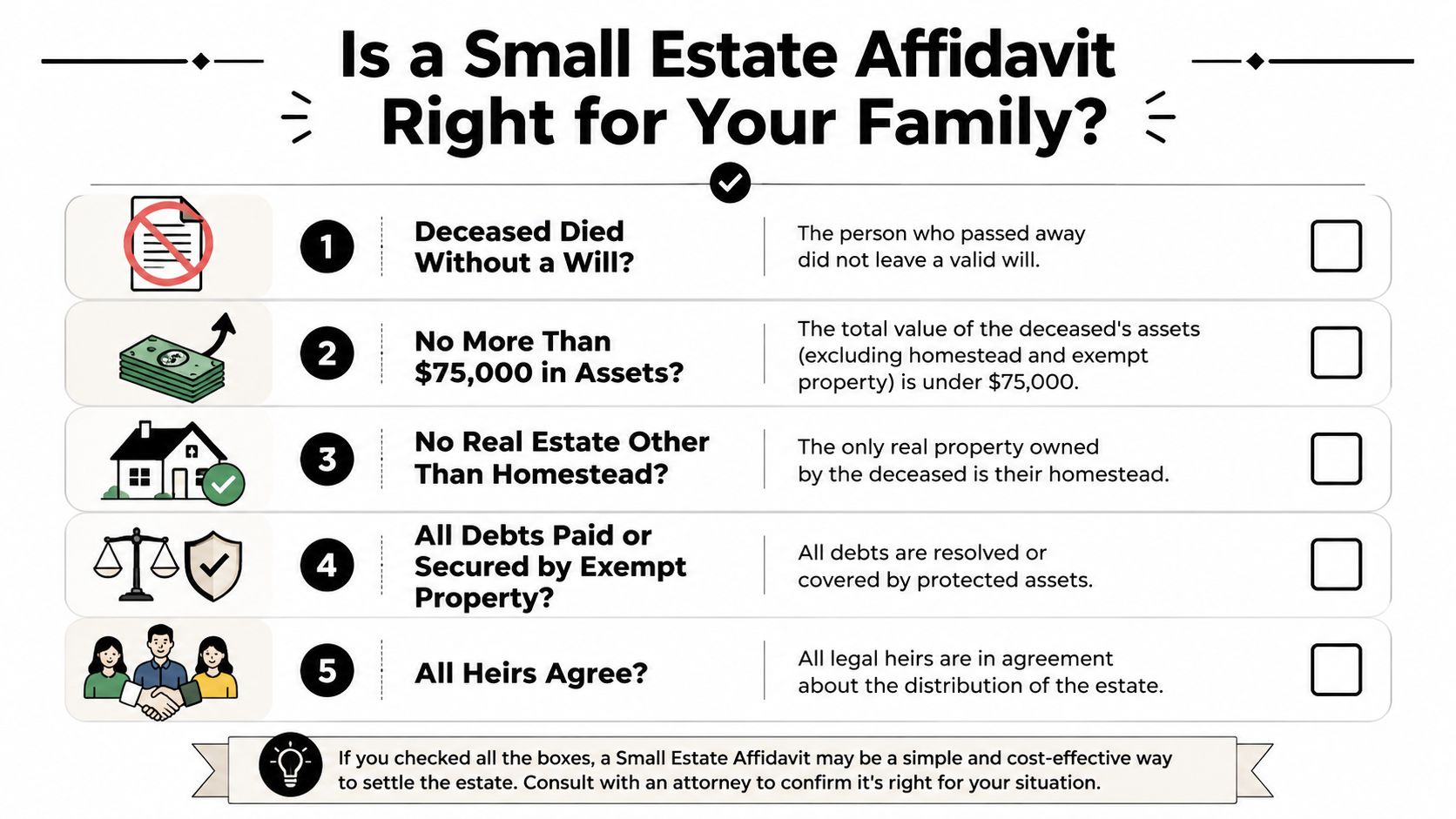
The easiest way to evaluate this is to ask a short series of yes-or-no questions. If one answer is no, the affidavit may not be the right fit.
Start with the legal threshold
The estate must be worth $75,000 or less, excluding the homestead and exempt property, for a Texas Small Estate Affidavit to be available under Texas Estates Code Chapter 205.
That one rule causes a lot of confusion in Harris County. People often count everything together, including the home and exempt items, then assume they don't qualify. Others do the opposite and leave out property that should have been counted.
Five questions to ask yourself
Did your loved one die without a will?
A Small Estate Affidavit is for an intestate estate. If there's a valid will, you'll usually need a different probate route.Has at least 30 days passed since the date of death?
Texas law requires that waiting period before filing.Are the non-exempt assets within the legal cap?
The counting rules matter. The homestead and exempt property are treated differently from other property.Is the only real estate the homestead?
If there's another piece of real property, families often need to look at another process.Can all heirs sign and agree on the filing?
Agreement and complete signatures are central to whether the affidavit can move forward.
What counts as exempt property
In plain language, exempt property means certain property Texas law protects and treats differently for this process. Families in Kingwood and Humble often think of this in practical categories: home furnishings, personal effects, and in some situations vehicles used by the family.
That doesn't mean every item is automatically excluded without analysis. It means the property needs to be categorized correctly. Mislabeling property is one of the ways a filing that looked simple on paper becomes difficult in court review.
Here's a simple way to consider this:
| Property question | Why it matters |
|---|---|
| Is this the homestead? | The homestead is treated differently from the estate cap calculation. |
| Is this exempt personal property? | Exempt items may be excluded from the calculation if properly identified. |
| Is this another asset like cash or a bank account? | Non-exempt assets are part of the key eligibility review. |
Families who are already thinking about future planning often pair this probate question with broader planning work. An Estate Planning Attorney in Humble handles wills, trusts, and estate plans for Humble families.
Some readers also want a broader homeowner-focused overview of ways probate issues can arise around a house. This discussion of probate solutions for homeowners can help you understand the broader context, even though Texas affidavit eligibility still depends on Texas law and Harris County procedure.
Gathering the Necessary Forms and Documents
Before you fill out anything, gather the paperwork first. That one habit prevents a lot of rework. In Harris County, families often get halfway through the affidavit and then realize they're missing a certified death certificate, a bank balance, or a witness familiar with the family history.

The core document checklist
Use a working folder, either paper or digital, and collect these items before you draft the affidavit:
County-specific affidavit form
Harris County filers should use the form accepted for that county. Counties often expect their own current template and formatting.Certified death certificate
You'll need an official certified copy, not just an informal copy from family records.Asset records
Bank statements, vehicle information, and other documents that help show what the decedent owned.Debt records
Funeral bills, final illness expenses, credit obligations, and other debts should be identified carefully.Family history information
Marriage history, children, and other heirship facts need to be complete and accurate.Homestead information
If the affidavit involves a home, gather the property description and paperwork that identifies it clearly.
The witness rule that trips people up
The Texas Small Estate Affidavit process requires all heirs to sign and also requires at least two disinterested witnesses with personal knowledge of the decedent's family history, and the filing must be made in the county where the decedent had a fixed residence at death, as explained by the Texas State Law Library's Small Estate Affidavit guide.
A disinterested witness is not just anyone willing to help. This person should not be an heir and should not benefit from the estate. In real life, that might be a longtime family friend, neighbor, or someone from church who knows the decedent's marital and family history.
A witness who only knows one child or only met the decedent recently may not be enough. Harris County reviewers want witnesses who can speak to the family picture, not just one corner of it.
A practical note for vehicles and family issues
Vehicle transfers cause a lot of stress because families often need transportation right away. If a car is part of the estate questions you're sorting through, this guide on how to transfer car title after death is a useful next read.
And sometimes estate issues overlap with family court orders. For example, a grandparent may have been helping raise a child, or a deceased parent may have had an active support order. In those situations, Child Support Attorney in Humble addresses establishing, modifying, and enforcing child support in Harris County.
Completing and Filing the Affidavit in Harris County
Once your documents are organized, the focus shifts from gathering facts to presenting them clearly. A Small Estate Affidavit Texas filing's success or failure often depends on this clear presentation. Harris County expects complete heirship information, accurate asset descriptions, and properly executed signatures.
Fill out the form with precision
Start with the decedent's identifying information exactly as it appears on the death certificate. Then move through the estate details carefully. The common problem isn't handwriting or formatting. It's incomplete legal information.
Pay close attention to these parts of the affidavit:
Heir identification
Every legal heir needs to be listed correctly. Missing one heir can create major problems.Asset listing
Describe assets clearly enough that a bank, title office, or other institution can match the order to the property.Debt information
Funeral and last-illness expenses matter. So does the difference between debts tied to exempt property and unsecured debts.Homestead details
If the affidavit involves the homestead, the property description needs to be accurate and consistent with the supporting records.
Signatures and notarization
All heirs who must sign should sign. The two disinterested witnesses should also sign, and the signatures should be notarized where required by the form and county practice. Families sometimes circulate partial drafts by text or email and then collect signatures before the information is final. That creates avoidable risks.
A better approach is to treat the affidavit as one final package. Review every name, relationship, and asset before anyone signs.
Practical rule: Never schedule notary appointments until the family tree, property list, and debt list all match the supporting documents.
Filing in the right place
Harris County residents should file in the county tied to the decedent's fixed residence. For Humble families, that often means Harris County, but not always. Humble-area residents sometimes have mailing addresses, property ownership, or family ties that create confusion. Residence at death is the key venue question.
For local court information and probate procedure context, many families find it helpful to review the Harris County probate court process near Humble.
The filing fee for a Texas Small Estate Affidavit is commonly described as ranging between $250 and $400, with some counties charging a specific amount such as $263 in Tarrant County, based on county court instructions referenced in the verified data. Formal probate often costs more, which is one reason families explore the affidavit first.
What happens after filing
After filing, the court reviews the affidavit and attachments. Some counties may require a hearing, while many approve correctly completed affidavits administratively, according to the verified data from the Texas State Law Library. If the court approves the affidavit, the clerk certifies it.
That certified paperwork is what families usually need to present to institutions like banks or the Department of Motor Vehicles. In other words, filing the affidavit is not the finish line by itself. The certified approval is the document that helps facilitate the transfer process.
For readers comparing legal help options, Probate Lawyer in Humble, TX handles probate administration and estate settlement in Harris County.
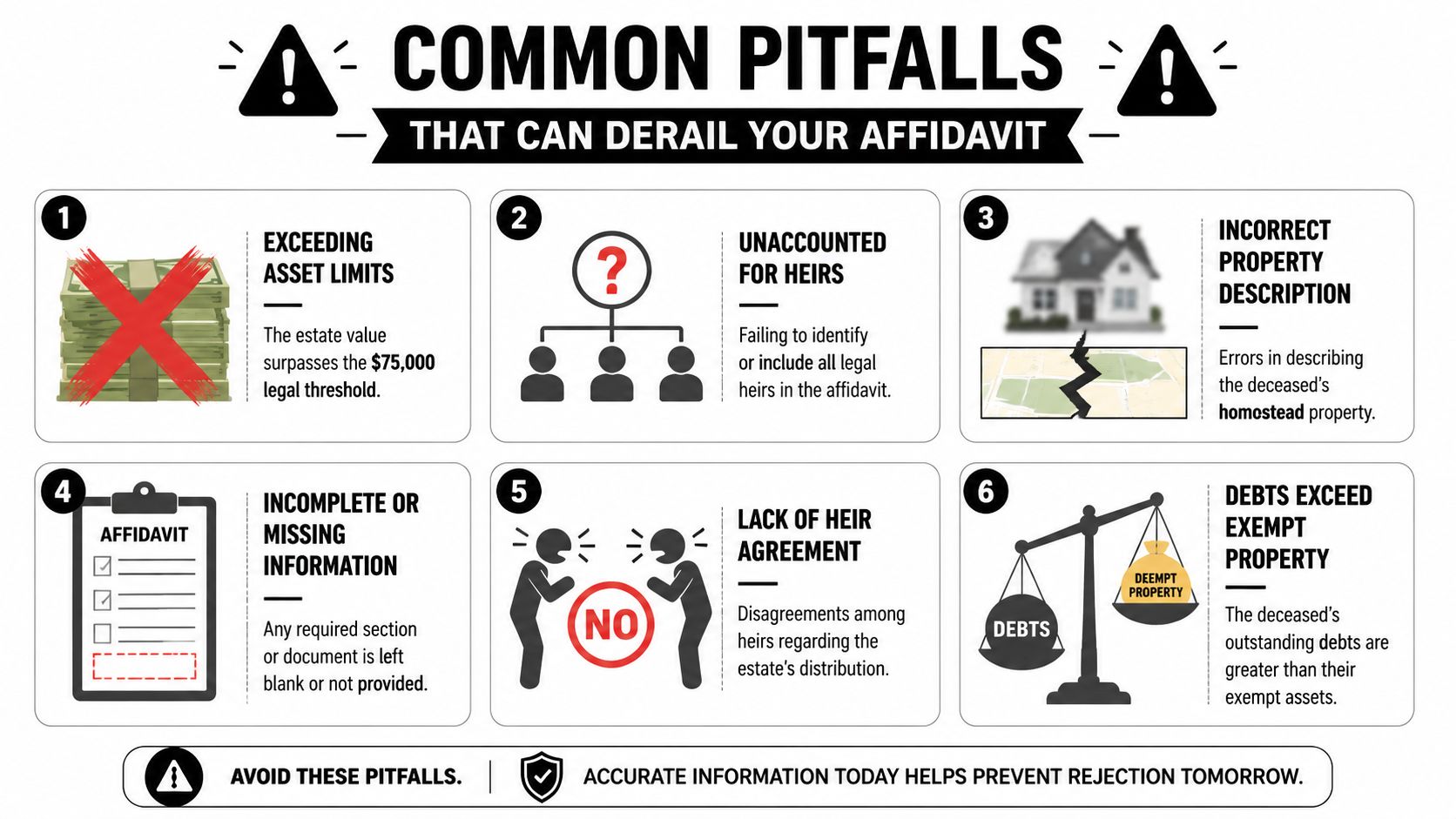
Common Pitfalls That Can Derail Your Affidavit
Many families assume the biggest problem is the form itself. Usually it isn't. The underlying problems are hidden in the facts behind the form.
Minor heirs change the analysis
A major roadblock in Harris County is the presence of a minor heir. Texas Law Help notes that courts routinely reject Small Estate Affidavits if heirs are minors without a legal guardian signing on their behalf, and many counties, including Dallas and Harris, state they will not approve an SEA involving minor distributees, as explained in this Texas Law Help article on small estate affidavits.
That catches many families off guard. A parent dies. The surviving relatives assume the child's inheritance can be listed on the affidavit. But Harris County may not accept that shortcut.
This comes up often for families already dealing with divorce, custody, or guardianship issues in Northeast Houston. If the child is the sole heir, or one of several heirs, the affidavit may stop unless someone already has the proper legal authority to sign.
Non-homestead real estate is another frequent barrier
Another common problem is real property beyond the homestead. Families sometimes think, “The estate is modest, so the affidavit should still work.” But if the decedent owned a rental house, vacant lot, or other non-homestead real estate, the filing may be rejected.
That's one of the most frustrating situations because the paperwork can look complete while still failing on eligibility.
Other mistakes that lead to rejection
Here are several issues Harris County families should watch closely:
Witnesses who aren't disinterested
A witness related to the decedent or an heir can create a serious problem.Incomplete heirship history
Prior marriages, children from another relationship, or an omitted heir can derail the affidavit.Asset values that aren't documented well
Guessing at balances or leaving property descriptions vague invites scrutiny.Debt issues
If the estate can't support required expenses in the way the statute expects, the affidavit may not be the right tool.
Don't assume a “simple family situation” is legally simple. Blended families, informal marriages, adopted children, and minors often create issues that aren't obvious until the court reviews the papers.
A lot of statewide articles mention these problems in passing. Harris County families need to treat them as front-end screening issues, not afterthoughts.
When an SEA Is Not an Option: Alternatives and Next Steps
If your family has learned that a Small Estate Affidavit won't work, that doesn't mean you're stuck. It means the estate likely needs a different legal tool.
Common alternatives families consider
Here's a simple side-by-side look:
| Option | When families look at it |
|---|---|
| Affidavit of Heirship | Often discussed when real estate is involved and the goal is to document family history. |
| Muniment of Title | Often considered when there is a will and the estate is otherwise simple. |
| Formal probate administration | Usually necessary when the estate is more complex, the affidavit doesn't qualify, or court authority is needed. |
Each option solves a different problem. An Affidavit of Heirship may help address family lineage issues tied to property records. Muniment of Title may fit a straightforward will-based estate. Formal probate provides broader court supervision and authority when the facts demand it.
A practical way to move forward
If your family is trying to compare Texas property-transfer rules with what happens in other states, broader real estate articles can be useful for context. For example, this overview on understanding Florida probate sales shows how state-specific probate rules can be, which is exactly why Harris County families shouldn't rely on out-of-state advice for a Texas filing.
If you're in Humble, Atascocita, Kingwood, or Northeast Houston, the next step is usually a focused review of the facts. What property existed at death? Are there minors? Was there a will? Is there any real estate besides the homestead? Those answers point you toward the correct path much faster than trying to force an affidavit that doesn't fit.
If you're facing probate questions after losing a loved one, a conversation with Law Office of Bryan Fagan can help you sort out whether a Small Estate Affidavit, heirship filing, or another probate option makes sense for your family. Our Humble office works with residents across Humble, Atascocita, Kingwood, and Northeast Houston, and we offer a free consultation so you can get clear, practical guidance before taking the next step.


