Skip to content

You're at the kitchen table in Humble, your phone lights up, and your shift just changed. You were supposed to have your child tonight, but now you'll be stuck at work for several hours. The question hits fast, do you call the other parent first, or do you line up a babysitter and handle it yourself?
That's where right of first refusal custody Humble TX disputes usually start. Parents often assume the rule is automatic, but in Texas it isn't. The Texas Family Code contains no statute that mandates ROFR, and Harris County courts generally won't enforce it unless it was negotiated into the parenting plan or ordered by the court. That distinction matters because it decides whether you must offer the time to the other parent before using third-party care, or whether you can lawfully make other arrangements on your own.
For families in Humble, Atascocita, Kingwood, and Northeast Houston, this is not a theory problem. It's a Tuesday night problem, a work-travel problem, and an after-school pickup problem. If you understand how the clause works, you protect yourself from two bad outcomes, overstepping your order or missing extra parenting time you may already be entitled to.
If you need practical help sorting through custody terms, find family law paralegals can be a useful starting point when you're gathering documents and organizing the facts for your lawyer. For parents comparing standard possession rules with negotiated custody terms, the court order itself matters more than assumptions, and the standard possession order in Humble is often where those differences become obvious.

When Right of First Refusal Matters for Humble Families
A Humble parent gets called into an unexpected evening shift, and the child is supposed to be with that parent until bedtime. If the order includes ROFR, the next move is simple, offer the time to the other parent first. If it doesn't, that parent may usually arrange babysitting, ask a relative to help, or use daycare without first making the offer.
That's the practical gap many families miss. Texas does not treat ROFR as a default rule, and Harris County courts will not read it into an order just because one parent thinks it sounds fair. The clause has to be specifically negotiated or ordered. That's why families in Atascocita, Kingwood, and across Northeast Houston need to read their decree closely instead of relying on what they've heard from friends or social media.
The doctrine grew out of custody drafting practice, not a statewide mandate. That history matters because it explains why one family's order can be strict and another family's order can be silent. Parents who know the difference can ask for the clause when it helps them, and avoid fighting over a rule that was never put in writing.
Practical rule: if the order doesn't say the other parent gets first chance at the time, don't assume they do.
A custody lawyer has to work with the language that's in front of the court, not the language a parent hoped was there. That's also why families often want a clean paper trail before they make any move. A clear order prevents arguments later, and it gives each parent a fair shot at extra time when work, illness, or travel gets in the way.
How the Right of First Refusal Actually Works
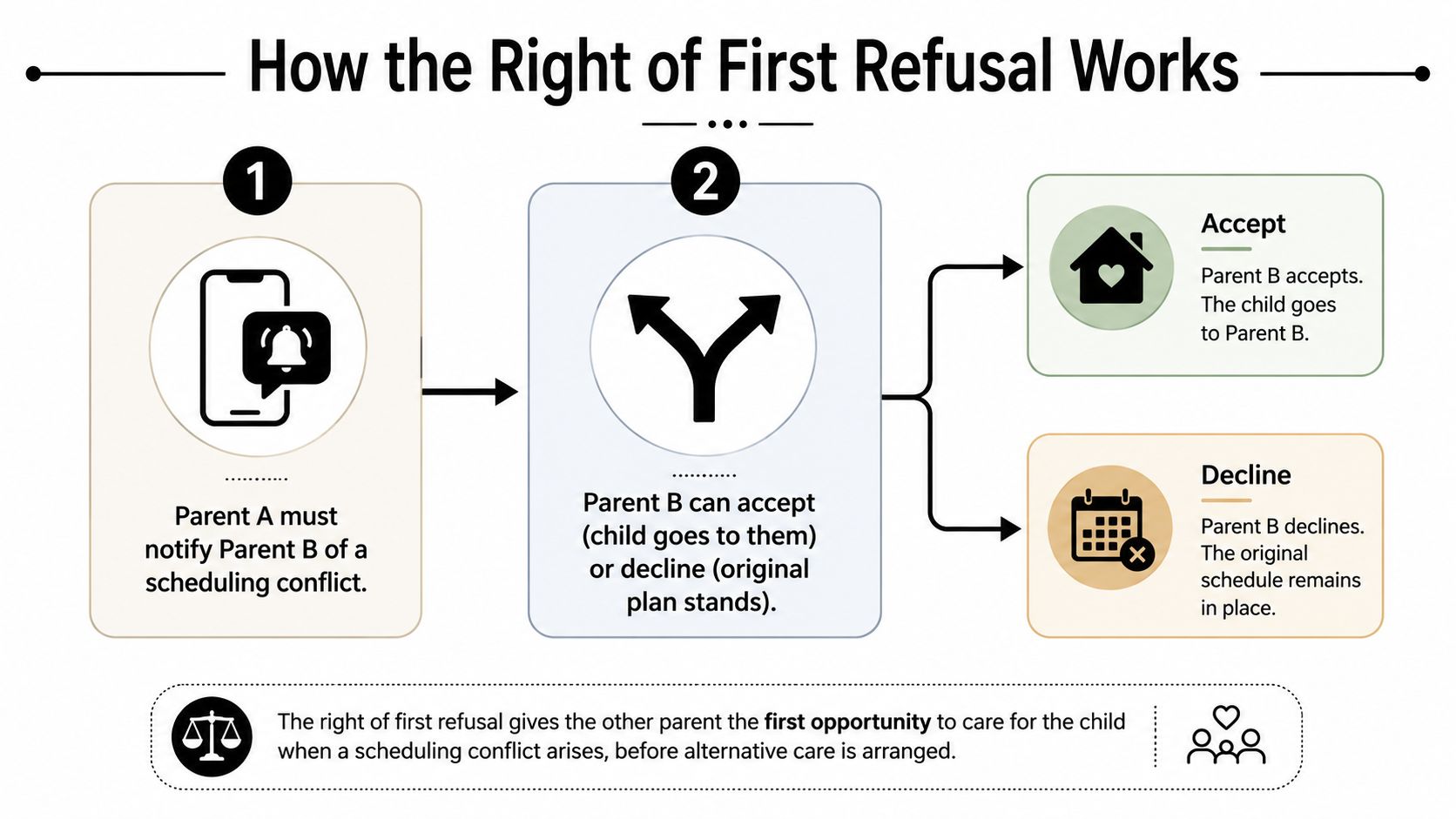
The core of ROFR is a two-step offer-and-decline process. First, the parent with scheduled possession must notify the other parent and offer the childcare opportunity. Second, only if the other parent declines or can't take the child may the parent use a babysitter, relative, or daycare.
A simple Atascocita example shows how this plays out. Say a parent has weekend possession, but a business trip pulls them away for six hours. If the order sets a four-hour trigger window, that absence activates the clause. The parent should give notice, usually in writing or by phone, and then wait for the other parent's response before arranging third-party care. Some orders also spell out a short response window, often about 2 to 4 hours, so the parent who has the first chance knows when the offer is considered declined.
Here's the point that saves arguments later, if the order does not define the trigger, the notice method, and the response window, the clause is too vague to manage real life well. That's when disputes start, because one parent says the time was short enough to ignore the clause while the other says it clearly should have been offered first.
The right language turns the clause into something usable instead of a source of constant texts. If you're working through custody representation, Child Custody Lawyer in Humble, TX is one place to look for custody and conservatorship representation for Humble families.
How Texas Courts Treat and Enforce ROFR Provisions
Texas family law ties ROFR to the child's best interest standard in Texas Family Code §153.002. That matters because judges are not deciding whether a parent “deserves” extra time. They're deciding whether a custody arrangement serves the child. A ROFR clause can support that goal by keeping the child with a parent instead of an outside caregiver, but only when the court order or settlement agreement includes it.
Texas courts also do not automatically add ROFR just because a parent asks casually at a hearing. They expect parents to come prepared with specific proposed language, and they expect that language to fit the family's actual schedule. In Harris County, where cases for Humble and Northeast Houston families are heard, that usually means the judge wants an order that spells out the trigger, the notice method, and the response window. If those pieces are missing, the clause may exist in theory but fail in practice.
ROFR is enforceable when the order says it is. Otherwise, it's just a talking point.
That is the reason courts treat ROFR as a negotiated parenting term rather than a default legal rule. It can be useful in temporary orders and final decrees, but it only changes childcare decisions when the written order says what happens, when it happens, and how quickly the other parent must answer.
For families wanting a sense of how cases move through the local system, Harris County Family Courts: A Humble Resident's Guide gives a helpful look at how family law matters proceed in the courts serving Humble. The takeaway is straightforward. Judges enforce clarity. They do not rescue vague parenting plans.
Drafting ROFR Language for Your Parenting Plan
If you want ROFR, negotiate it like a real custody term, not a slogan. Start by defining what triggers the offer, then define how notice is given, then define how long the other parent has to respond. If any one of those pieces is fuzzy, the clause becomes harder to use and easier to fight over.
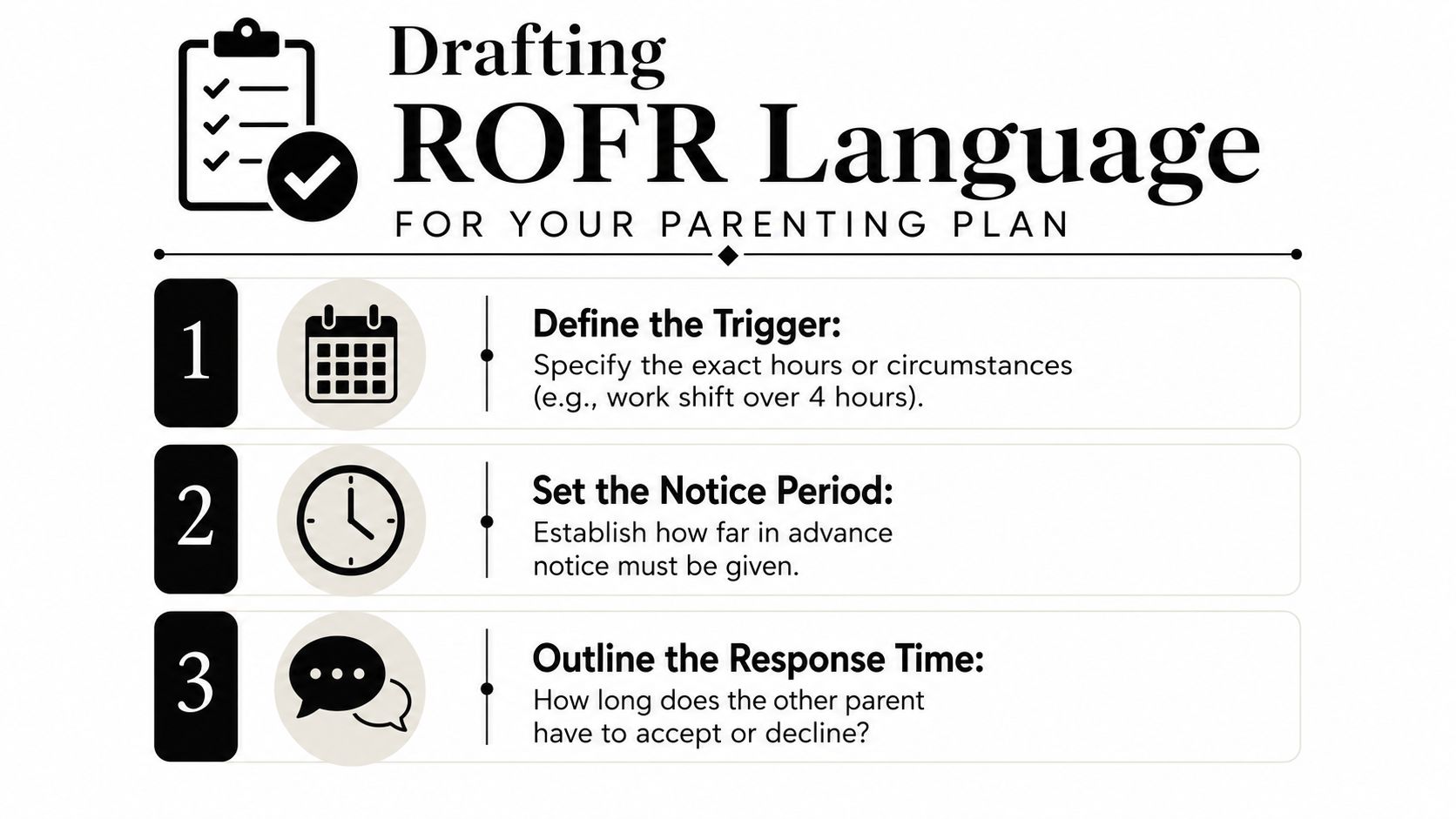
A strong drafting session usually covers these points:
- Define the Trigger. Say exactly when the clause starts, such as a work shift over a set number of hours, an overnight absence, or another clear event tied to your family's schedule.
- Set the Notice Period. Decide how notice will be delivered, by written message, phone call, or a co-parenting app.
- Outline the Response Time. State how long the other parent has to accept or decline before third-party care can be used.
You should also talk through exceptions. Regular school hours, routine daycare, and standing holiday rules often need their own treatment so ROFR doesn't interrupt normal logistics. Summer schedules deserve the same attention, because longer breaks can create more opportunities for the clause to matter. That's why ROFR is usually a negotiated custody term, not something imposed by statute.
If you want help turning those ideas into language that works, How to Write a Parenting Plan is a practical place to start before you meet with counsel. In real life, the strongest clauses are the ones that match the family's habits, not the ones that sound broad and dramatic.
When ROFR Helps and When It Creates Conflict
ROFR helps when parents communicate well and their schedules change often. A Humble nurse, a Kingwood lineman, or an Atascocita parent who travels for work can use the clause to keep a child with a parent instead of handing off care to a sitter. It can also make unplanned gaps in possession time feel less like losses and more like shared parenting opportunities.
It causes trouble when the order is too broad or the parents already fight about every text message. In those cases, the clause turns into a surveillance tool. One parent starts monitoring the other's schedule, and every short errand becomes a dispute over whether the clause was triggered. That is exactly how a useful provision turns into another source of hostility.
Best fit: cooperative parents with changing schedules.
Poor fit: high-conflict cases where every exchange turns into an argument.
ROFR can also be a bad idea if the family needs predictable childcare arrangements that don't fit a short-notice offer process. Some parents want the stability of a sitter or daycare because they work odd hours or share transportation issues. In that setting, a broad ROFR clause can create more last-minute stress than actual benefit.
The right question is not whether ROFR sounds fair. The right question is whether it will make your child's routine more stable and your order easier to follow. If it won't, leave it out or narrow it.
Enforcing and Modifying ROFR Orders in Harris County
If your order already includes ROFR and the other parent keeps skipping the offer, start documenting every missed chance. Save texts, emails, app messages, call logs, dates, and times. Judges care about patterns, not vague frustration, so your record has to show what happened and how often it happened.
Enforcement begins in the same Harris County family court that issued the order. A motion for enforcement asks the judge to require compliance with the existing decree, and the court may consider remedies tied to the violation. The cleaner your documentation, the easier it is to show that the order was ignored rather than misunderstood.
If you want to change the clause, you're talking about modification, not enforcement. Texas law requires a material and substantial change in circumstances, and the new language still has to serve the child's best interest. That matters for families in Humble, Atascocita, and Kingwood because real life changes, jobs shift, children get older, and the old order may stop matching the family's routine.
Keep the records. If the clause matters to you, the dates matter too.
If extended family caregivers are part of the problem, you may also want to look at Grandparents' Rights in Humble. That can matter when the core issue is who should have access to the child when a parent is unavailable.
The bottom line is simple. Enforce what's written, modify what no longer works, and don't try to solve a court-order problem with casual messages alone.
Get Local Custody Support from Our Humble Office
Right of first refusal can be a strong custody tool, but only when it's drafted with precision and enforced with discipline. Humble families, and parents across Atascocita, Kingwood, and Northeast Houston, need an order that matches real schedules instead of assumptions. That's where local knowledge makes the difference, because Harris County courts respond to clear language and clean facts.
The Law Office of Bryan Fagan works with families on custody, divorce, criminal defense, and estate planning matters from its downtown Humble location. If you're negotiating a new parenting plan, trying to enforce an existing ROFR provision, or deciding whether a modification makes sense, schedule a free consultation and get direct guidance before the conflict gets bigger. You deserve an order that protects your time with your child and holds up in court.
The Law Office of Bryan Fagan helps Humble parents draft, enforce, and modify custody orders that fit their lives and their children's needs. If you're dealing with right of first refusal issues, visit Law Office of Bryan Fagan and schedule a free consultation with a Humble family law attorney who knows how Harris County courts handle these disputes.