Skip to content

A first DWI arrest hits hard. One minute you're driving home through Northeast Houston, maybe after dinner in Humble or a late stop in Atascocita, and the next you're staring at a court date, a suspended license, and a question nobody answers clearly: can this be turned into something that won't follow you forever?
That's where deferred adjudication Texas DWI comes in, and it is not the clean slate a lot of people hope for. It can be a real second chance, but only for the right case, and only if you understand the trade-offs before you agree to anything in a Harris County courtroom. If you're worried about your job, your family, or what a background check will show next year, you need the blunt version, not the sugar-coated one.

What Deferred Adjudication Means for Your Texas DWI
A Humble resident gets pulled over on Highway 59, takes the cuffs off the steering wheel in his head, and then hears the officer say the words he's been dreading. That person usually wants one thing first, a way out that doesn't wreck his record. Deferred adjudication can be that path, but only if the court and the prosecutor agree to it.
The basic idea
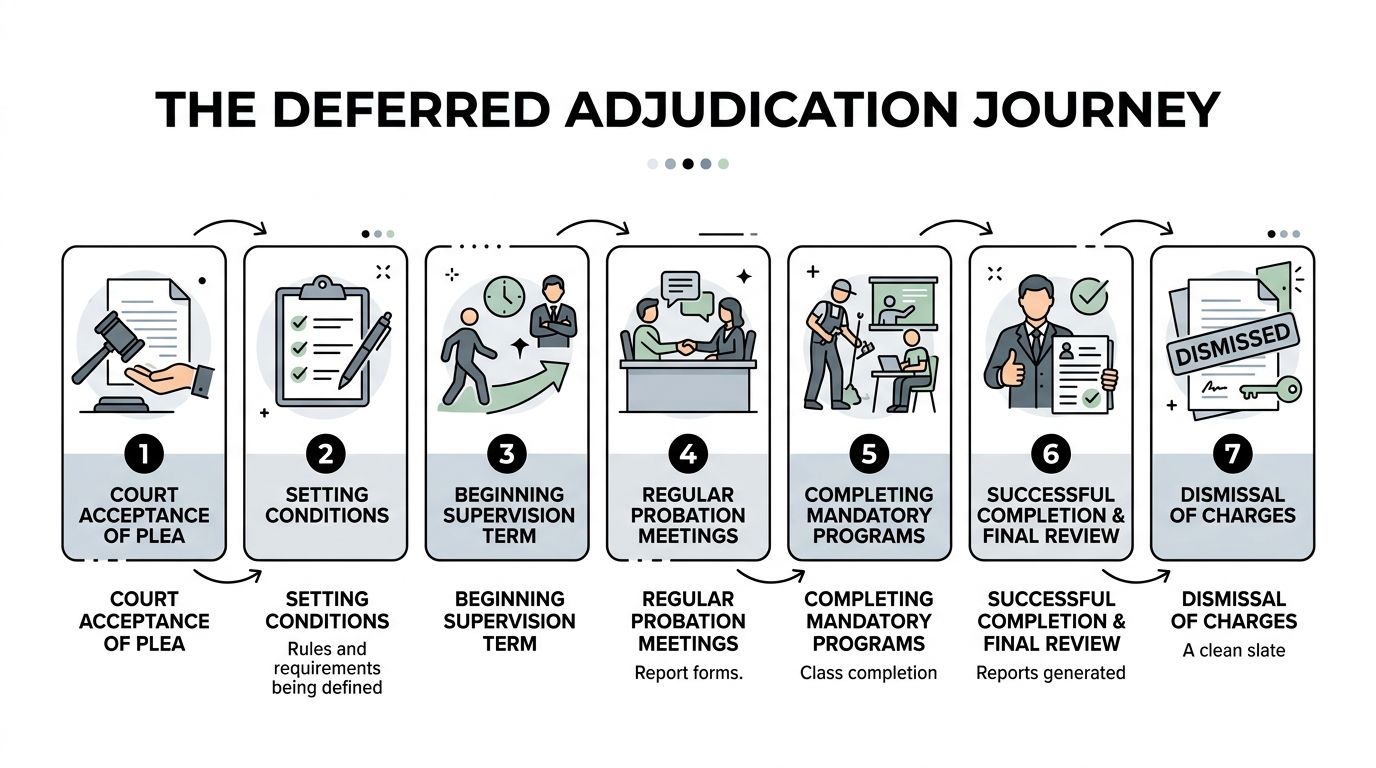
Deferred adjudication means the judge accepts a plea, usually guilty or no contest, but doesn't make a formal finding of guilt right away. Instead, the person is put on community supervision with conditions. If every condition gets completed, the case ends in dismissal rather than conviction, which is a real difference for people in Humble, Atascocita, Kingwood, and Northeast Houston who need to keep working and moving forward.
That does not mean the arrest disappears. It does not mean the charge never happened. It means the case is handled through a court-supervised second chance, and that second chance comes with rules that have to be followed exactly. The practical reality in Harris County is simple, if the facts are strong against you, the offer may be off the table, and if you violate the terms later, the court can still come back hard.
Practical rule: Treat deferred adjudication like a legal agreement, not a free pass. You earn the dismissal by staying compliant every step of the way.
The difference matters because families often hear “dismissed” and assume “gone.” Those are not the same thing. A dismissal after deferred adjudication is better than a conviction, but it still leaves questions about records, licensing, and future DWI exposure that need to be handled on purpose. For a plain-English overview, see what deferred adjudication means in Texas.
Who Qualifies for Deferred Adjudication on a DWI in Texas
A lot of people assume a first DWI arrest in Texas automatically opens the door to deferred adjudication. It does not. The statute is narrow, and HB 3582 took effect on September 1, 2019, making deferred adjudication for DWI a limited option rather than a broad one, with the BAC cutoff and offense history doing most of the work in deciding who even gets considered (Texas DWI Site).
The eligibility checklist
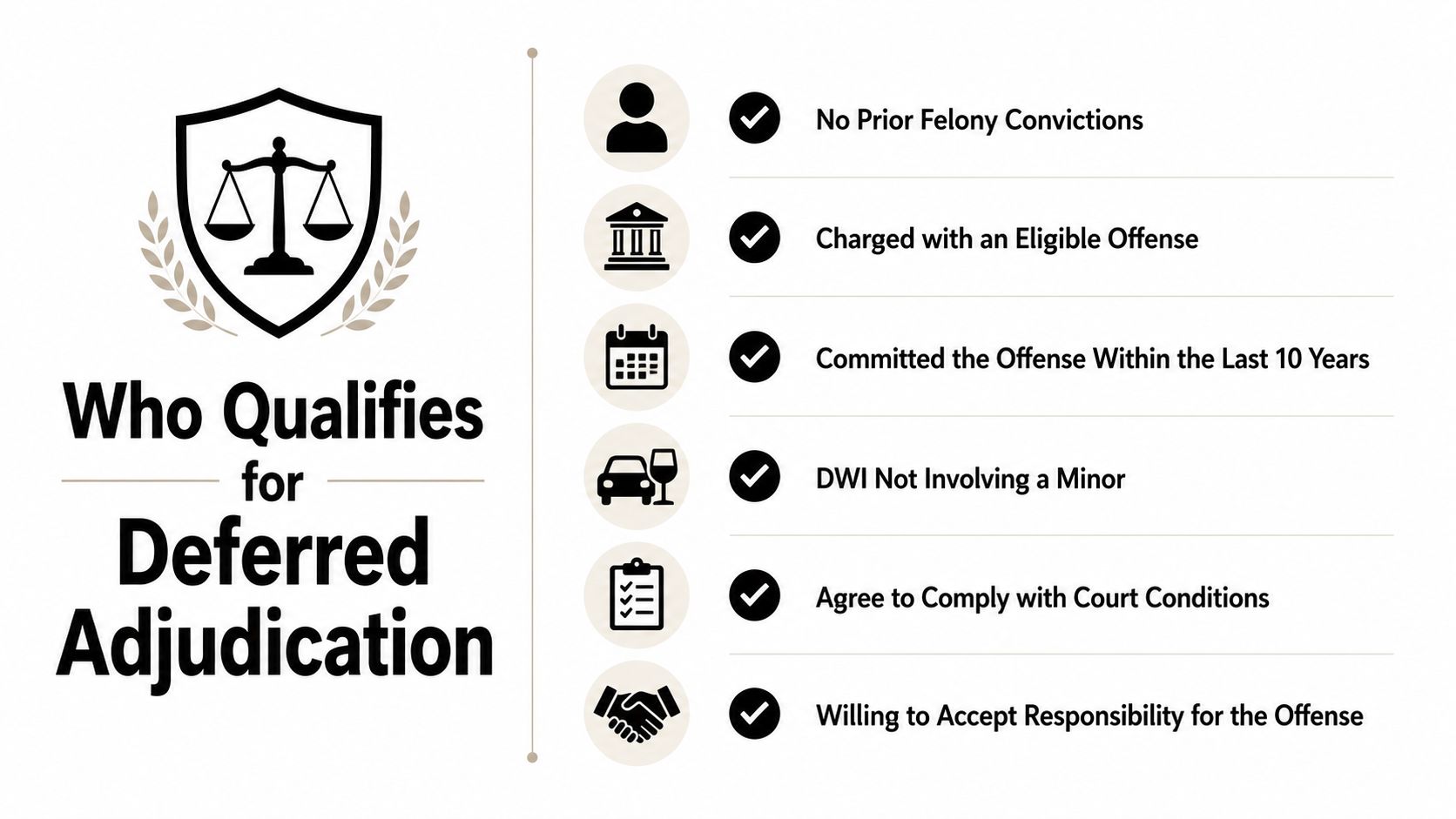
To have a shot at deferred adjudication on a Texas DWI, the case has to fit all of these conditions:
- First-offense DWI only. No prior DWI conviction.
- BAC below 0.15. If the BAC is 0.15 or higher, the case is a Class A misdemeanor and is specifically excluded from this option.
- No qualifying accident involving another person.
- No prior DWI conviction.
That is the starting point families need to understand. If one piece is missing, deferred adjudication is off the table and the defense has to focus on other ways to fight the case. People in Northeast Houston often hear “first-time arrest” and stop there, but that is not enough, and waiting to ask the right question can close off better options.
Why the details matter
The BAC number changes the whole legal picture. Once the result reaches 0.15 or higher, the case moves into a different category, and deferred adjudication is not available under the current rule. A defense lawyer has to examine the stop, the test result, and the charging paperwork before anyone starts treating eligibility as a given.
That review matters because the prosecutor's position often turns on the quality of the evidence. A close look at forensic pathology on DUI reports can show how blood, breath, and related records shape the case and what can be challenged before a plea is ever on the table.
If the case is in Harris County, local procedure matters too. The county courts handle criminal cases in a way that affects deadlines, plea timing, and the practical pressure on families trying to keep work and home life stable. For households already dealing with court issues in another part of life, Harris County Family Courts: A Humble Resident's Guide gives a useful picture of how court processes move through the same county system serving Humble residents.
If the file does not meet the statutory requirements, do not assume a judge will make an exception. Texas DWI law does not work that way.
The Courtroom and Probation Process Explained
The courtroom part is where this option stops being abstract. In Texas DWI deferred adjudication, the defendant usually enters a guilty or no-contest plea, then the judge defers a formal finding of guilt and puts the person on community supervision with conditions like probation reporting, alcohol education, drug testing, community service, and often an ignition interlock device (Cowboy Law Group).
What happens in court
The judge is not clearing the case. The judge is giving a structured chance to finish the case without a conviction, and that carries real consequences in Harris County courtrooms. Every deadline matters, every report matters, and every court order matters, because the court expects strict compliance from the start.
A useful resource for understanding how testing evidence is analyzed in DWI cases is forensic pathology on DUI reports. Blood, breath, and related reports can shape what the prosecutor is willing to offer and what a defense lawyer can challenge before a plea is ever entered.
What life on supervision looks like
Community supervision changes your schedule fast. You may be checking in with a probation officer, completing alcohol education, submitting to testing, and doing community service while still working, parenting, and keeping up with life in Humble or Kingwood. The ignition interlock requirement is especially disruptive because it affects the vehicles you can drive and the way you plan every trip.
The goal is compliance. If you miss a condition, the court can move against you. That is why clients need a system, calendar reminders, saved receipts, class certificates, and a plan for transportation before the supervision starts, not after the first problem.
The practical bottom line is simple, the dismissal at the end only happens if the whole term is completed successfully (Cowboy Law Group). If you violate the terms, the whole case can turn sharply in the wrong direction.
If you are also dealing with other Harris County court issues, Enforcement of Court Orders in Humble shows how seriously this county treats deadlines and compliance in court-ordered matters.
Hidden Consequences That Outlast the Probation Period
A lot of people hear “dismissed” and assume the case disappears. That is the wrong takeaway. A first DWI resolved through deferred adjudication can still be used as a prior offense under Texas Penal Code §49.09 if the person is later charged again, and there is no expiration or look-back window on that enhancement issue (Jed Silverman Law).
Why that matters forever
That enhancement risk changes the value of the deal. If you get arrested for DWI again later, the old deferred case may come back as the prior offense that pushes the new charge into a harsher misdemeanor or felony range. So the first case may end without a conviction on paper, but it is still alive in the place that matters most, the next criminal case.
That is the part people miss in Humble, Kingwood, and Atascocita. Jobs that involve driving, trust, licensing, or background screening can still feel the effects long after probation ends. A dismissed deferred DWI can still follow you into the next arrest, and the court can use it against you again.
The record problem nobody wants to talk about
Many guides stop at “the case was dismissed.” That is too shallow. The important questions are whether the arrest still shows up on background checks and whether the old case can still affect future criminal charges. The answer is yes unless you take extra steps, and even then the DWI history can still matter later (The Texas Trial Attorney).
A dismissed deferred DWI is better than a conviction, but it is not the same as a clean slate.
That distinction matters for parents, professionals, and anyone trying to keep employers, landlords, or licensing boards from seeing more than they should. The hidden cost is practical, not abstract. It can affect what shows up, who sees it, and how a later case is treated.
Deferred Adjudication Versus Conviction and Dismissal
People want a simple answer, and the comparison is the answer. Deferred adjudication is better than a conviction, but it is not as clean as a straight dismissal. Texas county courts resolved 352,053 misdemeanor cases in FY25, and 172,741 of those were dismissed, which means dismissals accounted for 49.1% of misdemeanor charge resolutions statewide (WM Attorneys). That's the bigger system your DWI case sits inside.
Comparing DWI outcomes in Texas
| Outcome | Criminal Record | Future DWI Enhancement | Background Check Visibility | License Impact |
|---|---|---|---|---|
| Deferred Adjudication | No formal conviction if completed successfully | Can still be used as a prior offense later | Often still visible unless later sealed | Can still create serious licensing and reporting problems |
| Conviction | Permanent conviction | Counts as a prior offense | Visible on standard checks | More damaging and harder to manage |
| Dismissal | No conviction | Usually much better than conviction and deferred outcomes | Often easier to address, depending on the case | Still needs careful handling if an arrest remains |
How to read the table
A dismissal is the cleanest legal result, but it usually requires the case to be weak, suppressed, or resolved before a plea. Deferred adjudication sits in the middle. It can save you from a conviction, but it leaves baggage behind that a lot of online articles gloss over.
That's why I tell Humble families to think past the headline result and ask what the case will look like in three years, not just today. A record that's technically dismissed can still matter for employment, housing, and future criminal exposure. The court system is full of outcomes that sound better than they are, and this is one of them.
Sealing Your Record Through Nondisclosure
A deferred DWI that ends in dismissal can still sit in background checks, hiring screens, and public search results unless you take the next step. That is the part too many people miss. In Harris County and across Texas, a “finished” case is not the same thing as a clean public record, and a deferred case can still follow you long after probation ends.
What nondisclosure does
An order of nondisclosure is the tool that can hide a completed deferred-adjudication record from most public-facing searches. It does not erase the case, and it does not make the arrest vanish for every government agency. It does, however, cut off the casual access that employers, landlords, and routine screening services rely on.
That matters because a dismissed deferred DWI can still come back in a background check unless the record is sealed the right way. For people dealing with old arrest photos or search results, online mugshot removal strategies explain why public visibility often hangs around even after the case itself is over.
The timing and the paperwork
The case has to be completed first. After that, the waiting period has to run before the petition can be filed, and the request has to go into the correct court with the right paperwork. Miss the timing or file in the wrong place, and the process drags when it should be closing the door on the record.
If you want to understand the difference between sealing, clearing, and other record-relief options, expunge criminal record in Texas gives a useful overview of how Texas handles those remedies. The practical point is simple. Deferred adjudication can end in dismissal, but the dismissal alone does not solve the visibility problem, and a first DWI deferred adjudication can still matter later if a new arrest happens.
That is why I tell families not to stop at the word “dismissed.” The court result may be good, but the record can still show up unless nondisclosure is available and pursued. If the file is left alone, the case is only half-finished.
Protecting Your Future with Local Legal Guidance
Deferred adjudication is worth pursuing only when the case qualifies and the long-term fallout is understood from day one. That means checking the BAC issue, prior history, accident facts, and probation terms before anybody accepts a deal. It also means planning for the record problem after the dismissal, because a case that looks finished can still show up in searches and future criminal decisions.
What to do next
If you're in Humble, Atascocita, Kingwood, or Northeast Houston, don't try to guess your way through it. A local defense lawyer can review the evidence, explain whether deferred adjudication is even available, and build a plan that accounts for future nondisclosure and enhancement risk. That kind of advice matters when the choice affects work, family stability, and your ability to move on.
If you're also concerned about how employers screen applicants, Employer criminal background checks shows why old records can still matter even after a case ends. That's the exact reason to act early instead of waiting for the problem to surface later.
The Law Office of Bryan Fagan handles DWI defense with the local court realities in mind, and it helps families map out the next step before deadlines and probation conditions start tightening the options. If you need straight answers about your case, review our DWI lawyer in Humble, TX page and schedule a free consultation before you make a decision that could follow you for years.
The Law Office of Bryan Fagan helps people in Humble and Northeast Houston make smart decisions after a DWI arrest, from first court dates through record-sealing strategy. If you want a clear plan for deferred adjudication, background checks, and what comes after dismissal, visit Law Office of Bryan Fagan and schedule a free consultation with our Humble office.